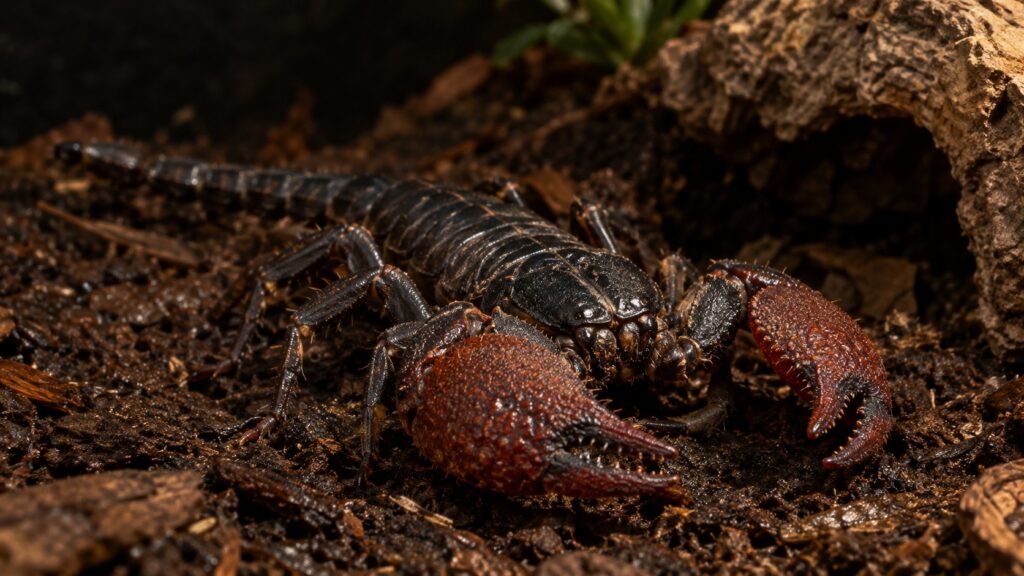
The red claw scorpion looks like an emperor and does not behave like one. Pandinus cavimanus is a close relative sold at a fraction of the price, reaching 4 to 5 inches with a dark body and distinctly reddish-brown pincers, and it is noticeably more defensive than the species it gets compared to. The husbandry is nearly identical: humid, warm, deep substrate, plenty of hiding places. The temperament is where buyers get caught out, and it is worth knowing before you choose between them.
Species Overview
Red claws come from East Africa, principally Tanzania and surrounding regions, where they live in humid forest floor conditions, burrowing under logs and leaf litter.
Adults reach 4 to 5 inches, smaller than an emperor but built on the same plan: a heavy dark body, thick pincers, and a relatively slender tail. The pincers are the identifying feature, running reddish-brown to rust against a near-black body, and they are noticeably more granular and textured than an emperor’s smooth ones.
As with other scorpions, the proportions tell you about the venom. Heavy pincers and a thin tail means an animal that subdues prey mechanically and has little need for potent venom. Red claw venom is mild, generally described as comparable to a bee sting.
On sourcing: most red claws in the trade are wild caught, since they are not bred commercially in the volume emperors are. That means animals of unknown age, frequently carrying mites, and stressed from shipping. It is the norm for this species rather than a red flag from a particular seller.
| Attribute | Details |
|---|---|
| Scientific name | Pandinus cavimanus |
| Adult size | 4 to 5 inches |
| Lifespan | 5 to 8 years |
| Difficulty | Intermediate |
| Temperature | 75 to 85F (24 to 29C) |
| Humidity | 70 to 80% |
| Venom potency | Mild, comparable to a bee sting |
Red Claw vs Emperor Scorpion
The comparison most buyers are actually making, so worth doing directly.
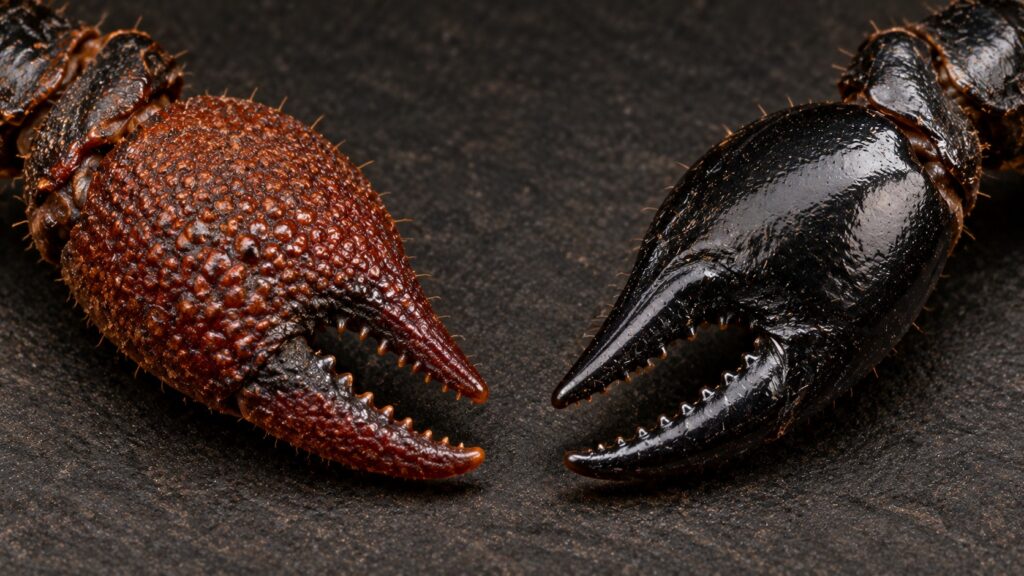
| Red claw | Emperor | |
|---|---|---|
| Adult size | 4 to 5 in | 6 to 8 in |
| Temperament | Defensive, quicker to strike | Docile, very tolerant |
| Communal | Risky | Commonly kept communally |
| Availability | Mostly wild caught | Captive bred widely available |
| Price | Lower | Higher |
| Care | Humid, warm, deep substrate | Identical |
The practical read: if you want a large docile scorpion you can keep in a group, buy an emperor and accept the price. If you want something smaller, cheaper, and are content with an animal that is more likely to posture and less likely to tolerate handling, a red claw is a reasonable choice.
Emperor care is covered in our emperor scorpion guide, and the size difference specifically in our breakdown of how large emperors actually get.
Enclosure Setup
Tank: a 5 to 10 gallon tank or equivalent plastic bin for one adult. Floor space over height. Secure the lid, since scorpions climb silicone seams.
Substrate: 4 to 6 inches, deep enough to burrow properly. Red claws are committed burrowers and will excavate under whatever cover you give them.
Mix: three parts coconut fibre, two parts organic topsoil with no additives, one part play sand. Add it damp and pack it firmly in layers so burrows hold their shape. Loose substrate collapses and produces an animal that paces the walls instead of settling.
Hides, more than one. Cork bark laid flat, a half log, or a piece of curved bark half buried at one end. Bed one edge in so it cannot shift and crush the animal.
Water dish: shallow, always filled, sunk level with the substrate.
Lighting: none needed. They are nocturnal, and a bright enclosure means an animal you never see. A dim red or blue night bulb shows far more, and all scorpions fluoresce under UV light if you want to look.
Leaf litter on the surface helps hold moisture and gives cover.
Temperature and Humidity
Target 75 to 85F and 70 to 80% humidity. This is a humid forest species and it is the opposite requirement to the arid scorpions.
Heat: a low wattage mat on one side wall, on a thermostat, creating a gradient the animal can move along. Never underneath, which bakes the substrate where the scorpion burrows.
Humidity comes from substrate moisture, not misting. Pour water into one section until it is damp throughout and let the rest stay moderately moist. The scorpion will position itself where it suits.
Do not let it dry out. Low humidity causes molting problems in this species, which is the most common cause of captive death.
Do not waterlog it either. Saturated substrate plus poor ventilation risks mycosis, a fungal infection showing as dark patches on the exoskeleton, which is close to untreatable once established.
The contrast with the arid species is instructive if you keep more than one: a desert hairy scorpion wants the reverse of everything above, and running either species on the other’s setup will kill it slowly.
Diet and Feeding
What to offer: crickets, dubia roach nymphs, red runners, and occasional mealworms. Prey should be no longer than the scorpion’s pincers.
How often: two or three prey items every 7 to 10 days for an adult. Juveniles eat more frequently, roughly weekly.
Refusal is normal, particularly ahead of a molt or when the animal has settled deep in its burrow. Provided the abdomen looks full rather than shrunken and water is available, a fast of several weeks is not a concern.
Remove uneaten prey within 24 hours. A cricket left in a burrow will gnaw at a molting scorpion, which is a preventable death.
Feed with tongs or drop prey near the burrow entrance rather than excavating the animal. Any feeding response happens at night.
Because the intervals are long and molts happen underground, the dates are the only reliable signal you get. Logging feeds, refusals, and molts in InvertMate gives you something to check rather than a vague sense of how long it has been.
Temperament and Handling
This is the section that matters for anyone choosing between red claws and emperors.
Red claws are more defensive than their reputation as an emperor substitute suggests. They are quicker to adopt a threat posture, more likely to strike at tongs, and less tolerant of disturbance. Individual variation is wide, and some are genuinely placid, but the species average sits well below an emperor.
Do not handle. The venom is mild, so a sting is painful rather than dangerous, but there is nothing to gain and the animal does not enjoy it. The likelier outcome of careless handling is a firm pinch from pincers built for crushing prey.
Normal behaviour is an animal that stays in its burrow by day, emerges at night, and moves little. A scorpion sitting exposed in daylight or repeatedly pacing the glass is usually telling you the enclosure is too hot, too dry, or short on hiding places.
Communal keeping is risky. Emperors are commonly kept in groups; red claws are not reliably communal and cannibalism is a real outcome. House individually unless you are prepared to lose animals.
Molting and Growth
Scorpions molt by splitting the old exoskeleton and working free, emerging pale and soft before hardening over several days.
Red claws molt underground, so you will usually see nothing and may only find the shed exoskeleton later. During that period the animal is defenceless.
Leave the enclosure completely alone. Do not feed, do not mist, do not rearrange.
Low humidity is the main cause of failed molts in this species, so the weeks before a molt are when substrate moisture matters most.
Growth to adult takes roughly two to three years through several instars. Lifespans across the group vary considerably, and the comparison is in our guide to how long scorpions live.
Breeding
Occasionally achieved in captivity, though far less commonly than with emperors, which is why wild caught stock dominates the trade.
Scorpions give birth to live young rather than laying eggs. The female carries the brood on her back until their first molt, after which they disperse and must be separated to avoid cannibalism.
Gestation is long and poorly documented for this species, with estimates ranging widely. Brood sizes are smaller than emperors manage.
Realistically, this is not a beginner project and the economics do not encourage commercial breeding, which is the root cause of the wild caught supply. If you buy a gravid wild caught female, be prepared for a brood you had not planned for.
Common Health Issues
Mycosis. Dark patches on the exoskeleton from excess humidity with poor ventilation. Largely untreatable, entirely preventable.
Mites. Common on wild caught imports. Pale specks around the joints and mouthparts. Rehouse into fresh substrate for a light load.
Failed molt. Usually follows a dried-out enclosure. Nothing to do at that stage beyond keeping humidity up.
Dehydration. Wrinkled or collapsed abdomen, almost always an empty water dish.
Shipping stress. Wild caught animals often refuse food for weeks after arrival. Set the enclosure up in advance, transfer once, and leave it alone.
FAQ
Are red claw scorpions aggressive?
More defensive than emperors, which is the comparison most buyers make. They are quicker to adopt a threat posture and less tolerant of disturbance. Individual variation is wide, but the species average is noticeably less placid.
How big do red claw scorpions get?
Four to five inches as adults, smaller than an emperor at six to eight inches but built on the same heavy-bodied plan. The reddish-brown pincers against a near-black body are the identifying feature.
Are red claw scorpions dangerous?
Not meaningfully. Their venom is mild and generally compared to a bee sting, consistent with the heavy pincers and slender tail. As with any sting an allergic reaction is possible, so treat it as you would a wasp sting.
Can red claw scorpions live together?
It is risky. Unlike emperors, which are commonly kept communally, red claws are not reliably social and cannibalism is a real outcome. House them individually unless you accept the possibility of losses.
How long do red claw scorpions live?
Five to eight years, which is typical for the genus and shorter than some arid species. Most animals in the trade are wild caught adults of unknown age, so the figure you get may be less than the species average.
Are red claw scorpions good for beginners?
The husbandry is straightforward, but the temperament and the wild caught supply make them a step up. A beginner wanting a large docile scorpion is better served by an emperor, and the wider options are covered in our guide to scorpions as pets.
Track Your Scorpion with InvertMate
A scorpion that burrows for weeks, eats every ten days, and molts out of sight is one you track by record rather than observation. InvertMate lets you log feeding dates and refusals, record molts and surface sightings, and monitor the temperature and humidity your enclosure actually runs at. Free on the App Store and Android.