Why do scorpions glow under UV light? Their outer shell contains compounds, including a beta-carboline and a coumarin, that absorb ultraviolet light and give it back as a blue-green glow. Almost every scorpion does it. Nobody knows for certain why, but the leading idea is that it helps them sense light and find shade.
Point a scorpion UV light, often sold as a black light torch, at almost any scorpion and it lights up like a glow stick. Keepers use the effect every week to find hidden animals, count communal groups and spot escapees, and it raises real questions: why a freshly molted scorpion stops glowing, whether the light harms them, and whether a glowing scorpion is even alive. This guide covers the chemistry, the theories, and the practical side of using UV light with pet scorpions.
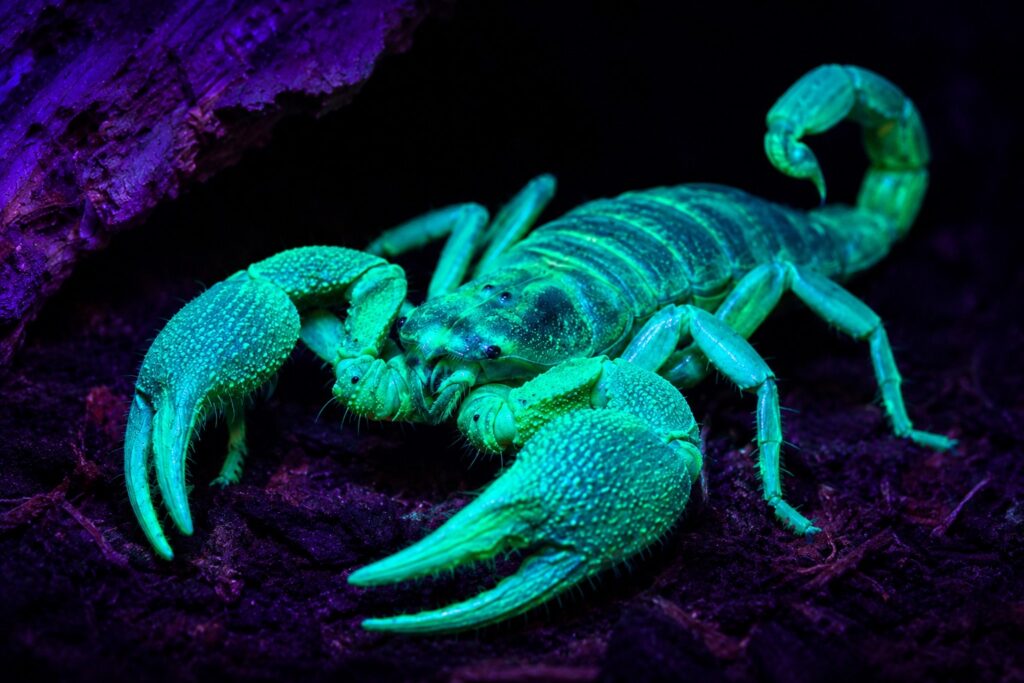
What Makes a Scorpion Glow
A scorpion’s exoskeleton is built in layers. The outermost part of the cuticle, a very thin, tough coating called the hyaline layer, holds the fluorescent compounds.
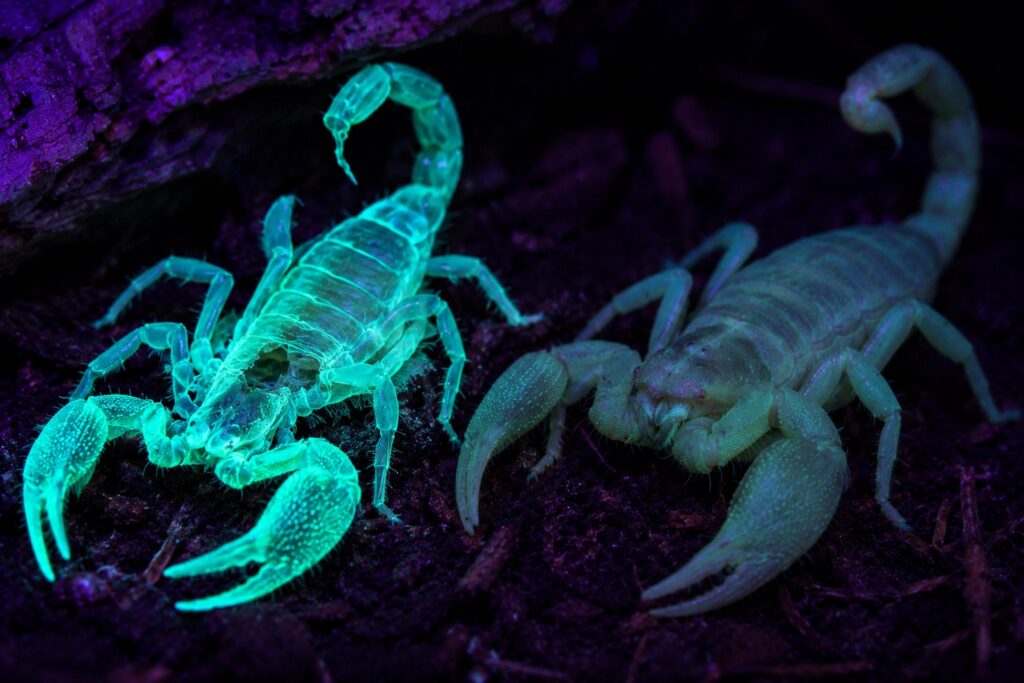
Two have been identified: a beta-carboline and 7-hydroxy-4-methylcoumarin. Both absorb ultraviolet light, which our eyes cannot see, and re-emit it at a slightly longer wavelength that we can see. The result is the familiar blue-green glow.
This is fluorescence, not bioluminescence. The scorpion does not make its own light the way a firefly does. Take the UV light away and the glow stops instantly. A scorpion in complete darkness does not glow at all, so it does not truly glow in the dark.
How Durable the Glow Is
The hyaline layer is remarkably tough:
- Scorpions preserved in alcohol can make the liquid itself glow, as the compounds leach out.
- Fossil scorpions have been found where the hyaline layer survives after other parts of the cuticle are gone, and that fossil layer can still fluoresce.
- Shed exoskeletons glow as well, which keepers often notice when shining a light into an enclosure after a molt.
That durability has a practical catch, covered below: a dead scorpion still glows.
Why Do Scorpions Glow? The Leading Theories
Fluorescence in scorpions was first reported in the 1950s, and its purpose is still debated. The main ideas:
1. A whole-body light sensor. The most tested idea comes from researcher Douglas Gaffin and colleagues. Scorpions see best in blue-green light. Fluorescence may convert dim ultraviolet from moonlight and starlight into that colour, turning the whole body into a light detector. Any part shaded by a rock or a burrow glows less, which could tell the scorpion where cover is. In experiments, scorpions became less active and more drawn to shelter under UV light, and those whose fluorescence had been reduced responded differently.
2. Avoiding bright nights. Scorpions are less active on bright moonlit nights, when predators can see them. Sensing UV through the cuticle could help them judge when it is safe to hunt.
3. Mate or species recognition. Some researchers suggested scorpions could recognise each other by their glow. There is little evidence for this.
4. Sunscreen. The compounds might protect against UV damage. This is hard to square with scorpions being nocturnal and hiding from the sun.
5. A by-product. The glow may be a side effect of the chemistry that hardens the cuticle, with no function of its own.
The honest answer is that the light-sensing idea has the most support, but no theory has been proven.
Does Every Scorpion Glow?
Almost every species studied fluoresces, from tiny bark scorpions to large forest species. The shade varies a little, from blue to green, and some species glow more brightly than others.
| Species | Typical glow | Notes |
|---|---|---|
| Emperor scorpion | Strong blue-green | Black body turns bright under UV |
| Asian forest scorpion | Strong blue-green | Useful for counting a group |
| Desert hairy scorpion | Bright green-yellow | Very vivid against sand |
| Bark scorpions | Bright blue-green | Easy to spot on walls and bark |
Our guides to the emperor scorpion, the desert hairy scorpion and the Asian forest scorpion cover the care of each.
Why a Freshly Molted Scorpion Does Not Glow
Right after a molt, a scorpion’s new exoskeleton is soft and pale, and it glows weakly or hardly at all. The fluorescent compounds settle into the cuticle as it hardens, so the glow builds back over the following days. A scorpion that has been through several molts as an adult tends to glow more strongly than a young one.
What this means for keepers:
- A dim scorpion after a molt is normal. It is not ill.
- The shed skin may glow more than the scorpion for a while.
- A soft scorpion is vulnerable. Remove live prey and leave it alone, as covered in our guide to what scorpions eat around a molt.
Using a Scorpion UV Light as a Keeper
A small ultraviolet torch is one of the most useful tools for anyone keeping scorpions.
Find a hidden scorpion. Scorpions hide under bark and in burrows during the day and often in the evening. A quick sweep at night shows a glowing tail or claw in seconds, without moving decor.
Count a group. With communal species, a UV check after dark is the fastest way to confirm everyone is there and nobody has gone missing.
Find an escapee. If a scorpion is out of its enclosure, darken the room and sweep the floor, skirting boards and under furniture. The glow stands out from across the room.
Spot scorplings. Newborn scorplings ride on their mother’s back. They glow faintly or not at all at first and become easier to see after their first molt.
Check for leftovers. Prey remains and shed skins sometimes catch the light too, making them easier to find and remove.
Is UV Light Safe for Scorpions?
Brief checks are fine. Constant UV is not.
- Scorpions avoid UV light. In tests they reduce activity and seek shelter under it. A UV lamp left on the enclosure is a source of stress, not enrichment.
- Long exposure can fade the glow. Researchers have reduced scorpion fluorescence by overexposing them to UV, because the compounds break down as they glow.
- Scorpions do not need UVB. Unlike reptiles, they need no UV lighting at all. Room light for a day and night rhythm is enough.
A sensible routine: a few seconds of UV when you need to find or count your scorpions, then lights off. Never use UV as display lighting.
Choosing a UV Torch
- 365 nm torches give a strong glow with very little visible purple light, so the scorpion stands out clearly.
- 395 nm torches are cheaper and common, but they spill more visible violet light, which washes out the glow a little.
- Small and handheld is all you need. Large blacklight tubes are unnecessary.
- Never shine a UV torch in anyone’s eyes, including your own. Treat it like a laser pointer.
Photographing a Scorpion Under Black Light
A glowing scorpion is one of the most striking photos in the hobby, and it takes very little equipment.
- Darken the room completely. Any stray light washes out the glow.
- Steady the camera. Use a small tripod or rest the phone on something solid. Most phones’ night mode works well.
- Hold the UV torch off to one side, not right behind the camera, so the light falls evenly and the lens does not pick up glare.
- Shoot through the front of the enclosure rather than opening it. Clean the glass or acrylic first, since dust glows too.
- Keep the session short, a minute or two at a time, for the same reasons as any UV check.
- Never take the scorpion out for a photo.
A shot taken at the same spot after each molt also makes a simple record of how the scorpion is growing.
Glowing Does Not Mean Alive
Because the hyaline layer keeps fluorescing after death, a glowing scorpion is not proof of a living one. A scorpion that has not moved for a long time should be checked another way:
- Look for slight movement in the legs, pincers or tail when the enclosure is gently tapped.
- Check its posture. Healthy scorpions stand with the body raised off the ground. A collapsed, flat body or legs curled under is worrying.
- Remember molting and fasting. A scorpion in pre-molt or a long fast can stay still for days.
How long scorpions live, and what normal ageing looks like, is covered in our scorpion lifespan guide.
Finding Scorpions at Night
Many people first see a glowing scorpion on a walk with a UV torch in a desert area. If you do:
- Wear closed shoes and long trousers.
- Never pick one up by hand. Many wild scorpions, including bark scorpions, have medically significant venom.
- Do not collect without checking local rules, and leave wild animals where you find them.
If a scorpion pet is what you are after, start with a captive-bred, beginner-friendly species. Our guide to keeping a scorpion as a pet explains which ones are suitable.
FAQ
Do scorpions glow in the dark?
Not on their own. Scorpions fluoresce, which means they glow only when ultraviolet light shines on them. In total darkness they do not glow. Moonlight contains a little UV, which may make them faintly fluorescent outdoors.
What colour do scorpions glow under black light?
Usually blue-green. The exact shade varies by species, from blue to green to green-yellow, and brightness varies too. Freshly molted scorpions glow only faintly until the new exoskeleton hardens.
Why do scorpions glow under UV light?
Compounds in the hyaline layer of the cuticle, including a beta-carboline and 7-hydroxy-4-methylcoumarin, absorb UV and re-emit visible blue-green light. Why scorpions evolved this is unknown, but the best-supported idea is that it helps them sense light and find shelter.
Is UV light bad for scorpions?
Brief use is fine. Scorpions avoid UV and become less active under it, and long exposure can fade their fluorescence, so do not leave a UV lamp on the enclosure. Scorpions need no UV lighting at all.
Do dead scorpions glow?
Yes. The fluorescent layer keeps working after death, and even fossil and preserved scorpions can glow. A glowing scorpion is not necessarily alive, so check for movement and posture instead.
Do baby scorpions glow?
Newborn scorplings glow faintly or not at all, because their exoskeleton has not yet hardened. They become easier to see under UV after their first molt.
The Glow Fades After Every Molt
That makes a UV check one of the easiest ways to notice a recent molt you missed. InvertMate logs every molt with a date and photo, records feedings and refusals so you can tell a pre-molt fast from a problem, and keeps a separate history for each scorpion in a communal group. Free on the App Store and Google Play.