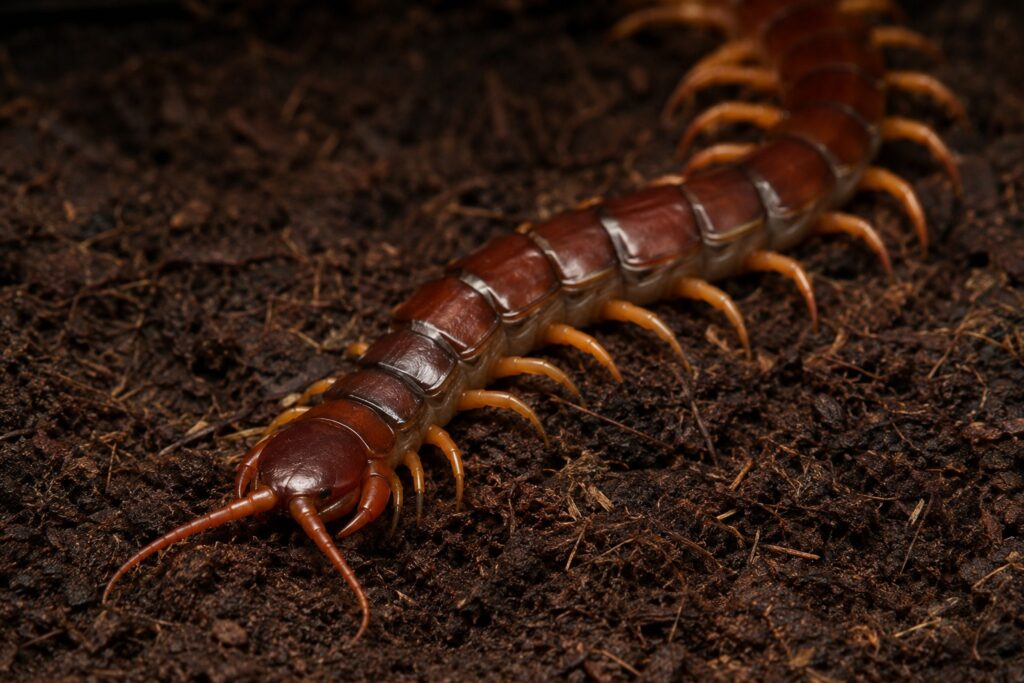
Giant centipede care is not for everyone, and that’s not a disclaimer thrown in to sound dramatic. Scolopendra species are venomous, fast, aggressive, and capable of delivering one of the most painful bites in the invertebrate world. They are strictly observation-only pets that demand respect, secure enclosures, and keepers who understand exactly what they’re getting into.
That said, if you’re an experienced invertebrate keeper looking for something genuinely challenging and fascinating to keep, giant centipedes are hard to match. Watching a Scolopendra hunt is one of the most impressive displays of predatory behavior you’ll see from any captive animal. Their speed, power, and alien appearance make them captivating display animals for those willing to put safety first.
This guide covers the essentials: species selection, enclosure security, substrate, temperature and humidity, feeding, molting, and the safety protocols you need to follow every single time you open that lid. If you’re not sure about the differences between centipedes and their harmless cousins, our millipede vs centipede guide breaks it down.
Species Overview
Giant centipedes belong to the genus Scolopendra, with dozens of species found across tropical and subtropical regions worldwide. They’re fast, flat-bodied, venomous predators with exactly one pair of legs per body segment (22 segments, 44 legs in most Scolopendra species). The first pair of legs has been modified into forcipules (venom-injecting claws) located just behind the head.
The most commonly kept species in the hobby include:
Scolopendra subspinipes (Vietnamese Centipede): The most widely available species. Adults reach 8-10 inches, sometimes larger. Reddish-brown body with yellow or orange legs. Fast, defensive, and has medically significant venom. Several color variants exist, including cherry leg and tiger leg forms.
Scolopendra dehaani (Vietnamese Giant Centipede): Often confused with S. subspinipes. One of the largest species, reaching 10-12 inches. Extremely fast and aggressive. Not recommended for beginners to centipede keeping.
Scolopendra polymorpha (Desert Centipede): A North American species, smaller (4-7 inches), and generally considered the most manageable Scolopendra for newcomers. Less aggressive temperament and milder venom than tropical species.
Scolopendra cingulata (Mediterranean Banded Centipede): A European/North African species with striking coloration. Smaller (4-6 inches) and has relatively mild venom compared to tropical giants. A reasonable starter species for keepers moving into centipedes.
| Attribute | Details |
|---|---|
| Scientific name | Scolopendra spp. |
| Adult size | 4-12 inches (varies by species) |
| Lifespan | 5-10+ years |
| Difficulty | Advanced |
| Temperature | 75-85°F (24-29°C) for tropical; 70-80°F for temperate |
| Humidity | 60-80% (varies by species) |
Safety First
This section comes before enclosure setup on purpose. If you’re not prepared to follow these protocols consistently, do not keep giant centipedes.
Venom: All Scolopendra species are venomous. A bite from a large tropical species like S. subspinipes or S. dehaani causes extreme pain, significant swelling, and potentially nausea, fever, and localized tissue damage. While fatalities from centipede bites are extremely rare (one documented case involving a child bitten on the head), the pain is consistently described as among the worst of any arthropod bite or sting. Seek medical attention for any bite from a large Scolopendra.
Speed: Giant centipedes are astonishingly fast. They can go from motionless to full sprint in an instant. This makes escape during maintenance the primary risk. You will not catch a loose centipede by hand.
Handling rules:
- Never handle a giant centipede with bare hands. Period.
- Use long (12+ inch) soft-tipped tongs or forceps for any interaction
- Always know exactly where the centipede is before opening the enclosure
- Work in a room with closed doors so an escaped centipede can’t leave the area
- Keep a large, clear plastic container nearby as a catch cup during maintenance
- Never do enclosure maintenance when tired, distracted, or impaired
Many experienced keepers transfer the centipede into a secure holding container before doing any cleaning, feeding, or substrate changes. This eliminates the risk of a bite or escape during maintenance.
Enclosure Setup
Enclosure security is the single most important factor. Giant centipedes are notorious escape artists. They’re strong enough to push loose lids, flexible enough to squeeze through surprisingly small gaps, and some species can chew through soft plastic. An escaped giant centipede in your home is a serious safety hazard.
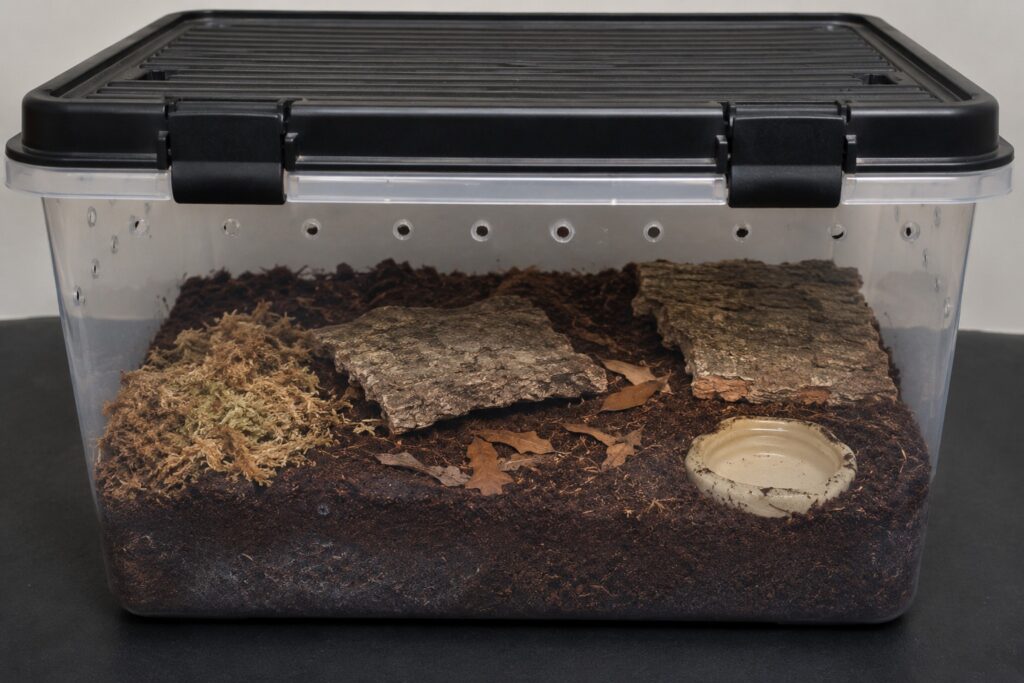
Enclosure type: A sturdy plastic tub with a latching, gasket-sealed lid is the safest option. Glass terrariums work for display but must have a secure, locking screen lid with no gaps. Avoid open-top enclosures, sliding-door terrariums with loose tracks, or any lid that isn’t mechanically secured. If you can push the lid open with one finger, a centipede can push it open with its body.
Size: A 10-gallon equivalent for smaller species (under 6 inches), 20 gallons or larger for big tropical species. Floor space matters more than height, as centipedes are primarily terrestrial, but they do climb. Enclosure walls should be tall enough that the centipede can’t reach the lid while standing on decor.
Ventilation: Drill or melt small holes in the tub sides near substrate level for cross-ventilation. Holes must be too small for the centipede to fit its head through (if the head fits, the whole body follows). For tropical species, moderate ventilation retains humidity. For desert species, increase ventilation for drier conditions.
Substrate should be 3-5 inches deep to allow burrowing. Use a mix appropriate to the species:
- Tropical species: coconut coir and organic topsoil (60/40 mix), kept moderately moist
- Arid/desert species: coconut coir, sand, and topsoil mix, kept mostly dry with one damp corner
Furnishings:
- Cork bark flats or curved pieces for hides (essential, centipedes need dark retreats)
- A shallow water dish (heavy enough that the centipede can’t tip it)
- Leaf litter scattered in areas for cover
- Sphagnum moss on the moist side for humidity retention (tropical species)
Keep decor simple. Centipedes don’t need elaborate setups, and too much clutter makes it harder to locate the animal during maintenance. You should always be able to see where the centipede is before opening the enclosure. The build itself, including hole sizing against the head capsule, the lid rim gap that catches most keepers out, and the maintenance routine that avoids opening the enclosure at all, is covered step by step in our guide to escape-proofing a centipede enclosure.
Temperature & Humidity
Requirements vary by species, which is why choosing the right species for your setup matters.
Tropical species (S. subspinipes, S. dehaani, S. multidens):
- Temperature: 75-85°F (24-29°C)
- Humidity: 70-80%
- Substrate should feel damp to the touch, with one side slightly drier
Arid/desert species (S. polymorpha, S. aztecorum):
- Temperature: 70-80°F (21-27°C)
- Humidity: 50-65%
- Substrate mostly dry, with one corner kept lightly moist by weekly misting
Temperate species (S. cingulata):
- Temperature: 68-78°F (20-26°C)
- Humidity: 55-70%
- Moderate moisture levels, avoid waterlogged substrate
Heat should come from an under-tank heater placed on the side wall of the enclosure (not the bottom, since centipedes burrow and could overheat). Always use a thermostat. Heat lamps dry out enclosures too quickly and create hot spots.
Mycosis (fungal infection) is the most serious humidity-related risk for centipedes. It’s caused by stagnant, overly wet conditions with poor ventilation. If you see white fuzzy growth on the substrate or on the centipede itself, reduce moisture immediately and improve airflow. Mycosis can be fatal and is much easier to prevent than treat.
Diet & Feeding
Giant centipedes are voracious predators with a strong feeding response. Watching them hunt is one of the main attractions of keeping them, but feeding also requires care because of their speed and aggression.
Suitable prey:
- Crickets and dubia roaches (primary staples)
- Superworms and mealworms
- Waxworms (as occasional treats)
- Small pieces of raw, unseasoned fish (salmon works well) or chicken
Some keepers offer pinky mice to large specimens, but this should be done sparingly. Overfeeding fatty prey like mice can shorten the centipede’s lifespan.
Feeding frequency: Adults eat once per week. Juveniles eat twice per week. Offer prey roughly half the length of the centipede’s body. Centipedes are not subtle eaters, and they typically strike and consume prey within seconds to minutes.
Feeding method: Use long tongs to drop prey into the enclosure. Never feed by hand. Remove uneaten prey within 24 hours, as live crickets or roaches left in the enclosure can stress or injure a centipede, especially during molting.
Pre-molt fasting is common. If your centipede refuses food for 1-2 weeks and appears less active, it’s likely preparing to molt. Stop offering food and ensure humidity is adequate.
Variety matters. A diet of only one prey type can lead to nutritional deficiencies over time. Rotate between different feeders and occasionally offer small pieces of raw fish or fruit (some species accept overripe sweet fruits).
Molting
Giant centipedes molt periodically throughout their lives, with juveniles molting more frequently (multiple times per year) and adults typically molting once annually. Unlike tarantulas, centipedes do not flip onto their backs to molt. They typically burrow into the substrate or tuck into a tight hide, shed their exoskeleton, and emerge with a fresh, slightly larger body.
Pre-molt signs:
- Loss of appetite for 1-2 weeks
- Reduced activity, spending more time burrowed or hidden
- Duller coloration and slightly sluggish movements
During the molt, do not open the enclosure. Do not feed. Do not mist directly near the centipede. A molting centipede is soft, vulnerable, and incapable of defending itself. Any disturbance can cause a failed molt, which is often fatal.
After the molt, the new exoskeleton is pale and soft. The centipede will remain hidden for several days while it hardens. Wait at least 5-7 days after the centipede resurfaces before offering food. Remove any live prey from the enclosure during this entire period.
Centipedes often eat their shed exoskeleton to reclaim nutrients. Don’t remove it unless it starts to mold.
Humidity is especially critical around molting time. If the substrate is too dry, the old exoskeleton can harden and trap the centipede mid-molt. Ensure the moist side of the enclosure is properly damp in the weeks leading up to a suspected molt.
Common Health Issues
Mycosis (fungal infection) is the leading cause of death in captive centipedes. It appears as white, fuzzy, or cottony growth on the body or legs. It’s caused by overly wet, poorly ventilated conditions. Prevention: maintain proper ventilation, avoid waterlogged substrate, and spot-clean regularly. Once visible, mycosis is difficult to treat and often fatal.
Dehydration affects tropical species kept in conditions that are too dry. Signs include a shriveled appearance and sluggish movement. Increase substrate moisture and ensure the water dish is always full.
Prey injuries can occur when large, aggressive feeder insects (especially crickets) are left in the enclosure. Crickets can bite a molting or resting centipede. Always remove uneaten prey promptly.
Failed molts happen when humidity is insufficient or the centipede is disturbed during the process. The old exoskeleton dries and traps part of the body, leading to injury or death. Maintaining proper humidity is the best prevention.
Escape is a health issue for you, not the centipede. A loose Scolopendra in your home poses a real bite risk. If your centipede escapes, close all doors to the room, check shoes and clothing before wearing them, and search methodically. Centipedes are drawn to dark, tight spaces: under furniture, inside shoes, behind appliances.
FAQ
Are giant centipedes dangerous?
Yes. All Scolopendra species have medically significant venom. A bite from a large tropical species causes extreme pain, significant swelling, and can cause nausea, fever, and localized tissue damage. Fatalities are extremely rare but have been documented. These are strictly observation-only pets that should never be handled with bare hands.
What is the best centipede species for beginners?
Scolopendra polymorpha (desert centipede) or Scolopendra cingulata (Mediterranean banded centipede) are generally considered the most manageable species for keepers new to centipedes. Both are smaller, less aggressive, and have milder venom than large tropical species. That said, “beginner centipede” still means experienced invertebrate keeper. These are not first-time pets.
How long do giant centipedes live?
Most Scolopendra species live 5-10 years in captivity with proper care. Some keepers report individuals living longer. They molt annually as adults, and growth is slow after they reach full size. Juveniles take 3-4 years to reach adult dimensions.
Can you handle a giant centipede?
No. Handling is strongly discouraged for all Scolopendra species. Their speed, unpredictable behavior, and painful venomous bite make bare-handed contact genuinely dangerous. All enclosure maintenance should be done with long tongs, and many keepers transfer the centipede to a secure holding container before doing any work inside the enclosure.
What is the difference between a centipede and a millipede?
Centipedes are fast, flat-bodied predators with one pair of legs per segment and venomous forcipules. Millipedes are slow, round-bodied detritivores with two pairs of legs per segment and no venom. Centipedes are aggressive hunters; millipedes eat decaying plant matter. As pets, millipedes are docile and handleable, while centipedes are dangerous and observation-only. For more details, see our millipede care guide, which covers the docile side of the comparison.
Track Your Centipede with InvertMate
Keep a detailed care log for your giant centipede with InvertMate. Track molts, log feedings, monitor enclosure conditions, and set reminders for substrate changes and maintenance. Free on the App Store.