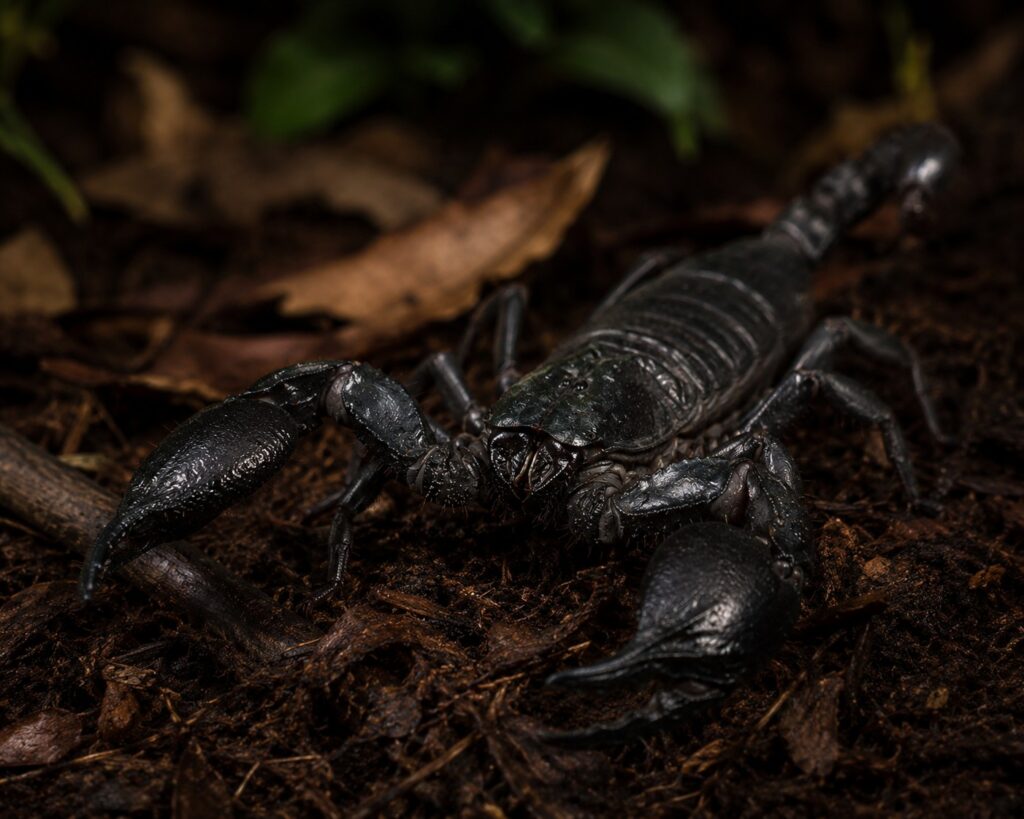
The Asian forest scorpion is one of the most popular pet scorpions in the hobby, and for good reason. These large, glossy black arachnids are hardy, relatively calm for a scorpion, and easy to care for once you understand their tropical needs. If you’ve seen a big black scorpion at a pet store that wasn’t labeled as an emperor, there’s a strong chance it was a Heterometrus species.
Here’s something worth knowing right away: “Asian forest scorpion” is actually an umbrella name covering several species in the genus Heterometrus, including H. petersii (the most commonly sold), H. spinifer, H. longimanus, and others. The care requirements are nearly identical across these species, so this guide applies to all of them. If you’re coming from emperor scorpion care, you’ll notice plenty of overlap, but there are meaningful differences in temperament, handling, and identification that matter.
This guide covers enclosure setup, substrate depth, the humidity levels these tropical scorpions demand, feeding, handling (with honest warnings), breeding, and how to tell your Asian forest scorpion apart from an emperor.
Species Overview
Asian forest scorpions (Heterometrus spp.) are native to the tropical and subtropical rainforests of Southeast Asia, found across India, Malaysia, Thailand, Indonesia, Vietnam, and the Philippines. In the wild, they live on the forest floor beneath logs, leaf litter, rocks, and inside shallow burrows, emerging at night to hunt insects and other small invertebrates.
Adults reach 5-6 inches (12-15 cm) in total length, making them slightly smaller than emperor scorpions but still impressively large. Their bodies are a deep, uniform matte black, and their pedipalps (pincers) are smooth and glossy rather than the bumpy, granulated texture you see on emperors. Like all scorpions, they fluoresce a pale blue-green under ultraviolet light.
These scorpions are more defensive than emperors. They won’t chase you across the room, but they’re quicker to adopt a threat posture with pincers open and tail raised, and more willing to pinch or sting when disturbed. Their venom is mild and comparable to a bee sting, so they’re still considered a beginner-friendly species, but expect more attitude.
| Attribute | Details |
|---|---|
| Scientific name | Heterometrus spp. (commonly H. petersii, H. spinifer, H. longimanus) |
| Adult size | 5-6 inches (12-15 cm) |
| Lifespan | 7-8 years (up to 10 with excellent care) |
| Difficulty | Beginner |
| Temperature | 75-85°F (24-29°C) |
| Humidity | 70-80% |
Enclosure Setup
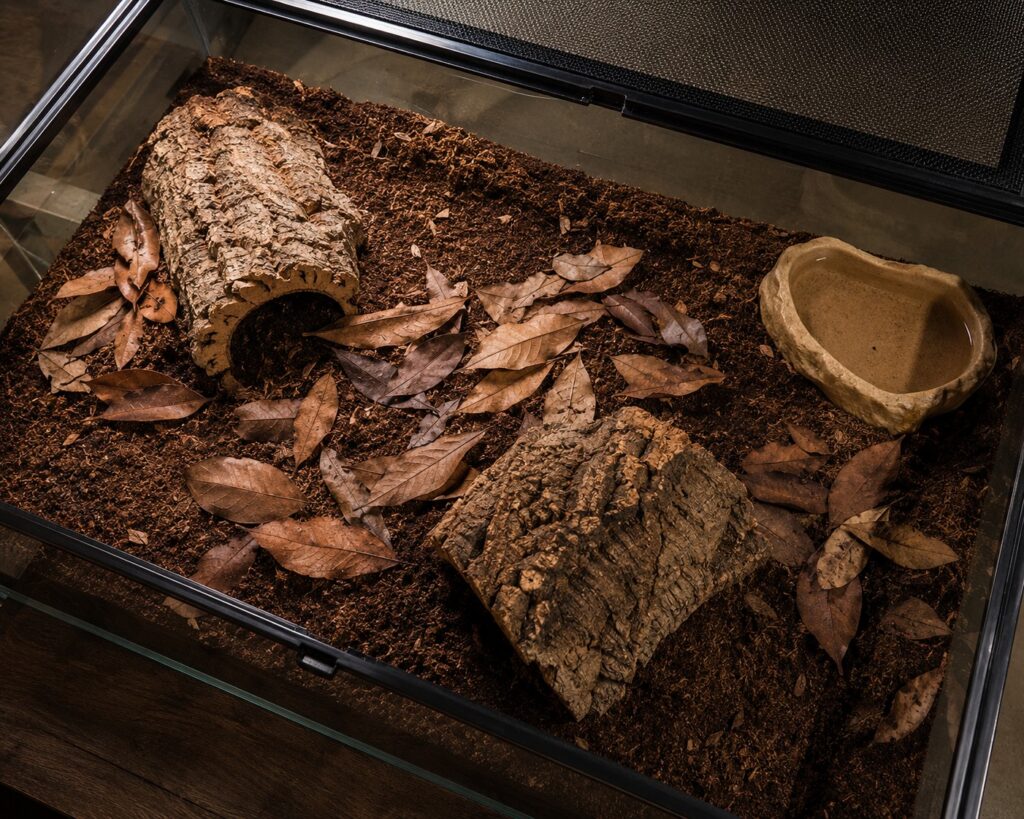
A 10-gallon glass terrarium is the minimum for a single adult Asian forest scorpion. Larger is always better, and a 15- or 20-gallon long tank gives your scorpion more room to burrow and explore at night. Glass works well because it holds humidity without trapping too much heat. Avoid wooden vivariums, which retain heat too efficiently for this species.
A secure, tight-fitting lid is essential. Asian forest scorpions are surprisingly strong and can push off a loose screen top. They can also climb silicone seams inside the tank, so never assume they’ll stay on the ground.
Substrate is the single most important part of the setup. These scorpions are enthusiastic burrowers, and deep substrate is non-negotiable. Use a mix of coconut fiber (coco coir) and organic, pesticide-free topsoil at a ratio of about 70/30. Aim for a depth of at least 4-6 inches. The substrate should be damp enough to hold its shape when squeezed but not so wet that water drips out. Never use sand on its own. Sand doesn’t hold humidity and can irritate the scorpion’s joints and book lungs.
Add 2-3 hides using cork bark flats, half logs, or curved cork rounds. Place at least one hide on the warmer side and one on the cooler side so your scorpion can thermoregulate while staying hidden. A layer of dried leaf litter on the substrate surface mimics the forest floor and gives the enclosure a more natural feel. Your scorpion will spend most of the day hidden, so don’t worry if you rarely see it during daylight hours.
A shallow water dish should always be available. Use something low-profile that the scorpion can’t tip over or drown in. A jar lid or shallow ceramic dish works perfectly. Rinse and refill it every few days.
No special lighting is needed. Asian forest scorpions are strictly nocturnal and will actively avoid light. Ambient room lighting is fine, but direct sunlight or bright overhead lamps will stress them.
Temperature and Humidity
Asian forest scorpions thrive in a temperature range of 75-85°F (24-29°C). In most homes, room temperature sits comfortably in this range, which means supplemental heating may not be necessary at all. If your room drops below 72°F, add a low-wattage heat mat on one side of the terrarium, not the bottom. Heating from underneath can overheat a burrowing scorpion that digs down to cool off. Stick the heat mat to the side of the glass, about one-third of the way up, and always use a thermostat to prevent overheating.
Creating a slight temperature gradient (warmer on one side, cooler on the other) lets the scorpion choose its comfort zone. Don’t worry about nighttime temperature drops of a few degrees, as this mimics natural conditions.
Humidity is the care parameter that makes or breaks Asian forest scorpion keeping. Aim for 70-80% consistently. Achieve this by keeping the substrate properly moistened and misting the enclosure once daily with dechlorinated water. The bottom layers of substrate should stay damp while the surface dries slightly between mistings. If humidity keeps dropping, a partial glass or plastic lid over part of the screen top helps trap moisture without eliminating airflow completely.
Use a digital hygrometer to monitor humidity levels rather than guessing. Tracking temperature and humidity over time helps you spot trends before they become problems.
Ventilation matters too. Stagnant, overly wet conditions invite mold and bacterial growth. You want humid air, not swampy air. If you see mold on the substrate surface or walls, increase airflow slightly and reduce misting frequency until conditions stabilize.
Diet and Feeding
Asian forest scorpions are opportunistic predators that eat a variety of insects in the wild. In captivity, their diet is straightforward.
Staple feeders: Crickets and dubia roaches are the best primary food sources. Both are easy to gut-load with fresh vegetables, which passes nutrition along to your scorpion. Mealworms and superworms make good supplemental feeders but shouldn’t be the only food offered since their hard chitin can be difficult to digest in large quantities.
Feeding frequency: Adults should be fed 2-3 appropriately sized prey items once per week. Juveniles eat more frequently, roughly every 4-5 days, with smaller prey items like pinhead crickets or small mealworms. “Appropriately sized” means the prey item is no larger than the width of the scorpion’s body.
Gut-loading your feeders is the most important nutritional step. Feed crickets or roaches fresh vegetables (carrots, sweet potato, leafy greens) for at least 24 hours before offering them to your scorpion. This ensures the scorpion gets real nutrition, not empty chitin.
Remove uneaten prey within 24 hours. Live crickets left in the enclosure can stress or even bite a molting scorpion. Never feed your scorpion wild-caught insects, which may carry pesticides or parasites.
A shallow water dish provides drinking water. You may notice your scorpion standing in the dish occasionally, which is normal behavior, especially when humidity is too low.
Behavior and Handling
Asian forest scorpions are nocturnal and spend the vast majority of daylight hours hidden in burrows or under hides. At night, they emerge to patrol their territory, hunt, and drink. If you want to observe natural behavior, a red or dim blue LED light lets you watch without disturbing them.
Temperament is where Asian forest scorpions differ most from their emperor scorpion cousins. While emperors tend to be relatively tolerant of disturbance, Asian forest scorpions are noticeably more defensive. When startled or cornered, they’ll quickly raise their pincers and tail into a threat posture. They pinch harder and more readily than emperors, and they’re somewhat more likely to sting.
That said, their venom is mild. A sting is roughly comparable to a bee sting: painful, with localized swelling and redness, but not medically dangerous for most people. Anyone with known allergies to insect stings should exercise extra caution.
Handling is not recommended as a regular activity. These are observation pets, not interactive ones. If you need to move your scorpion for enclosure maintenance, use a long pair of soft-tipped tongs to gently guide it into a temporary container, or place a container over it and slide cardboard underneath. Free-hand handling invites defensive pinches or stings, and the experience stresses the scorpion more than it benefits you.
Molting happens several times as juveniles grow and occasionally in adults. Pre-molt signs include refusing food for 1-2 weeks, reduced activity, and a slightly duller or grayish appearance. During a molt, the scorpion flips onto its back and sheds its exoskeleton. Tarantulas molt in the same position, and our tarantula molting guide covers the warning signs of a failed molt in more detail. Never disturb a molting scorpion, and remove any live prey items from the enclosure during this period. The new exoskeleton takes several days to harden, during which the scorpion is extremely vulnerable.
Breeding
Breeding Asian forest scorpions in captivity is achievable but requires patience due to the long gestation period.
Sexing can be tricky. Males tend to have slightly longer tails, larger pedipalps relative to body size, and a more slender build. The most reliable method is examining the pectines (comb-like structures on the underside between the last pair of legs). Males have longer pectines with more teeth. You’ll likely need a magnifying glass and a clear-bottomed container to check without handling.
To breed, place a confirmed male and female together in a large enclosure (20 gallons minimum) with flat rocks or bark on the surface. The male initiates a courtship “dance” called a promenade à deux, grasping the female’s pincers with his own and walking her back and forth until he deposits a spermatophore on the ground. He then guides her over it for pickup. This process can take hours.
Gestation lasts 9-12 months, which is one of the longest among commonly kept scorpions. The female will become visibly swollen as the embryos develop. She gives live birth (scorpions are viviparous) to a brood of 20-40 white, grub-like scorplings that immediately climb onto her back. They’ll stay there through their first molt, roughly 2-3 weeks, before dispersing.
Separate the male before birth, as the mother becomes highly defensive and may attack him. Once the scorplings leave the mother’s back after their first molt, house them individually in small deli cups with damp substrate and pinhead crickets. Cannibalism among siblings is common if they’re kept together.
Common Health Issues
Most health problems in Asian forest scorpions trace back to incorrect humidity or hygiene.
Dehydration is the most common issue. Signs include a shriveled or wrinkled appearance, lethargy, and a sunken abdomen. Increase misting, check that the water dish is full, and ensure the substrate isn’t bone dry. Severely dehydrated scorpions may sit in their water dish for extended periods.
Mycosis (fungal infection) appears as dark or discolored patches on the exoskeleton, often on the legs or underside. It develops in conditions that are too wet with poor airflow. Treatment is difficult once established, so prevention is key: keep substrate damp but never waterlogged, and maintain adequate ventilation.
Stuck molts can happen if humidity is too low during the molting process. The old exoskeleton hardens before the scorpion can fully escape, trapping limbs or other body parts. Maintaining 75-80% humidity during suspected pre-molt periods reduces this risk significantly.
Mites occasionally appear, especially on wild-caught specimens. Tiny white or brown specks moving on the scorpion’s body or substrate indicate a mite infestation. Improve ventilation, reduce moisture temporarily, and introduce springtails as biological mite competitors.
Misidentification deserves mention here. Asian forest scorpions and emperor scorpions look similar at a glance, and pet stores frequently mislabel them. The quickest way to tell them apart: Asian forest scorpion pedipalps are smooth and glossy, while emperor scorpion pedipalps have a rough, granulated, dimpled texture. The telson (stinger tip) color also differs: dark/black on Asian forest scorpions, amber or reddish on emperors. Getting the ID right matters because while care is similar, temperament and handling tolerance differ noticeably.
FAQ
Are Asian forest scorpions good for beginners?
Yes, with a caveat. They’re hardy, their venom is mild, and their care requirements are straightforward. However, they’re more defensive and faster to pinch or sting than emperor scorpions. If you want a scorpion you can occasionally handle, an emperor may be the better first choice. If you’re happy observing rather than handling, Asian forest scorpions are an excellent beginner species. If you’re still choosing, our guide to keeping a scorpion as a pet compares the common species. Tailless whip scorpions are also worth a look if you want something stingless, though they’re not true scorpions.
How long do Asian forest scorpions live?
With proper care, 7-8 years is typical, and some individuals reach 10 years. Females tend to live slightly longer than males. For more details on scorpion lifespans across species, check out our guide on how long scorpions live.
Can Asian forest scorpions be kept together?
Cautiously. While cannibalism is less common in Heterometrus than in many other scorpion genera, it does happen, especially when individuals are different sizes or during molting. If you want to try communal keeping, use a large enclosure (30+ gallons for 2-3 scorpions), provide multiple hides and food sources, and monitor carefully for aggression. Housing them individually is always the safer option.
What’s the difference between an Asian forest scorpion and an emperor scorpion?
The easiest identification cues are the pedipalps and telson. Asian forest scorpion pincers are smooth and glossy. Emperor scorpion pincers are rough and granulated (bumpy). The stinger tip is dark or black on Asian forest scorpions and amber or reddish on emperors. Temperament also differs: emperors are generally calmer, while Asian forest scorpions are more defensive and quicker to pinch.
Why is my Asian forest scorpion always hiding?
That’s completely normal. These are nocturnal animals that spend the vast majority of daylight hours underground or inside hides. You’ll see the most activity after dark. If you want to watch your scorpion’s nighttime behavior, use a dim red or blue LED light, or place a UV blacklight nearby to see the fluorescent glow without disturbing your pet.
Track Your Scorpion with InvertMate
Keep a detailed care log for your Asian forest scorpion with InvertMate. Track molts, log feedings, monitor enclosure conditions, and set reminders for misting and substrate changes. Free on the App Store.