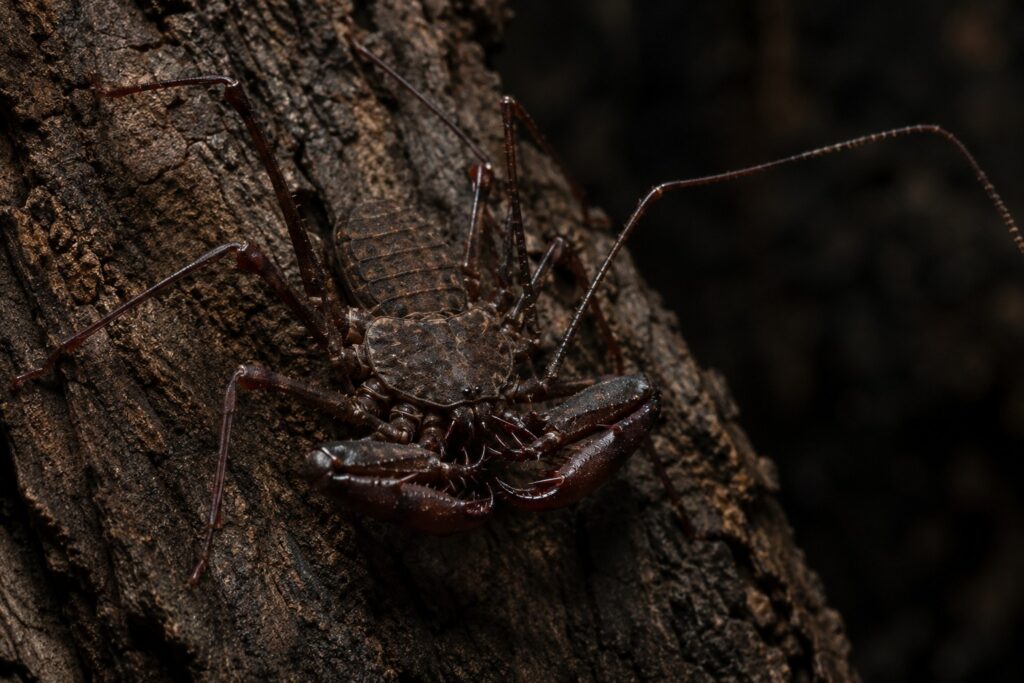
Few invertebrates turn heads quite like a tailless whip scorpion. With a flattened body, oversized raptorial pedipalps, and front legs that can stretch over two feet long in some species, they look like something straight out of a sci-fi film. They even made it into the Harry Potter franchise as the creature Moody demonstrates the Unforgivable Curses on.
Here’s the thing most people don’t expect: they’re completely harmless. No venom, no stinger, no dangerous bite. Tailless whip scorpions (order Amblypygi) are gentle, fascinating arachnids that make surprisingly good pets for keepers willing to meet their humidity needs.
This guide covers everything you need to know about keeping amblypygids in captivity: enclosure setup, temperature and humidity, feeding, molting, handling, and breeding.
Species Overview
Tailless whip scorpions belong to the order Amblypygi, a group of arachnids that are neither true scorpions nor true spiders, despite being called “whip scorpions” or “whip spiders” depending on who you ask. There are over 150 known species, found across tropical and subtropical regions of the Americas, Africa, and Asia. In the wild, they inhabit dark, humid spaces: caves, the undersides of rocks, inside rotting logs, and beneath loose tree bark.
The most common species in the pet trade include Damon diadema (Tanzanian giant), Damon medius, Damon variegatus, and Phrynus marginemaculatus (Florida species). Care requirements are broadly similar across these species, with minor differences in adult size and humidity preferences.
Their anatomy is distinctive. The body is extremely flat, which allows them to squeeze into impossibly tight crevices. They have eight legs, but only six are used for walking. The front pair has evolved into enormously long, thin, whip-like sensory appendages (called antenniform legs) that they sweep ahead of them to navigate in complete darkness. Their pedipalps, the pincer-like appendages near the mouth, are used to grab and crush prey. Despite looking intimidating, the pedipalps are not dangerous to humans.
Amblypygids walk sideways, like crabs. They’re nocturnal, spending the day tucked into crevices and emerging at night to hunt.
| Attribute | Details |
|---|---|
| Scientific name | Order Amblypygi (various species) |
| Adult size | 4-10 inch legspan (varies by species) |
| Lifespan | 5-15 years (females live longer) |
| Difficulty | Beginner to Intermediate |
| Temperature | 70-85°F (21-29°C) |
| Humidity | 70-90% |
For a deeper look at amblypygid growth stages, see our tailless whip scorpion lifespan guide.
Enclosure Setup
The most important thing to understand about tailless whip scorpion enclosures is that vertical space matters more than floor space. These animals spend almost all of their time clinging to vertical surfaces, not walking on the ground. A tall enclosure with ample climbing surfaces is far more important than a wide one.
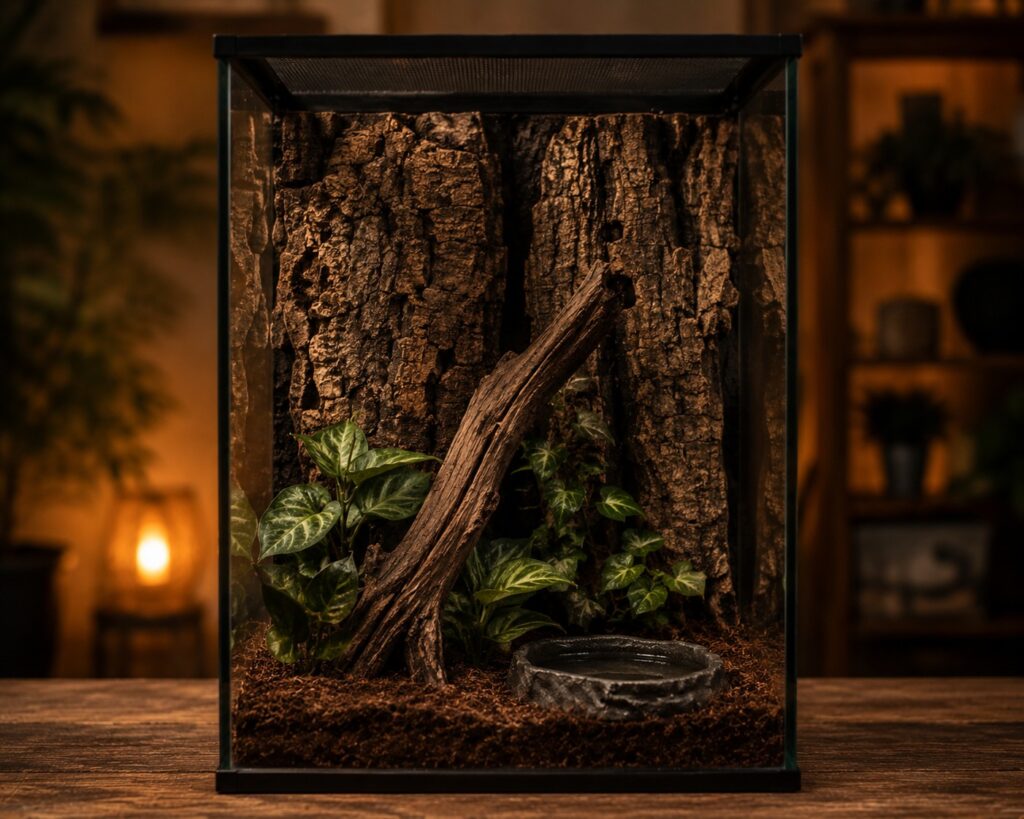
For a single adult of an average-sized species (Damon diadema or D. medius), a 10-gallon tank oriented vertically or an Exo Terra Nano Tall (8″ x 8″ x 12″) works well. Larger species like D. variegatus or Phrynus species with bigger legspans need proportionally more room. The general rule is that the enclosure dimensions should each be at least twice the animal’s legspan.
Cork bark is the single most important furnishing. Place large, flat pieces of cork bark vertically against the enclosure walls, leaving a tight gap between the bark and the glass. Tailless whip scorpions feel most secure wedged into narrow spaces where their flat bodies press against surfaces on both sides. This also provides the vertical surface they need for molting. Without proper cork bark placement, your amblypygid will be stressed, exposed, and at risk during molts.
Additional furnishings:
- More cork bark pieces (you really can’t have too much)
- Pieces of driftwood or grapevine wood for climbing variety
- Live or artificial plants for visual cover
- A small, shallow water dish at the bottom
Substrate should be 2-3 inches of moisture-retaining material: coconut coir, sphagnum moss, or a mix of both. The substrate primarily serves to maintain humidity, since amblypygids rarely spend time on the ground. Keep it consistently moist but not waterlogged.
Ventilation is a balancing act. You need enough airflow to prevent mold and stagnant conditions, but not so much that humidity drops too quickly. A mesh lid with most of the enclosure sealed works for most setups. Adding springtails to the substrate helps control mold and keeps things clean.
Lighting is not needed. Tailless whip scorpions are nocturnal and actively avoid light. If you want to observe them at night, a dim red light is the least disruptive option.
Temperature & Humidity
Humidity is the single most critical factor in tailless whip scorpion care. Get this wrong and your amblypygid will dehydrate, fail to molt, and eventually die. Get it right and everything else becomes relatively easy.
Aim for 70-90% humidity consistently. Mist the enclosure 2-3 times per week, focusing on the cork bark and substrate rather than spraying the animal directly. The substrate should stay moist to the touch at all times. A well-sealed enclosure with moist substrate and sphagnum moss will hold humidity between mistings, but you’ll want a digital hygrometer inside the enclosure to monitor levels.
If humidity keeps dropping too fast, check your ventilation. Too many open holes or too much mesh will bleed moisture. You can cover part of a mesh lid with plastic wrap or aluminum foil to retain more humidity while still allowing some airflow.
Temperature is more forgiving. Tailless whip scorpions do well at 70-85°F (21-29°C), and room temperature in most homes is perfectly adequate. They don’t need basking spots or heat mats in most situations. If your home drops below 68°F regularly, a low-wattage heat lamp placed to one side of the enclosure (never directly on top of mesh where the animal might climb) can help.
Diet & Feeding
Tailless whip scorpions are insectivores. They’re ambush predators that wait in the dark, detect prey with their long antenniform legs, then snatch it with their pedipalps. Watching an amblypygid hunt at night is one of the highlights of keeping them.
Suitable prey items:
- Crickets (the most common feeder choice)
- Dubia roach nymphs
- Discoid roach nymphs
- Mealworms or superworms (occasionally)
- Waxworms (as a treat)
Feed adults once per week. Each meal should be roughly one-quarter the size of the amblypygid’s body (not counting the antenniform legs). For juveniles, feed twice per week with appropriately sized prey: fruit flies or pinhead crickets for small nymphs, graduating to larger prey as they grow.
Always remove uneaten prey within 24 hours. This is especially important with tailless whip scorpions because they’re vulnerable during and after molting, and a hungry cricket left in the enclosure can injure or kill a molting amblypygid.
Water should always be available. Provide a small, shallow water dish at the bottom of the enclosure. Many amblypygids will also drink water droplets from cork bark and enclosure walls after misting.
Pre-molt fasting is normal. If your tailless whip scorpion refuses food for a week or two, check for other signs of an approaching molt (dull coloration, reduced activity, spending more time near the top of the enclosure). Simply wait it out and remove any live prey from the enclosure.
Behavior & Handling
Tailless whip scorpions have some of the most interesting behavior of any commonly kept invertebrate. They navigate their environment almost entirely by touch, sweeping those impossibly long antenniform legs ahead of them like a person feeling their way through a dark room. They walk sideways in a crab-like shuffle, and they can squeeze through gaps that seem far too small for their legspan.
They’re nocturnal, so daytime viewing is limited to seeing them tucked into their cork bark hides. The real show happens after lights go out, when they emerge to patrol their enclosure. A dim red light lets you watch without disturbing them.
Despite their alien appearance, tailless whip scorpions are docile. They have no venom and their pedipalps, while capable of a mild pinch, pose no real threat to humans. Their first response to disturbance is to freeze or flee, not to attack.
Handling is possible but not recommended as a regular habit. Their bodies are fragile, and a fall from even a short height can cause serious injury. If you need to move your amblypygid, coax it onto a piece of cork bark or into a plastic container rather than picking it up. If you do handle it, keep your hands low over a soft surface and move slowly. Never grab the antenniform legs, as they’re extremely delicate and can break off (they do regenerate over subsequent molts, but slowly).
Communal keeping works with some amblypygid species, particularly Damon species, which have been observed living in groups in the wild. The enclosure needs to be large enough with plenty of cork bark hides so each animal has its own retreat. However, cannibalism can occur, especially during molts or if food is scarce. Many experienced keepers recommend housing them individually to avoid losses.
Breeding
Breeding tailless whip scorpions in captivity is achievable but requires patience and proper timing.
Sexing: Males have noticeably longer pedipalps relative to body size. In some species, males also have slightly slimmer bodies. Sexing juveniles is difficult, and it’s easier to wait until they’re approaching maturity.
Pairing: Introduce a well-fed male into the female’s enclosure. The male performs a courtship ritual, stroking the female with his antenniform legs. If she’s receptive, he deposits a spermatophore (a packet of sperm) on the ground, and the female walks over it to pick it up. Mating should be supervised, and the male should be removed afterward.
Both the male and female should be well past their most recent molt before pairing. If the female is close to molting, she may lose the eggs during the process. Timing is critical.
After fertilization, the female carries the eggs in a sac attached to the underside of her abdomen. The gestation period varies by species but generally lasts several months. During this time, the female becomes reclusive and may refuse food. Do not disturb her.
When the nymphs hatch, they climb onto the mother’s back and ride there until after their first molt. This maternal care is one of the most remarkable behaviors in the arachnid world. After the nymphs leave the mother, they should be separated into individual containers and fed small prey like fruit flies or pinhead crickets.
Common Health Issues
Failed molts are the leading cause of death in captive tailless whip scorpions. Amblypygids molt by hanging upside down from vertical surfaces and wriggling out of their old exoskeleton. If humidity is too low, the old exoskeleton dries and hardens before the animal can fully emerge. If the climbing surface is inadequate, they can fall mid-molt. Prevention: maintain humidity at 70-90%, provide secure vertical cork bark, and never disturb a molting animal. After a successful molt, wait 5-7 days before offering food to let the new exoskeleton harden.
Dehydration is a constant risk. These animals evolved in caves and other perpetually humid environments. If humidity drops below 60% for extended periods, your amblypygid will suffer. A shriveled, wrinkled abdomen is a warning sign. Increase misting immediately and check that your enclosure is retaining moisture properly.
Prey injuries happen when live feeders (especially crickets) are left in the enclosure too long. A cricket can seriously injure or kill a tailless whip scorpion, especially during or right after a molt when the exoskeleton is soft. Always remove uneaten prey within 24 hours, and never leave live prey in the enclosure if you suspect a molt is approaching.
Leg loss can happen from rough handling, falls, or aggression from tank mates. The good news is that amblypygids can regenerate lost legs over subsequent molts, including the antenniform legs. However, regeneration takes time and multiple molts.
FAQ
Are tailless whip scorpions dangerous?
Not at all. Despite their intimidating appearance, tailless whip scorpions have no venom, no stinger, and no dangerous bite. Their pedipalps can deliver a mild pinch if handled carelessly, but it’s comparable to a light squeeze and poses no health risk. They’re one of the most harmless arachnids you can keep.
How long do tailless whip scorpions live?
With proper care, most common pet species live 5-15 years in captivity, with some reports of individuals reaching 20 years. Females generally outlive males by a significant margin. Unlike many arachnids, amblypygids don’t have an “ultimate molt.” They continue molting and growing slowly throughout their entire lives.
Can you handle a tailless whip scorpion?
You can, but it’s best kept to a minimum. Their bodies are fragile, and a fall can cause serious injury. If handling is necessary, let the animal walk onto your hand on its own terms, keep your hands low, and move slowly. Never grab the antenniform legs. For routine maintenance, coaxing them onto cork bark or into a container is safer.
What do tailless whip scorpions eat?
They eat live insects: crickets, dubia roach nymphs, and other appropriately sized feeders. Adults eat once per week, juveniles twice. Prey should be about one-quarter the body size. Always remove uneaten prey within 24 hours to prevent injuries.
Why is my tailless whip scorpion not moving?
If your amblypygid is motionless during the day, that’s completely normal. They’re nocturnal and spend daylight hours tucked into their cork bark hide. If it’s immobile at night or hanging from the top of the enclosure for an extended period, it may be preparing to molt. Check humidity levels and leave it undisturbed.
Track Your Amblypygid with InvertMate
Keep a detailed care log for your tailless whip scorpion with InvertMate. Track molts, log feedings, monitor enclosure conditions, and set smart reminders so you never miss a care task. Free on the App Store.