
The ghost mantis is one of those species that makes people fall in love with mantis keeping. Between the dead-leaf camouflage, the alien-looking head crest, and the fact that they’re one of the few mantis species you can keep in groups, Phyllocrania paradoxa has earned its reputation as the go-to first mantis for beginners and a favorite among experienced keepers alike.
This guide walks you through everything you need to keep a ghost mantis healthy and thriving: enclosure sizing, temperature and humidity, feeding at every instar, molting, breeding, and the common problems to watch out for. If you’re new to mantis keeping in general, our praying mantis care 101 covers the basics across all species.
Species Overview
The ghost mantis (Phyllocrania paradoxa) is native to sub-Saharan Africa and Madagascar, where it lives on shrubs, bushes, and low tree branches in dry woodland and savannah habitats. Its entire body is built for camouflage: the head has a tall, jagged crest, the limbs feature leaf-like lobes, and the abdomen has flat, ragged extensions on each side. When sitting still on a branch, a ghost mantis is almost indistinguishable from a dried, curled leaf.
Coloration ranges from dark brown (nearly black) to tan, beige, and even green. Here’s the interesting part: color is not genetic. It shifts between molts based on environmental conditions, particularly humidity. Higher humidity tends to produce greener individuals, while drier conditions push them toward darker browns.
Ghost mantises are small by mantis standards. Adults reach about 4.5-5 cm (roughly 1.8-2.0 inches), with minimal size difference between males and females. Males are slimmer, lighter, and have longer antennae and wings that extend past the abdomen. Females are broader and bulkier, with shorter wings that just reach the tip of the abdomen.
| Attribute | Details |
|---|---|
| Scientific name | Phyllocrania paradoxa |
| Adult size | 4.5-5 cm (1.8-2.0 in) |
| Lifespan | 7-12 months (total) |
| Difficulty | Beginner to Intermediate |
| Temperature | 65-85°F (18-29°C) |
| Humidity | 40-70% |
For more on mantis lifespans across different species, see our praying mantis lifespan guide.
Enclosure Setup
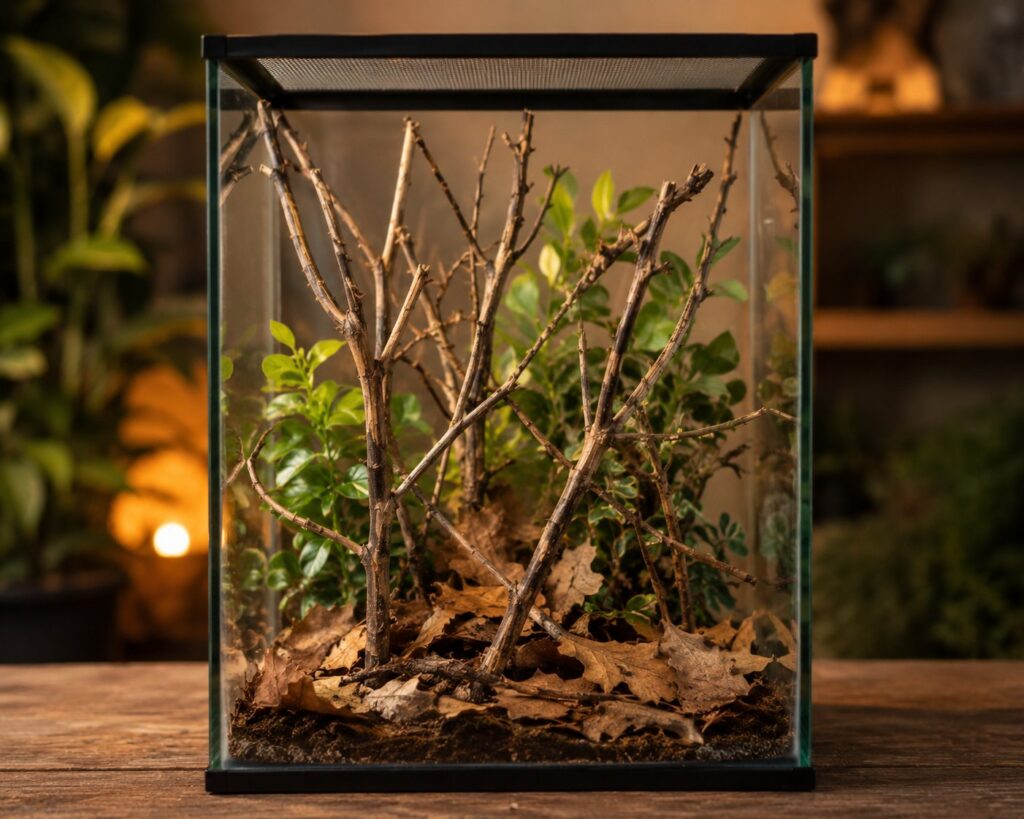
Mantis enclosures follow the “Rule of Three”: the height should be at least 3 times the mantis’s length, and the width should be at least 2 times its length. For an adult ghost mantis at 5 cm, that means a minimum of about 6 inches tall and 4 inches wide. Bigger is always better, especially if you plan to keep a small group together.
For a single ghost mantis, a 1-gallon container, deli cup, or small mesh enclosure works well during earlier instars. Adults do best in something like an 8″ x 8″ x 12″ glass or mesh terrarium. Mesh enclosures are popular because they provide excellent ventilation and give the mantis a surface to grip and hang from, which is critical during molting.
If you use a glass or plastic enclosure, make sure the lid is mesh or screen. Ghost mantises need to hang upside down from the ceiling to molt safely. Smooth glass or plastic lids don’t give them enough grip, and a fall during molting can be fatal.
Decor and climbing structures are essential. Fill the enclosure with:
- Vertical twigs and thin branches for perching and molting
- Artificial or live plants (artificial is easier to maintain and won’t rot)
- A few dried leaves for visual cover and to help the mantis feel secure
Substrate is optional. Some keepers use a thin layer of coconut coir or paper towel at the bottom to retain a bit of moisture and make cleanup easier. Others skip substrate entirely and just mist the enclosure walls and decor directly. Either approach works fine.
Ventilation is non-negotiable. Stagnant air leads to mold and bacterial growth, which can kill a mantis quickly. Cross-ventilation (holes or mesh on opposite sides of the enclosure) is ideal. If you’re using a mesh enclosure, this is already taken care of.
Temperature & Humidity
Ghost mantises are remarkably adaptable when it comes to climate. They tolerate a temperature range of 65-85°F (18-29°C), which means most homes provide suitable conditions without supplemental heating. The sweet spot is 72-80°F (22-27°C) for steady growth and activity.
Keep in mind that temperature directly affects lifespan and development speed. Warmer temperatures speed up metabolism, which means faster growth through instars but a shorter overall life. Cooler temperatures slow things down, extending both development time and total lifespan. If you’re not in a rush, keeping them at the lower end of the comfortable range can give you more time with your mantis.
Humidity should stay between 40-70%. Ghost mantises come from relatively dry habitats compared to many tropical mantis species, so they don’t need high humidity. Mist the enclosure lightly once every day or two for nymphs, and 2-3 times per week for older nymphs and adults. The goal is to provide water droplets on branches and leaves for drinking, not to create a wet environment.
One fascinating quirk: humidity influences color. If you keep your ghost mantis in a more humid environment, it’s more likely to develop green coloring at its next molt. Drier conditions tend to produce darker browns. You can’t choose exact colors, but you can nudge things in a direction.
Tracking temperature and humidity trends over time helps you keep conditions consistent, especially through molting periods when stability matters most. A small digital thermometer/hygrometer combo inside the enclosure is a worthwhile investment.
Diet & Feeding
Ghost mantises are ambush predators. They sit perfectly still on a branch, blending into their surroundings, and snatch prey as it passes within striking range. They won’t chase food, so the prey needs to come to them (or at least be placed nearby).
Feeding requirements change as your mantis grows through its instars (growth stages). Here’s a general guide:
L1-L2 nymphs: Drosophila melanogaster (flightless fruit flies). Feed every 1-2 days. Nymphs at this stage are tiny and can be tricky to feed, as they may ignore crawling prey. Flying or climbing prey works best.
L3-L4 nymphs: Drosophila hydei (larger fruit flies) or small houseflies. Feed every 2-3 days.
L5-L6 nymphs: Houseflies, small crickets, or blue bottle flies. Feed every 3-4 days.
Sub-adult and adult: Blue bottle flies, moths, small roaches, or appropriately sized crickets. Feed every 3-5 days. A good rule of thumb is that prey should be roughly half the length of the mantis’s body.
In the wild, ghost mantises primarily eat flying insects. Flies are generally preferred over crickets, and many keepers find that their ghost mantises take flies far more eagerly. That said, most captive ghost mantises will accept crickets without issue, especially if the crickets are active and climbing near the mantis.
Hydration comes from misting. Ghost mantises drink water droplets from branches and enclosure walls. Make sure to mist lightly every day or two so fresh droplets are always available.
Don’t panic if your mantis refuses food for a few days. Pre-molt fasting is completely normal. A ghost mantis will often stop eating 3-7 days before a molt. As long as the abdomen isn’t severely shrunken, just wait it out.
For a broader look at the conditions mantids need across species, see our guide on what praying mantises need to survive.
Behavior & Handling
Ghost mantises are among the calmest mantis species you’ll encounter. They spend most of their time sitting motionless on a branch, swaying gently to mimic a leaf in the breeze. When prey comes close, they strike with startling speed, then return to their patient stillness.
If a ghost mantis feels threatened, it will typically freeze or slowly sway rather than flee. Some may raise their front legs in a threat display (called a deimatic display), flashing the underside of their forelegs. It looks dramatic but is purely defensive. They rarely bite humans, and even when they do, the bite is harmless.
Handling is possible with ghost mantises, as they’re docile and rarely skittish. Gently coax the mantis onto your hand rather than grabbing it. Move slowly and avoid sudden movements. That said, handling should be kept to a minimum. Mantises are observation pets, not handling pets, and too much interaction causes stress.
Communal keeping is one of the ghost mantis’s most appealing traits. Unlike most mantis species, P. paradoxa has a relatively low cannibalism risk and can be kept in groups. The key requirements for successful communal housing are plenty of space, abundant climbing surfaces and hiding spots, and consistent food availability. If the group runs low on food, cannibalism risk increases sharply. Nymphs should also be roughly the same size. Mixing large and small individuals is asking for trouble.
Even with precautions, some cannibalism may still occur. It’s a manageable risk, not an eliminated one. If you want zero risk, house them individually.
Molting happens every 2-3 weeks in young nymphs, with the interval increasing as the mantis matures. The final sub-adult stage can last 6-8 weeks or even longer. Males go through 6 molts to reach adulthood (L7), while females need 7 (L8). During molting, the mantis hangs upside down from the ceiling or a branch and wriggles out of its old exoskeleton. Do not disturb a molting mantis under any circumstances. Failed molts are one of the most common causes of death in captive mantises, and disturbance greatly increases the risk. If a mantis loses a leg during a molt while still young, it can often regenerate the limb over subsequent molts.
Breeding
Breeding ghost mantises is considered relatively straightforward compared to many other mantis species, which makes it a good starting point for keepers who want to try their hand at mantis breeding.
Sexing: Males are slimmer with longer antennae and wings extending past the abdomen. They also have 8 abdominal segments visible on the underside. Females are broader, have shorter wings, and show 6-7 segments. These differences become easier to spot from around L4-L5 onward. Males also tend to have a more pronounced, spikier head crest.
Timing: Males mature faster than females (6 molts vs. 7), so if you’re raising both from nymphs, the male may reach adulthood several weeks before the female. Keep the male well-fed and at slightly cooler temperatures to slow him down if needed.
Mating: Females can mate about 2 weeks after their final molt. Make sure the female is very well-fed before introducing the male, as a hungry female is more likely to eat him. Sexual cannibalism in mantids is less universal than its reputation suggests, but hunger is the single biggest trigger. Place the male in the female’s enclosure and give them space. The male will typically approach cautiously and mount the female. Mating can last several hours.
After mating, the female will produce an ootheca (egg case), a foam-like structure she attaches to a branch or enclosure wall. Each ootheca contains roughly 20-60 eggs. Females can produce multiple oothecae from a single mating, usually around 4-6 over their remaining lifespan.
Keep the ootheca at the same temperature and humidity as the adults. At around 77°F (25°C), nymphs typically hatch in 4-6 weeks. At cooler temperatures, hatching can take up to 8-10 weeks. Newly hatched L1 nymphs look like tiny black ants (a form of protective mimicry) and should be offered Drosophila melanogaster within a day or two of hatching.
Common Health Issues
Failed molts are the biggest risk for captive ghost mantises. A mantis that can’t hang properly, gets stuck in its old exoskeleton, or falls during the process may suffer permanent damage or die. Prevention comes down to three things: adequate vertical space, a textured surface to grip (mesh lids, rough branches), and proper humidity. Misting the enclosure a few hours before an expected molt helps soften the old exoskeleton.
Dehydration shows up as a shrunken, wrinkled abdomen. If your mantis looks deflated and isn’t in pre-molt, increase misting frequency. Always make sure water droplets are available on branches and enclosure walls.
Overfeeding can actually be a problem with mantises. An overfed mantis becomes obese, which can cause complications during molting and shorten its lifespan. If the abdomen looks extremely swollen and tight between feedings, reduce the feeding frequency.
Mold and bacteria thrive in poorly ventilated enclosures. If you see mold growing on substrate, decor, or uneaten prey, improve ventilation immediately and remove the affected material. Always remove uneaten prey within 24 hours.
Nymph mortality is highest in the first two instars. L1 nymphs are fragile and can drown in water droplets that are too large, get stuck on residue or tape inside the enclosure, or simply fail to feed. Light misting (fine droplets, not puddles) and appropriately tiny prey are essential.
FAQ
Are ghost mantises good for beginners?
Yes, ghost mantises are widely considered one of the best beginner mantis species. They tolerate a broad range of temperatures and humidity levels, they’re docile, and their care requirements are straightforward. The ability to keep them in small groups is an added bonus that most other species can’t offer.
How long do ghost mantises live?
Total lifespan is typically 7-12 months from hatching to death, with females living longer than males. Adults live roughly 4-8 months after their final molt. Cooler temperatures slow metabolism and can extend lifespan slightly, while warmer conditions speed up development but shorten overall life.
Can ghost mantises be kept together?
Yes, Phyllocrania paradoxa is one of the few mantis species that can be kept communally with a relatively low risk of cannibalism. The keys are providing enough space, plenty of climbing structures, and consistent food. Keep group members at similar sizes, and be aware that some cannibalism is still possible, especially if food runs short.
What do ghost mantises eat?
They eat live insects appropriate to their size: fruit flies for nymphs, graduating to houseflies, blue bottle flies, small crickets, and moths as they grow. Prey should be about half the mantis’s body length. Adults eat every 3-5 days. Ghost mantises are ambush predators that prefer flying prey, so flies tend to work better than crickets.
Why is my ghost mantis not eating?
The most common reason is pre-molt fasting, which is perfectly normal. Ghost mantises often refuse food for 3-7 days before a molt. Other causes include temperatures that are too low (which slows metabolism and reduces appetite), stress from too much handling, or illness. If the mantis hasn’t eaten in over two weeks and shows no signs of molting, check your enclosure conditions.
Track Your Mantis with InvertMate
Keep a detailed care log for your ghost mantis with InvertMate. Track each molt, log feedings, monitor enclosure conditions, and set smart reminders so you never miss a care task. Free on the App Store.