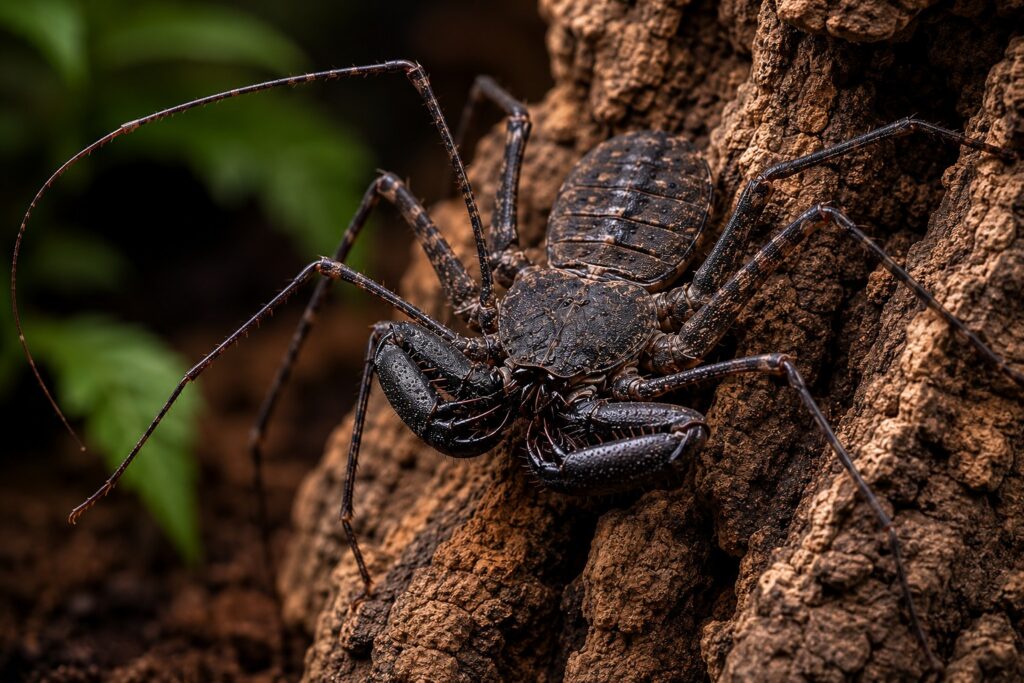
Tailless whip scorpion lifespan surprises a lot of new keepers. These alien-looking arachnids are not built for a quick life. With good care, a tailless whip scorpion (order Amblypygi) commonly lives 5 to 10 years, and well-kept individuals of larger Damon species have been reported to reach 15 or even 20 years in captivity. That puts them among the longer-lived invertebrate pets you can own.
Despite the name, tailless whip scorpions are not true scorpions at all. They belong to their own ancient order, Amblypygi, and they have no tail, no stinger, and no venom. They capture prey with raptorial pedipalps and navigate the world using long, whip-like antenniform legs. Understanding their growth stages and molt cycle is the key to keeping one alive for its full potential lifespan. This guide breaks down how long these creatures live, walks through each growth stage, and explains how to help your whip scorpion thrive for the long haul. For full husbandry details, see our complete tailless whip scorpion care guide.
How Long Do Tailless Whip Scorpions Live?
The honest answer is that lifespan depends heavily on species and care quality. Most commonly kept tailless whip scorpions live 5 to 10 years, but the range extends considerably in both directions.
Larger Damon species like Damon diadema, Damon medius, and Damon variegatus are the long-lived stars of the group. With proper enclosure setup, consistent humidity, and gentle handling, these species have been documented living 10 years or more as adults, and some keepers report lifespans approaching 20 years. Smaller species such as Phrynus marginemaculatus tend toward the shorter end of the range.
One consistent pattern: females outlive males by a significant margin. This holds true across most amblypygid species, similar to what you see in true scorpions. If maximizing lifespan is your priority, a female is the better long-term choice.
| Species | Captive Lifespan | Notes |
|---|---|---|
| Damon diadema | 10-15+ years | Tanzanian giant, popular in the hobby |
| Damon medius | 10-20 years | Slightly smaller, hardy |
| Damon variegatus | 10-20 years | Striking banded legs |
| Phrynus marginemaculatus | 5-7 years | Smaller, social species |
For comparison, these lifespans rival or exceed many true scorpions. If you’re weighing different arachnid pets, our guide on how long scorpions live covers the true scorpion side of the equation, and scorpion as a pet compares the common beginner species side by side.
Growth Stages: From Nymph to Adult
Tailless whip scorpions go through a fascinating life cycle that begins with one of the most unusual sights in the arachnid world: a mother carrying her young on her back.
Egg sac stage. After mating, the female carries a cluster of eggs in a sac (called a brood sac) tucked beneath her abdomen. She holds this sac for several months, and during this time she becomes especially sensitive to disturbance. Any significant vibration or stress can cause her to drop the sac, which ends the brood.
Practonymph and first instar. When the eggs hatch, the pale, soft-bodied young (called practonymphs initially) climb onto the mother’s back and cling there. They remain attached through their first molt. This maternal care period is critical, and the young are highly vulnerable. They don’t eat during this stage, relying on yolk reserves.
Second instar and independence. After molting into their second instar, the young become more substantial, darken in color, and disperse from the mother. At this point they’re miniature versions of the adults and can already tackle prey close to their own size. This is when keepers typically separate them, since cannibalism becomes a risk once they’re independent.
Juvenile instars. From here, the whip scorpion grows through a series of molts, each one called an instar. With every molt, it increases in size, its pedipalps grow more robust, and its antenniform legs lengthen. Growth rate depends on temperature, feeding, and humidity. Warmer, well-fed individuals molt more frequently.
Adulthood. After several molts (typically reached over 1 to 3 years depending on species and conditions), the whip scorpion reaches its final adult form. Adults of large Damon species can have a leg span exceeding 8 inches, even though the body itself remains relatively small. Once mature, molting slows dramatically or stops, and the animal settles into its long adult lifespan.
Molting: The Most Critical Process
Molting is how a tailless whip scorpion grows, and it’s also the single most dangerous moment in its life. Understanding it is essential to keeping your pet alive.
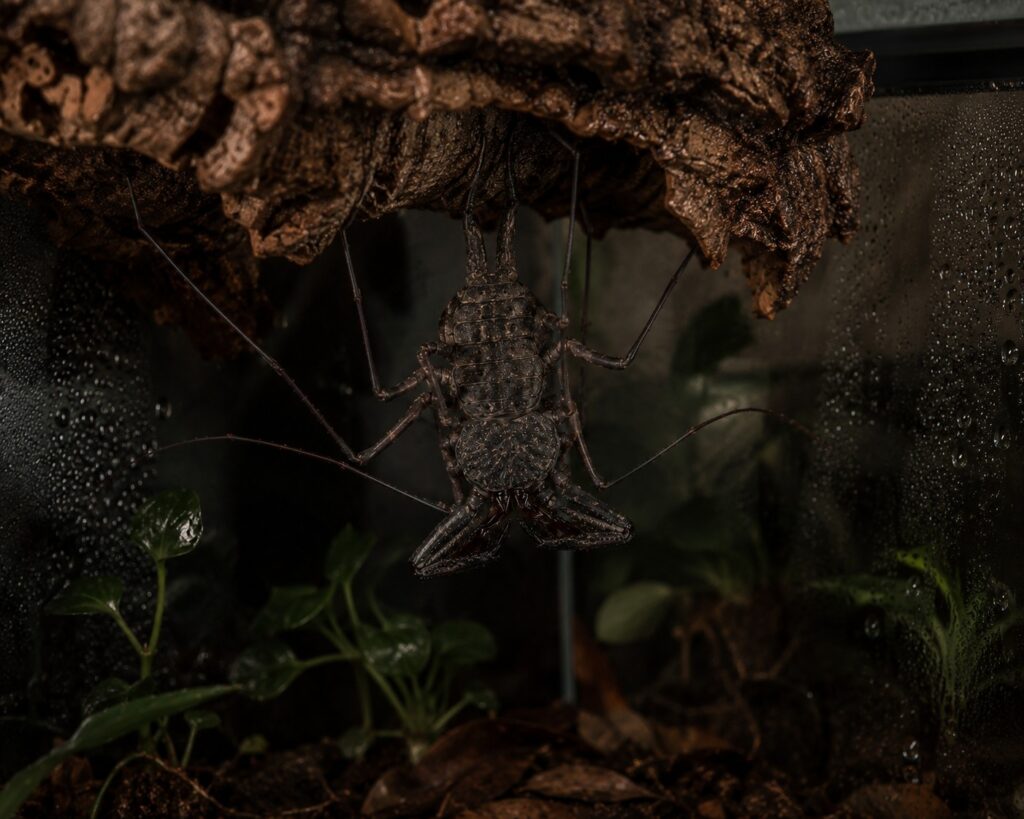
Unlike true scorpions that molt lying on their back, amblypygids molt while hanging upside down from a vertical or overhead surface. Tarantulas molt the same way as true scorpions, which is why their enclosure requirements differ so much from an amblypygid’s. They use gravity to help pull their body free of the old exoskeleton. This is why vertical cork bark is non-negotiable in a tailless whip scorpion enclosure. Without something to climb and hang from, the animal cannot molt properly and will likely die.
Pre-molt signs include refusing food for one to several weeks, reduced activity, and the animal positioning itself high on a vertical surface. Tailless whip scorpions can go a month or more without eating around a molt, so don’t panic at a fasting period.
During the molt, the whip scorpion hangs motionless and slowly extracts itself from the old skin. This process is delicate. Humidity is critical here. If conditions are too dry, the molt can fail, trapping the animal’s delicate legs or pedipalps in the old exoskeleton. A failed molt is frequently fatal or results in lost or deformed limbs.
After the molt, the new exoskeleton is soft and pale. The animal is extremely vulnerable for several days while it hardens. Never feed or disturb a freshly molted whip scorpion. Wait 5 to 10 days, until the exoskeleton has fully hardened, before offering food. Remove any live prey from the enclosure during the molt period, as even a small cricket can injure a soft, defenseless whip scorpion.
Interestingly, tailless whip scorpions can regenerate lost legs over subsequent molts, so a leg lost to a bad molt isn’t always permanent, provided the animal is still young enough to keep molting.
How to Maximize Your Whip Scorpion’s Lifespan
Reaching the upper end of that lifespan range comes down to a few key husbandry points. Maintain humidity above 75% consistently, since dehydration and failed molts are the leading causes of premature death. Keep temperatures in a comfortable 70 to 80°F range, avoiding extreme heat. Provide ample vertical cork bark for climbing and molting, which is the most important structural element in the enclosure.
Feed appropriately sized prey (small crickets, roach nymphs, flightless fruit flies for young ones) twice a week, and always remove uneaten prey within 24 hours. Keep handling to an absolute minimum. Tailless whip scorpions are fast, fragile, and easily stressed, and they’re strictly observation animals. Place the enclosure somewhere stable and low-traffic, since these animals are highly sensitive to vibration, especially gravid females.
Monitoring conditions over time is the easiest way to catch the humidity dips and temperature swings that cause failed molts. Keeping a record of each molt also helps you anticipate the next one and know when to leave your animal undisturbed.
Common Issues That Shorten Lifespan
Most premature deaths in tailless whip scorpions are preventable husbandry failures. Failed molts from low humidity are the number one killer, which is why consistent moisture and vertical climbing surfaces matter so much. Dehydration shows up as lethargy and a shriveled appearance, usually from humidity that’s too low or a lack of misting. Falls and injury can happen to a freshly molted animal or one startled off its perch, since the soft post-molt body is easily damaged. Prey injury occurs when live insects are left in with a molting or freshly molted whip scorpion. Stress from frequent handling, vibration, and disturbance wears the animal down over time and can cause a gravid female to drop her brood.
FAQ
How long do tailless whip scorpions live in captivity?
Most live 5 to 10 years, but larger Damon species commonly reach 10 to 15 years, and some individuals have been reported living close to 20 years with excellent care. Females consistently outlive males.
Do tailless whip scorpions stop molting when they reach adulthood?
Largely, yes. Molting is most frequent during the juvenile growth stages. Once a whip scorpion reaches its adult size, molting slows dramatically or stops altogether, and the animal settles into its long adult phase.
How can I tell if my tailless whip scorpion is about to molt?
Watch for a loss of appetite lasting a week or more, reduced movement, and the animal positioning itself high on a vertical surface. These are reliable pre-molt signs. Stop feeding, remove any live prey, and avoid disturbing the enclosure until well after the molt completes.
Why is my tailless whip scorpion not eating?
Fasting is normal around molting, and these animals can go a month or longer without food during this period. As long as humidity and temperature are correct and the animal appears otherwise healthy, a fasting whip scorpion is usually just preparing to molt. Check your enclosure conditions if fasting is paired with other signs of distress.
Can a tailless whip scorpion regrow a lost leg?
Yes, to a degree. Younger whip scorpions that are still molting can regenerate lost or damaged legs over successive molts. Once the animal reaches adulthood and stops molting, lost limbs are permanent.
Track Your Whip Scorpion with InvertMate
Keeping a tailless whip scorpion for a decade or more means tracking a lot of molts and conditions. InvertMate lets you log each molt, monitor humidity and temperature trends, and set feeding reminders, so you can give your whip scorpion the long, healthy life it’s capable of. Free on the App Store.