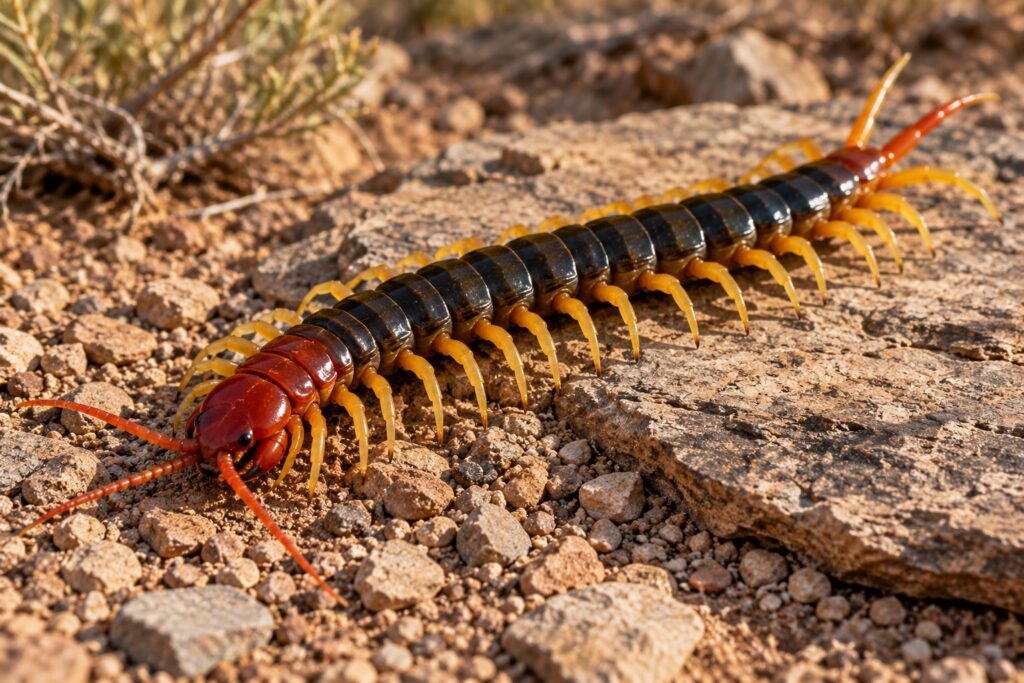
Scolopendra heros, the Texas redheaded centipede, is North America’s largest centipede and one of the most striking animals in the invertebrate hobby: a glossy black body, a cherry-red head and a yellow-legged tail end that looks like a second head. It is also fast, defensive and venomous enough to put an adult in real pain for a day or more. Keep one only if you are happy never to touch it.
For the right keeper it is a rewarding, long-lived animal that suits a dry room-temperature setup and needs feeding only once a week or so. This guide covers the colour forms, the bite risk, enclosure and escape-proofing, climate, feeding, molting, brooding females, and how it compares with the smaller tiger leg centipede.
Texas Redheaded Centipede at a Glance
| Attribute | Details |
|---|---|
| Scientific name | Scolopendra heros |
| Common names | Texas redheaded centipede, giant redheaded centipede, giant desert centipede, Arizona desert centipede |
| Native range | Southwestern and south-central United States, from Arizona and New Mexico east to Arkansas, Missouri and Louisiana, and northern Mexico |
| Adult length | About 6.5 inches on average, up to 8 inches in the wild, sometimes more in captivity |
| Lifespan | Several years, and can pass a decade |
| Temperature | 72 to 85F (22 to 29C) |
| Humidity | 50 to 70%, from a damp section of substrate |
| Diet | Crickets, roaches, other large insects |
| Handling | Never |
| Difficulty | Intermediate, for keepers with escape-proofing experience |
Colour Forms: Red Head, Black Head, Orange Body
“Texas redheaded centipede” describes the best-known form, not every S. heros you will see for sale.
- The redheaded form has a red to orange-red head, a black or greenish-black body and a yellow to orange tail section. This is the classic look across Texas, Oklahoma, Arkansas and nearby states, and it is the form behind the giant redheaded centipede Texas searches.
- Arizona and desert forms sold in the hobby are often yellow, orange or tan in the body, sometimes with a dark head and dark tail. Keepers often call these “Arizona heros”.
- Juveniles can look quite different from adults, and colour can shift over several molts.
All of them are the same species with the same care and the same bite. If you buy one, ask the seller where the line comes from, mainly so you know roughly what the adult will look like.
The Bite: Painful, Rarely Dangerous
Every large Scolopendra injects venom through a pair of modified front legs called forcipules, which work like fangs. Scolopendra heros has not been linked to any confirmed deaths, but a bite is a serious event.
What a bite usually causes: sharp, burning pain at the site, swelling and redness, sometimes lasting a day or longer. Some people also report nausea and headache. Severe reactions from Scolopendra bites are rare but have been reported, including skin damage at the site and, in a few cases, effects on the kidneys or heart.
If you are bitten: wash the area with soap and water, apply a cold pack to ease pain, and seek medical advice, especially if swelling spreads, you feel unwell, or you have a history of allergic reactions. Do not cut the wound, suck it or apply a tourniquet. This is general information, not a substitute for advice from a doctor.
The rule that prevents bites: never handle it. Not with gloves, not when it seems calm, not briefly. Every routine task, from feeding to rehousing, is done with long tongs, a catch cup and a closed lid. Our guide to whether a centipede suits you as a pet explains why that rule has no exceptions, and is worth reading before you buy.
The Centipede That Escapes
Escape is a bigger everyday risk than a bite. A Texas redheaded centipede is strong, flexible and fast, can flatten its body to pass through narrow gaps, and some individuals climb smooth walls. One that gets out in a house is hard to find and dangerous to stumble on.
The essentials:
- A lid that locks. Latching clips, a locking sliding lid, or a lid held by clamps. A screen lid that sits by friction is not good enough.
- Holes smaller than the head. If the head fits through a gap, the rest of the centipede follows.
- A gap check after every opening. Lids get closed off-centre more often than keepers admit.
- No climbing route to the lid. Keep decor well below the top, so the centipede cannot reach the seam from a branch or cork piece.
The full method, including how to work with the enclosure open, is in our centipede enclosure and escape-proofing guide.
Scolopendra Heros Enclosure
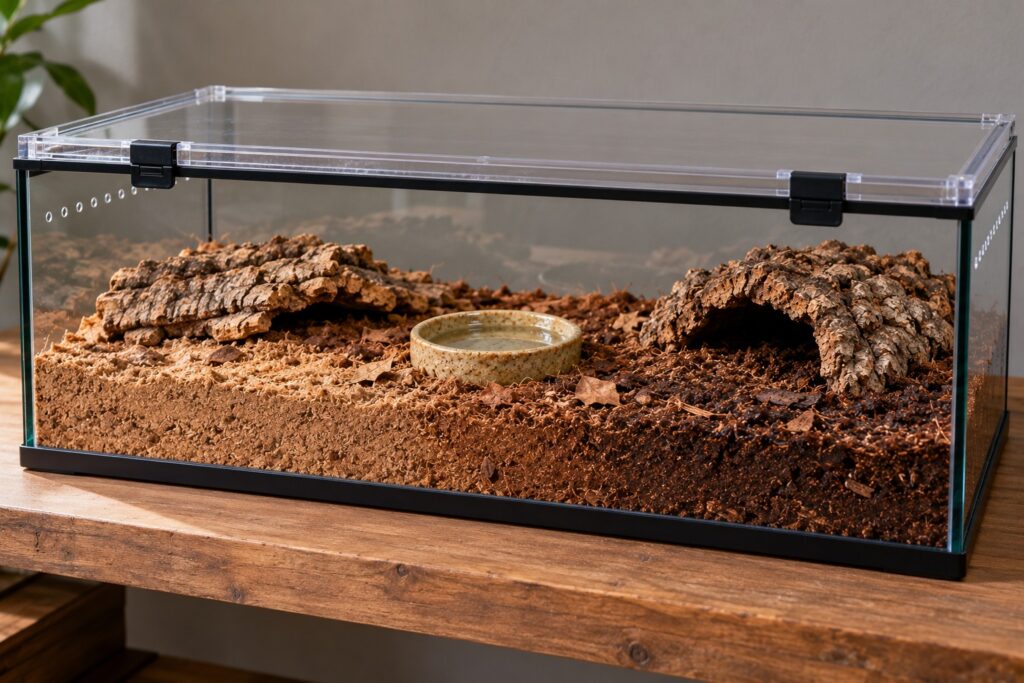
Centipedes need floor space and depth, not height. Most of their life happens under the surface.
| Length | Enclosure footprint | Substrate depth |
|---|---|---|
| Under 2 inches | 32 oz deli cup or small tub | 3 to 4 inches |
| 2 to 4 inches | About 12 by 6 inches | 4 inches |
| 4 to 6 inches | About 16 by 8 inches | 5 inches |
| Adult, 6 inches and up | About 20 by 10 inches or larger, such as a 10 gallon tank with a locking lid | 5 to 6 inches |
Footprint: at least twice the centipede’s length on the long side and about its length on the short side. Bigger is fine if the lid is secure.
Substrate: a mix of coconut fibre, additive-free topsoil and sand, packed firmly so burrows hold their shape. Make one end slightly damp.
Hides: two or three pieces of cork bark or flat stone resting on the substrate, bedded so they cannot shift onto the animal.
Water dish: shallow and stable, kept full. Centipedes drink regularly and dry out faster than spiders.
Ventilation: small holes on two opposite sides, every one smaller than the head.
A Dry Animal With One Damp Corner
S. heros lives in deserts, grassland and rocky woodland, spending hot days underground where the soil holds a little moisture and coming up at night or in cloudy weather. That shapes the setup: drier than a tropical centipede, but not bone dry.
- Temperature: 72 to 85F. Normal room temperature covers most of that. If your room runs cooler, fix a low wattage heat mat to a side wall on a thermostat, never underneath.
- Humidity: 50 to 70%, achieved by keeping one end of the substrate damp and the rest dry, so the centipede can choose.
- Water: pour it into the damp end every few days so it soaks down. Do not mist. It does nothing for the substrate and stresses the animal.
This is the same arid-with-a-damp-corner logic used for desert scorpions, and keepers with a desert hairy scorpion setup will recognise most of it.
A centipede short of water curls, moves slowly and refuses food. A full dish and a damp corner prevent almost all of it.
Feeding: Tongs Only
Texas redheaded centipedes are powerful, fast eaters and will take most insects that fit.
- What to feed: crickets, dubia roaches, red runners and other large insects. Prey about half the centipede’s length or a little more is fine.
- How often: juveniles every 4 to 5 days, adults every 7 to 10 days. A plump, smooth body means it is well fed.
- How to offer: drop prey in with long tongs and close the lid. Do not hold food in front of the centipede with your fingers anywhere near it.
- Remove leftovers within 24 hours. Uneaten crickets can injure a molting centipede.
Wild centipedes also take small vertebrates such as lizards and rodents. In captivity, insects are cleaner, safer and entirely sufficient. A centipede that refuses food is usually about to molt, or is too cold or too dry.
Logging each feeding in InvertMate also means you never need to open the lid “just to check” whether it ate, which is one less chance for an escape.
Molting Underground
Centipedes grow by molting, and S. heros does it in a sealed chamber underground. Before a molt it stops eating, burrows and may stay hidden for weeks.
- Do not dig it up. A freshly molted centipede is soft and easily injured.
- Remove any live prey that might find it.
- Keep the damp corner damp. A molt in dry substrate is more likely to go wrong.
- Wait until it surfaces and moves normally before feeding again, usually a few days.
Growth is slow. A juvenile can take several years to reach full size, which is part of why the species lives so long.
Brooding Females: Leave Her Completely Alone
Female Scolopendra guard their eggs. A gravid female digs a chamber, lays a cluster of eggs, and coils around them, cleaning them and keeping fungus off until the young hatch and pass their first molts.
If you discover a female curled around eggs:
- Do not open the enclosure except to refill water quickly and carefully.
- Do not feed until the brood disperses.
- Do not disturb the chamber. A stressed female may eat her eggs.
Once the young leave her, separate them into individual containers. Centipedes are cannibalistic and do not share.
Texas Redheaded or Tiger Leg Centipede?
Both are native North American Scolopendra that suit dry setups. The difference is size and risk.
| Scolopendra heros | Scolopendra polymorpha | |
|---|---|---|
| Common name | Texas redheaded centipede | Tiger leg centipede |
| Adult length | 6.5 to 8 inches | 4 to 6 inches |
| Look | Red head, black body, yellow tail | Tan body with dark bands |
| Bite | Painful, can last a day or more | Painful but milder |
| Escape risk | High | High |
| Best for | Keepers with centipede experience | A first centipede |
If this would be your first centipede, start with the tiger leg centipede and move up. The tropical giants, covered in our giant centipede care guide, are bigger and more dangerous again.
Buying and Collecting
- Wild-caught animals are common in the trade, since the species is native and widespread. Captive-bred young are available less often.
- Collecting rules vary by state. Check local wildlife regulations before collecting your own.
- Quarantine any wild animal in a separate enclosure for a few weeks and check for mites.
- Buy on scientific name. “Giant redheaded centipede” is also used for the Asian Scolopendra subspinipes mutilans, a different species with different care.
Five Problems to Plan For
- Escape. A loose lid or an oversized hole. Fix the lid before anything else.
- Dehydration. Empty dish or fully dry substrate.
- Mites. Usually from uneaten food or wet substrate. Remove leftovers and let the surface dry.
- Failed molt. Usually from dry conditions or disturbance.
- A bite. Almost always during handling or careless feeding.
FAQ
How big do Texas redheaded centipedes get?
Adults average about 6.5 inches and reach up to 8 inches in the wild, with some captive animals growing larger. That makes Scolopendra heros the largest centipede native to North America.
Is a Texas redheaded centipede bite dangerous?
It is very painful but rarely dangerous. A bite usually causes burning pain and swelling at the site, sometimes with nausea or headache, and no confirmed deaths have been linked to the species. Seek medical advice after any bite, especially if symptoms spread.
Can you keep a Texas redheaded centipede as a pet?
Yes, in a secure, escape-proof enclosure, but it is not a beginner animal or a pet you can handle. It suits keepers who already have experience with centipedes and are comfortable doing everything with tongs.
How long do Texas redheaded centipedes live?
Several years in captivity, and individuals can live more than a decade. They grow slowly and spend long periods underground, especially before molts.
What do Texas redheaded centipedes eat?
Large insects such as crickets and roaches, fed every 7 to 10 days for adults and every 4 to 5 days for juveniles. Wild centipedes also catch lizards and small rodents, but insects are all a captive centipede needs.
Is Scolopendra heros the same as the giant redheaded centipede?
Usually, yes, in the United States. But the same common name is sometimes used for the Asian Scolopendra subspinipes mutilans, so check the scientific name before buying.
Fewer Reasons to Open the Lid
Every time the lid comes off is a chance for an escape, so the less guesswork you have, the better. InvertMate records each feeding and refusal, logs the dates your centipede burrows and resurfaces, and reminds you when the damp corner needs water. Free on the App Store and Google Play.