Are centipedes dangerous? The house centipede you find in a bathroom is not: its bite is rare, usually fails to break skin, and feels like a mild bee sting. Large Scolopendra kept as pets are another matter, with a very painful bite that warrants medical advice, though deaths are extremely rare.
So the honest answer depends entirely on which centipede you mean. Almost everyone who searches this question has seen one of two animals: a fast, many-legged thing running across a basement floor, or a thick, glossy, foot-long hunter in a pet shop tank or a news story. This guide covers both, starting with the one in your house.
Two Very Different Animals
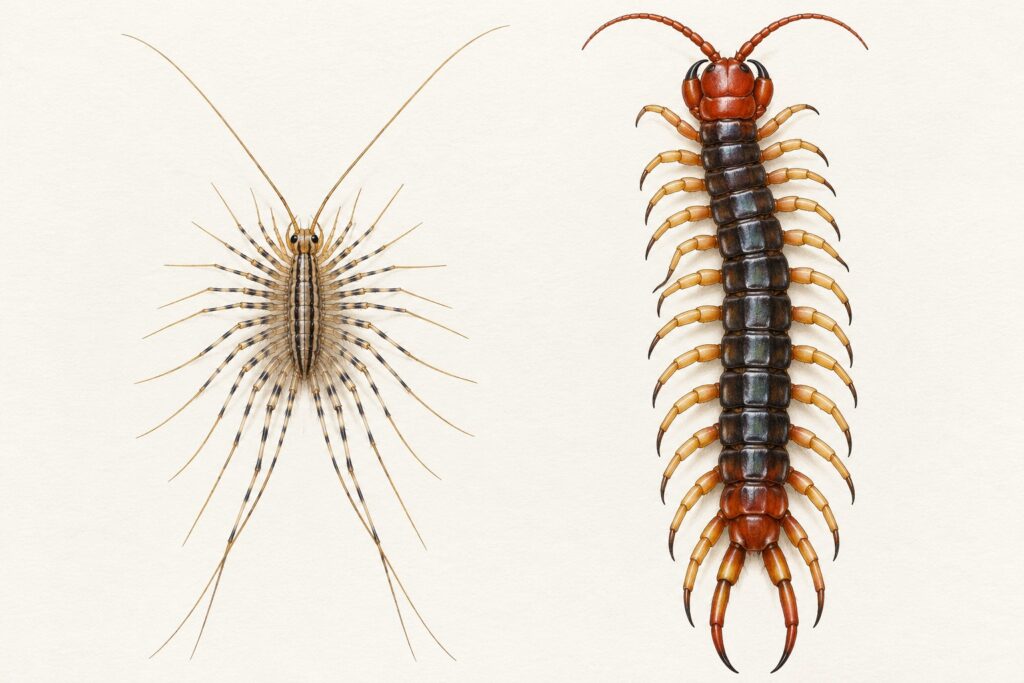
| House centipede | Giant centipede (Scolopendra) | |
|---|---|---|
| Scientific name | Scutigera coleoptrata | Scolopendra species |
| Where you meet it | Basements, bathrooms, garages | Pet trade, warm regions outdoors |
| Body length | About 1 to 1.5 inches | 4 to 10 inches or more |
| Legs | 15 pairs, very long and thin | One pair per segment, short and sturdy |
| Bite | Rare, often cannot break skin, mild | Painful, swelling for a day or more |
| Danger to people | Essentially none | Painful, rarely serious |
| Handling | Avoid, but low risk | Never |
Both are centipedes, and both have venom. Every centipede has a pair of modified front legs called forcipules, which work like fangs and inject venom into prey. What changes between species is how big those forcipules are, how much venom they deliver, and how willing the animal is to use them on you.
Are House Centipedes Dangerous?
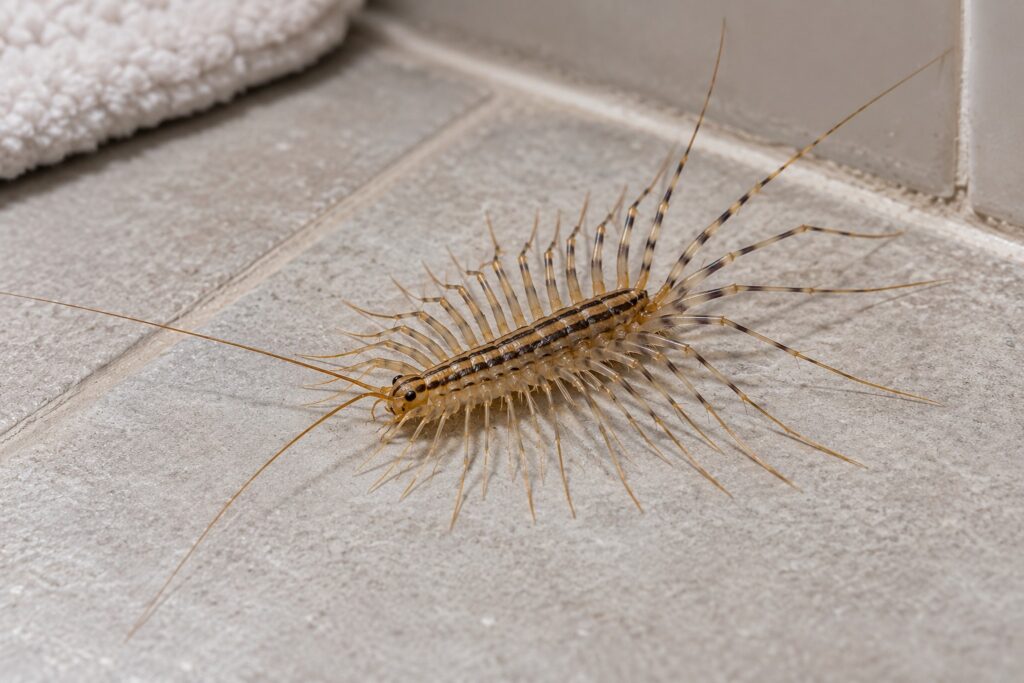
No. The house centipede, Scutigera coleoptrata, is the fast, spidery, 15-pair-legged centipede found in homes across North America and Europe. It looks alarming, mostly because of its speed and its very long legs and antennae, which make it seem three or four inches long. The body itself is only about an inch.
Does it bite? Rarely. A house centipede runs from people. Bites happen almost only when one is trapped against skin, for example in a shoe or under a hand. Its forcipules are small and often cannot get through human skin at all.
What does a bite feel like? When one does connect, it causes mild, local pain and a little swelling, often compared to a bee sting, which settles within hours. Allergic reactions are rare but possible, as with any sting.
Is it dangerous to pets? Not in any meaningful way. A dog or cat that catches one may get a brief nip on the mouth or paw.
Is it poisonous to eat? No. Venom has to be injected to work, so a pet that eats a house centipede is not poisoned.
Does it damage the house? No. House centipedes do not eat wood, fabric or stored food, and they do not build nests.
Why You Might Want to Leave It Alone
A house centipede is a predator, and what it hunts in your home is everything else. It eats spiders, silverfish, cockroaches, termites, bed bugs and ants, and it hunts at night when they are active.
Seeing several house centipedes usually means two things: the house is damp somewhere, and there are other small insects for them to eat. Fixing damp basements and bathrooms, sealing gaps around doors and pipes, and cutting down on clutter will reduce both. Killing the centipedes alone does not.
If you want one out of the room, cover it with a glass, slide a card underneath and take it outside.
Are Giant Centipedes Dangerous?
Large Scolopendra are a different story. These are thick-bodied tropical and desert centipedes that can reach 8 inches or more, kept by a small number of hobbyists and found wild in warm regions including the southern United States.
What a bite causes: intense burning pain at the site, often described as among the worst of any invertebrate bite or sting, with swelling and redness that can last a day or several. Some people also have nausea, headache or fever.
How serious can it get? For healthy adults, a bite is usually a very painful local event that passes. Severe reactions are rare but have been reported, including skin damage at the bite site and, in a few cases, effects on the kidneys or heart. Deaths are extremely rare, with very few documented cases, and none confirmed from the North American species.
Which species? Bite severity broadly tracks size:
- Tropical giants such as the Vietnamese centipede (Scolopendra subspinipes) produce the most severe bites. They are covered in our giant centipede care guide.
- The Texas redheaded centipede (Scolopendra heros), North America’s largest centipede at up to about 8 inches, delivers a very painful bite but has no confirmed deaths. Our Texas redheaded centipede guide covers it in full.
- The tiger leg centipede (Scolopendra polymorpha), smaller at 4 to 6 inches, has a painful but milder bite, which is why it is the usual first pet centipede. See our tiger leg centipede care sheet.
Are Centipedes Dangerous Outdoors?
Gardens hold more centipedes than houses, and almost all of them are harmless to people.
- Stone centipedes are short, brown and quick. They live under rocks, logs and pots, and their bite rarely gets through skin.
- Soil centipedes are thin, yellowish and slow, with many short legs. They live in the soil and leaf litter and almost never bite.
- Wild Scolopendra are the exception. In the southern and southwestern United States, Mexico and other warm regions, large species shelter under rocks, boards, firewood and debris, and sometimes come indoors.
If you live where large centipedes occur, a few habits prevent nearly every bite:
- Wear gloves when moving firewood, stones, boards or garden debris.
- Shake out shoes, boots and gloves that have been left outside or in a garage.
- Check bedding and towels on the floor before picking them up.
- Use a jar and card, never bare hands, to move one.
So are centipedes dangerous in the garden? Only the large ones, and only when they are trapped against skin.
What to Do if a Centipede Bites You
This is general information and not a substitute for medical advice.
- Move away from the centipede and, if it is a pet, get it contained before anything else.
- Wash the bite with soap and water.
- Use a cold pack wrapped in cloth to ease pain and swelling.
- Do not cut the bite, suck it or apply a tourniquet.
- Note what bit you. A photo of the centipede, or its species if it is a pet, helps a doctor.
Seek medical advice after any bite from a large Scolopendra, and after any centipede bite if you notice spreading redness or swelling, hives, dizziness, trouble breathing, chest pain, dark urine, or signs of infection. Children, older people and anyone with known allergies to stings should be checked sooner rather than later.
Centipede or Millipede?
Many people asking whether centipedes are dangerous have actually seen a millipede. The difference matters.
- Centipedes have a flattened body, one pair of legs per segment, long antennae, and venomous forcipules. They are fast predators.
- Millipedes have a rounded body, two pairs of legs per segment, short antennae, and no venom. They are slow, eat decaying plants, and curl up when disturbed. Some release a defensive fluid that irritates skin and eyes, but they cannot bite you.
Our guide to telling millipedes and centipedes apart has side-by-side photos.
Is a Pet Centipede Safe to Keep?
It can be, with three rules that never bend:
- Never handle it. Not with gloves, not when it seems calm. Every task is done with long tongs and a catch cup.
- Escape-proof the enclosure. A locking lid and holes smaller than the centipede’s head. Our centipede enclosure and escape-proofing guide covers the details.
- Keep it away from children and pets. Put the enclosure where curious hands and paws cannot reach it.
Most bites to keepers happen during feeding or cleaning, usually when someone rushes, reaches in, or loses track of where the centipede is. Logging feeding and molt dates in InvertMate cuts down on the times you need to open the lid at all.
Whether a centipede suits you in the first place, which species to start with and what a realistic setup costs are all covered in our guide to centipedes as pets.
How Centipedes Compare to Other Invertebrates
| Animal | Worst realistic outcome for a healthy adult |
|---|---|
| House centipede | Brief sting like a mild bee sting, often nothing |
| Millipede | Skin irritation from defensive fluid, no bite |
| New World tarantula | Itchy rash from hairs, bite like a wasp sting |
| Tiger leg centipede | Painful bite, swelling for hours to a day |
| Texas redheaded centipede | Very painful bite, swelling for a day or more |
| Tropical giant centipede | Severe pain and swelling for days, medical advice needed |
FAQ
Can a house centipede hurt you?
Very rarely. House centipedes avoid people and usually bite only when trapped against skin, and their small forcipules often cannot break it. A successful bite causes mild, local pain and swelling, similar to a bee sting, that fades within hours.
Can a centipede bite kill you?
Deaths are extremely rare and limited to very few documented cases involving large tropical Scolopendra. House centipedes pose essentially no risk. A large centipede bite is very painful and should be checked by a doctor, especially in children or people with allergies.
Are centipedes poisonous to dogs and cats?
Centipedes are venomous, not poisonous, so a pet that eats one is not poisoned. A bite from a house centipede causes brief irritation at most. A bite from a large Scolopendra is painful for a pet too, so contact your vet if swelling spreads or your pet seems unwell.
Should I kill house centipedes?
You do not need to. They eat silverfish, cockroaches, spiders and other household pests. If you would rather not have them, reduce damp and seal entry points, then move any you find outside with a glass and a card.
What does a centipede bite look like?
Usually two small puncture marks close together, with redness and swelling around them. A house centipede bite may leave only a faint red mark. A large Scolopendra bite typically swells more and stays painful for longer.
Which centipedes are the most dangerous?
Large tropical Scolopendra, such as the Vietnamese and Chinese red head centipedes, have the most severe bites. North American species such as the Texas redheaded centipede bite painfully but less severely, and the house centipede is the least dangerous of all.
Keeping One? Open the Lid Less
The safest centipede keeper is the one who opens the enclosure only when there is a reason to. InvertMate records every feeding, refusal and molt so you can see what your centipede needs without disturbing it, and sends reminders for water and substrate checks. Free on the App Store and Google Play.