The rainbow stag beetle is the beetle that makes people take up beetle keeping. Males shine in metallic green, red, gold and copper with long, upturned jaws, they are calm enough to hold, and their larvae thrive on the same rotting wood substrate that other beetle grubs eat. Before you order one, though, check whether it is legal where you live, because for most American keepers it is not an option.
Phalacrognathus muelleri comes from the rainforests of northern Queensland in Australia and from New Guinea. It is bred in large numbers in Japan, Europe and parts of Asia, where it is one of the most popular pet beetles. This guide covers the legal question first, then larvae, substrate, pupation, adult care, breeding, and native alternatives for keepers in the United States.
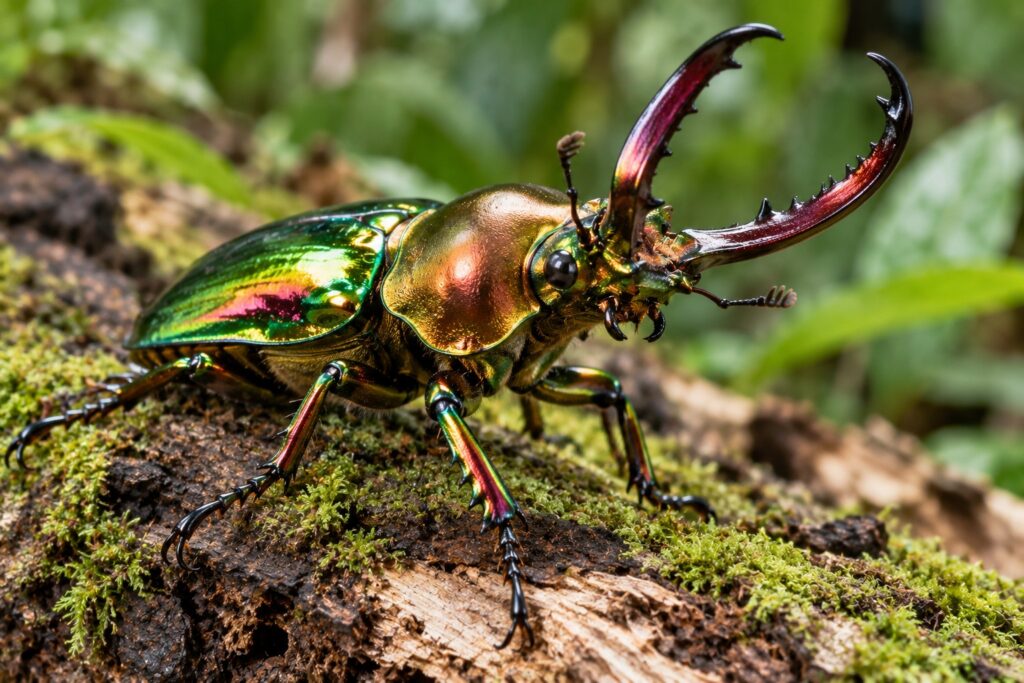
Rainbow Stag Beetle at a Glance
| Attribute | Details |
|---|---|
| Scientific name | Phalacrognathus muelleri |
| Native range | Northern Queensland, Australia, and New Guinea |
| Adult size | Males 24 to 70 mm, females 23 to 46 mm |
| Larval stage | Roughly 1 to 2 years in captivity, up to 3 in the wild |
| Adult active life | Usually a few months, sometimes longer |
| Larval substrate | Fermented hardwood (flake soil) and decayed white-rot wood |
| Adult diet | Beetle jelly, ripe banana, apple |
| Temperature | 68 to 77F (20 to 25C) |
| Handling | Calm, safe to hold |
Can You Keep One Where You Live?
This is the one question that decides everything else, so answer it before buying.
United States. The rainbow stag beetle is not native, and USDA’s guidance on invertebrate pets says many non-native invertebrates are illegal to keep because they could damage agriculture or the environment if they escaped. Importing or moving a live land invertebrate across state lines generally needs a PPQ 526 permit, and USDA asks keepers to contact its Plant Protection and Quarantine program before buying one. In practice, live rainbow stags are not legally available in the American pet trade. A listing that offers to ship one to a US address is not a sign that it is allowed.
Elsewhere. Captive-bred rainbow stags are sold openly in Japan, much of Europe and parts of Asia. Rules still differ by country, so check your national import and wildlife rules, and buy captive-bred stock from a breeder who names the species.
If you are in the US, skip to the section on native stag beetles near the end. The larval care below applies to those species too.
Green, Red, Blue: The Colour Lines
Wild rainbow stags vary, but the hobby has bred colour lines that hold reasonably well from parents to offspring: green, red, blue or purple, black, and mixed. Breeders sell larvae and adults by line.
- Colour belongs to the adult only. Larvae look the same whatever their line. You find out what you have when the adult comes out of the pupa.
- Lines are tendencies, not guarantees. A red pair can produce offspring that lean orange or copper.
- Colour fades after death, which is why preserved specimens look duller than photos of live animals.
Stag Beetle Larvae Live on Rotting Wood
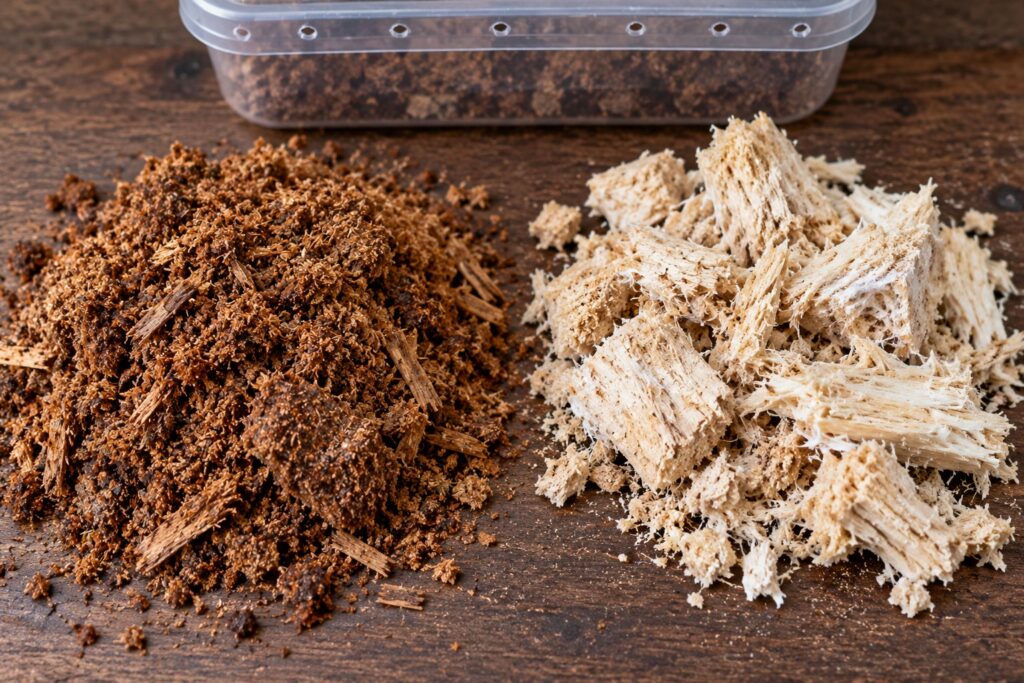
Like rhinoceros beetle grubs, stag beetle larvae live inside their food. In the wild, rainbow stag larvae are found in wet, rotting wood, often close to white-rot fungi, the fungi that bleach and soften hardwood. In captivity you recreate that with fermented hardwood sawdust, sold as flake soil.
The difference from a rhino grub is the texture. Our guide to rhino beetle grub care recommends dark, well-fermented flake soil. Stag beetle larvae do better on a lighter, more woody substrate.
A workable mix for rainbow stag larvae:
- 7 parts light to medium flake soil, still recognisably woody
- 3 parts crumbled white-rot hardwood, soft enough to break by hand
Moisture. Squeeze a handful. It should clump and release no water.
Packing. Press the substrate down hard in layers. Stag larvae tunnel through firm wood in nature and seem to do better in packed substrate than in loose fill.
Kinshi. Some breeders raise larvae in kinshi, sawdust colonised by a living white-rot fungus and sold in bottles. Larvae raised this way often grow into larger adults, which matters to keepers chasing big males. It costs more and needs replacing as the fungus is eaten. Flake soil alone raises healthy beetles.
Collecting your own wood follows the same rules we use for rotten hardwood in a millipede bin: hardwood only, no conifers, nothing from treated or sprayed land. White-rot wood is also exactly what isopods eat in a bioactive bin, which is why many keepers already have a source.
One Larva, One Container
Stag beetle larvae bite each other, and a wounded larva rarely survives. House them individually from the second instar onward.
| Stage | What you see | Container per larva |
|---|---|---|
| L1 | Under an inch, translucent | 8 oz cup, or kept together briefly |
| L2 | 1 to 1.5 inches, head capsule clearly larger | 16 to 32 oz cup |
| L3 | 2 to 3 inches, plump, C-shaped | 1 to 2 quart container, larger for a big male |
A few pinholes in the lid are enough ventilation. Too many dry the substrate out.
Change the substrate when it is mostly frass, the small dark pellets the larva leaves behind. For an L3 that is usually every two to three months. Replace about two thirds with fresh mix and keep a third of the old substrate.
Sexing larvae. In late L3, many female stag beetle larvae show a small yellowish spot through the skin on the back, near the rear of the body. Males are usually larger and heavier at the same age. Neither sign is perfect, but they help when you decide which larvae need bigger containers.
Size Is Decided in the Third Instar
An adult beetle never grows. The size of a male’s jaws is set by how much his larva ate, and most of that eating happens in the third instar, the last and longest larval stage.
Four things help:
- Room. A larva that fills its container stops growing early.
- Fresh substrate. Change it before it is used up, not after.
- Cooler temperatures. Larvae kept at the warm end grow faster and pupate sooner, at a smaller size. The cooler half of the range gives a longer larval stage and a bigger adult.
- Little disturbance. Every dig-out costs the larva time and energy.
Weigh each larva on a kitchen scale at every substrate change. A steady gain in grams is the clearest health check you have for an animal you cannot see. Logging the weight in InvertMate turns those numbers into a growth curve, and a larva that stops gaining stands out right away.
Temperature
Keep larvae and adults at 68 to 77F (20 to 25C). A dark cupboard in a normal room is usually right. Avoid anything sustained above about 80F, which shortens the larval stage, shrinks the adult and can kill the animal. If you need warmth, raise the room temperature or fix a heat mat to the side of the shelf on a thermostat, never under a container.
Pupation: Leave the Container Alone
Late in L3 the larva stops eating, turns a deeper yellow and wrinkled, and builds a pupal cell, a smooth oval chamber packed hard against the side or bottom of the container. Inside it becomes a pupa, and after a month or two, an adult.
From the first sign of a cell:
- Stop all substrate changes.
- Do not move, tip or shake the container.
- Keep moisture steady by adding a little water at the edges, never over the cell.
- Do not dig the adult out early. A new adult stays in the cell for weeks while its shell hardens. It will come out on its own and start walking the surface, usually at night.
If a cell breaks by accident, keepers make an artificial one by pressing a smooth hollow into damp floral foam or packed substrate. It is a rescue, not a method.
Adult Rainbow Stags: Jelly, Bark and a Short Life
What do stag beetles eat? Adults do not eat wood. They lap up sugary liquids with a brush-like mouthpart. Beetle jelly cups are the cleanest food. Ripe banana and apple work too, changed every day or two before they ferment and draw flies.
Housing. A 5 to 10 gallon tank or plastic tub with a secure lid. Adult beetles fly. Add 2 to 3 inches of moist flake soil or coconut fibre, a few pieces of bark, and leaf litter. A beetle that falls on its back on a smooth floor can exhaust itself trying to turn over, so make sure there is always something to grab.
One male per enclosure. Males fight with their jaws, and in a tank the loser cannot escape.
Handling. Rainbow stags are calm and safe to hold. A large male can give a firm pinch with his jaws, but it is more surprising than painful. Let the beetle walk onto your hand rather than picking it up by the body.
Lifespan. Most sources give a few months of active adult life, often three to six, and some keepers report longer. Either way, the larval stage is most of the animal’s life. If you want a rotting-wood eater you can keep and handle for years, a giant African millipede, which lives for years, is the better fit.
Breeding Rainbow Stags
Rainbow stags are among the easier stag beetles to breed, which is why they are so widely available where they are legal.
- Let the adults mature. Wait a few weeks after they emerge and start feeding before pairing them.
- Pair them for a few days in a small enclosure with jelly.
- Set up a laying container with 6 to 8 inches of flake soil, the lower half packed very firmly. Many breeders bury a soaked piece of soft white-rot hardwood in it as well.
- Move the female in alone with food and leave her for one to two months.
- Tip it out gently and collect the eggs and L1 larvae into their own cups.
Rainbow or a Native Stag?
For keepers in the United States, native stag beetles offer the same larval care without the legal problem.
- Giant stag beetle (Lucanus elaphus). The largest stag in the eastern US, with long, curved jaws on the males. Larvae feed in rotting hardwood stumps and logs.
- Reddish-brown stag beetle (Lucanus capreolus). Smaller and more common across the eastern half of the country.
Captive-bred native stags are sometimes sold by US breeders, and the care follows everything above. Check any state rules before collecting from the wild, and leave rotting logs in place where you find them, since they are habitat for far more than beetles. The bigger, longer-lived native grub that many US keepers start with is the eastern Hercules beetle, covered in our rhino beetle guide.
Problems With Stag Beetle Larvae
- Larva on the surface. Substrate too wet, too dry, used up or too warm.
- Dark patches or a soft, limp larva. Usually a bite or infection. Isolate it.
- Larva shrinking in weight. Substrate spent or unsuitable. Change it.
- Mold on the surface. Too wet with too little air. Stir in drier substrate.
- Small adult. Not enough food, room or time in L3, or temperatures too high.
- Deformed jaws or wings. A disturbed pupal cell.
FAQ
How big do rainbow stag beetles get?
Males reach 24 to 70 mm, including their long jaws, and females 23 to 46 mm. Adult size is fixed by how well the larva fed, so large males come from larvae given plenty of room and fresh substrate at cool temperatures.
Can you keep a rainbow stag beetle in the US?
Generally not. It is a non-native species, and USDA says many non-native invertebrates are illegal to keep as pets. Importing or moving live land invertebrates between states usually requires a PPQ 526 permit. Native stag beetles are the legal alternative for US keepers.
What do stag beetle larvae eat?
Rotting hardwood. In captivity that means flake soil, fermented hardwood sawdust, mixed with crumbled white-rot wood. Some breeders use kinshi, sawdust colonised by living fungus, to raise larger adults. Larvae need no fruit or protein.
How long do rainbow stag beetle larvae take to grow?
Roughly one to two years in captivity, and up to three years in the wild. Warmer temperatures shorten the larval stage but produce smaller adults.
What do adult stag beetles eat?
Sugary liquids. Beetle jelly is the standard captive food, and ripe banana or apple works too. Adults cannot eat wood or solid food, and they need fresh food every day or two.
Do rainbow stag beetles bite?
They can pinch with their jaws, especially large males, but they are calm and rarely do. A pinch is more surprising than painful, and they have no venom or sting.
Two Years of Weigh-Ins, Then the Colour Reveal
By the time a rainbow stag shows you its colour, you will have raised it blind for over a year. InvertMate logs each larva’s weight and substrate changes so you can see which ones are growing, keeps a photo timeline from L1 to adult, and sends reminders when a container is due for fresh substrate. Free on the App Store and Google Play.