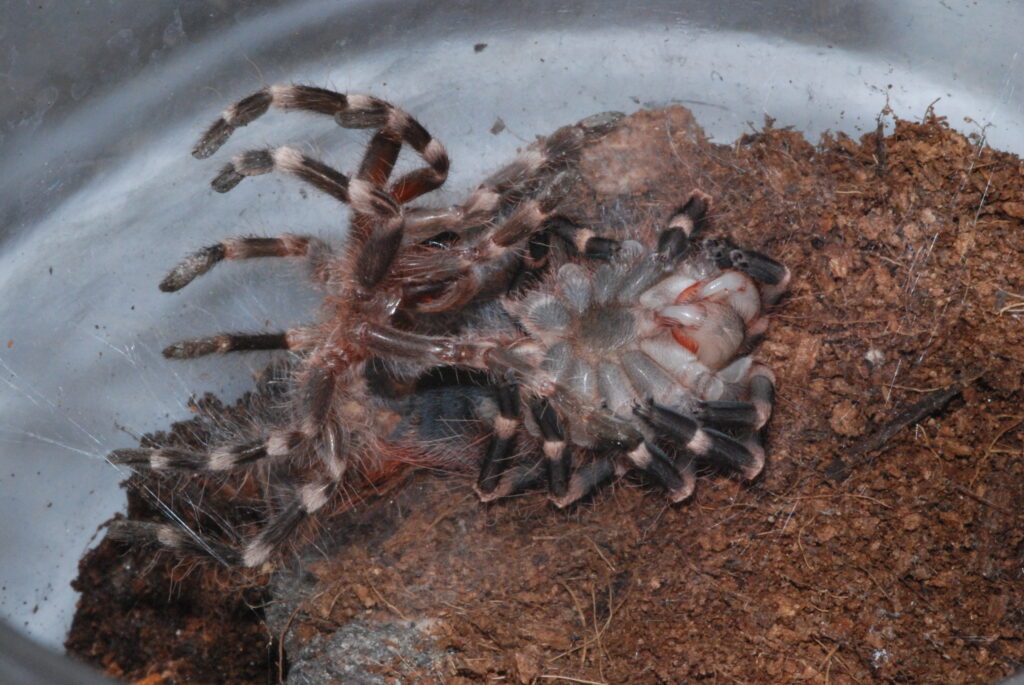
If you’ve never seen a tarantula molt before, the first time can be genuinely alarming. You walk up to the enclosure and find your tarantula flat on its back, legs in the air, barely moving. It looks dead. It’s not. It’s doing one of the most important things it will ever do: shedding its old exoskeleton so it can grow.
Tarantula molting (called ecdysis) is a natural, necessary process that every tarantula goes through multiple times in its life. Understanding the signs, stages, and proper care around a molt is one of the most important things you can learn as a keeper. A little knowledge goes a long way toward keeping your tarantula safe during its most vulnerable moments.
Why Tarantulas Molt
Tarantulas have a rigid exoskeleton that doesn’t grow with them. To get bigger, they have to periodically shed the old one and form a new, larger one underneath. This process doesn’t just allow for growth. It also replaces the lining of the sucking stomach, sheds the outer layer of the fangs (which emerge soft and white before hardening to black), and can even regenerate lost or damaged limbs over the course of one or more molts. The same basic process runs across arachnids with some notable variations. Tailless whip scorpions molt hanging upside down rather than on their backs, and unlike tarantulas they never stop molting, continuing throughout their entire lives.
How often a tarantula molts depends on its age and growth rate. Spiderlings (baby tarantulas) may molt every few weeks to a couple of months because they’re growing rapidly. Juveniles slow down to every few months. Once a tarantula reaches adulthood, molts become far less frequent, typically once a year or even less. Mature males of most species stop molting entirely after their “ultimate molt” into adulthood.
Temperature, diet, and species all play a role in molt frequency. Warmer temperatures and regular feeding tend to speed up the cycle, while cooler conditions and less frequent meals slow things down.
Premolt Signs: How to Know a Molt Is Coming
Recognizing premolt behavior is one of the most useful skills for any tarantula keeper. The signs tend to appear days to weeks (sometimes months) before the actual molt, and they’re fairly consistent across species. Here’s what to watch for:
Loss of appetite
This is usually the first and most obvious sign. A tarantula that normally eats eagerly will start refusing food. Some will kill prey but not eat it. Others will completely ignore feeders. This fasting period can last anywhere from a few days (in fast-growing spiderlings) to several weeks or even months in adults. Don’t panic and don’t try to force-feed. Just remove uneaten prey and wait.
Darkening abdomen
As the new exoskeleton forms underneath the old one, the abdomen often darkens noticeably. In species with a bald patch on the abdomen (from kicking urticating hairs), the bald spot may turn black as the new hairs develop beneath the old skin. Worth knowing that this sign is only available on some tarantulas. Only New World species carry urticating hairs, so an Old World animal never develops a bald patch and never gives you that particular warning, which is one of several practical consequences of the Old World and New World split. This darkening usually means the molt is 1-2 weeks away.
Dull, faded coloring
The old exoskeleton thins and stretches as it prepares to separate. This can make the tarantula’s overall coloration look washed out, muted, or grayish compared to its usual vibrant appearance.
Reduced activity
Your tarantula may become lethargic, spending more time in its hide or burrow and moving less than usual. Terrestrial species may seal off their burrow entrance with silk and substrate. This is normal protective behavior.
Webbing a molting mat
Many tarantulas spin a silk mat on the substrate (or within their retreat for arboreal species) shortly before molting. They’ll lie on this mat during the molt itself. If you see your tarantula laying down a thick silk sheet, the molt is likely within 24-48 hours.
Swollen, tight-looking abdomen
Just before the molt, the abdomen may appear plump and stretched, almost like it’s about to burst. This is the new exoskeleton expanding under the old one.
Not every tarantula will show all of these signs, and some species are more subtle than others. The Chilean rose hair (Grammostola rosea), for example, is notorious for long fasting periods even outside of premolt, making it harder to use appetite as a reliable indicator.
The Molt Itself: What Happens
When the time comes, most tarantulas flip onto their backs. This is the position they molt in, and it’s the moment that terrifies new keepers because it looks exactly like a dead spider. Here’s the critical difference: a molting tarantula lies on its back with legs extended or slightly bent. A dead tarantula curls its legs inward underneath its body (this is called the death curl).
If you find your tarantula on its back, do not touch it. Do not flip it over. Do not spray it with water. Leave it completely alone.
The actual shedding process works like this:
- The tarantula secretes a molting fluid between the old and new exoskeletons, which loosens and lubricates the separation.
- The carapace (the top plate of the cephalothorax) lifts off first, creating a gap between the old and new body.
- The tarantula slowly pumps fluid into its body and works its way out of the old exoskeleton, pulling each leg free one at a time.
- The abdomen slides out last.
- Once free, the tarantula lies still while its new exoskeleton begins to harden.
The entire process can take as little as 15 minutes for a small spiderling or up to several hours for a large adult. Some older tarantulas may take 12 hours or longer. Don’t assume something is wrong unless the tarantula appears genuinely stuck (see the “Stuck Molts” section below).
Post-Molt Care
After the molt is complete, your tarantula will flip back onto its feet. It will look different: colors are often brighter and more vivid, the exoskeleton appears lighter and somewhat translucent, and the fangs will be white (they darken to black as they harden over the next few days).
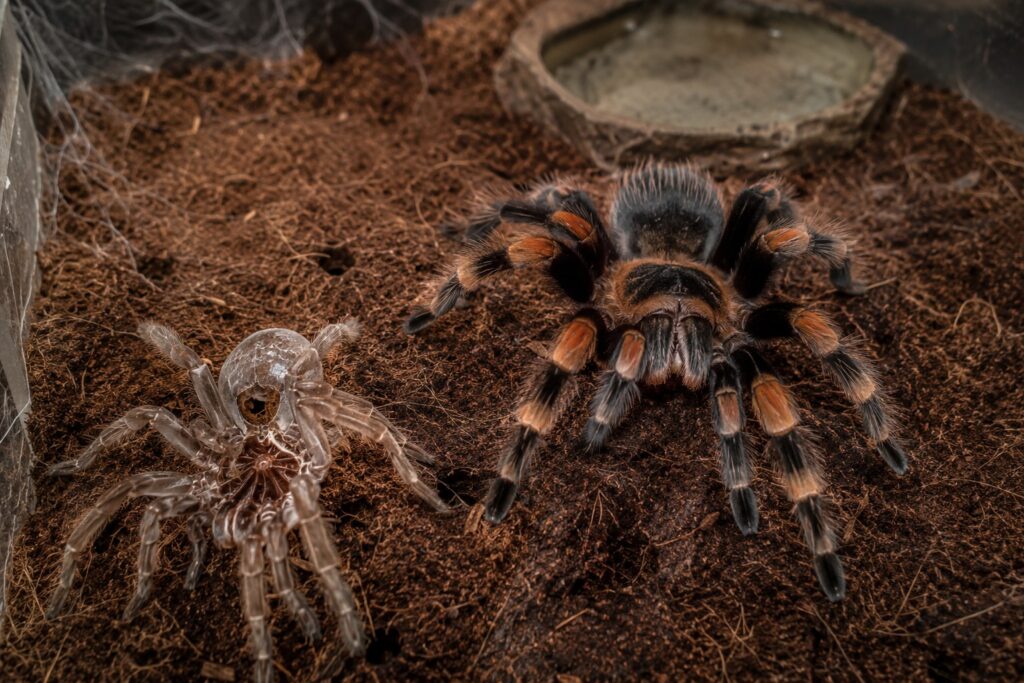
Here’s what you need to do (and not do) after a molt:
Do not feed your tarantula immediately. The new exoskeleton is soft, including the fangs. Your tarantula physically cannot eat until the fangs harden enough to puncture prey. Wait at least 7 days for small tarantulas and 10-14 days for larger adults before offering food. Feeding too early risks injury to the soft, new fangs.
Do not handle your tarantula. The new exoskeleton is fragile. Even a short fall could rupture the abdomen, which can be fatal. Avoid handling for at least 1-2 weeks after a molt.
Remove any live prey from the enclosure. A cricket or roach left in the enclosure can bite or injure a freshly molted tarantula. This is one of the most common and easily preventable causes of post-molt injury and death.
Make sure water is available. Many tarantulas will drink heavily after a molt. Ensure the water dish is full and accessible.
Leave the shed exoskeleton in place for a day, then remove it with tweezers. Some keepers like to carefully unfold and preserve the exuvium (shed skin), as it can be used to sex the tarantula by examining the spermatheca area.
Stuck Molts: When Things Go Wrong
A stuck molt (also called a “bad molt” or “failed molt”) is one of the most dangerous situations a tarantula can face. It happens when the tarantula cannot fully separate from its old exoskeleton and gets trapped partway through the process.
Common causes of stuck molts:
- Humidity too low, causing the old exoskeleton to dry and harden before the tarantula can escape
- Dehydration in the weeks leading up to the molt
- The tarantula being disturbed mid-molt
- Underlying health issues or weakness
Warning signs that a molt may be stuck:
- The process has stalled for several hours with no visible progress
- The tarantula is clearly struggling to free specific limbs
- Part of the old exoskeleton is visibly dried and rigid against the new body
- For younger/smaller tarantulas, any molt lasting over 12 hours is concerning
What you can do (carefully):
If you believe a molt is genuinely stuck, the safest first step is to gently increase humidity in the enclosure. Overflow the water dish slightly or add a damp paper towel near (not on) the tarantula. The added moisture can soften the old exoskeleton enough for the tarantula to work free on its own. Excess height above the substrate is a real hazard, which is why the fall-height rule governs terrestrial setups.
If a small piece of old exoskeleton is clearly stuck on a leg or the body after the tarantula has otherwise completed the molt, you can dampen it with a wet cotton swab and very gently ease it off. Be extremely careful not to tear the new exoskeleton underneath.
For severe cases where large portions of the old exoskeleton are stuck and the tarantula has stopped making progress, the chances of survival unfortunately drop significantly. This is why prevention (maintaining proper humidity and ensuring your tarantula stays hydrated before a molt) is so much more effective than intervention.
Molt Frequency by Age
Understanding how often tarantulas molt helps you anticipate premolt behavior and plan your care accordingly.
Spiderlings (slings): Every 3-6 weeks. At this stage, growth is rapid and each molt brings noticeable size increases. Slings may go through 5-8 molts in their first year.
Juveniles: Every 2-4 months. Growth slows but is still steady. Premolt fasting periods become longer.
Sub-adults: Every 4-8 months. The tarantula is approaching its adult size, and each molt takes longer to prepare for.
Adults: Once a year or less. Some adult females may go 1-2 years between molts. Adult males of most species undergo a final “ultimate molt” after which they do not molt again.
Terminal molts aren’t unique to tarantulas. Scorpion lifespans follow a comparable pattern, where molt count and maturity are closely linked.
These are general ranges. Species, temperature, and feeding schedule all affect the timeline. Fast-growing species like Pterinochilus murinus (OBT) molt more frequently than slow growers like Grammostola pulchripes.
FAQ
Is my tarantula dead or molting?
This is the most common question new keepers ask. A molting tarantula lies on its back with legs extended or slightly bent outward. A dead tarantula curls its legs underneath its body in what’s called a death curl. If your tarantula is on its back, leave it alone. It’s almost certainly molting. If its legs are curled inward and it’s facedown, that’s a much more concerning sign.
How long does tarantula molting take?
The active shedding process takes anywhere from 15 minutes (for spiderlings) to several hours (for large adults). Very old or large tarantulas may take up to 12 hours or more. The entire premolt period, including fasting and behavior changes, can last days to months before the actual molt occurs.
Can I help my tarantula molt?
In almost all cases, no. The best thing you can do is maintain proper humidity, make sure water is available, remove any live prey, and leave the tarantula undisturbed. Only intervene if the molt is clearly stuck and stalled for many hours, and even then, the safest approach is to increase humidity rather than physically handling the tarantula.
How often do tarantulas molt?
Spiderlings molt every few weeks, juveniles every few months, and adults typically once a year or less. Molt frequency decreases with age. Mature males of most species stop molting entirely. For more on spiderling growth timelines, see our spiderling care guide.
Should I remove the shed exoskeleton?
Yes, but wait a day. Leave it in the enclosure initially in case the tarantula isn’t fully done. After 24 hours, you can remove it with tweezers. If you want, you can carefully unfold and flatten the exuvium to preserve it or use it for sexing.
Track Every Molt with InvertMate
Never lose track of your tarantula’s molt cycle. InvertMate lets you log every molt with dates and photos, track feeding refusals that signal premolt, monitor enclosure conditions, and manage your entire collection in one place. Free on the App Store.