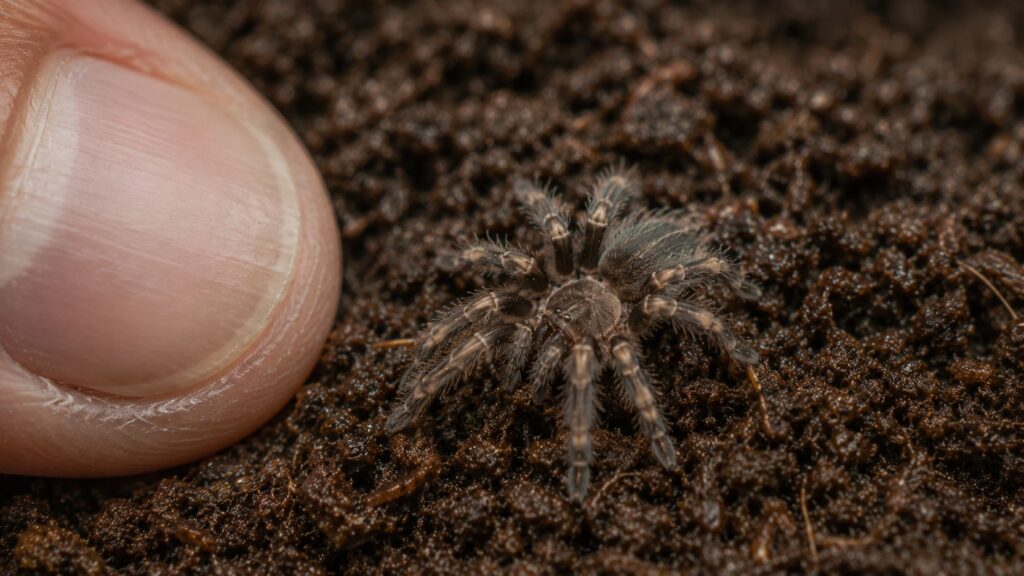
Tarantula spiderlings are cheap, widely available, and kill more first-time keepers’ confidence than any adult ever will. A sling costs a fraction of what a juvenile does, and the trade-off is that a body measuring a quarter of an inch across dehydrates in days rather than weeks. Almost everything that goes wrong comes down to two things: an enclosure that is too large, and substrate that dried out while nobody was looking. This guide covers housing, ventilation, prey sizing, moisture, molt intervals, and when to rehouse, for both terrestrial and arboreal species.
What Counts as a Spiderling
A tarantula’s life stages are measured in instars, meaning the intervals between molts. First instar spiderlings, sometimes called postembryos, stay inside the egg sac and have not yet developed working fangs. What you buy is almost always second or third instar, freshly separated and able to hunt.
Size is quoted as DLS, diagonal leg span, measured from the tip of one front leg to the tip of the opposite rear leg. A second instar sling of a common species runs about 0.25 to 0.5 inches DLS. Some Theraphosa slings arrive closer to an inch, and some dwarf species never get much bigger than a fingernail.
| Attribute | Details |
|---|---|
| Typical purchase size | 0.25 to 0.5 inches DLS, 2nd to 3rd instar |
| Enclosure size | Roughly 3 times DLS in width and length |
| Molt interval | Every 3 to 6 weeks at early instars |
| Feeding frequency | Every 3 to 5 days |
| Prey size | No larger than the sling’s carapace |
| Difficulty | Beginner, with a much narrower margin for error |
Spiderling Enclosure: Small on Purpose

The most common beginner mistake is a generous enclosure. A sling in a large container cannot reliably find prey, spends energy wandering, and is far harder to monitor. Small is correct, and it is not cruelty.
Size: aim for an enclosure roughly three times the sling’s diagonal leg span in each horizontal direction. In practice that means a 2 dram or 4 dram vial for the smallest slings, graduating to a 2 ounce or 4 ounce deli cup, then a 32 ounce cup around the one inch mark.
Ventilation: make holes with a pin or needle heated over a flame, which produces clean small openings rather than the ragged slots a drill leaves. Slings escape through gaps you would swear were too small. Put the holes around the sides at substrate level and above for terrestrial species, and high up plus a few low ones for arboreal species. Never rely on a single hole in the lid, since that gives you stagnant air with no cross flow, and stagnant humid air grows mold fast.
Terrestrial and fossorial slings: fill two thirds of the height with substrate. Most terrestrial slings burrow when young regardless of what the adult does, so give them the depth to do it. Add a small cork bark hide and a starter divot at one edge.
Arboreal slings: counterintuitively, arboreal spiderlings often burrow too, so still give a few inches of substrate along with a vertical piece of cork bark for climbing and webbing. They transition to living up high as they grow. Once they do, an arboreal enclosure build applies, which is close to the reverse of the terrestrial one.
Decor: one hide, a pinch of dry leaf litter, and nothing else. Leaf litter gives web anchor points and hiding cover, and costs nothing.
Substrate and Moisture
Coconut fibre, peat, or a coco and topsoil mix all work. What matters more is the moisture gradient.
Keep one corner damp and let the rest stay dry, then let the sling choose. This applies even to arid species as slings. An adult Grammostola wants bone dry substrate, but its spiderling will dehydrate on the same setup, so the damp corner stays until it is over an inch or so.
Rewet by dribbling water down one side wall rather than misting the whole enclosure. Misting raises humidity briefly, does nothing for the substrate, and coats the sling. Dribbling puts water where it is needed and leaves the rest of the enclosure alone.
Never let the substrate dry out completely. Dehydration is the leading cause of sling death, and it presents as the legs folding underneath the body, which is the tarantula death curl and is often reversible if caught in time.
Water for Slings
Slings under roughly 0.75 inches DLS do not get a water dish, because they can drown in one and it takes up space they need. They drink from droplets on the enclosure wall and from moist substrate. Add a few drops to the side wall every couple of days.
At around 1 to 1.5 inches DLS, introduce a bottle cap as a dish and keep it filled from then on. There is a persistent myth that small tarantulas do not need standing water. They need water constantly, just in a form that will not drown them.
Feeding Spiderlings
Prey size: nothing larger than the sling’s carapace, the shield covering the front section of the body. Smaller is safer. A prey item that is too large gets ignored at best and injures the sling at worst.
What to feed:
- Flightless fruit flies (Drosophila hydei is larger and better for most slings than melanogaster)
- Pinhead or 1/8 inch crickets
- Small red runner roach nymphs
- A cut section of mealworm or cricket, pre-killed
Pre-killed prey is standard practice for the smallest slings, and there is no shame in it. Crush the prey’s head and drop it beside the sling or at the burrow entrance. Many keepers pre-kill everything until the sling passes half an inch.
Frequency: every 3 to 5 days, or roughly twice a week. Slings have small reserves compared to adults, so they eat more often relative to their size.
Remove uneaten prey within 24 hours, along with boluses, the compressed remains left after feeding. Left in a warm humid vial, both grow mold and attract grain mites quickly. If mold keeps returning in a larger enclosure, a few dwarf whites as a cleanup crew will process leftovers, though they are not practical in a vial and are no substitute for pulling boluses out.
Refusal is normal. A sling that stops eating is usually in pre-molt. Keep water available, stop offering food after two refusals, and wait.
Molting and Growth Rate
Early instars molt every 3 to 6 weeks, and the interval stretches as the spider grows. Each molt brings a jump in size and often a shift in colour, since many species look nothing like their adult form as slings. Pink toe slings are the classic example, starting out blue with an orange abdomen.
Growth rate varies enormously by species and is worth checking before you buy. Fast growers such as Theraphosa and many Pterinochilus species put on visible size every few months. Grammostola rosea is famous for doing almost nothing for a year. Its relative Grammostola pulchripes grows somewhat faster but is still a patient species. Neither is a health problem. That split is not random. Old World species tend to grow considerably faster than New World terrestrials, so checking where your species falls in Old World vs New World tarantulas gives you a rough expectation before you buy.
Because molt intervals are the clearest signal you have about a sling’s condition, they are worth recording. Two months between molts followed by four months of nothing tells you something; a vague sense that it has been a while tells you nothing. It takes seconds to track feeding and molts with InvertMate at the point it happens. The mechanics of the process itself, including what a normal molt looks like, are covered in our guide to tarantula molting.
On power feeding: feeding heavily at higher temperatures does accelerate growth, and keepers are split on whether it matters. The common claim is that it shortens lifespan, which has never been demonstrated in tarantulas. What is reasonably well established is that faster growth means males reach maturity sooner, and mature males have short lives regardless. Feed to a normal schedule and you avoid the question entirely.
Rehousing
Upgrade when the sling has roughly outgrown a third of its enclosure, or when the old one is too small to hold a hide and a water dish. Expect to rehouse several times in the first two years.
Do it over a large empty bin so a bolting sling lands somewhere you can reach it. Have the new enclosure prepared first. Coax the sling with a soft paintbrush rather than picking it up, and if it webbed itself into a burrow, transfer the whole clump of substrate and let it re-dig. Slings at this size are fast and light enough that a fall is survivable, but they are also faster than you.
Once a sling passes about an inch and a half, adult terrestrial housing rules start to apply.
Common Problems
- Mold. Almost always uneaten prey plus poor cross ventilation. Remove the food, add holes.
- Grain mites. White specks moving on the substrate surface. Rehouse into fresh dry substrate and tighten up the feeding hygiene.
- Escapes. Check every seam and lid seal. A sling that gets out of a vial in a warm dry room does not last long.
- Dehydration. The main killer, and the reason for the damp corner.
- Stuck molt. Usually follows a dried-out enclosure. Keep the damp corner going and leave the sling alone.
- Communal keeping. Not advisable for most species. A handful, notably Monocentropus balfouri, are genuinely communal, and beyond that the usual result is a smaller number of larger slings. If you want more, buy more enclosures.
FAQ
How often should I feed a tarantula sling?
Every 3 to 5 days, using prey no larger than the sling’s carapace. Pre-killed prey is fine and often easier. Remove anything uneaten after 24 hours, and expect refusals in the weeks before a molt.
How big is a tarantula spiderling?
Most are sold at second or third instar, around 0.25 to 0.5 inches in diagonal leg span. Some larger genera arrive closer to an inch. Slings typically molt every 3 to 6 weeks at that stage, gaining size with each one.
Do tarantula spiderlings need a water dish?
Not below about 0.75 inches, where a dish is a drowning risk. Provide water as droplets on the enclosure wall and keep one corner of substrate damp. Add a bottle cap dish once the sling passes an inch or so.
How fast do tarantula spiderlings grow?
It depends almost entirely on species. Fast growers can reach several inches within two years, while some Grammostola species take five or more years to mature. Temperature and feeding frequency shift the pace, but species sets the range.
Can tarantula spiderlings live together?
For most species, no. Cannibalism is the usual outcome. A small number of species including Monocentropus balfouri are reliably communal, and even then keepers disagree on best practice. Housing individually is the safe default.
Why is my spiderling not eating?
Pre-molt is the most likely answer, especially with a darkening abdomen and a sealed burrow. Prey that is too large is the second. Stop offering food, make sure water is available, and check back in a week or two.
Track Your Spiderlings with InvertMate
Slings molt every few weeks and the interval is the best health signal you get, which makes it worth logging while it is fresh. InvertMate lets you record each molt with dates, log feeding refusals, and set reminders to rewet the damp corner before it dries out. Free on the App Store.