
An arboreal tarantula enclosure needs height rather than floor space, a vertical cork bark slab running most of that height, and far more ventilation than a terrestrial setup. Aim for 12 to 18 inches tall for an adult, with cross ventilation on opposing walls and front access rather than a top-opening lid.
Arboreal species live off the ground, web themselves into a retreat, and react to disturbance by running rather than standing their ground. Both facts shape the build. This guide covers sizing, cork placement, the ventilation problem, front-opening versus top-opening enclosures, and the rehousing routine for a species that moves faster than you do.
What Makes a Species Arboreal
Arboreal tarantulas live on vertical surfaces: tree trunks, bark crevices, bromeliads, and the undersides of branches. They build silk retreats rather than burrows, and their feet carry denser adhesive setae that let them grip smooth surfaces, which is why an arboreal will happily walk up glass.
Commonly kept arboreal genera:
- New World: Caribena and Avicularia (pink toes), Psalmopoeus (Trinidad chevron, irminia), Tapinauchenius
- Old World: Poecilotheria (ornamentals), Heteroscodra, Stromatopelma
Only the Avicularia and Caribena pink toes are reasonable beginner arboreals, and the pink toe tarantula is the one most keepers start with. The rest are fast, defensive, or both. Which hemisphere a species comes from matters more than almost anything else for handling risk, and that split is covered in our comparison of tarantula groups by origin.
One behavioural note that affects the build: arboreals bolt upward and outward when startled, and they are far more likely to escape a routine enclosure opening than a terrestrial species is.
Enclosure Size
Height is the dimension that matters, and the ratio is roughly the reverse of a terrestrial setup.
| Leg span (DLS) | Enclosure size | Typical container |
|---|---|---|
| Under 1 inch | 4 to 6 inches tall | Vial or small deli cup, stood upright |
| 1 to 2 inches | 6 to 8 inches tall | 32 oz deli cup, upright |
| 2 to 3.5 inches | 8 to 12 inches tall | Small acrylic arboreal enclosure |
| 3.5 inches and up | 12 to 18 inches tall | Purpose-built arboreal enclosure |
Proportions: aim for height roughly two to three times the width and depth. A tall narrow footprint suits the animal and keeps the retreat within view.
Fall risk is not the concern it is for terrestrials. Arboreal species are lighter, longer legged, and built to catch themselves. Do not let that make you careless with a heavy-bodied adult Poecilotheria, but the terrestrial rule capping open height at 1.5 times leg span does not apply here.
Do not oversize. A large enclosure means a spider that webs a retreat somewhere you cannot see and prey that never finds it. Housing for the smallest sizes is covered in our guide to raising tarantula spiderlings, and arboreal slings often burrow before they take to climbing.
Cork Bark and Layout
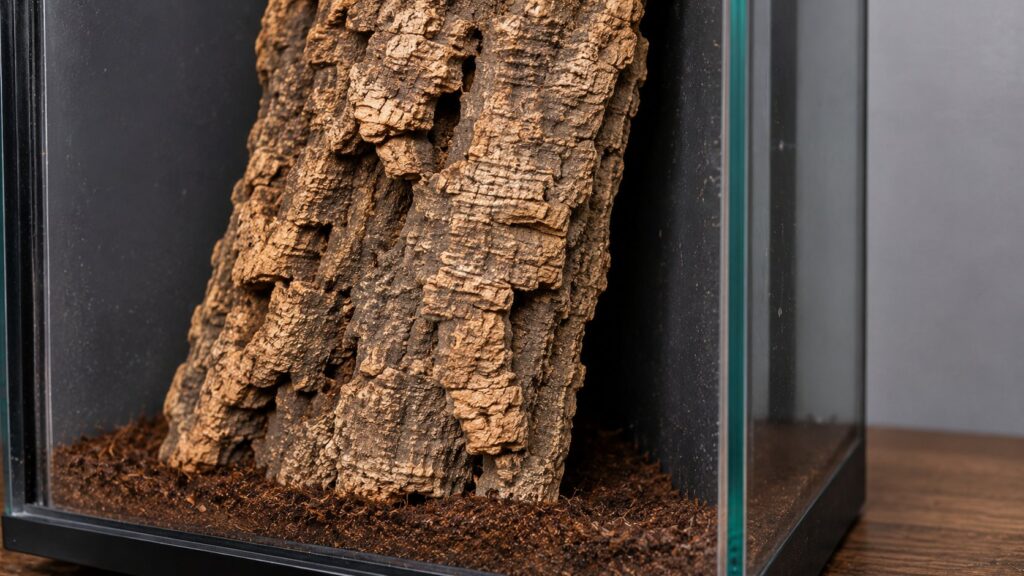
The cork slab is the enclosure’s structure, in the same way substrate depth is for a terrestrial.
Use a vertical piece of cork bark running most of the enclosure height, either a flat slab leaned against a back corner or a hollow cork tube stood upright. The tube is better, because it gives an enclosed retreat immediately rather than making the spider build one.
Bed the base into the substrate so it cannot slip. A cork slab that falls while the spider is behind it is a genuine hazard.
Leave a gap behind a flat slab. That gap is where the retreat gets built, and a slab pressed flat to the glass gives the animal nowhere to go.
Add foliage. Artificial plants, dried oak leaves, or a few thin branches near the top give anchor points for webbing and cover the retreat. Real plants mostly die and are not worth the trouble.
Substrate: 1 to 2 inches only. Enough to hold moisture and root the cork, no more. Arboreals do not use floor depth, and a damp thin layer is the humidity source.
Water dish: a small one on the substrate for anything over about 2 inches. Many arboreals drink from misted webbing and leaves instead, but the dish costs nothing and covers you.
Ventilation
This is where arboreal setups differ most sharply, and where beginners most often go wrong by borrowing a terrestrial build.
Arboreal species come from exposed positions in tree canopy with constant air movement. Stagnant humid air causes them real harm, and the Avicularia pink toes are notorious for declining in enclosures that are humid and closed. Keepers historically blamed a mystery ailment, and the current consensus is that poor ventilation combined with over-misting was the cause.
The rule: cross ventilation, generously. Holes or mesh panels on two opposing side walls, so air enters one side and leaves the other. A mesh lid alone gives you a stagnant column.
Err toward too much rather than too little. An arboreal tarantula enclosure that dries out slightly is a minor problem you fix by dampening the substrate. One that holds still, humid air is a slow-moving serious one.
Do not mist heavily. Dampen a section of the substrate and let evaporation carry the humidity upward. If you mist at all, do it lightly on the webbing so the spider can drink, not to raise a humidity reading.
Front Opening vs Top Opening
Worth thinking about before you buy, because it changes how every interaction goes.
Front-opening enclosures let you work at the level of the substrate while the spider sits in its retreat higher up. It is the arrangement most arboreal keepers prefer, and purpose-built acrylic enclosures are usually made this way.
Top-opening puts your hand directly in the escape path. An arboreal that bolts goes up, which means out through the lid you just removed and onto your arm. Workable for a calm pink toe, genuinely unpleasant with a fast Old World species.
A practical compromise for smaller animals: use a deli cup stood on end with the lid becoming a side wall, giving side access instead of top access at no cost.
Whichever you use, open the enclosure slowly and know where the spider is before the door moves.
Temperature and Humidity
Room temperature suits nearly all commonly kept arboreals, 72 to 82F, and no supplemental heat is needed indoors in most homes. If you heat, use a low wattage mat on a side wall with a thermostat, never underneath.
Humidity is species specific rather than a trait of being arboreal. Poecilotheria and Caribena want a damp substrate section and reliable airflow. Psalmopoeus tolerates drier conditions. Look up the species rather than assuming.
The way to raise humidity is a damp substrate section plus a full water dish, with ventilation intact. Dehydration presents the same way in an arboreal as in any other tarantula, with the legs folding beneath the body, which is the tarantula death curl, and it is usually reversible if caught early.
Rehousing an Arboreal
Faster and more upward than a terrestrial rehouse, so the preparation matters more.
- Prepare the new enclosure fully first, cork bedded in, substrate damp, water dish filled.
- Work inside a large bin or a bathtub, with the bathroom door shut.
- Have a catch cup in hand, not on the bench.
- Move the retreat, not the spider. If the animal has webbed itself into a cork tube, lift the whole tube across into the new enclosure and let it re-web. This is the single best trick in arboreal keeping and it avoids nearly all the risk.
- If it must be coaxed, use a long soft brush behind it and let it walk. Never chase an arboreal downward, since they climb by preference and will run up whatever is nearest, including you.
- Do not rehouse in pre-molt. Wait one to two weeks after a molt for the exoskeleton to harden.
Molt timing is what tells you whether a rehouse is safe, and track feeding and molts with InvertMate keeps those dates to hand instead of relying on a rough sense of how long it has been. The process itself is covered in our guide to tarantula molting.
Common Arboreal Tarantula Enclosure Mistakes
- Not enough ventilation. The defining arboreal error, and the likely cause of most pink toe losses.
- Heavy misting. Feels like husbandry, achieves stagnant damp air.
- No vertical cork. Leaves the spider nowhere to build a retreat.
- Cork pressed flat against the glass. Removes the gap the retreat needs.
- Too much floor space, not enough height. A terrestrial build with an arboreal animal in it.
- Top-opening lid on a fast species. Puts your hand in the escape route.
- Deep substrate. Wasted volume that reduces usable height.
- Unsecured cork. A falling slab can crush the animal.
FAQ
How tall should an arboreal tarantula enclosure be?
Around 12 to 18 inches for an adult, with height roughly two to three times the width and depth. Slings need proportionally smaller enclosures, from 4 inches tall for the smallest, since an oversized enclosure makes prey hard to find.
Do arboreal tarantulas need more ventilation?
Yes, considerably more than terrestrial species. They come from exposed canopy positions with constant airflow, and stagnant humid air is linked to losses in Avicularia pink toes in particular. Use cross ventilation on opposing walls rather than a mesh lid alone.
How much substrate does an arboreal tarantula need?
One to two inches, enough to hold moisture and anchor the cork bark. Arboreals spend almost no time on the floor, so extra depth just reduces the vertical space the animal actually uses.
Should an arboreal enclosure open at the front or the top?
Front opening is better. An arboreal that bolts runs upward, so a top-opening lid puts your hand directly in the escape path. Front access lets you work at substrate level while the spider stays in its retreat above.
Can arboreal tarantulas fall and hurt themselves?
They are far less vulnerable than heavy-bodied terrestrials, being lighter and better able to catch themselves. The fall-height limit that governs terrestrial tarantula enclosures does not apply, though it is still worth avoiding hard decor.
Do arboreal tarantulas need misting?
Not as a routine. Dampen a section of substrate and let it evaporate upward instead. A light mist on webbing gives the spider something to drink from, but misting to raise a humidity reading works against the ventilation the animal needs.
Track Your Enclosures with InvertMate
Running several arboreal enclosures means keeping track of which needs its substrate dampened, which spider is in pre-molt, and which retreat has an animal you have not seen in a fortnight. InvertMate lets you log molts and rehousing dates, monitor temperature and humidity, and set reminders for water and substrate checks. Free on the App Store & Play Store.