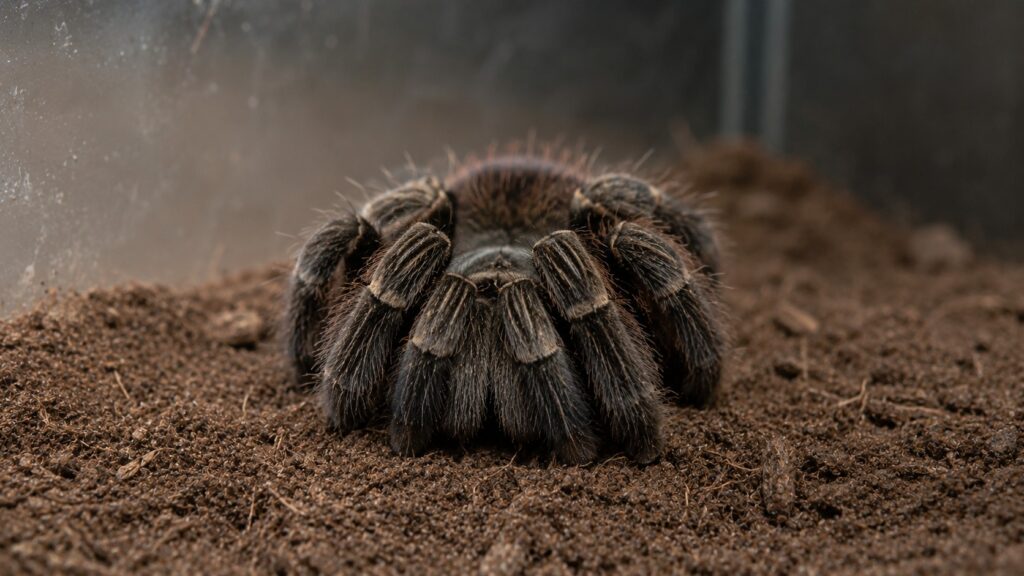
A tarantula death curl is a posture where the legs fold tightly underneath the body, pulled inward like a closed fist. It happens because tarantulas extend their legs using fluid pressure rather than muscle, so a dehydrated or dying spider physically cannot straighten them. Dehydration is the most common cause and is often reversible.
If your tarantula is sitting hunched with its legs tucked under it and will not move, you have probably already searched this phrase at 2am with your heart going. The good news is that the single most common cause is dehydration, and dehydration is fixable, sometimes within hours. The bad news is that the same posture appears at the end of a mature male’s natural life and during a few conditions nothing can reverse. This guide covers what the curl actually is, how to tell it apart from a normal molt, what to do in the next thirty minutes, and how honest keepers rate the odds for each cause.
Why the Legs Curl: The Hydraulics
Tarantulas have flexor muscles that pull their legs in, but no extensor muscles to push them back out. Extension is hydraulic. The spider raises the pressure of its hemolymph, the blood equivalent, and that pressure pushes each leg straight.
Everything follows from that one fact. A tarantula that loses fluid, loses the ability to pressurise fluid, or loses the coordination to control it will end up with its legs folded under its body, because folding is the default state that the flexors produce with no pressure opposing them. It is the arachnid version of hydraulic failure.
This also explains why a dead tarantula is always curled and why a spider that dies suddenly of trauma may be found in a more open posture at first.
| Posture | What it looks like | What it usually means |
|---|---|---|
| Death curl | Legs folded tightly under the body, spider hunched, often cannot right itself | Dehydration, DKS, terminal decline |
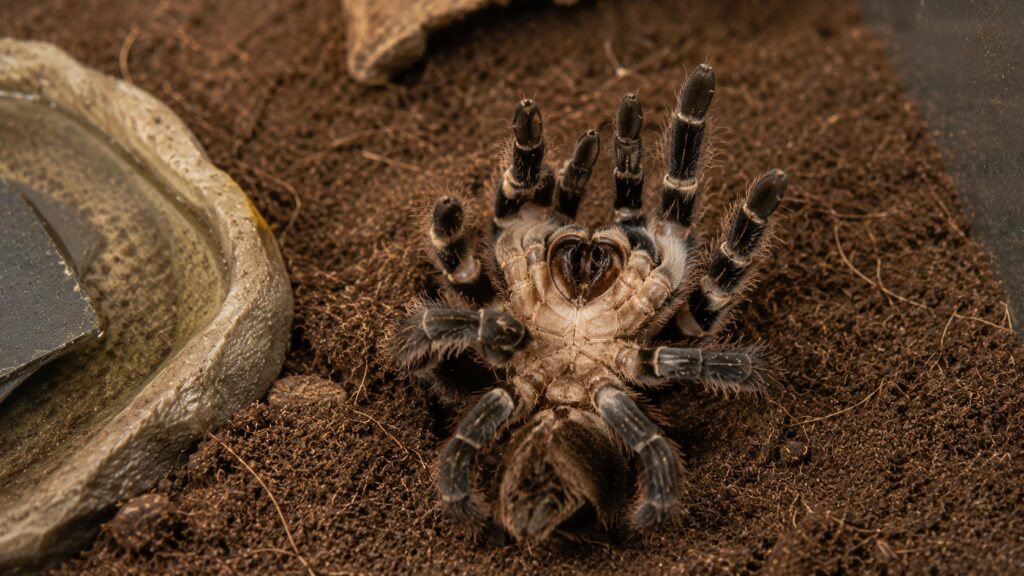
| Molting | Flipped onto its back, legs upward, motionless for hours | Completely normal, do not intervene |
| Pre-molt | Legs tucked but loose, dark shiny abdomen, refusing food, hiding | Normal, weeks away from molting |
| Stress crouch | Low to the ground, legs out and braced, alert | Reacting to disturbance, not ill |
Death Curl or Molting? Check This First
The most reassuring thing to know is that a molting tarantula flips onto its back. Legs point up at the ceiling, the spider lies motionless for hours, and to a new keeper it looks exactly like death. It is not. A tarantula on its back is molting and needs to be left completely alone, with no misting, no poking, and no moving of the enclosure.
A death curl is the opposite orientation. The spider is upright or slumped on its side, legs folded underneath, and it does not shift position when you approach.
Two supporting checks:
Abdomen condition. A pre-molt tarantula usually has a dark, taut, shiny abdomen with a bald patch. A dehydrated tarantula often has a shrunken, wrinkled abdomen that looks smaller than the carapace.
Time since last feed and last molt. Refusing food for weeks with a fat abdomen points to pre-molt. Refusing food with a shrinking abdomen points to a problem. If you are not sure of the dates, this is the moment you wish you had them written down, which is exactly why it helps to log molts in InvertMate as they happen rather than trying to reconstruct a timeline in a panic. The full picture of what normal looks like is in our guide to the tarantula molting process.
What Actually Causes a Death Curl
Dehydration
The leading cause by a wide margin, and the most treatable. Usually traceable to an empty water dish, substrate that dried out completely, or excessive cross-ventilation in a species that needs humidity. Slings dehydrate fastest because their small bodies lose water quickly and because of a persistent myth that spiderlings do not need a water dish. They do.
Odds: good. A dehydrated tarantula caught early often recovers within hours to a couple of days.
Terminal decline in a mature male
Once a male reaches his ultimate molt, marked by tibial hooks and swollen pedipalps, he stops molting and lives a matter of weeks to months. The death curl at the end of that is not husbandry failure. It is the natural end of the animal’s life.
Odds: none, and nothing was done wrong.
DKS (dyskinetic syndrome)
Jerky, uncoordinated, spasming movement, often described as looking drunk, sometimes progressing to a curl. The cause is not established. The strongest suspicion among keepers is chemical exposure, with pesticide residue the usual suspect, though nobody has demonstrated a single mechanism and it may well be several unrelated problems sharing one label. Be sceptical of anyone who tells you they know what DKS is.
Odds: poor. Some recoveries are reported after moving the spider to clean substrate in a fresh enclosure. Most cases do not recover.
Falls and abdominal injury
Tarantulas are heavy and their abdomens rupture easily. A fall from waist height onto a hard floor can be fatal, which is the main argument against handling. A leaking abdomen loses hemolymph, pressure drops, and the legs curl. Keepers commonly dab a leak with corn starch or a smear of petroleum jelly to seal it, with mixed results and no controlled evidence behind either.
Odds: variable, and worse the larger the spider.
Chemical exposure
Flea and tick treatments on household pets, bug bombs, wasp spray, plug-in insecticides, scented cleaning products, and cedar shavings all kill invertebrates at concentrations you cannot smell. If anything was sprayed in the room, move the enclosure to clean air and replace the substrate.
Odds: poor once symptoms show, but worth trying.
Cold
Sustained temperatures below about 65F slow a tarantula down severely and prolonged cold can kill. This is usually a shipping problem or a winter heating failure rather than an everyday one.
Odds: often good if warmed gradually.
Failed molt
A tarantula stuck in a partial molt will exhaust itself and curl. Nothing reliable can be done at that stage beyond keeping humidity up. Prevention is the whole game here, and it comes down to substrate moisture and a filled water dish in the weeks beforehand.
Odds: poor.
What to Do in the Next Thirty Minutes
Keeper consensus is genuinely split on the classic first-aid response, so here is the honest version rather than the confident one.
The old advice was an ICU cup: seal the tarantula into a small container with soaking wet paper towel and warmth. It was standard for years.
The current majority view is that this does more harm than good. A tarantula does not absorb meaningful water through its exoskeleton, so the humidity accomplishes little, while soaking wet towel risks the book lungs, encourages fungal growth, and adds stress to an animal that has none to spare. Some experienced keepers still use a milder version and report success. Nobody has run a controlled comparison, and probably nobody will.
What almost everyone agrees on:
- Fill a shallow water dish and place the tarantula so its chelicerae, the fangs at the front, are right at the water’s edge. If it can drink, it will.
- Moisten one corner of the substrate. Not the whole enclosure, and not to the point of standing water.
- Keep normal room temperature. Do not apply heat mats or lamps.
- Cover the enclosure or move it somewhere dark and quiet. Stop checking every ten minutes.
- Do not feed. A curled tarantula cannot handle prey and a live cricket will stress or injure it.
- Do not handle it, flip it, or move it more than the one time needed to position it at the water.
- Wait. Improvement often shows within a few hours as the legs begin to extend.
A tarantula that starts to straighten its legs and shifts position on its own is rehydrating. Leave the dish full and let it finish.
When It Is Not Recoverable
Signs that the outcome is already decided: a shrivelled abdomen with no fluid left to redistribute, a mature male past his ultimate molt, visible hemolymph loss that will not stop, or no change at all after 48 hours at the water dish.
Confirming death is harder than people expect. A dead tarantula is fully curled, stiff, and unresponsive, and it will not right itself if gently tipped. A dehydrated one still shows small movements in the pedipalps or fangs. When you cannot tell, wait another day. There is no cost to waiting and a real cost to being wrong.
Prevention
Almost every preventable death curl comes down to four things.
A water dish that is never empty. Every tarantula, every size, including slings, which can use a bottle cap. Check it as a habit, not when you remember.
Substrate moisture matched to the species. Arid species stay dry with a full dish. Tropical species need a damp section. Dry out a tropical species and you get exactly the scenario this article is about. Note that this is a species question, not a hemisphere one. New World and Old World species both span deserts and rainforests, and the assumption that Old World means dry has killed tropical animals.
No chemicals anywhere near the room. That includes treating the dog with a spot-on flea product in the same space.
No handling over hard surfaces. If you handle at all, do it sitting on the floor over carpet, at a height that makes a damaging fall impossible.
Worth adding: mites thrive in a neglected enclosure and a heavy infestation stresses a spider that is already struggling. A small population of dwarf white isopods in a moist tropical setup clears boluses and shed skin before mites get established, which removes one variable from the list. If you want a broader look at species requirements, the rest of our tarantula guides cover setup by type.
Substrate moisture and a filled dish are both enclosure decisions, covered in our guide to setting up for a ground-dwelling species.
FAQ
Can a tarantula recover from a death curl?
Yes, if the cause is dehydration or cold. Position it at a filled water dish, keep it dark and undisturbed, and improvement often shows within a few hours. Recovery from DKS, a ruptured abdomen, or terminal old age in a mature male is uncommon.
What does a tarantula death curl look like?
The legs fold tightly underneath the body and the spider hunches down, unable to straighten or right itself. It looks compressed and inward, quite different from a stressed tarantula that braces low with its legs still extended outward.
Is my tarantula molting or dying?
If it is on its back with legs pointing upward, it is molting, and it must be left alone. If it is upright or on its side with legs folded under it, that is a death curl. Orientation is the fastest reliable tell.
Should I use an ICU cup?
Most keepers no longer recommend it. Tarantulas do not rehydrate meaningfully through the exoskeleton, and a saturated container adds stress and fungal risk. Access to drinking water at the fangs plus a dark, quiet enclosure is the safer approach.
How long does a tarantula live after curling?
There is no fixed window. A dehydrated spider may turn around in hours, while a slow decline can take days. If there is no change at all after 48 hours with water available, the prognosis is poor.
Do tarantulas curl up before molting?
Not into a true death curl. Pre-molt tarantulas tuck their legs loosely, hide, refuse food, and develop a dark shiny abdomen, then flip onto their back for the molt itself. A tight curl with a shrunken abdomen is not pre-molt.
Track Your Tarantula with InvertMate
The fastest way to tell a real emergency from normal pre-molt behaviour is knowing exactly when your tarantula last ate, last molted, and last had its water dish topped up. InvertMate lets you log every molt, record feeding refusals with dates, and set reminders for water and humidity checks. Free on the App Store.