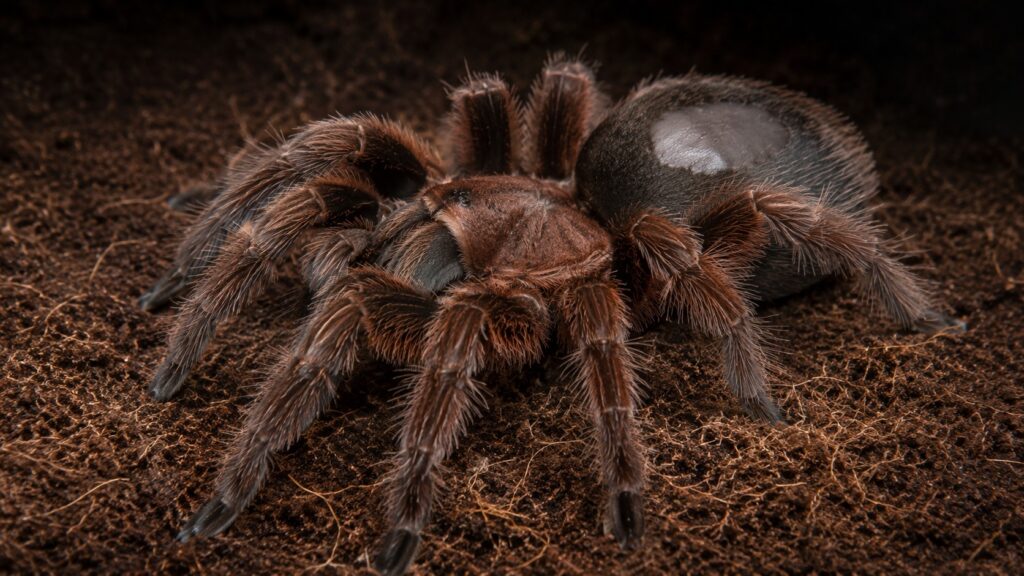
Old World vs New World tarantulas is the first distinction to understand before buying one. Tarantulas divide into two groups by hemisphere, and the difference is not cosmetic. New World species, from the Americas, carry urticating setae, barbed abdominal hairs they kick as a first line of defence. Old World species, from Africa, Asia and Australia, have none, and rely instead on speed and considerably more potent venom.
Ask which tarantula a beginner should start with and you will get a dozen species names, but almost every experienced keeper is applying the same filter underneath: New World first. Anyone weighing up Old World vs New World tarantulas is really asking one question, which is how much margin for error they get in the hobby, and it is also the one most often stated badly, either as “Old World are aggressive” or as a rule about humidity that does not exist. This guide covers what actually differs, what does not, the genera in each group, and the exceptions that make the categories leaky.
A first tarantula also needs housing suited to a ground dweller, which our terrestrial enclosure guide covers in detail.
What the Terms Actually Mean
The terms are borrowed geographic shorthand, not taxonomy. Old World means the Eastern Hemisphere: Africa, Asia, Europe, and Australia. New World means the Americas, north and south.
No taxonomist groups Theraphosidae this way. There is no clade called Old World. What makes the split useful anyway is that the two regions produced tarantulas with genuinely different defensive strategies, and defensive strategy is the thing that determines how you house, feed, and rehouse an animal.
Some keepers argue the categories should be dropped in favour of researching each species individually, and they have a point. There are docile Old World species and unpleasant New World ones. Treat the division as a strong prior that tells you what questions to ask, not as a substitute for looking up the species you are actually buying.
Urticating Setae: The Defining Difference
This is the one physical difference that holds up almost universally.
New World tarantulas have urticating setae on the abdomen: fine barbed bristles they detach by rubbing a rear leg across the abdomen, throwing a cloud of irritant hairs at whatever is bothering them. The hairs cause itching and welts on skin, and are genuinely dangerous to eyes, which is why keepers are told never to lean over an open New World enclosure and never to rub their eyes after handling one.
That defence has a visible consequence. A New World tarantula that has been kicking hairs develops a bald patch on the abdomen, which is also the patch that darkens ahead of a molt. Both signs are covered in our guide to the tarantula molting process.
Old World tarantulas have no urticating setae at all. An animal with no projectile defence and no interest in being eaten needs something else, which is where the other two differences come from.
Venom Potency
Old World venom is broadly more medically significant. That phrase gets thrown around loosely, so here is the honest version.
No tarantula bite has ever been reliably recorded as killing a healthy adult human, and there is no antivenom for tarantula bites because none is needed. What Old World bites do produce, particularly from Poecilotheria, is severe and prolonged: intense pain, muscle cramping that can begin hours after the bite and last for days, sweating, and cramping in muscle groups nowhere near the bite site. People describe it as one of the worst experiences of their lives without it ever being life threatening.
New World bites are typically compared to a wasp sting: sharp local pain, swelling, and done within hours.
There is also a mechanical difference worth knowing. A big terrestrial New World tarantula has fangs that can be over half an inch long, so a dry bite from one still punctures. Fang length and venom potency are separate concerns.
The practical upshot is not that Old World tarantulas are dangerous animals. It is that the cost of a mistake is much higher, and mistakes happen most often during rehousing.
Speed, Temperament and Defensive Behaviour
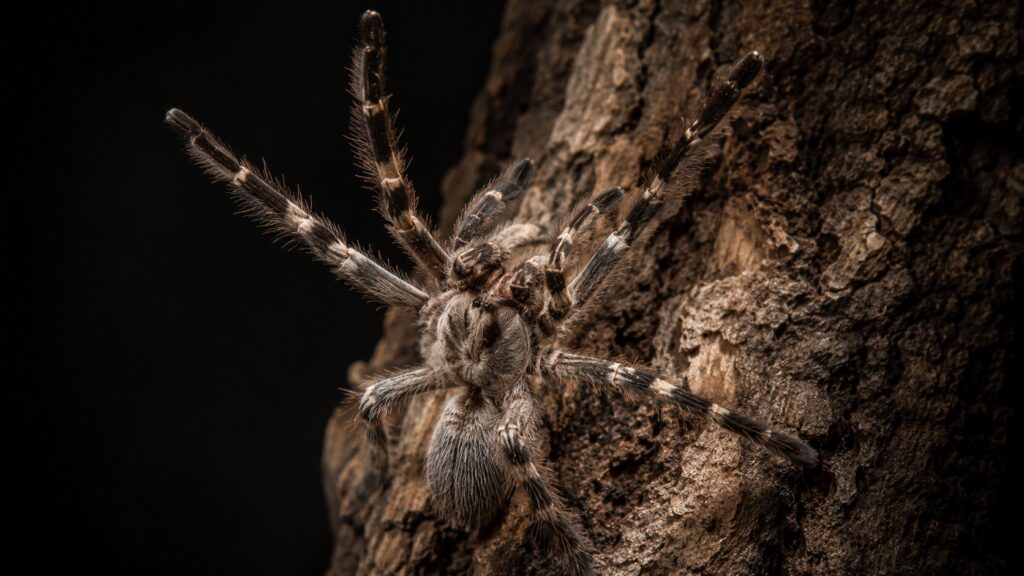
Old World species are, as a group, dramatically faster. An adult Pterinochilus murinus crossing a table is not something you catch by hand, and the speed is the single most common reason keepers say Old World species need experience.
On temperament, “aggressive” is the wrong word and worth retiring. No tarantula wants a confrontation with something the size of a person. What differs is the threshold and the chosen response:
- New World terrestrials typically retreat, then kick hairs, then adopt a threat posture, then bite. Several steps of warning.
- Old World species typically retreat at speed, then go straight to a threat posture and a bite. Fewer steps, executed faster.
Neither group should be handled. For Old World species that is not a debate, it is a straightforward rule.
Old World vs New World Tarantulas Compared
| New World | Old World | |
|---|---|---|
| Region | The Americas | Africa, Asia, Europe, Australia |
| Urticating setae | Yes, on the abdomen | None |
| Venom | Comparable to a wasp sting | Severe pain and cramping for days |
| Speed | Moderate to slow, terrestrials especially | Fast to extremely fast |
| Warning behaviour | Multiple stages | Few stages, rapid escalation |
| Growth rate | Often slower | Often faster |
| Webbing | Variable, usually light | Frequently heavy |
| Suitable first tarantula | Yes, for terrestrial species | No |
Common New World genera
| Genus | Examples | Notes |
|---|---|---|
| Grammostola | Chaco golden knee, Chilean rose | Slow, docile, classic beginner terrestrials |
| Tliltocatl and Brachypelma | Curly hair, Mexican red knee | Docile, heavy hair kickers |
| Aphonopelma | Various North American species | Very slow growing, hardy |
| Caribena and Avicularia | Pink toes | Arboreal, docile, prone to bolting rather than biting |
| Theraphosa | Goliath birdeater | Enormous, and the most irritating urticating setae in the hobby |
| Chromatopelma | Green bottle blue | Spectacular, heavy webber, faster than most New World species |
Common Old World genera
| Genus | Examples | Notes |
|---|---|---|
| Poecilotheria | Ornamentals, including the blue metallica | Fast, arboreal, the most medically notable bites |
| Pterinochilus | Orange baboon tarantula | Fast, defensive, heavy webber, notoriously unbothered by your feelings |
| Ceratogyrus | Horned baboons | Fossorial, defensive, distinctive |
| Chilobrachys | Asian species | Extremely heavy webbers, fast |
| Heteroscodra and Stromatopelma | Togo starburst, feather leg baboon | Fast, arboreal, potent venom |
| Cyriopagopus | Cobalt blue and relatives | Stunning, fossorial, seldom seen, defensive |
The Exceptions
The categories leak, and the exceptions matter because they are common in the trade.
New World species without urticating setae. Psalmopoeus (including the Trinidad chevron and the popular irminia) and Tapinauchenius are American genera with no urticating hairs. Both are fast and quick to bolt or bite, and both are usually described as behaving like Old World species. A Psalmopoeus is often recommended as the stepping stone between the two groups for exactly this reason.
Setae in the wrong place. Ephebopus species carry their urticating setae on the pedipalps rather than the abdomen, and flick them forward with a very different motion.
Docile Old World species. Some Eucratoscelus and certain baboon species are considerably calmer than their reputation implies.
Unpleasant New World species. Theraphosa will kick clouds of hair at the slightest provocation, and the setae are severe enough that many keepers wear gloves and eye protection to service the enclosure. Docile does not mean pleasant to keep.
Which Should a Beginner Keep?
A New World terrestrial. That is the settled answer and there is little serious disagreement about it.
Practically that means a Grammostola, Tliltocatl, Brachypelma, or Aphonopelma species: slow, forgiving of a clumsy rehouse, and inclined to warn you several times before doing anything. The most recommended of these is the chaco golden knee tarantula. A pink toe tarantula is a reasonable arboreal alternative, with the caveat that arboreal species bolt upward and outward when startled. That bolting habit is why the housing for an arboreal species differs so much, right down to whether the enclosure opens at the front or the top.
Start with a spiderling or a juvenile rather than an adult if you can. They are cheaper, they are less consequential to handle badly, and you learn the species while it is small. The specifics of that are covered in our guide to raising tarantula spiderlings.
Move to Old World species when you can rehouse confidently, when you have a catch cup routine you have actually used, and when you have somewhere sensible to work. Not before. There is no achievement in owning an Ornithoctonus you cannot service.
Since growth rates differ so much between the groups, molt records are the clearest way to know what stage an animal is at, and the InvertMate husbandry tracker keeps those dates in one place across a growing collection.
What Does Not Differ
Two persistent myths about Old World vs New World tarantulas are worth clearing up.
Humidity is not a hemisphere trait. There is no Old World humidity requirement. Poecilotheria wants moisture and Pterinochilus murinus wants it fairly dry, and both are Old World. New World spans the Amazon and the Arizona desert. Look up the species, not the group.
Basic husbandry is identical. Substrate depth by species type, a water dish that is never empty, appropriate prey sizing, and leaving a molting animal alone apply equally to both groups. Dehydration presents identically in either, showing as the legs folding underneath the body, which is the tarantula death curl, and the response is the same regardless of origin.
The difference is in handling risk and margin for error, not in the care sheet.
FAQ
What is the main difference between Old World and New World tarantulas?
Urticating setae. New World species have barbed abdominal hairs they kick as a defence, and Old World species have none. Because Old World tarantulas lack that option, they rely on speed and stronger venom instead.
Are Old World tarantulas dangerous?
No tarantula bite has been reliably recorded as killing a healthy adult, and no antivenom exists or is needed. Old World bites, particularly from Poecilotheria, can cause severe pain and muscle cramping lasting several days. Treat any bite as a reason to seek medical advice.
Can a beginner keep an Old World tarantula?
It is strongly discouraged. The issue is speed during rehousing rather than the animal’s disposition. Build confidence with a New World terrestrial first, then consider Psalmopoeus as an intermediate step before a true Old World species.
Which tarantulas have no urticating hairs?
All Old World species, plus two New World genera, Psalmopoeus and Tapinauchenius. Ephebopus species have them on the pedipalps rather than the abdomen. This is why the categories are a guide rather than a rule.
Do Old World tarantulas grow faster?
Often, yes. Many Old World species grow considerably faster than New World terrestrials, some of which take five or more years to mature. Growth rate varies by species within both groups, so check the specific animal rather than assuming.
Are Old World tarantulas more colourful?
Neither group has a monopoly. Poecilotheria metallica is Old World and vivid blue, while the green bottle blue is New World and equally striking. Plenty of species in both groups are subdued brown. The rest of our tarantula care guides cover individual species.
Track Your Collection with InvertMate
Once you are keeping species from both groups, the details worth remembering multiply fast: which enclosures hold a fast species, when each animal last molted, which ones are in pre-molt. InvertMate lets you log every molt with dates, record feeding across species, and monitor enclosure conditions in one place. Free on the App Store.