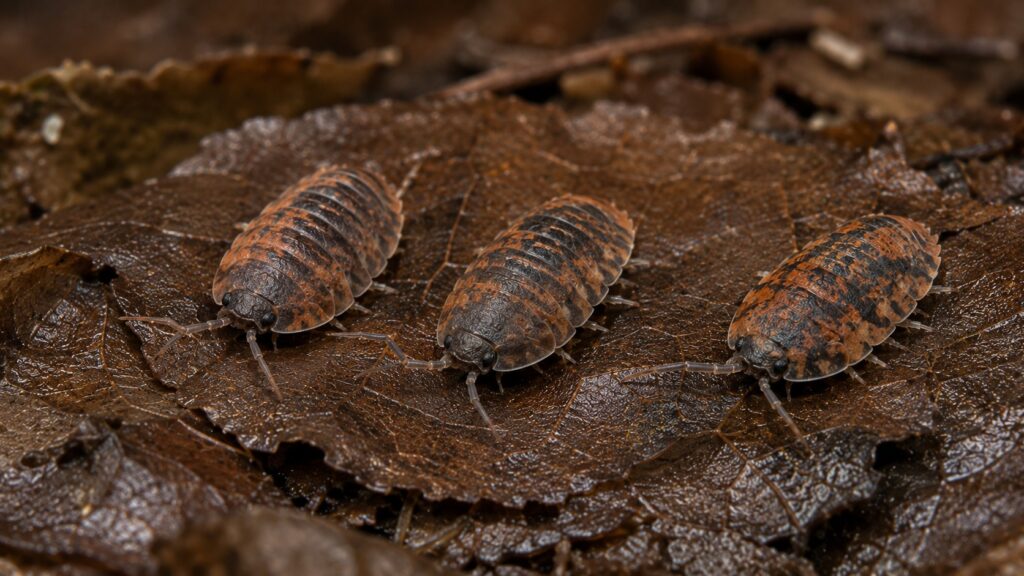
Lava isopods give you most of what people want from an expensive Cubaris at a fraction of the price and about ten times the breeding speed. Porcellio scaber “Lava” is an orange and charcoal mottled morph of the common rough woodlouse, and the pattern genuinely does look like cooling basalt. They are hardy, cheap, tolerant of mistakes, and prolific enough that a starter group of ten becomes a colony you are giving away within a year. This guide covers the bin setup, the moisture range, how fast the population actually climbs, and why they need a lid you have thought about.
Species Overview
Lava is a captive-selected colour morph of Porcellio scaber, the rough woodlouse found across most of the temperate world and quite possibly under a plant pot in your garden. That ancestry is the reason they are so forgiving. This is an animal adapted to fluctuating temperatures, imperfect moisture, and whatever organic matter happens to be available.
Adults reach roughly 0.5 to 0.6 inches, with a slightly textured, matte exoskeleton in mottled orange over dark grey. Pattern varies considerably between individuals and lineages, and a bin of lavas will contain some strikingly bright animals and some fairly dull ones.
They cannot conglobate. Unlike Armadillidium species, which roll into a ball, Porcellio flatten themselves against a surface and cling. That difference matters practically, because a flattening species relies on grip and is a much better climber.
Worth being honest about naming. Morph names in the isopod trade are inconsistent, and “Lava” is applied by some sellers to other orange Porcellio morphs and occasionally to a different species entirely. Buy on photographs of the actual stock rather than on the name, and if you care about keeping a lineage clean, ask the seller what it was bred from. For orientation on where this sits among the alternatives, a rundown of popular isopod species covers the range.
| Attribute | Details |
|---|---|
| Scientific name | Porcellio scaber “Lava” |
| Adult size | 0.5 to 0.6 inches |
| Lifespan | 2 to 3 years |
| Difficulty | Beginner |
| Temperature | 65 to 80F (18 to 27C) |
| Humidity | 50 to 70%, with one moist corner |
| Brood size | 20 to 40, several times a year |
Enclosure Setup
A 6 quart plastic bin suits a starter group of 10 to 20. Given how fast they breed, plan on a 12 quart or larger within the first year, or plan on splitting the colony.
Substrate, 2 to 3 inches:
- 3 parts coconut fibre or peat
- 2 parts organic topsoil with no fertiliser
- 1 part crushed limestone, oyster shell, or coral sand
- A generous handful of crumbling hardwood
No drainage layer required. Lavas are not a wet-bin species and the sump a cave species needs is wasted depth here.
Leaf litter, thickly. Oak, magnolia, or beech across the whole surface, several leaves deep. It functions as food, cover, and humidity buffer simultaneously, and a bin that looks under-littered is usually a bin that is not breeding well.
Bark and cover. Two or three pieces of cork bark laid flat. Lift one after a few weeks and you will find most of the colony underneath it.
The lid needs thought. This is the practical quirk of the species. Porcellio scaber climbs smooth plastic competently and will find any gap. Use a tight-fitting lid with pinhole ventilation rather than a loose one, check the seal around the rim, and be aware that escapees in a warm dry house do not survive long but escapees in a damp basement may set up shop.
Ventilation: a generous field of pinholes in the lid and high on two opposing walls. Lavas want airflow and suffer in stagnant air.
If this is your first colony, the walkthrough on building a first isopod bin from scratch covers the fundamentals that apply across every species.
Temperature and Humidity
Room temperature is fine across a wide band, 65 to 80F, and they tolerate brief excursions either side better than almost anything else in the hobby. No supplemental heat needed in a normally heated home. Warmer temperatures within that range do speed up breeding noticeably, so if you want population growth, aim for the upper half.
Humidity should sit around 50 to 70% across most of the bin with one persistently damp corner. Rewet that corner by pouring water down the wall every few days.
Do not keep the whole bin wet. A saturated Porcellio bin invites mold, grain mites, and dieback, and the animals themselves will crowd into whatever dry cover they can find, which tells you plainly what they prefer. The visual test: two thirds of the surface litter dry enough to crunch, one third dark and soft.
Diet and Feeding
Leaf litter and rotting hardwood are the staple. Top it up every couple of months and most of the feeding is done.
Calcium, always available. Cuttlebone, crushed eggshell, or limestone left on the surface. Non-negotiable, and they use it visibly.
Vegetables, twice weekly. Carrot, cucumber, courgette, squash, sweet potato. Remove anything uneaten within 48 hours.
Protein, weekly. A pinch of fish flake, a freeze dried shrimp, or a piece of dried river shrimp. This is the lever that controls breeding speed more than anything else. Increase it and broods come faster. Overdo it and grain mites arrive within a fortnight.
Skip: citrus, salted foods, produce from a treated garden.
Lavas are less fussy than most species and will process almost anything organic, which is part of why they work so well in a bioactive setup. Broader principles on what to feed a colony apply directly here, with the note that this species needs proportionally more calcium than its size suggests.
Springtails are worth adding at setup. They suppress mold in the damp corner and compete for nothing that matters.
Behaviour and Handling
Lavas are active and reasonably visible, particularly at night and in the hours after you mist the damp corner. Lift a piece of bark and you will see the colony properly, which is the main way to check on them.
They handle without any difficulty. A lava isopod picked up will flatten, cling, and walk across your palm, and there is nothing to be wary of. They will not roll into a ball, so expect a flat clinging animal rather than a neat sphere.
Signs of a problem: chalky white patches on dying individuals, which means calcium deficiency, or a colony that abandons the damp corner entirely, which usually means the bin is too wet.
Breeding and Colony Growth
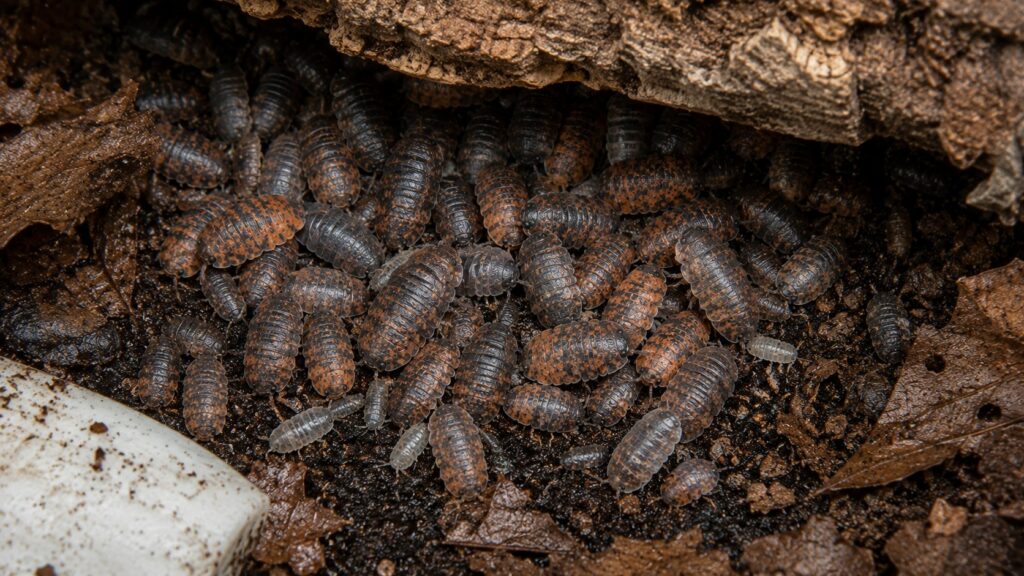
This is the species’ main advantage. Females produce 20 to 40 young per brood and manage several broods a year, so a colony compounds quickly.
Realistic expectations from a starter group of 10 to 15 at room temperature with weekly protein:
- Months 1 to 2: little visible change while they settle in
- Months 3 to 5: first broods appear, small pale juveniles in the litter
- Months 6 to 9: population visibly climbing, first bin starting to look busy
- Months 10 to 14: surplus to sell, trade, or seed a second bin
Nothing needs managing. Warmth at the upper end, a damp corner, constant calcium, and weekly protein is the whole method.
Females carry eggs in a marsupium, a fluid-filled brood pouch on the underside, and a gravid female is often visible as a pale swelling there. Juveniles emerge as miniature adults without the orange, which develops over successive molts.
Because the growth curve is the interesting part with a prolific species, it is worth a rough headcount when you top up the litter, logged in the CrabPod isopod tracker so you can see whether a change in feeding actually moved the numbers. How individual lifespan relates to colony persistence is covered in isopod lifespan across species.
Lava Isopods as Feeders and Cleanup Crew
Two practical uses beyond keeping them for their own sake.
Bioactive cleanup crew. They process shed skin, uneaten prey, and waste in a terrestrial enclosure, tolerate a moderately dry substrate, and reproduce fast enough to keep pace with an animal that actually generates mess. Seed the enclosure a few weeks ahead of the animal so the population establishes first, and keep a calcium source in there.
Feeders. Lavas breed quickly enough to be a sustainable live food source for small reptiles and amphibians, and they are a reasonable calcium source given the mineral-rich diet. Do not harvest from a bin you are also trying to grow, and never feed out animals from a bin that has had mite problems.
For a faster-establishing cleanup crew, powder blue isopods reproduce even more quickly, at the cost of being far less interesting to look at.
Common Problems
Grain mites. White specks swarming food remains. Cut protein frequency, remove food, increase ventilation.
Mold. Too wet, too closed, or too much food. Fix in that order.
Chalky patches on dying individuals. Calcium deficiency. Add limestone.
Escapes. Check the lid seal. This species is a better climber than most.
Colony not growing. Almost always insufficient protein or a bin that is too cool. Both are easy to correct.
Fading colour over generations. Selectively remove the dullest animals from your breeding bin if pattern matters to you. Colour morphs drift back toward wild type without selection.
FAQ
Are lava isopods good for beginners?
Yes, among the best. They tolerate a wide temperature range, need no heating, forgive irregular maintenance, and breed fast enough that early mistakes do not sink the colony. The only real requirement is a well-sealed lid.
How fast do lava isopods breed?
Females produce 20 to 40 young per brood, several times a year. From a group of 10 to 15, expect first broods within 3 to 5 months and a genuinely populous bin by around a year, faster if kept warm with weekly protein.
How long do lava isopods live?
Two to three years as individuals, which is typical for Porcellio scaber. A colony sustains itself indefinitely through overlapping generations, so an established bin never needs restocking.
Can lava isopods climb out of their enclosure?
Yes. Porcellio species flatten and cling rather than rolling into a ball, and they climb smooth plastic well. Use a tight-fitting lid with pinhole ventilation and check the rim seal, particularly on bins that have warped.
What is the difference between lava isopods and dairy cows?
Both are Porcellio morphs with similar care, but dairy cows are a different species, Porcellio laevis, and grow noticeably larger and faster. Care and setup overlap almost entirely, as covered in our dairy cow isopod guide.
Do lava isopods need a moist bin?
No, and this is the most common mistake. They want most of the bin on the dry side with one persistently damp corner. A uniformly wet bin causes mold, mites, and dieback in this species faster than a dry one causes dehydration.
Track Your Lava Colony with CrabPod
A prolific colony changes fast enough that the numbers are worth knowing, and slowly enough that you will not notice without writing them down. CrabPod lets you log population counts over time, track the moisture and temperature your bin actually runs at, and set reminders for leaf litter top ups and protein feeds. Free on the App Store.