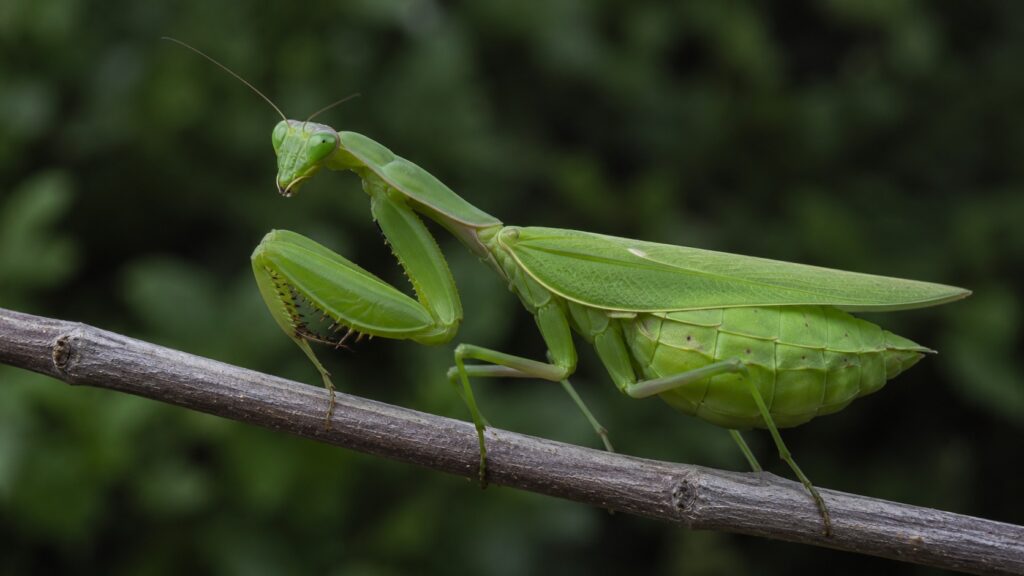
The giant Asian mantis is the species to get if you want a mantis you can actually see across the room. Hierodula membranacea is bulky, bright green, unfussy about conditions, and hungry enough that feeding it stops being a chore and becomes the entertainment. Females reach three and a half inches with a thick abdomen that looks almost too heavy to fly. They are also among the most forgiving mantids for a first-time keeper, provided you get one thing right: enclosure height. This guide covers the setup, the feeding schedule by instar, how long each sex lives, and how to sex them before you plan a pairing.
Species Overview
Giant Asian mantids come from India, Sri Lanka, and across Southeast Asia, where they live in shrubs and low tree canopy. They are ambush predators that sit still for hours and strike at almost anything that moves within reach.
Adults are usually vivid green, though yellowish and pale brown individuals turn up and the colour can shift slightly between molts depending on humidity and surroundings. The build is what sets them apart from most commonly kept species. Where a Chinese mantis is long and slender, a Hierodula female is short, broad, and heavy, with thick raptorial forelegs.
Females reach roughly 3 to 3.5 inches. Males are noticeably smaller and slimmer at around 2.5 to 3 inches, with longer antennae and the ability to fly properly, which females largely lose as their abdomen fills out.
| Attribute | Details |
|---|---|
| Scientific name | Hierodula membranacea |
| Adult size | 2.5 to 3.5 inches, females larger |
| Total lifespan | 10 to 14 months from hatching |
| Difficulty | Beginner |
| Temperature | 75 to 85F (24 to 29C) |
| Humidity | 60 to 70% |
| Instars to adult | 7 for males, 8 to 9 for females |
Enclosure Setup

Height is the rule that matters. A mantis molts hanging upside down and pulls itself free using gravity, so it needs clear vertical space of at least three times its body length below the point where it hangs. Get this wrong and you get a failed molt, which is the leading cause of death in captive mantids.
Minimum size for an adult female: 12 inches tall by 8 by 8. Taller is better and there is no such thing as too tall. For nymphs, scale down so the enclosure is roughly three times body length in height and twice in width, which for early instars means a deli cup rather than a tank.
The lid must be climbable. Fine mesh, gauze, or plastic screen. A mantis that cannot get a grip on the ceiling cannot molt safely. Smooth glass lids are the single most common build mistake.
Ventilation: mantids need real airflow and suffer in stagnant humid air far more than they suffer from a dry spell. Mesh on at least two surfaces, or mesh lid plus ventilation panels on opposing sides.
Furnishings: twigs, thin branches, and artificial or live foliage arranged so the mantis can climb and hang from multiple points near the top. Leave the lower two thirds relatively open, since that is the molting space.
Substrate: an inch or two of coco fibre holds humidity. For nymphs, plain kitchen paper is easier to keep clean and lets you see whether prey has been eaten.
Temperature and Humidity
Room temperature at the upper end suits them: 75 to 85F, with a drop into the low 70s at night being fine and arguably beneficial. A heat mat on one side wall, on a thermostat, covers colder homes. Avoid overhead bulbs, which cook the top of the enclosure where the mantis spends its time.
Humidity between 60 and 70% is the target. In practice this means a light mist on one side of the enclosure once a day, or every other day in a humid climate. Mist the mesh and furnishings rather than the mantis. They drink from droplets, and misting is how they get water, since a dish is of no use.
Two things to avoid. Do not mist an enclosure that never dries out, because chronically saturated air plus poor ventilation causes fungal problems. And do not mist a mantis that has begun a molt, which means one that has been hanging motionless for several hours.
Diet and Feeding
Hierodula are enthusiastic feeders and will take prey that looks too large for them. That appetite makes them easy to keep and easy to overfeed.
By stage:
| Stage | Prey | Frequency |
|---|---|---|
| L1 to L3 | Flightless fruit flies (Drosophila hydei) | Daily, keep a few in the enclosure |
| L4 to L5 | Houseflies, small crickets | Every 1 to 2 days |
| L6 to adult | Blue bottle flies, medium crickets, roach nymphs, locusts | Every 2 to 3 days |
Prey should be no longer than half the mantis’s body length, and flying prey is better than crawling prey at every stage, because it triggers a stronger feeding response and cannot hide in the substrate.
Signs to stop feeding: a distended, tight abdomen means the mantis has had plenty. Skip a day or two. An overfed nymph is at higher risk of a bad molt, and an overfed adult female may lay unusually large oothecae that exhaust her.
Refusal means pre-molt. A mantis that ignores food, sits still, and looks slightly dull is preparing to molt. Remove uneaten prey and leave it alone. Never leave crickets in with a molting mantis, since they will chew on a soft one.
Adults can be hand fed with tweezers, which is genuinely one of the pleasures of keeping this species.
Molting and Growth
Giant Asian mantids pass through 7 instars before the adult molt in males and 8 or 9 in females, reaching adulthood in roughly 4 to 6 months from hatching. Early instars molt every one to two weeks, and the intervals stretch to three or four weeks by the later stages.
A molt looks like this: the mantis stops eating, moves to the top of the enclosure, hangs upside down, and stays motionless for several hours. Then it splits the old exoskeleton and works itself free, emerging pale and soft before darkening over the next day. Do not touch, mist, or move the enclosure at any point in that process.
Because the whole life is over inside about a year, instar dates are unusually informative in this species. Knowing you are on L6 rather than L5 tells you what prey to buy and roughly when the adult molt is coming. It takes a moment to log each one in InvertMate, our free invertebrate care app, and the record is more useful here than with a species that lives for decades.
Lifespan and Telling Males from Females
Total lifespan runs 10 to 14 months from hatching, and the split by sex is the thing most keepers want to know.
Males: mature faster with fewer instars, then live roughly 3 to 5 months as adults. A mature male that has mated typically declines sooner.
Females: take longer to mature and live roughly 5 to 8 months as adults, giving a total closer to 12 to 14 months. Well fed females that never produce oothecae sometimes last longer still.
Sexing is reliable from around L4 or L5 by counting abdominal segments on the underside. Females show 6 visible segments, males show 8, with the male’s terminal segments being small and narrow. Two supporting signs: males have longer, thicker antennae, and males stay slimmer while a female’s abdomen broadens noticeably after each molt.
How this compares across the group is covered in how mantis lifespan varies by species, which is worth reading if you are choosing between species on longevity.
Behaviour and Handling
Giant Asian mantids are calm and among the easiest mantids to handle. Let one walk onto your hand rather than grabbing it, keep it low over a soft surface, and expect it to sit still and look at you. Adult females are heavy enough that a fall from height can injure them, so stay near a table.
Normal behaviour is stillness punctuated by sudden strikes. They track movement by turning the head, which is one of the few insects that can do so, and they will follow your finger across a room.
A defensive display, meaning raised forelegs, spread wings, and a wide stance, means back off. It is a bluff, and a mantis that feels cornered may grab with its forelegs, which is startling rather than damaging.
Breeding
Wait about two weeks after the adult molt for both sexes to be ready. Feed the female heavily beforehand, which is the single best thing you can do to reduce the chance of her eating the male. Introduce the male into her enclosure and watch.
Cannibalism during or after mating is a real possibility, though it is less routine than folklore suggests, and the reasons are covered in why females sometimes eat the male.
A mated female produces an ootheca, the foam egg case, within a few weeks, then usually several more at intervals. Each contains a large number of nymphs, commonly quoted in the low hundreds. Incubate at 77 to 82F with moderate humidity and expect hatching in roughly 4 to 8 weeks.
Be realistic about what hatching means. A single ootheca can produce more nymphs than you can house, and they must be separated quickly or they eat each other. Have containers and a fruit fly culture running before the hatch, not after.
Common Problems
Failed molt. Insufficient height, a lid the mantis cannot grip, or low humidity. Prevention is the only fix.
Fell during a molt. Sometimes survivable with a deformed leg, often not. Do not intervene beyond keeping the enclosure quiet.
Prey injury. Crickets left in with a soft, freshly molted mantis. Remove uneaten prey.
Black or dark patches on the abdomen. Often linked to chronically damp, poorly ventilated enclosures. Increase airflow.
Refusing food for weeks as an adult. Usually old age in a mantis past its prime, especially a male. There is no treatment, and it is the normal end of a short life.
Escapes. They are strong climbers and the mesh lid is the weak point. Check the seal.
FAQ
How big do giant Asian mantis get?
Females reach 3 to 3.5 inches and are broad and heavy bodied. Males are slimmer at 2.5 to 3 inches with longer antennae. Both are considerably bulkier than a Chinese mantis of similar length, which is covered in our Chinese mantis care sheet.
How long do Hierodula membranacea live?
Total lifespan is 10 to 14 months from hatching. Females live longer as adults, around 5 to 8 months after the final molt, while males manage roughly 3 to 5 months and mature after fewer instars.
Are giant Asian mantis good for beginners?
Yes, one of the best. They tolerate a wide temperature range, eat readily, handle calmly, and are large enough to be easy to observe and feed. The only strict requirement is a tall enclosure with a mesh lid.
What is the difference between Hierodula membranacea and Hierodula patellifera?
Both are sold as Asian mantids. H. membranacea is the larger of the two, reaching over 3 inches, while H. patellifera, often called the shield mantis, stays closer to 2 inches with a broader thorax. Care is essentially the same, and lifespan in patellifera is somewhat shorter.
How often should I feed a giant Asian mantis?
Nymphs daily to every other day, adults every 2 to 3 days. Prey no longer than half the mantis’s body. Stop feeding when the abdomen looks tight and full, and expect a fast of a week or more before each molt.
Do giant Asian mantis need a water dish?
No. They drink droplets from misted surfaces, so a light mist once a day or every other day covers it. A standing dish is unnecessary and small nymphs can drown in one. General care principles across species are covered in our mantis keeping fundamentals.
Track Your Mantis with InvertMate
A mantis that lives about a year passes through eight or nine molts, and knowing which instar you are on tells you what to feed and what comes next. InvertMate lets you log every molt with dates, record feeding refusals that signal pre-molt, and monitor temperature and humidity trends. Free on the App Store.