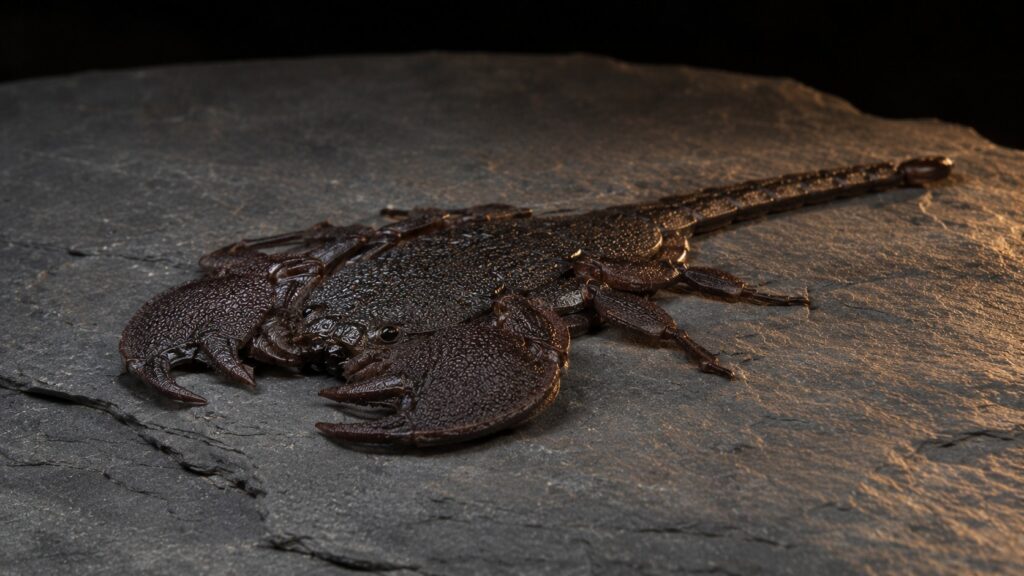
The flat rock scorpion is the longest scorpion in the world and one of the least dangerous animals in the hobby. Hadogenes troglodytes reaches around 8 inches from pincer to tail tip, has venom weaker than a bee sting, and can live past 25 years in captivity. It is also compressed almost flat, because it spends its life wedged in the seams between rocks rather than in a burrow. That single adaptation changes the entire enclosure build, and it is the part most care sheets skip. This guide covers the rock stack, the arid conditions they need, why they eat so little, and what to know about sourcing.
Species Overview
Flat rock scorpions come from the rocky outcrops of southern Africa, across South Africa, Zimbabwe, and Mozambique. They are lithophilous, meaning rock dwelling, and their entire body plan is built around one behaviour: sliding into a crevice too narrow for anything else to follow.
The body is dorsoventrally flattened to an extent that looks almost injured if you have only seen typical scorpions. The tail is thin and the pincers are large, which across scorpions is a reliable rule of thumb: heavy pincers and a slender tail means the animal subdues prey mechanically and has little need for potent venom.
Males carry a dramatically elongated metasoma, the tail, which is where the record length comes from. Females are shorter and noticeably bulkier. On sheer length they beat every other scorpion, though on mass they lose to emperors, which is worth knowing if you are choosing between the two. Our guide to how large emperor scorpions get covers the other end of that comparison.
| Attribute | Details |
|---|---|
| Scientific name | Hadogenes troglodytes |
| Adult size | 6 to 8 inches |
| Lifespan | 20 to 25+ years |
| Difficulty | Intermediate |
| Temperature | 75 to 85F (24 to 29C) |
| Humidity | 40 to 50% |
| Venom potency | Very low, comparable to a bee sting or less |
Enclosure Setup
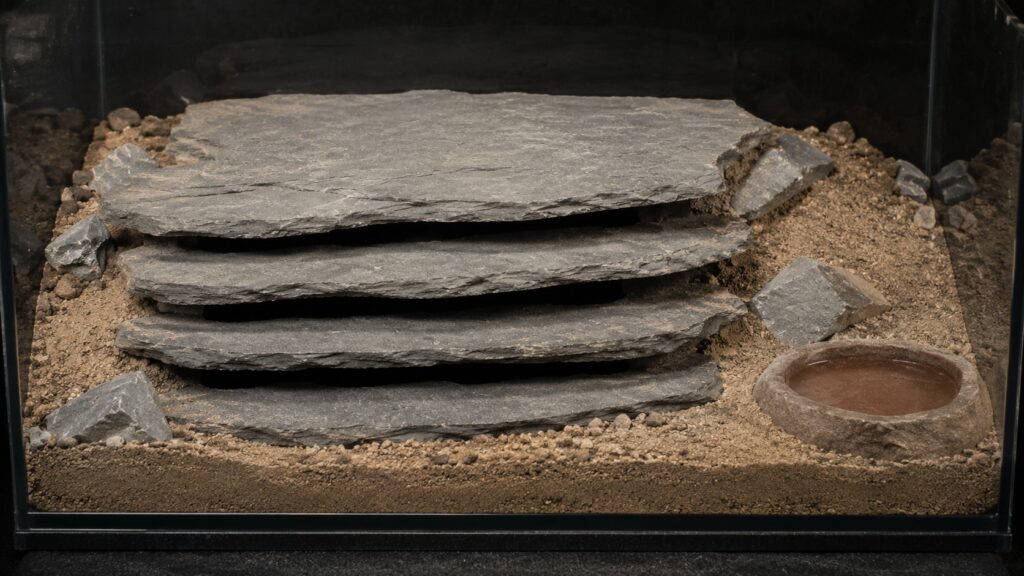
Everything here follows from the crevice habit. A flat rock scorpion given deep substrate and a coconut hide will use neither, and will spend its life looking for a gap that does not exist.
Tank: a 10 gallon suits one adult, a 20 gallon long is better. Horizontal floor space matters, but so does enough height to build upward. Secure the lid, because they climb rock faces well.
Substrate: shallow, 1 to 2 inches only. Use a dry mix of sand and coco fibre or topsoil, roughly 60:40, packed firm. They do not burrow, so depth is wasted volume that would be better spent on rock.
The rock stack is the enclosure. Use flat slate, shale, or slabs of tile, stacked in layers with gaps of roughly a quarter to half an inch between them. Aim for three or four horizontal seams at different heights. The scorpion will pick one and stay there.
Secure everything. This is the one genuine safety issue in the whole setup. A collapsing stack will crush the animal, and a scorpion that lives inside your rockwork gives you no warning before it shifts. Bed the bottom slab into the packed substrate, and silicone the stack together with aquarium-safe sealant, cured and aired out fully before the scorpion goes in. Do not rely on gravity and good intentions.
Water: a shallow dish, always filled, sunk level with the substrate.
Lighting: none needed. They are nocturnal and a bright enclosure just means an animal you never see. A dim red or blue night bulb, or a UV torch used briefly, will show you far more, since all scorpions fluoresce under ultraviolet light.
Temperature and Humidity
Target 75 to 85F with humidity in the 40 to 50% range. This is an arid species and the moisture side is where captive deaths come from.
For heat, use a low wattage heat mat on one side wall of the tank, on a thermostat, creating a gradient the scorpion can move along. Avoid overhead bulbs, which dry the air aggressively and serve no purpose for a nocturnal animal that lives under rock.
For humidity, the water dish plus normal room air is usually enough. Do not mist. Do not keep a damp corner. A flat rock scorpion in a humid enclosure is at real risk of mycosis, a fungal infection that shows as dark patches on the exoskeleton and is close to untreatable once established. If your room runs humid, increase ventilation rather than accepting it.
The contrast with the other common pet species is stark. Emperors want 75 to 80% humidity and a moist substrate, and running a flat rock scorpion on emperor scorpion conditions will kill it slowly. The closer template is the arid setup used for desert hairy scorpions.
Diet and Feeding
Flat rock scorpions eat remarkably little. Their metabolism is slow even by scorpion standards, and overfeeding is a more common error than underfeeding.
What to offer: appropriately sized crickets, dubia roach nymphs, red runners, or the occasional mealworm. Prey should be no longer than the scorpion’s pincers.
How often: two or three prey items every one to two weeks for an adult. Juveniles eat slightly more often, perhaps weekly.
Refusal is routine. A healthy adult may ignore food for a month or more, particularly ahead of a molt or when settled deep in a crevice. Provided the abdomen looks full rather than shrunken and water is available, this is not a problem.
Remove uneaten prey within 24 hours. A cricket left in a dry enclosure will die, mould, and attract mites, and a loose cricket can gnaw at a molting scorpion.
Feed with tongs or drop prey near the crevice entrance rather than digging the animal out. Any feeding response you get will happen at night.
Behaviour and Handling
This is one of the calmest scorpions kept in the hobby. Flat rock scorpions rarely sting, and the venom is mild enough that a sting is generally described as less consequential than a wasp. The likelier outcome of careless handling is a firm pinch from pincers built for gripping rock.
That said, they are not a species to handle regularly. The flattened body means they wedge into anything, including between fingers, and pulling a wedged scorpion free can injure it. They are also easily stressed by being lifted out of a crevice, which is the one place they feel secure.
Normal behaviour looks like almost nothing. Expect an animal that stays in its seam by day, emerges at night, and moves very little. A scorpion sitting exposed in the open during the day, or repeatedly pacing the glass, is usually telling you the enclosure is too hot or the crevices are too wide.
Growth and Molting
Growth is glacial. Flat rock scorpions can take five to seven years to reach maturity, and adults may go years between molts or stop molting altogether once mature. There is no way to speed this up and no reason to try.
Practically, this means the intervals that tell you something about the animal’s health are measured in years rather than weeks. Nobody remembers a molt date from three years ago, which is exactly the kind of thing the InvertMate husbandry tracker exists for. A dated photo and a molt log turn a two decade animal into a record you can actually read.
During a molt, leave the enclosure completely alone. Do not feed, do not mist, do not rearrange. A molting scorpion inside a rock seam is invisible and vulnerable.
Breeding
Rarely achieved in captivity, and worth being honest about why. Gestation in Hadogenes runs extraordinarily long, with estimates around 12 to 18 months, broods are small at roughly 20 to 30 young, and the offspring then grow at the species’ usual glacial pace. The economics do not work for commercial breeders.
The practical consequence for a keeper is sourcing. Most flat rock scorpions in the trade are wild caught adults, which brings two things worth knowing. First, an adult of unknown age may already be a decade into its life. Second, wild caught animals commonly arrive with mites and are stressed from shipping, so a quarantine period in a simple enclosure with no rock stack, where you can actually see the animal, is sensible for the first few weeks.
If you find captive bred stock, it is worth paying more for. If you buy wild caught, which most people do, accept it as the norm for this species rather than a red flag from a particular seller.
Common Health Issues
Mycosis. Dark or black patches on the exoskeleton, caused by excess humidity. Largely untreatable, entirely preventable. Keep the enclosure dry.
Mites. Common on wild caught imports. Visible as tiny pale specks around the joints and mouthparts. Rehouse into fresh dry substrate and consider a predatory mite treatment for a heavy load.
Dehydration. Wrinkled or collapsed abdomen. Almost always an empty water dish.
Failed molt. Rare, and usually follows an enclosure that was too dry during a molt cycle or a stack that shifted. Nothing to do but leave the animal alone.
Injury from a collapsed stack. Preventable, and the reason to silicone your rockwork.
FAQ
Are flat rock scorpions dangerous?
Not meaningfully. Their venom is among the weakest of any scorpion, generally compared to a bee sting or less, and they are reluctant to sting at all. The realistic risk is a pinch. As with any sting, an allergic reaction is possible, so treat it as you would a wasp sting.
How long do flat rock scorpions live?
Commonly 20 to 25 years, with some individuals reported beyond that. They are among the longest-lived invertebrates in the hobby. Since most available animals are wild caught adults, the age at purchase is usually unknown.
How big do flat rock scorpions get?
Six to eight inches from pincer tip to tail tip, making them the longest scorpion species in the world. Males are longer thanks to an elongated tail, while females are shorter and heavier bodied.
What do flat rock scorpions eat?
Crickets, dubia nymphs, red runners, and occasional mealworms, sized no longer than the scorpion’s pincers. Two or three items every one to two weeks is enough for an adult. Long voluntary fasts are normal and not a cause for concern.
Do flat rock scorpions need a deep substrate?
No. They do not burrow. One to two inches of firmly packed dry substrate is enough, with the enclosure’s real structure coming from stacked flat rocks that create narrow horizontal crevices.
Are flat rock scorpions good for beginners?
The husbandry is simple, but the species suits a patient keeper rather than a first-time one. Growth is measured in years, they are usually wild caught, and they spend most of their lives out of sight. A beginner wanting visible activity would be better served elsewhere in the range of pet scorpion species, and lifespans across the group are compared in our scorpion longevity breakdown.
Track Your Flat Rock Scorpion with InvertMate
A scorpion that lives 25 years and molts every few years generates a record no memory holds onto. InvertMate lets you log every molt with a dated photo, record feeding refusals across long fasts, and monitor the temperature and humidity your enclosure actually runs at. Free on the App Store.