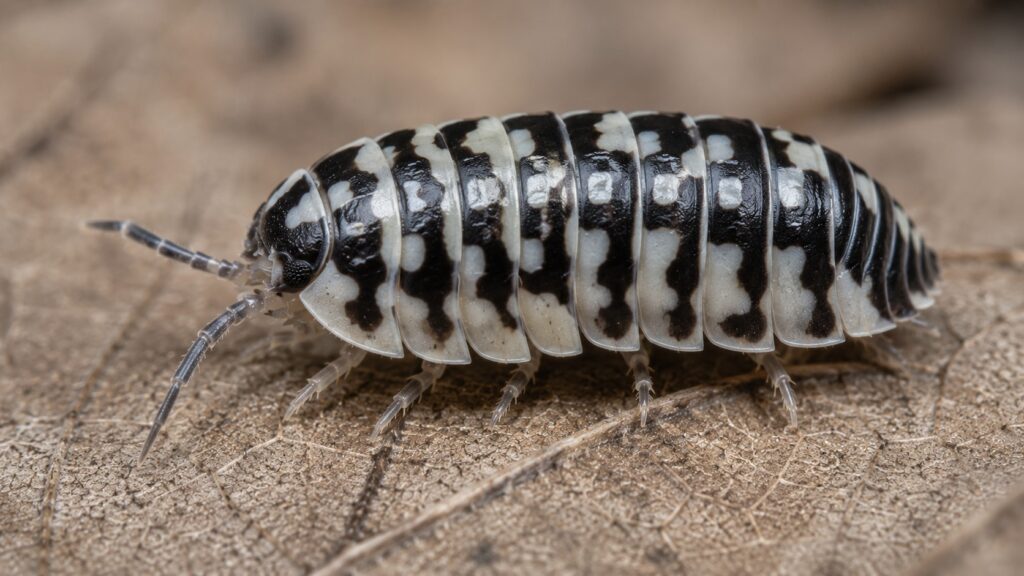
Zebra isopods are the species that convinces people isopods can be a display animal. Armadillidium maculatum is a crisp black and white striped crustacean about two thirds of an inch long, it walks around in the open instead of hiding, and it rolls into a perfect sphere when startled. They are also cheap, hardy, and one of the few attractive species a beginner can keep without much room for error. The one thing most new keepers get wrong is moisture, because zebras want a drier bin than almost every care sheet implies. This guide covers the setup, the breeding pace, and where they fit in a bioactive enclosure.
Species Overview
Zebra isopods come from limestone regions of southern France and northern Italy, which explains both the striping and the appetite for calcium. The species name maculatum means spotted, which is a little unhelpful given the common name, and the reason “zebra” and “dalmatian” get used interchangeably in the trade.
Adults reach roughly 0.6 to 0.7 inches, making them one of the larger Armadillidium species available. The pattern is high contrast black with white bands that vary between individuals, and lineages have been selected for wider or cleaner banding.
They conglobate, meaning they roll into a tight ball when threatened, which Porcellio species like powder blues cannot do. That behaviour tells you something about the care: an animal that relies on sealing itself up is better adapted to drier air than one that relies on running for cover. If you are still deciding what to keep, it is worth seeing how they compare to other common species before committing to a bin.
| Attribute | Details |
|---|---|
| Scientific name | Armadillidium maculatum |
| Adult size | 0.6 to 0.7 inches |
| Lifespan | 2 to 3 years |
| Difficulty | Beginner |
| Temperature | 68 to 78F (20 to 26C) |
| Humidity | 55 to 70%, with one moist corner |
| Brood size | 20 to 50 offspring |
Enclosure Setup
A 6 quart plastic bin holds a starter group of 10 to 15 comfortably, and a colony will happily fill a 12 quart within a couple of years.
Substrate, 2 to 3 inches, is a simple mix:
- 3 parts coconut fibre or peat
- 2 parts organic topsoil with no added fertiliser
- 1 part crushed limestone, oyster shell, or coral sand
- A handful of rotting hardwood, broken up
No drainage layer is needed. Zebras are not a species you keep wet, so the sump that a Cubaris bin requires is unnecessary here and just eats depth.
Cover and litter. A thick surface layer of dry oak, magnolia, or beech leaves, plus two or three pieces of cork bark laid flat. Leaf litter is simultaneously the food, the cover, and the humidity buffer, so be generous with it and top it up rather than replacing it.
Ventilation matters more than with most species. Punch a generous field of pinholes in the lid and high on two opposing walls. Zebras tolerate, and arguably prefer, real air movement. Poor ventilation combined with a wet bin is how healthy colonies turn into mite farms.
Moisture gradient. Keep one corner damp and let the remaining two thirds stay on the dry side. Pour water down one wall to rewet that corner every few days. If the whole bin looks uniformly dark and damp, it is too wet. The general bin architecture is covered in the standard bin build if you want the fundamentals alongside this.
Calcium, always visible. A piece of cuttlebone or a chunk of limestone left on the surface. Zebras get through it faster than most species and molt poorly without it.
Temperature and Humidity
Room temperature is fine. Anywhere in the 68 to 78F range works, and short excursions either side are tolerated better than by most popular species. They need no supplemental heat in a normally heated home.
Humidity is where people go wrong. Aim for 55 to 70% across most of the bin with one persistently damp corner, rather than the 80% plus that suits cave species. Zebras drown, sicken, and stop breeding in a saturated bin far more readily than they suffer in a dry one, provided the damp corner is always available.
The practical test is visual. The dry two thirds of the surface litter should crunch slightly when you press it. The damp corner should stay dark and soft. If mold appears anywhere other than on food, the bin is too wet or too closed.
Comparing across species helps calibrate this. Dwarf whites want a permanently moist substrate throughout, which is a genuinely different setup. Reading dwarf white isopod requirements alongside this one makes the contrast obvious, and it is the clearest illustration of why a single generic isopod care sheet does not work.
Diet and Feeding
Leaf litter and decaying hardwood are the staple diet, not an extra. A well stocked bin needs topping up every two to three months and very little else.
Calcium, permanently available. Cuttlebone, crushed eggshell, or limestone. Non-negotiable for a species this reliant on a hard exoskeleton.
Vegetables, twice weekly at most. Carrot, cucumber, courgette, squash, and sweet potato all get eaten. Remove leftovers within 48 hours.
Protein, every one to two weeks. A pinch of fish flake, a freeze dried shrimp, or a piece of dried river shrimp. Protein is what drives brood production, so a colony that is stalling often just needs more of it. Overdo it and you get grain mites within a fortnight.
Skip: citrus, salted anything, produce from a treated garden, and anything mouldy that is not deliberately rotting wood.
Add springtails at setup. They handle mold in the damp corner and never compete with the isopods for anything that matters.
Behaviour and Handling
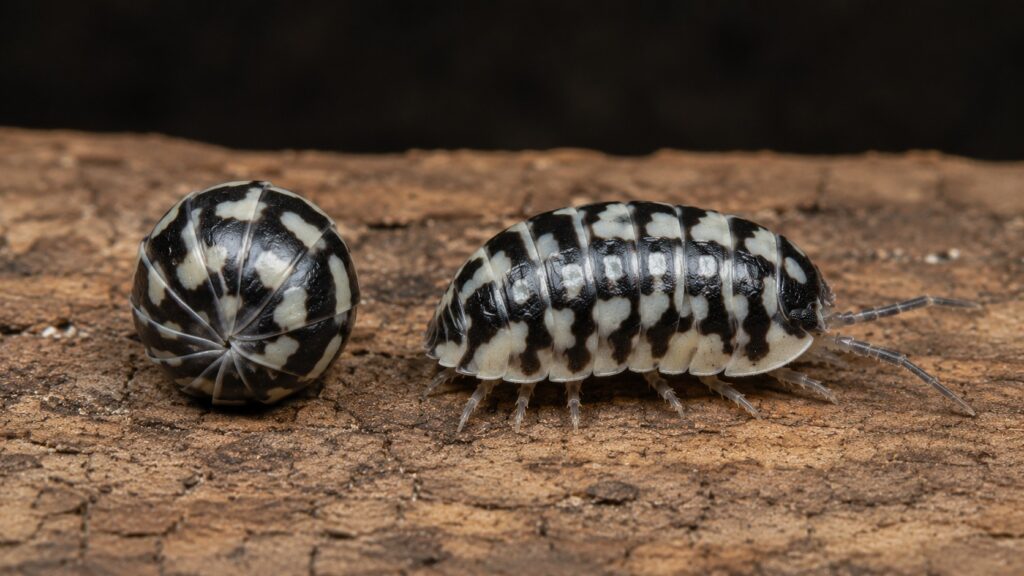
Zebras are one of the more visible species, which is most of their appeal. They forage on the surface during the day, cluster on the underside of bark, and a settled colony gives you something to look at rather than a bin that appears empty.
They handle well by isopod standards. A zebra picked up gently will roll into a ball, sit in your palm, then unroll and start walking after a few seconds. There is no bite, no defensive secretion, and nothing to be wary of. Just do it over a table, because a rolled isopod dropped on a carpet is genuinely difficult to find.
Signs of a problem: individuals dying with pale or chalky patches, which usually means calcium deficiency, or a colony that vanishes below the surface permanently, which usually means the bin is too wet or too warm.
Breeding
Zebras breed readily but not quickly. A mature female produces 20 to 50 young per brood, and a colony typically manages one or two broods per female per year, which is slow compared to a Porcellio species turning out broods every few weeks.
There is no trigger to manage. Warmth, a damp corner, constant calcium, and periodic protein will get you there. Expect 6 to 12 months from a group of 10 before numbers visibly climb, and around 18 months before you have surplus to trade.
Females carry eggs in a marsupium, a fluid filled pouch on the underside, and you can sometimes spot a gravid female by a pale swelling there. Young are miniature versions of the adults, without the contrast, and they darken up over successive molts.
The gap between a colony that is establishing and one that has stalled is only visible over months, and only if you wrote something down. A rough headcount when you top up the leaf litter, logged in CrabPod, our free isopod and hermit crab care app, turns guesswork into a trend line. Expectations across species vary a lot, and how long isopods live in a colony covers why individual lifespan matters less than generational overlap.
Using Zebra Isopods in a Bioactive Enclosure
This is where zebras earn their place beyond looking good. Their tolerance for drier substrate makes them one of the better choices for a bioactive setup that is not kept swampy, which covers most terrestrial arachnid and reptile enclosures.
What they do in that role: break down shed skin, uneaten prey remains, and waste before it moulds, and turn leaf litter into something the substrate can use.
Two caveats worth knowing. Zebras are slower to establish than dwarf whites or powder oranges, so seed the enclosure well ahead of adding the animal, ideally by a month. And they need the same calcium source in a bioactive enclosure that they need in a bin, which is easy to forget once they are out of sight.
If you want a species that tolerates a genuinely dry enclosure, giant canyon isopods handle it better still, at the cost of the striking appearance.
Common Problems
Grain mites. White specks swarming on food remains. Cut the protein frequency, remove the food, and increase ventilation.
Mold. Too wet, too closed, or too much food. Address in that order.
Chalky white patches on dying individuals. Calcium deficiency. Add limestone and cuttlebone and it resolves within a generation.
Colony not growing. Usually insufficient protein or a bin kept too uniformly damp. Both are quick fixes.
Everything hiding permanently. Too warm, too wet, or too little cover. Add more leaf litter and bark before changing anything else.
FAQ
Are zebra isopods good for beginners?
Yes. They tolerate a wide temperature range, need no heating, and survive minor mistakes. The only real requirement is resisting the urge to keep the bin wet. A damp corner with drier substrate elsewhere is what they want.
What is the difference between zebra and dalmatian isopods?
Both are Armadillidium maculatum, and the names describe pattern rather than species. Zebra usually refers to banded individuals, dalmatian to more broken or spotted patterning. Care is identical, and sellers use the terms inconsistently.
How fast do zebra isopods breed?
Slowly compared to Porcellio species. Females produce 20 to 50 young per brood and manage one or two broods a year. Expect 6 to 12 months from a starter group of 10 before the population visibly increases.
How long do zebra isopods live?
Two to three years as individuals. A colony sustains itself indefinitely through overlapping generations, so an established bin does not need restocking once it is going.
Can zebra isopods live with other isopods?
They can, but it rarely works out well. Faster breeding species outcompete them for food and cover, and a mixed bin is impossible to count. Keep them alone unless you are deliberately seeding a bioactive enclosure.
Do zebra isopods need calcium?
Yes, permanently. They come from limestone country and depend heavily on calcium carbonate for molting. Leave cuttlebone or crushed limestone on the surface at all times, and expect them to get through it faster than other species.
Track Your Colony with CrabPod
A zebra colony changes slowly enough that six months of progress is invisible unless you recorded where it started. CrabPod lets you log population counts, track the moisture and temperature your bin actually runs at, and set reminders for leaf litter top ups and protein feeds. Free on the App Store.