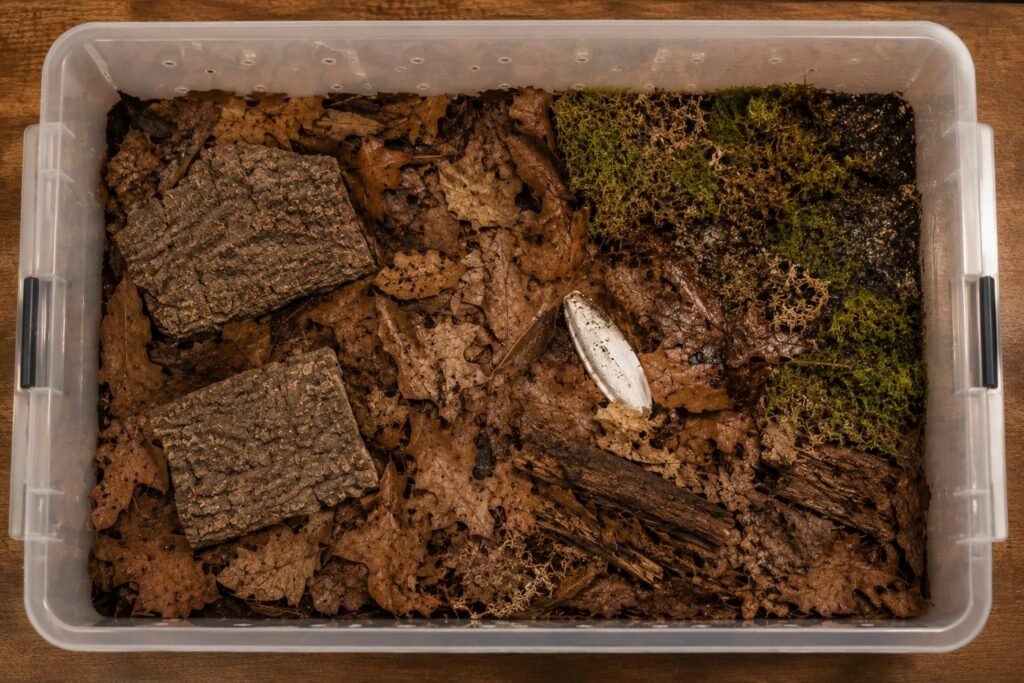
Setting up an isopod enclosure is one of the simplest projects in the invertebrate hobby. You don’t need expensive equipment, specialized lighting, or complicated filtration. A plastic bin, the right substrate, some leaf litter, a few hides, and attention to humidity are all it takes to build a home where your colony can thrive for years.
That said, there are details that matter. The difference between a colony that explodes in population and one that stagnates often comes down to substrate depth, ventilation balance, or moisture gradient. This guide walks you through every step, from choosing your container to adding your first isopods, so you get it right the first time.
Step 1: Choose Your Container
The most popular choice among isopod keepers is a clear plastic storage bin. They’re cheap, lightweight, hold humidity well, and come in every size you could need. You can pick one up at any big-box store for a few dollars.
Recommended sizes:
- 6-quart bin: Perfect for a starter colony of 10-15 isopods, or for culturing small species
- 15-quart bin: The sweet spot for an established colony of most species
- 32-quart bin: Ideal for large or fast-breeding species, or colonies you plan to grow long-term
Glass terrariums and aquariums also work, especially if you want a display setup. The tradeoff is that glass is heavier, more expensive, and loses humidity faster than plastic. If you go glass, you’ll need a tight-fitting lid (not a mesh screen, which bleeds humidity too quickly).
Key features to look for:
- Clear walls so you can observe the colony without opening the lid
- A flat, snap-on lid that seals reasonably well
- Smooth interior walls (isopods can’t climb smooth plastic or glass, so escapes aren’t usually a concern, but some tiny species can climb)
Wide and shallow is better than tall and narrow. Isopods are terrestrial and don’t use vertical space much. Floor area matters more than height.
Step 2: Add Ventilation
Every isopod enclosure needs airflow. Without ventilation, moisture builds up, air becomes stagnant, ammonia accumulates from waste, and mold takes over. Too much ventilation, however, causes humidity to drop too fast.
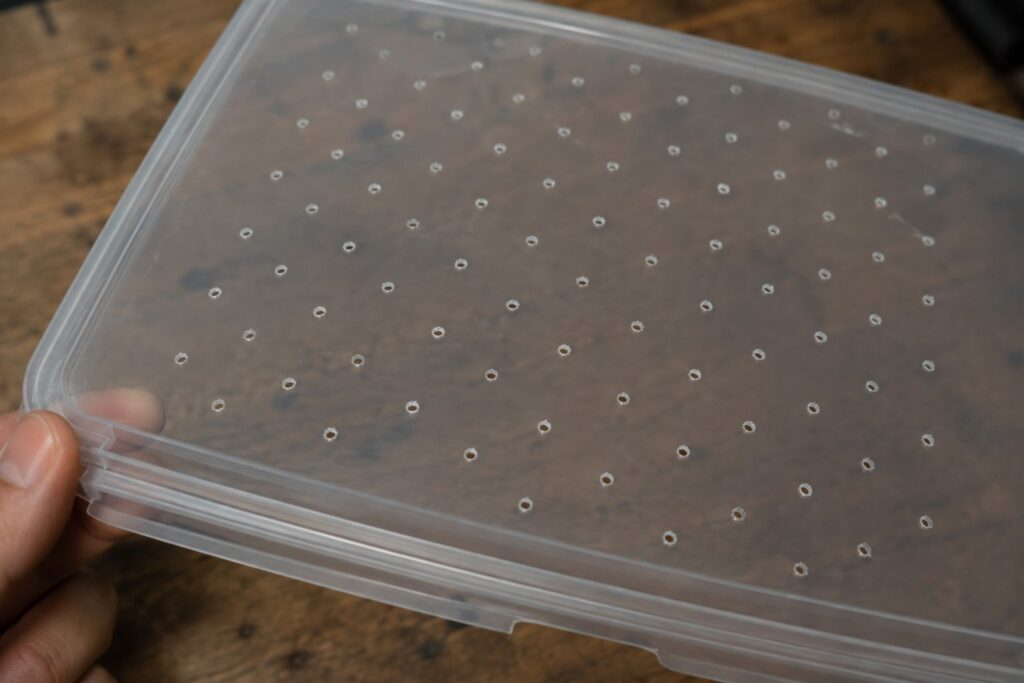
For a plastic bin, the easiest method is to drill or melt small holes in the lid or upper walls. Here’s how:
- Use a drill with a small bit (1/16″ to 1/8″) or a heated nail/soldering iron to melt holes
- Place holes in the lid or in the upper third of the side walls
- Aim for roughly 10-15% of the lid surface area covered by ventilation for most species
- For high-humidity species (like Cubaris or tropical species), use fewer, smaller holes
- For species that tolerate drier conditions (like Porcellio scaber), you can be more generous with ventilation
Cross-ventilation is ideal: holes on opposite sides of the bin create gentle airflow across the enclosure. If you only add ventilation to the lid, air exchange is slower but humidity stays higher.
Important: Make sure your ventilation holes are small enough that baby isopods (mancae) can’t escape through them. Mancae from some species are incredibly tiny. Pin-sized holes or fine mesh glued over larger openings prevents escapes.
If you’re using a glass terrarium, the lid is your main ventilation point. A partially open lid or a lid with a mesh strip works. You can cover portions of a full mesh lid with plastic wrap or aluminum foil to retain more humidity while still allowing some airflow.
Step 3: Mix and Add Substrate
Substrate is arguably the most important component of your isopod enclosure. It retains moisture, provides a burrowing medium, and for many species, serves as a food source. Getting the substrate right makes everything else easier.
Basic substrate recipe (works for most species):
- 60% organic topsoil (pesticide-free, no added fertilizers)
- 40% coconut coir (rehydrate from a compressed brick)
Mix these together thoroughly until the consistency is uniform. The final mix should feel like damp, crumbly earth: moist enough to hold its shape when squeezed in your fist, but not so wet that water drips out.
Substrate depth: 3-4 inches minimum for most species. Some species that burrow heavily (like Cubaris or large Armadillidium) benefit from 4-5 inches.
Optional additions to the base mix:
- Flake soil or decomposed hardwood (10-20% of total volume): Especially beneficial for Cubaris and wood-eating species. Provides nutrition directly in the substrate.
- Calcium carbonate powder (a light dusting mixed in): Gives isopods access to calcium throughout the substrate, not just on the surface.
- Earthworm castings (a small handful): Boosts microbial activity in the substrate, which benefits the colony over time.
- Charcoal pieces (a few scattered at the bottom): Helps with drainage and reduces odor.
Avoid: potting soil with perlite (the white balls can be mistaken for food), anything with added fertilizers or moisture-control chemicals, and pure peat moss as a standalone substrate (too acidic for most species).
Pour the mixed substrate into your bin and press it down lightly. You want it firm enough to hold burrows but not packed so tight that isopods can’t dig.
Depth matters even more for animals that bury to molt. A hermit crab enclosure needs six inches minimum for the same reason isopods need a moisture gradient.
Step 4: Create a Moisture Gradient
A moisture gradient means one side of the enclosure stays damper than the other. This is one of the most important principles in isopod keeping, because it lets individual isopods choose the moisture level they need at any given time. Molting isopods, for example, often seek out the damp side, while others prefer drier conditions.
How to create it:
- Place a generous clump of sphagnum moss on one end of the enclosure. This is your “wet side.” Mist the moss until it’s damp (not soaking).
- Leave the opposite end bare substrate with no added moisture. This is your “dry side.”
- The middle of the enclosure will naturally fall somewhere in between.
When you mist the enclosure (2-3 times per week for most species), focus your misting on the sphagnum moss end. Let the dry side stay dry. Over time, you’ll develop a feel for how much moisture your specific setup needs based on your ventilation, room temperature, and species.
How to check: Squeeze a pinch of substrate from the moist side. It should feel damp and hold together. Squeeze substrate from the dry side. It should be barely moist or dry to the touch. If both sides feel equally wet, reduce misting. If both sides feel dry, mist more and check your ventilation.
The same squeeze test governs the substrate a hermit crab molts in, where a tunnel that collapses because the mix was too dry is usually fatal rather than just inconvenient.
Step 5: Add Leaf Litter
Leaf litter covers the substrate surface and serves as both the primary food source and habitat structure for your colony. It should be the thickest layer in the enclosure, covering the substrate so you can barely see it underneath.
Best leaves:
- Oak (the most popular choice, decomposes slowly, widely available)
- Magnolia (thick and durable, great for larger species)
- Indian almond / catappa (popular in the hobby, contains beneficial tannins)
- Beech, maple, birch (all work well)
Collect naturally fallen, dry leaves from areas free of pesticides. If you’re unsure about contamination, bake leaves at 200°F for 20-30 minutes or boil them briefly and dry them before use.
Add a thick layer. When it looks like too much, add a bit more. The colony will eat through it over time, and you’ll need to replenish periodically. A varied mix of 2-3 leaf types is ideal, as isopods eat more and breed better with dietary variety.
For a complete breakdown of what isopods eat, see our isopod feeding guide.
Step 6: Add Hides and Decor
Isopods need dark retreats to feel secure. Without hides, the colony is stressed, less active, and slower to breed.
Cork bark is the standard choice. Place flat pieces directly on the substrate surface so isopods can tuck underneath. Cork bark also slowly decomposes, providing an additional food source. Two or three pieces scattered across the enclosure is plenty for a small bin.
Other good options:
- Coconut shell halves (inexpensive, widely available)
- Egg carton pieces (cheap and effective, but mold faster in humid conditions)
- Small pieces of driftwood or grapevine wood
- Seed pods (lotus pods are popular in the Cubaris community)
Don’t overcrowd the enclosure with decor. Isopods need open space on the substrate surface for foraging as well as hides for retreat. A few well-placed hides are better than a cluttered bin.
Step 7: Add a Calcium Source
Calcium is essential for every isopod species. They need it to build and maintain their exoskeleton, and demand increases during molting and reproduction. A calcium source should be available in the enclosure at all times.
Best options:
- Cuttlebone (sold in the bird section of pet stores). Break a piece off and place it on the substrate. The colony will graze on it constantly.
- Crushed oyster shell (available as poultry grit at farm supply stores). Scatter a small amount on the substrate surface.
- Crushed eggshell (boil first, then dry and crush). A free option from your kitchen.
Many keepers use multiple calcium sources simultaneously. A piece of cuttlebone plus some crushed oyster shell scattered nearby covers all your bases.
Replace calcium as it gets consumed. In a fast-growing colony, you’ll be surprised how quickly a piece of cuttlebone disappears.
Step 8: Add Springtails (Optional but Recommended)
Springtails are tiny, harmless arthropods that feed on mold and fungal spores. Adding a culture of springtails to your isopod enclosure is the single best thing you can do to prevent mold problems. They act as a cleanup crew for the cleanup crew. This same springtail-and-isopod cleanup crew is what powers bioactive reptile enclosures, where they break down waste in a self-sustaining vivarium.
You can purchase springtail cultures online or at reptile expos. Tropical springtails (Folsomia candida or similar) are the most common. Simply pour a portion of the culture onto the substrate and they’ll establish themselves within days. The same trick works in other high-humidity setups. A springtail culture is one of the easiest ways to keep mold down in a hermit crab tank, where the required humidity makes fungal growth a constant battle.
Springtails are completely harmless to isopods. They coexist peacefully and actually improve the overall health of the enclosure by keeping fungal growth in check.
Step 9: Introduce Your Isopods
Once the enclosure is set up and has had a few hours to stabilize (especially after misting), you’re ready to add your isopods.
Gently tip the isopods onto the substrate surface near a hide. Don’t dump them from a height. Let them explore and find their way under cork bark and leaf litter on their own. Most will disappear within minutes.
After introducing your colony:
- Don’t open the lid for the first 24-48 hours (let them settle)
- Offer a small piece of vegetable or protein after 2 days
- Begin your regular misting schedule
- Resist the urge to check on them constantly. Frequent disturbance slows colony establishment.
Those first few weeks are also worth recording. Population changes are slow enough that you won’t notice them day to day, which is what CrabPod is built to surface.
Species-Specific Adjustments
The setup above works for the majority of pet isopod species. Here are quick adjustments for common species groups:
Not sure which species to start with? Our rundown of beginner isopod species covers what to expect from each.
Porcellio species (dairy cow isopods, giant canyon isopods, P. scaber, P. ornatus): Standard setup as described. Moderate ventilation, standard moisture gradient. These are forgiving and tolerant of a range of conditions.
Porcellionides pruinosus (powder blue isopods): Standard setup. These are escape artists, so make sure ventilation holes are small. A petroleum jelly barrier near the rim adds extra security.
Cubaris species (panda king isopods, Rubber Ducky): Less ventilation (they need higher humidity), deeper substrate (4-5 inches), add flake soil and limestone pieces to the substrate. These species are more sensitive to humidity drops.
Armadillidium species (A. vulgare, A. maculatum): Standard to slightly drier setup. These tolerate lower humidity than Porcellio or Cubaris but still need a moisture gradient. Good ventilation is important.
FAQ
What size enclosure do isopods need?
A 6-quart plastic bin works for a starter colony of 10-15 isopods. As the colony grows, upgrade to a 15-quart or 32-quart bin. The general guideline is at least 1 gallon of space per 10-15 isopods, though larger is always better. Wide and shallow containers are preferred over tall and narrow ones.
What substrate is best for isopods?
A mix of 60% organic topsoil and 40% coconut coir is the standard base that works for most species. Avoid potting soil with perlite, fertilizers, or moisture-control additives. For Cubaris species, add 10-20% flake soil or decomposed hardwood to the mix.
How often should I mist my isopod enclosure?
Most setups need misting 2-3 times per week, focusing on the sphagnum moss end to maintain the moisture gradient. The exact frequency depends on your ventilation, room temperature, and species. Check the substrate moisture regularly and adjust accordingly. The moist side should be damp, the dry side should be mostly dry.
Do isopods need light?
No supplemental lighting is needed. Most isopod species are nocturnal and prefer low light. Normal room lighting provides a sufficient day/night cycle. Avoid placing the enclosure in direct sunlight, which can overheat a small bin quickly.
Can I keep isopods in a glass terrarium?
Yes, but glass terrariums lose humidity faster than plastic bins. You’ll need a tight-fitting lid (not a full mesh screen) and may need to mist more frequently. Glass works best as a display option for species you want to observe more easily.
Track Your Colony with CrabPod
Keep your isopod enclosure conditions dialed in with CrabPod. Monitor humidity and temperature trends, set misting and feeding reminders, and track your colony’s growth over time. Free on the App Store.