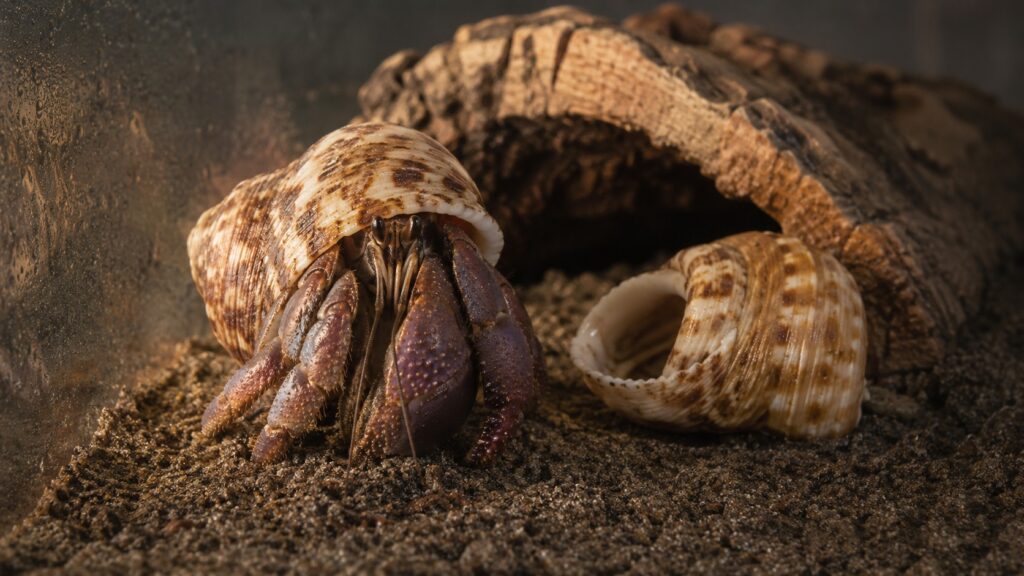
A hermit crab habitat is the single biggest factor in whether your crabs live for two years or twenty. Purple pincher hermit crabs (Coenobita clypeatus) regularly pass 20 years in captivity when the tank gets substrate, heat, and humidity right, and most starter setups fail on all three at once. The plastic carrier with a sponge and a bag of colored gravel is not a habitat, it is a shipping container. This guide covers the full build: tank size, substrate depth and mix, temperature and humidity targets, both water pools, shell selection, and the maintenance routine that keeps everything stable once it is dialled in.
What Hermit Crabs Need in Captivity
Land hermit crabs come from tropical coastlines, usually within a short walk of the sea. They spend daylight hours buried or wedged under driftwood and come out at night to forage along the tide line. Two things follow from that. They need warm, humid air because they breathe through modified gills that have to stay moist, and they need deep substrate because they bury themselves completely to molt, sometimes for two months at a time.
The species sold in almost every North American pet shop is the purple pincher, identifiable by the large dark purple claw. Ecuadorian crabs (Coenobita compressus) show up second most often, are smaller, faster, and want slightly higher salinity access. The build below suits both.
| Attribute | Details |
|---|---|
| Scientific name | Coenobita clypeatus |
| Adult size | 2 to 6 inches including shell |
| Lifespan | 20 to 30 years, 40+ recorded |
| Difficulty | Beginner, with the caveat that the setup is unforgiving |
| Temperature | 75 to 85F (24 to 29C) |
| Humidity | 75 to 85% |
| Substrate depth | 6 inches minimum |
Tank Size and Type
Start with a 10 gallon glass tank for one or two small crabs, and 20 gallons for a group of three to five. Glass matters more than it sounds. Plastic scratches, warps under a heat mat, and will not hold humidity anywhere near as well as glass with a solid lid.
Floor space beats height. Hermit crabs climb, but they forage horizontally, and a 20 gallon long gives far more usable ground than a 20 gallon tall at the same price. If you are buying secondhand, a leaking aquarium is perfectly fine here since nothing above the water pools ever holds water.
The lid is not optional. A mesh screen lid alone will drop your humidity into the 40s within hours. Cover the mesh with glass, acrylic, or plastic wrap, leaving a small gap at one corner for air exchange. Complete sealing invites stagnant air and mold, so aim for restricted airflow rather than none.
Plan the total height with substrate in mind. Six inches of packed sand takes up a real portion of a 10 gallon tank, so the crabs need at least another 8 to 10 inches above it for climbing decor.
Substrate: The Part Most Setups Get Wrong
Substrate is where hermit crabs molt, and a failed molt is usually fatal. This is the single highest priority item in the build.
Depth: 6 inches minimum, or three times the height of your largest crab’s shell, whichever is greater. A jumbo crab needs closer to 10 inches.
Mix: five parts playground sand to one part coconut fiber, mixed dry, then moistened. Some keepers run 50:50 and get equally good results. What is not negotiable is the consistency test: squeeze a handful and it should hold its shape like damp sandcastle sand without water beading out. Too dry and the molting tunnel collapses on the crab. Too wet and it goes anaerobic and starts to smell of sulphur.
Moisten with saltwater, not tap water. Marine saltwater mixed to roughly half the strength of your drinking pool keeps the substrate from souring and matches what crabs encounter on a beach. Dechlorinated fresh water is acceptable if that is what you have.
What to keep out: calcium sand, gravel, wood chips, cedar or pine shavings, and anything marketed as reptile bedding with added scent. Gravel cannot be tunnelled and calci-sand sets like concrete when wet.
The layering logic here is close to what works in a bioactive isopod bin: a deep moisture-retaining base, a drier surface zone, and a gradient the animal chooses from rather than a single uniform condition.
Temperature and Humidity
Target 75 to 85F (24 to 29C) and 75 to 85% relative humidity, measured with a digital thermometer and hygrometer at substrate level. The analog dial gauges that come bundled with starter kits are routinely off by 10 to 20 percentage points and are the reason many keepers believe their tank is fine when it is not.
For heat, mount an under tank heater on the side of the glass, above the substrate line, rather than underneath. A pad on the bottom bakes the lower substrate where crabs molt and drives moisture out of the mix. Run it through a thermostat or dimmer. Avoid heat lamps and ceramic emitters entirely, since they strip humidity faster than you can replace it.
For humidity, a solid lid plus correctly moistened substrate plus two open water pools will usually get you there without misting. If you are still low, add a bubbler to the saltwater pool or increase the substrate moisture slightly. Constant misting is a symptom of a leaky lid, not a solution.
Both readings drift slowly, especially across a seasonal change, and the drift is easy to miss when you check the gauge in passing. Logging your numbers in CrabPod, our free isopod and hermit crab care app makes a two week downward trend obvious well before the crabs start reacting to it.
Water Pools: You Need Both
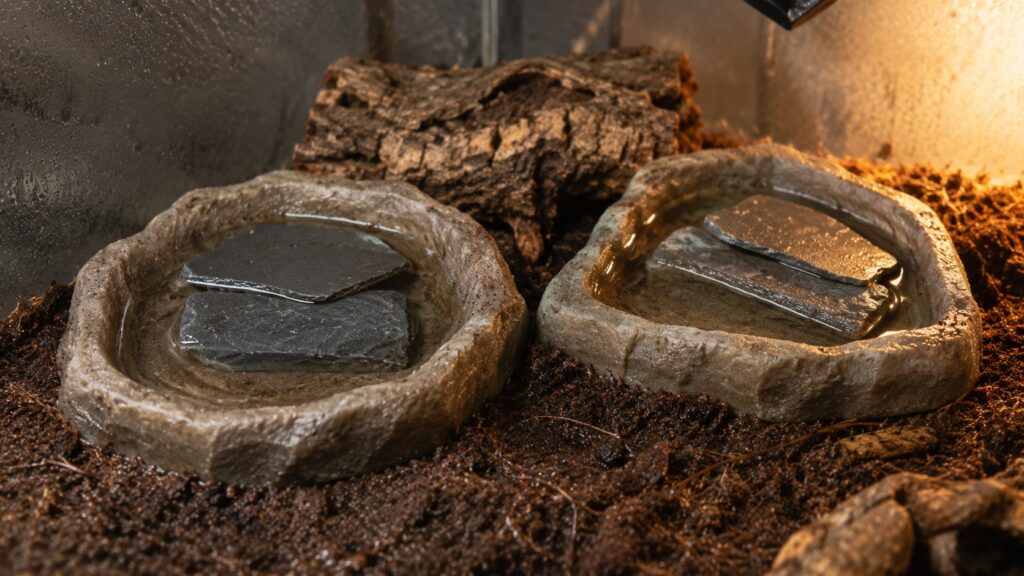
Hermit crabs require two pools at all times: dechlorinated fresh water and marine saltwater. They drink from both, bathe in both, and top up the water inside their shells from both. Offering only fresh water is one of the most common causes of slow decline.
Fresh water: treat with a dechlorinator that removes chlorine, chloramine, and heavy metals. Bottled spring water works. Distilled water does not, since it lacks the trace minerals crabs use.
Saltwater: mix marine aquarium salt to the instructions on the box. Never use table salt, and do not use freshwater aquarium salt, which is a different product entirely. The full breakdown of which salt to use and which to avoid covers mixing and storage too.
Both pools must be deep enough for your largest crab to submerge completely, and both need an exit route. Crabs drown in steep-sided dishes. Use a sloped dish, or stack a few flat stones, or wedge a piece of plastic mesh against one wall as a ramp. Change the water every two to three days, sooner if food debris ends up in it.
Shells, Hides and Climbing Decor
Offer at least three to five spare shells per crab, in a range of sizes bracketing what each crab currently wears, roughly a quarter size smaller through a size larger. Opening shape matters as much as size: purple pinchers prefer round or D-shaped openings, Ecuadorians prefer oval. Turbo shells are the reliable default.
Skip painted shells. The paint chips, gets eaten, and the dyes are not something you want inside a filter-feeding gut.
For everything else, think cover and vertical texture. Cholla wood, cork bark, coconut huts, and cleaned driftwood all work. Add climbing structure such as netting, dried vines, or a stack of bark, because crabs are genuinely good climbers and use the height when it is available. Two or three separate hides mean a nervous crab always has somewhere to be.
Leave a food dish and a calcium source such as cuttlebone, crushed oyster shell, or crushed eggshell, all of which get used heavily in the weeks after a molt. What goes in the food dish is covered in our hermit crab feeding guide.
The full breakdown of sizing, opening shape, and how many spares to stock is in our shell selection guide.
A Cleanup Crew Is Worth Adding
A hermit crab tank is warm, humid, and full of uneaten food, which is close to ideal conditions for mites and mold. A small detritivore population fixes most of it.
Springtails are the standard first addition and multiply fast in a moist substrate. Dwarf white isopods are the other reliable choice, since they stay small, tolerate the humidity, and work through leftover protein and shed exoskeletons without bothering the crabs. Add a handful of leaf litter for them to graze and they largely look after themselves. If you want to compare options before committing, the isopod species most people start with covers which ones tolerate a permanently damp enclosure.
One caution: a cleanup crew reduces maintenance, it does not replace it. Uneaten fresh food still comes out daily.
Maintenance Routine
Daily: remove uneaten fresh food, check both pools for debris, glance at the thermometer and hygrometer.
Every two to three days: full water changes on both pools.
Weekly: spot clean the surface, wipe the glass, check substrate consistency by squeezing a handful from an area no crab is buried in.
Monthly: stir and remoisten the top two inches only, never deeper, since a buried molting crab is invisible and disturbing one usually kills it. Sanitize decor with hot water, no soap.
Every 6 to 12 months: replace roughly a third of the substrate, again only from sections with no buried crabs.
If a crab disappears, assume it is molting and leave it alone. Do not dig, do not isolate it in a separate container, and do not remove what looks like a dead crab until you are certain, because a freshly molted crab lying next to its own shed exoskeleton looks alarming and is fine. Molting can take four to eight weeks for a large crab, and considerably longer for a jumbo. The full molt timeline, including how to tell a molter from a dead crab without digging, is worth reading before it happens rather than during. The rest of day to day hermit crab care covers feeding and handling once the habitat itself is sorted.
Common Habitat Mistakes
- Shallow substrate. Two inches of gravel means no molting, which means a shortened life. This is the most common fatal error.
- Screen lid with no cover. Humidity crashes and the crabs slowly suffocate as their gills dry.
- A sponge instead of pools. Sponges harbour bacteria and provide none of the submersion crabs need.
- Only fresh water. Both pools, always.
- Heat lamp for warmth. Dries the tank out. Side-mounted mat instead.
- Isolating a molting crab. Well intentioned and usually lethal.
- One crab alone. They are social and do noticeably better in groups of three or more where space allows.
FAQ
How big should a hermit crab tank be?
A 10 gallon glass tank is the workable minimum for one or two small crabs, and 20 gallons suits three to five. Prioritise floor space over height, and remember that 6 inches of substrate eats a real share of a small tank’s volume before the crabs get any of it.
How deep does hermit crab substrate need to be?
Six inches minimum, or three times the height of your largest crab’s shell if that is more. Crabs bury completely to molt, and shallow substrate causes collapsed tunnels and failed molts. Jumbo crabs want closer to 10 inches.
Do hermit crabs need salt water?
Yes, and it is not optional. Crabs need a marine saltwater pool alongside a dechlorinated fresh water pool, both deep enough to submerge in. Use marine aquarium salt mixed per the packet. Table salt and freshwater aquarium salt are both unsuitable.
What temperature do hermit crabs need?
Between 75 and 85F (24 to 29C), measured at substrate level with a digital gauge. Use a side-mounted under tank heater on a thermostat. Below 72F crabs become lethargic and stop eating, and prolonged cold is dangerous.
How many shells should I put in the tank?
Three to five spares per crab, spanning a quarter size smaller to a size larger than each crab’s current shell, with opening shapes matched to the species. Round openings for purple pinchers, oval for Ecuadorians. Avoid painted shells entirely.
Can hermit crabs live in a plastic tank?
Short term, yes, but plastic holds humidity poorly, scratches, and can warp against a heat source. Glass with a solid lid is the practical long term choice, and secondhand aquariums with leaks work fine since nothing structural holds water.
Track Your Crabitat with CrabPod
A tank like this takes a couple of weeks to stabilise and one hot spell to unsettle. CrabPod lets you log temperature and humidity readings over time, track each crab through its molt cycle, and set reminders for saltwater changes and substrate refreshes. Free on the App Store.