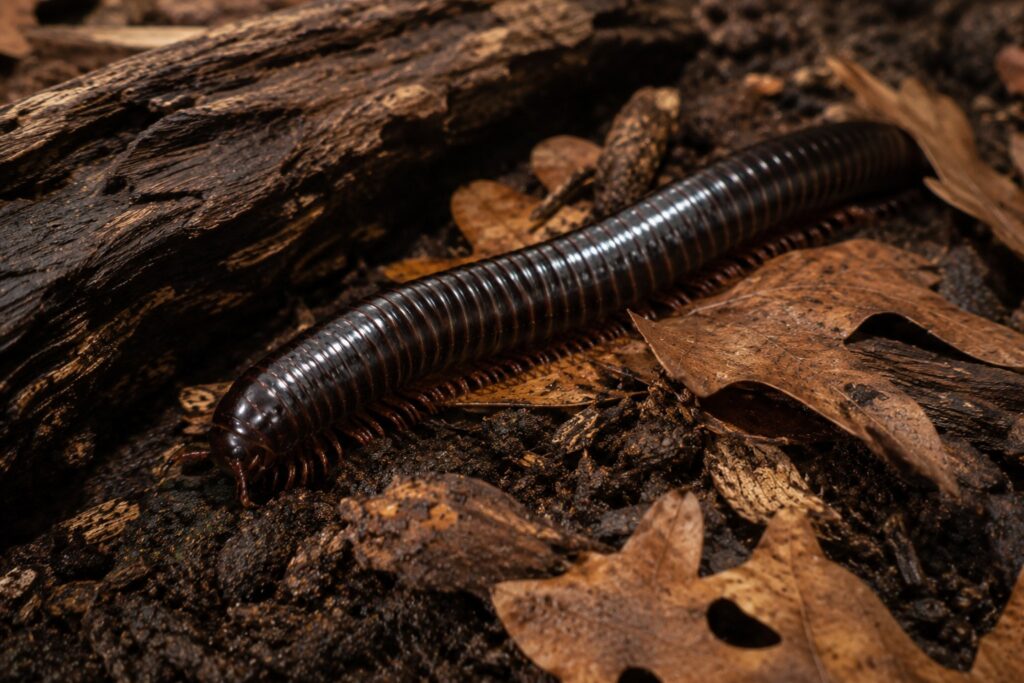
Millipede care is refreshingly simple once you understand the one principle that governs everything: the substrate is not just where your millipede lives, it’s what your millipede eats. Get the substrate right and most other problems solve themselves. Get it wrong and no amount of misting, feeding, or fussing will keep the animal healthy.
That single idea separates millipedes from nearly every other invertebrate pet. A tarantula sits on its substrate. A millipede consumes it. This is why a properly built enclosure feeds your millipede continuously, and why “spent” substrate that has been eaten through needs replacing on a schedule.
This guide covers the fundamentals that apply to any millipede species: enclosure setup, building the right substrate mix, humidity and temperature, calcium (the most commonly neglected requirement), supplemental feeding, handling, and the problems that trip up new keepers. Species-specific details vary, but these principles hold across the hobby.
Choosing Your First Millipede
Millipedes are among the most beginner-friendly invertebrates available. They can’t bite, they have no venom, they move slowly, and most species tolerate gentle handling. They’re also long-lived, with many species reaching 5 to 10 years, so choosing one is a real commitment. If you’re not certain whether what you’re looking at is a millipede at all, our millipede vs centipede guide settles it in one look.
For most beginners, the giant African millipede (Archispirostreptus gigas) is the classic starting point. It’s the largest species in the hobby at 8 to 12 inches, exceptionally docile, and thrives in a straightforward humid tropical setup.
If you’d rather avoid constant humidity management, the desert millipede (Orthoporus ornatus) is an excellent alternative. It needs drier conditions with strong ventilation and a moisture gradient rather than uniform dampness, which some keepers find easier to maintain.
Smaller species like bumblebee and chocolate millipedes are also widely available, breed readily, and work well for keepers who want an active colony rather than a single large individual. The Texas gold millipede, also sold as the Florida ivory, is the pick of them for a first-time keeper and one of the few you can buy captive bred.
Whichever species you choose, always buy captive-bred where possible. Wild-caught millipedes arrive stressed, often carry heavy mite loads, and their exact age is unknown.
Enclosure Setup
Millipedes need floor space, not height. A 10-gallon long-style tank comfortably houses one or two adults of a large species, and a 20-gallon long suits a small group. Smaller species can be kept in appropriately sized plastic containers or acrylic enclosures.
The two non-negotiables are a secure lid and adequate ventilation. Millipedes are persistent and will find gaps, and they can climb silicone seams and decor. At the same time, stagnant air breeds mold and fungal problems. Tropical species do well with a partially covered screen top that retains humidity while still allowing airflow. Arid species need considerably more ventilation, typically a fully open screen lid.
Depth matters more than most beginners expect. Millipedes burrow to molt, and a millipede that cannot construct a proper underground molting chamber will eventually die trying. The working rule is substrate depth of at least one to two times the length of your largest millipede. For a large species, that means 6 to 8 inches minimum, and more is genuinely better. Sizing by species, the full substrate recipe, and safe wood sourcing are in our step-by-step millipede enclosure build.
Add hides using cork bark, dried bark pieces, or half logs. Keep climbing structures low, since these are heavy-bodied animals and a fall onto hard decor can cause injury. A layer of sphagnum moss in one corner helps hold a humid pocket.
Provide a shallow water dish with dechlorinated water. Millipedes drink from droplets and moist substrate, but a dish should still be available. Use something shallow enough that the animal can’t drown, like a jar lid or petri dish.
Lighting is unnecessary. Millipedes are nocturnal and avoid light. Ambient room lighting is fine.
Substrate: The Most Important Element
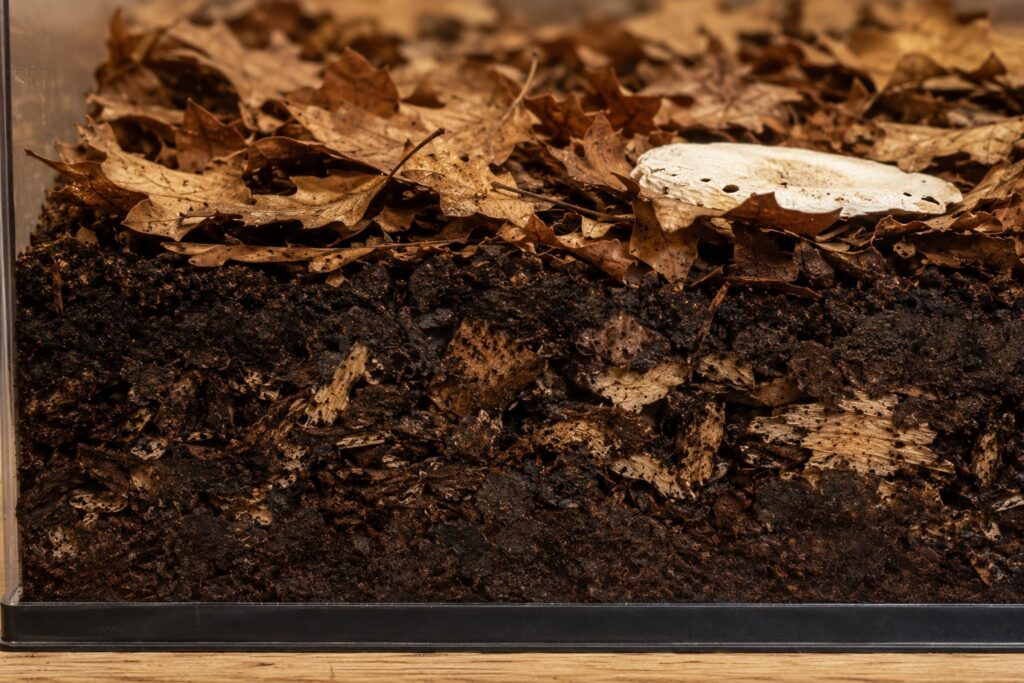
This is where millipede care genuinely differs from other invertebrates, and where most failures originate. Substrate serves three jobs simultaneously: habitat, molting chamber, and primary food source.
A good millipede substrate mix looks roughly like this:
| Component | Proportion | Purpose |
|---|---|---|
| Organic topsoil (pesticide-free) | 50-60% | Base structure, burrowing medium |
| Decaying hardwood | 20-30% | Primary nutrition, gut flora |
| Leaf litter (oak, maple) | 10-20% | Nutrition, foraging surface |
| Calcium source | Small amount | Exoskeleton hardening |
Decaying hardwood is the critical ingredient, and it’s what most beginners skip. Well-rotted oak, beech, or maple that crumbles easily in your hand provides the bulk of a millipede’s actual nutrition. White-rot wood, flake soil, and commercial millipede substrate blends all work. Fresh or treated wood does not.
Leaf litter should be layered generously on top, at least an inch deep. Oak and maple leaves are ideal. Millipedes spend hours rooting through leaf litter, and it functions as both food and enrichment.
Everything must be pesticide-free and untreated. Because millipedes eat their substrate directly, contamination from garden chemicals, treated lumber, or fertilized soil goes straight into the animal. Source organic topsoil from a garden center and collect leaves and wood from areas you know haven’t been sprayed, or buy prepared invertebrate substrate.
Substrate gets used up. Over time, your millipede will consume the nutritional content and leave behind small round pellets of frass (waste), which is the visual sign that the substrate is spent. Replace roughly a third of the substrate every few months rather than doing a full change all at once, which preserves the established microfauna. If your millipedes are breeding, delay substrate changes, since eggs and tiny hatchlings live in the substrate and hatchlings feed on adult frass to establish their gut bacteria.
Temperature and Humidity
Most tropical millipede species do well at 70 to 80°F (21 to 27°C), which is normal room temperature in most homes. Supplemental heat usually isn’t needed. If your room runs cold, use a low-wattage heat mat mounted on the side of the enclosure with a thermostat. Never place heat underneath, since a burrowing millipede digs down to escape heat and would be moving toward the source instead of away from it.
Humidity requirements split by species type. Tropical species need consistent humidity around 70 to 80%. Millipedes lack the waxy waterproof exoskeleton layer that many arthropods have, which makes them unusually prone to dehydration. Maintain moisture by keeping the substrate damp throughout its depth, not just at the surface, and mist lightly as needed.
Arid species need a different approach entirely: lower ambient humidity, much stronger ventilation, and a moisture gradient created by dampening only a portion of the substrate. This lets the animal choose its conditions and is covered fully in our desert millipede guide.
For either type, the substrate should feel like a wrung-out sponge in its damp zones: moist to the touch, holding shape when squeezed, but never releasing standing water. Waterlogged substrate causes fungal problems and can be fatal.
A digital hygrometer removes the guesswork. Tracking humidity and temperature over time is the easiest way to notice the slow drift toward too dry or too wet before it harms your animal.
Feeding and Calcium
Because substrate provides the foundation of a millipede’s diet, feeding is more of a supplement than a necessity. Offer small portions of fresh food once or twice a week.
Good supplemental foods include cucumber, zucchini, squash, carrot, sweet potato, leafy greens, apple, melon, mango, and banana. Cut into small pieces and place directly on the substrate surface. Remove anything uneaten within 24 to 48 hours before it molds.
Calcium is the most commonly neglected requirement in millipede care. Every molt requires calcium to harden the new exoskeleton, and a deficiency produces soft, failed molts that frequently kill the animal. Provide it by leaving a piece of cuttlebone in the enclosure permanently, mixing crushed eggshell into the substrate, or using a calcium-infused commercial substrate blend. One useful tip: don’t dust fruits and vegetables with calcium powder, as many millipedes will simply refuse to eat treated food. Keep the calcium source separate.
Some keepers offer occasional protein such as fish flakes or a commercial invertebrate diet. This is optional and should be sparing, since millipedes are fundamentally detritivores rather than omnivores.
Handling and Behavior
Millipedes are nocturnal, spending daylight hours burrowed or hidden and becoming active after dark. Expect long stretches where you don’t see your millipede at all, particularly around molts.
Unlike most invertebrate pets, millipedes can genuinely be handled. They have no venom, no biting mouthparts capable of harming you, and a slow, deliberate temperament. Let the millipede walk onto a flat open palm rather than picking it up, and never pull on the body or legs, which can cause serious injury. Keep sessions brief and stay seated over a soft surface.
The important caveat is the defensive secretion. When stressed, millipedes coil tightly and may release a yellow-brown fluid containing benzoquinones from glands along their sides. It smells foul, can temporarily stain skin a brownish-purple, and genuinely irritates eyes and mucous membranes. Always wash your hands thoroughly after handling and never let young children handle millipedes unsupervised.
Molting occurs underground. The millipede burrows, seals itself into a chamber, and stays hidden for days or sometimes weeks while it sheds and the new exoskeleton hardens. If your millipede disappears, leave it alone. Digging up a molting millipede can kill it. After molting, it eats its own shed exoskeleton to reclaim the calcium, which is entirely normal.
Cleanup Crew and Common Problems
Adding a cleanup crew transforms millipede keeping. Springtails are close to mandatory in a humid enclosure. These tiny organisms consume mold and fungal spores continuously, keeping the setup clean with no effort from you. Add them early and they’ll establish a self-sustaining population.
Isopods are frequently recommended, but use judgment. Aggressive, fast-breeding species compete directly with millipedes for calcium and protein, and have been known to harass millipedes during vulnerable molting periods. If you add isopods, stick to small, docile dwarf species.
Mites are almost universal, especially on wild-caught millipedes, and most are harmless commensal hitchhikers rather than parasites. Concern is warranted only if populations explode or cluster around the spiracles (breathing pores) and leg joints. In that case, replace the substrate, improve ventilation, and consider predatory mites as a biological control. Never use commercial mite sprays on millipedes.
Mold in a humid enclosure is normal, particularly white fuzz on decaying wood, and springtails handle it. Extensive mold indicates the enclosure is too wet or food is sitting too long.
Dehydration is the most common serious problem, showing as wrinkled or shrunken body segments and reduced activity. Increase moisture and verify the substrate is damp throughout its depth rather than just on top.
Failed molts are the leading cause of preventable death, and nearly always trace back to shallow substrate, insufficient moisture, or calcium deficiency.
FAQ
What do millipedes eat?
Millipedes are detritivores whose primary diet is their own substrate, specifically decaying hardwood and leaf litter. Supplement this once or twice weekly with small portions of fresh vegetables and fruit such as cucumber, zucchini, carrot, apple, and leafy greens. A permanent calcium source like cuttlebone is essential for successful molting.
How deep should millipede substrate be?
At minimum, one to two times the length of your largest millipede. For a large species like the giant African millipede, that means 6 to 8 inches or more. Millipedes burrow underground to molt, and insufficient depth prevents them from building a proper molting chamber.
Why has my millipede disappeared into the substrate?
Almost certainly molting. Millipedes burrow and seal themselves in an underground chamber for days or even weeks while they shed and harden a new exoskeleton. This is completely normal behavior. Do not dig the animal up, as disturbing a molting millipede can kill it.
Are millipedes safe to handle?
Yes, with sensible precautions. Millipedes cannot bite or sting and have no venom. However, they secrete an irritating defensive fluid when stressed that can bother skin and eyes. Handle gently, never pull on the body or legs, wash your hands afterward, and supervise children closely.
Do millipedes need heat lamps?
No. Most species do fine at normal room temperature between 70 and 80°F. If your home runs cold, use a low-wattage heat mat on the side of the enclosure with a thermostat, never underneath. Millipedes are nocturnal and bright basking lamps stress them.
Track Your Millipede with InvertMate
Millipedes can live a decade or more, which means a lot of molts, substrate changes, and condition checks to keep straight. InvertMate lets you log molts, monitor humidity and temperature trends, and set reminders for feeding and substrate refreshes. Built for invertebrate keepers who care about the details. Free on the App Store.