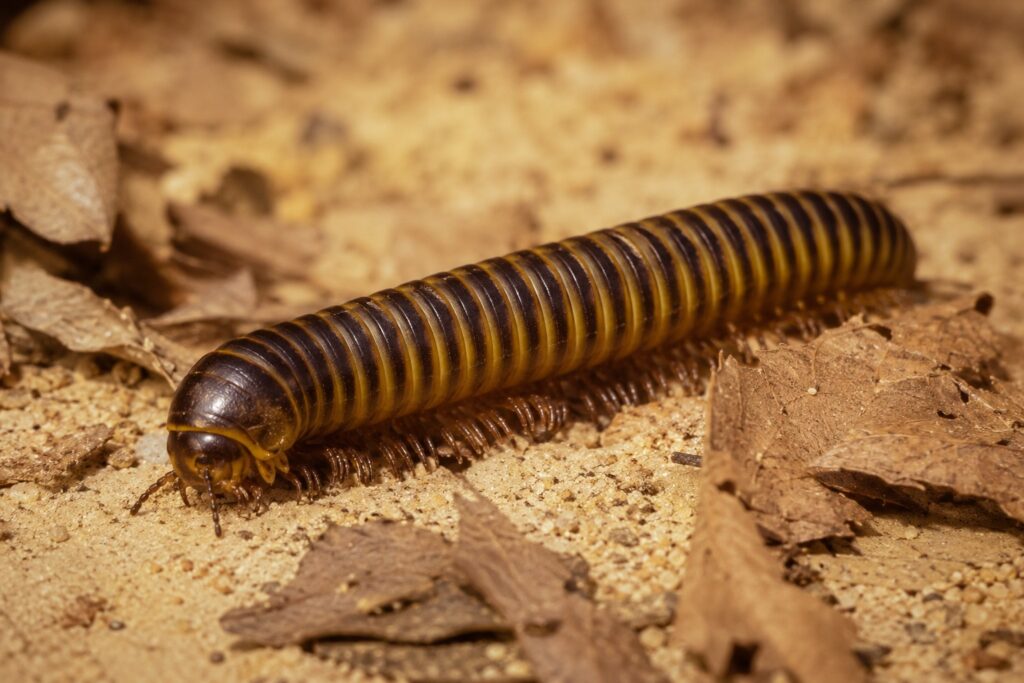
The desert millipede is one of the most underrated invertebrate pets in the hobby. Native to the deserts of the American Southwest, this hardy, gold-banded detritivore is docile enough to handle, capable of living over 10 years, and considerably more forgiving than the tropical species most keepers start with. If you want a millipede that doesn’t demand constant misting and swampy humidity, this is the species to consider.
Desert millipedes (Orthoporus ornatus, also sold as the Sonoran desert millipede or Texas gold millipede) reach 4 to 8 inches at maturity, with robust, cylindrical bodies ranging from golden yellow through orange to dark brown. Their exoskeleton is noticeably thicker and harder than that of African species, an adaptation to the harsh sun and rapid moisture loss of their native habitat.
This guide covers everything you need: enclosure setup, the moisture gradient approach that keeps this species healthy, ventilation (which matters more here than with any other millipede), diet, handling, and breeding. The one thing to understand up front is that desert millipedes need a completely different approach from tropical species. Drier, better ventilated, with localized damp zones rather than uniform humidity.
Species Overview
Desert millipedes are native to the arid regions of the southwestern United States, including Arizona, New Mexico, Texas, and southern California, extending into northern Mexico. They inhabit sandy deserts, rocky foothills, and desert scrub dominated by creosote bush, cholla cactus, and mesquite. In the wild they’re strictly nocturnal, sheltering in burrows and rock crevices through the brutal daytime heat and emerging at night to forage on decaying plant matter.
Adults typically measure 4 to 8 inches, with some individuals reaching close to 9 inches. Coloration varies considerably by locality, from bright golden yellow and orange banding to nearly uniform dark brown. All have the classic rigid, cylindrical millipede body with two pairs of legs per segment.
These are exceptionally docile animals. They have no bite, no sting, and no interest in defending themselves aggressively. When threatened, a desert millipede coils into a tight spiral and may secrete a noxious yellow-brown fluid from glands along its sides. This secretion is harmless in the sense that it can’t seriously injure you, but it irritates skin and is genuinely unpleasant in the eyes, so wash your hands after handling.
One behavior worth knowing: during prolonged dry or cold periods, desert millipedes enter a diapause-like state, burrowing down and aestivating to conserve moisture. A captive millipede that vanishes for weeks is usually either molting or waiting out conditions it doesn’t like.
| Attribute | Details |
|---|---|
| Scientific name | Orthoporus ornatus |
| Adult size | 4-8 inches (10-20 cm) |
| Lifespan | 10+ years |
| Difficulty | Beginner |
| Temperature | 72-82°F (22-28°C) |
| Humidity | 50-70% ambient, with damp substrate zones |
Enclosure Setup
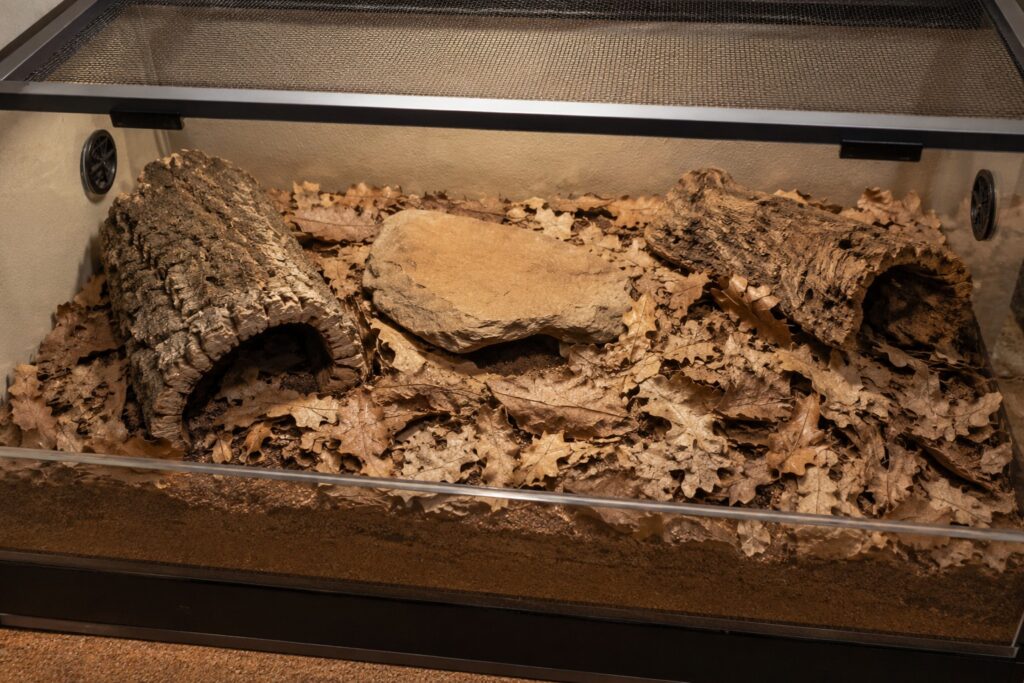
A 10-gallon long-style tank (roughly 20 inches by 10 inches) is the practical minimum for one or two adult desert millipedes. A 20-gallon long is better and comfortably houses a small group. Floor space matters far more than height, since these are terrestrial burrowers rather than climbers. The lid must be secure and tight-fitting, because millipedes are surprisingly persistent at finding gaps.
Ventilation is the defining requirement for this species, and it’s where most keepers coming from tropical millipedes go wrong. Desert millipedes need constant fresh airflow to prevent respiratory problems and fungal issues. Use a screen lid rather than a solid or mostly-covered one. If you’re modifying a plastic bin, cut out 50 to 70% of the lid surface and cover it with mesh screening. Stagnant, saturated air is a genuine health risk for this species.
Substrate should be at least 4 inches deep, and deeper is better. A good working rule for any millipede is substrate depth of one to two times the length of your largest animal, which gives them room to construct proper molting chambers. The mix should be different from a tropical setup: combine organic topsoil (pesticide-free), decaying hardwood, crushed oak leaf litter, and a meaningful proportion of sand. The sand keeps the mix from holding too much water and staying soggy. Our millipede care guide covers the standard tropical mix if you’re comparing setups.
Top the substrate with at least an inch of oak leaf litter. This isn’t decoration, it’s food, and desert millipedes spend a lot of time rooting through it.
Hides and decor: Pieces of dried bark, flat rocks, and cork bark provide daytime shelter. Adding low bark ramps and tunnels encourages visible surface wandering, which makes the animal more interesting to watch. Keep climbing structures low, since a fall onto hard decor can injure a heavy-bodied millipede.
Lighting: None needed. These are nocturnal animals that actively avoid light. Ambient room lighting is fine.
Temperature and Humidity
Desert millipedes do well between 72 and 82°F (22 to 28°C), with a slight drop at night being natural and beneficial. Avoid sustained temperatures below 68°F, which push the animal into inactivity, and avoid spikes into the high 80s. Room temperature works in most homes. If supplemental heat is needed, use a low-wattage heat mat on the side of the enclosure with a thermostat, never underneath, since a burrowing millipede will dig down and could overheat.
Humidity is where desert millipede care differs most from tropical millipede care, and getting it right is the whole game. Rather than maintaining uniform high humidity throughout the enclosure, you want a moisture gradient. Pour water into roughly one third of the substrate until that section is damp but not saturated, leaving the remaining two thirds noticeably drier. This gives the millipede a choice, letting it move between damp and dry zones depending on what it needs, especially when preparing to molt.
Ambient humidity in the 50 to 70% range works well, but the localized damp zone deeper in the substrate is what actually matters for successful molting. A millipede that can’t find a moist pocket will struggle to molt safely.
Re-dampen the moist section every few days as it dries. Light misting once daily is optional and helps, but never let the whole enclosure become uniformly wet. Combined with strong ventilation, this gradient approach prevents both dehydration and the fungal problems that kill desert species kept too wet.
A digital hygrometer takes the guesswork out of this. Tracking humidity and temperature over time makes it far easier to spot the slow drift toward too-dry or too-wet before it becomes a problem.
Diet and Feeding
Desert millipedes are detritivores, which means the bulk of their nutrition comes from the enclosure itself rather than from anything you place in a dish. Decaying hardwood and leaf litter in the substrate are the foundation of their diet, and a well-built enclosure feeds the animal continuously.
Supplemental foods are still worth offering two or three times a week. Fresh vegetables and fruit work well: cucumber, zucchini, squash, carrot, sweet potato, apple, and melon are all readily accepted. Desert millipedes are particularly fond of lichens if you can source them from a pesticide-free area. Offer small portions and remove uneaten food within 24 to 48 hours before it molds.
Calcium is essential and frequently overlooked. Millipedes need calcium to harden each new exoskeleton after molting, and a deficiency causes soft, failed molts. Leave a piece of cuttlebone in the enclosure permanently, or mix crushed eggshell into the substrate. This single step prevents one of the most common causes of premature death.
Some keepers offer a small amount of protein occasionally, such as fish flakes, though this is optional and should be sparing.
Never use substrate, wood, or leaf litter collected from areas treated with pesticides or fertilizers. Millipedes eat their substrate directly, so contamination goes straight into the animal.
Behavior and Handling
Desert millipedes are nocturnal and spend daylight hours burrowed or tucked under bark. Activity picks up after dark, when they emerge to graze on leaf litter and wander the enclosure. Providing bark ramps and open surface areas encourages more visible activity.
Unlike most invertebrate pets, desert millipedes can genuinely be handled. They’re slow, docile, incapable of biting or stinging, and tolerate gentle interaction better than almost any other invert. Let the millipede walk onto a flat, open palm rather than grabbing it, and never pull on the body or legs, which can injure the animal. Keep sessions short and stay seated over a soft surface.
The one caveat is the defensive secretion. A stressed millipede may release a yellow-brown fluid containing benzoquinones from glands along its sides. It smells unpleasant, can temporarily stain skin, and genuinely irritates eyes and mucous membranes. Always wash your hands thoroughly after handling, and keep hands away from your face beforehand.
Molting happens underground. The millipede burrows, seals itself into a chamber, and remains hidden for days or sometimes weeks while it sheds and hardens. This is why deep substrate and a damp zone matter so much. If your millipede disappears, do not dig it up. Disturbing a molting millipede can kill it. After molting, the animal eats its own shed exoskeleton to reclaim the calcium, which is completely normal.
Breeding
Desert millipedes can be bred in captivity, though they reproduce more slowly than many tropical species. Housing several individuals together in a spacious enclosure is the simplest approach, since sexing is difficult and communal housing generally works well for this species.
Sexing requires examining the seventh body segment. Mature males have modified legs called gonopods in place of one pair of walking legs on that segment, giving the area a slightly gapped or altered appearance. Females have normal legs throughout. A magnifying glass helps considerably.
Mating involves the male wrapping around the female and transferring sperm. Afterward, the female deposits eggs in the substrate, often in a small constructed chamber. Clutch sizes vary but can number in the dozens to low hundreds. Incubation typically runs several weeks to around three months depending on temperature.
Hatchlings are tiny, pale, and have only a few body segments with three pairs of legs. They grow through anamorphosis, adding segments and legs with each molt, gradually developing into miniature adults. There’s no parental care, so the young are independent immediately.
Keep the substrate deep and undisturbed if you’re hoping for offspring, and be patient. Desert millipedes reach maturity slowly, and it can take a couple of years for young to reach adult size.
Common Health Issues
Most desert millipede problems trace back to moisture being wrong in one direction or the other.
Dehydration is common when the enclosure lacks a properly damp zone. Signs include a shriveled appearance, inactivity, and reluctance to feed. Re-dampen a section of substrate and check that the moist pocket is reaching deep enough.
Fungal and respiratory problems develop when the enclosure is too wet with insufficient ventilation, which is the more dangerous error for a desert species. Increase airflow, reduce misting, and ensure the drier zones stay genuinely dry.
Failed molts result from shallow substrate, an absent moist zone, or calcium deficiency. Deep substrate, a reliable damp pocket, and permanent access to cuttlebone prevent nearly all of them.
Mites occasionally appear, particularly on wild-caught specimens. A few mites are normal and harmless, but heavy infestations weaken the animal. Improve ventilation and consider adding springtails as a biological cleanup crew.
Substrate contamination from pesticides or treated wood poisons millipedes directly, since they consume their substrate. Source organic materials only.
FAQ
Are desert millipedes good for beginners?
Yes, they’re one of the best beginner millipedes. They’re hardy, tolerate a wider range of conditions than tropical species, can be gently handled, and live over a decade. The main learning curve is understanding the ventilation and moisture gradient approach, which is different from typical tropical millipede care.
How long do desert millipedes live?
Desert millipedes commonly live 10 years or more in captivity, making them one of the longest-lived invertebrate pets available. For lifespan across other species, see our guide on how long millipedes live.
Can desert millipedes be kept together?
Yes. Desert millipedes are communal and do well in groups, provided the enclosure is large enough and has plenty of substrate and leaf litter. The only consideration is that a mixed-sex group will likely produce offspring, so keep a single animal if you don’t want babies.
How are desert millipedes different from giant African millipedes?
The main difference is environment. Desert millipedes need drier conditions, strong ventilation, and a moisture gradient, while giant African millipedes need consistently high humidity throughout. Desert species also have a noticeably harder, thicker exoskeleton and tend toward gold and orange coloration. Our giant African millipede care guide covers the tropical approach in detail.
Do desert millipedes bite?
No. Desert millipedes have no biting mouthparts capable of harming a human and no venom whatsoever. Centipedes are the ones with venom, and the two are frequently confused. Our millipede vs centipede guide covers how to tell them apart at a glance. Their only defense is coiling up and releasing an irritating secretion. Wash your hands after handling and avoid touching your eyes.
Track Your Millipede with InvertMate
A desert millipede can be part of your household for over a decade, which means a lot of molts and substrate changes to keep track of. InvertMate lets you log molts, monitor humidity and temperature trends, and set reminders for feeding and maintenance. Built for invertebrate keepers who care about the details. Free on the App Store.