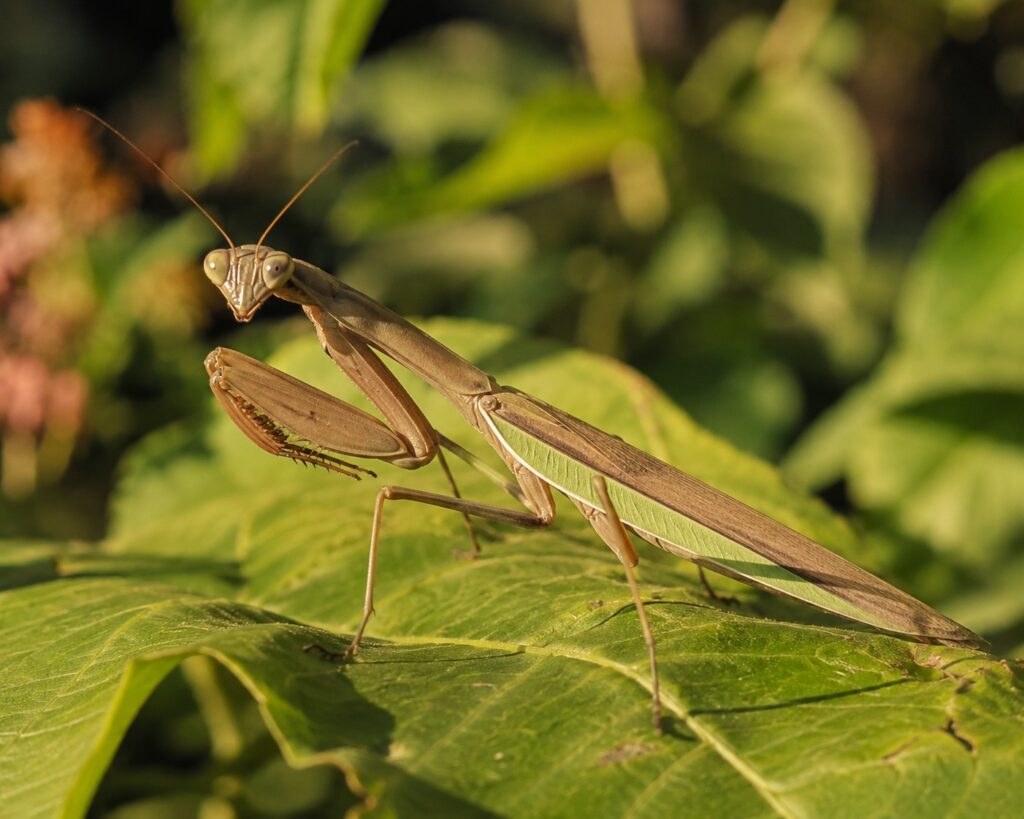
The Chinese mantis is the most popular pet mantis species in North America, and it earned that spot by being big, tough, and nearly impossible to kill through beginner mistakes. Originally introduced from China in the 1890s as a biological pest control agent, Tenodera sinensis has since established wild populations across the entire continental United States. Chances are, if you’ve ever seen a large mantis in your garden, it was a Chinese mantis.
In captivity, they’re the species most commonly recommended alongside ghost mantises as a first pet mantis. Where ghost mantises win on calm temperament and unique appearance, Chinese mantises win on sheer size and hardiness. An adult female can reach over 4 inches, making them one of the largest mantises you’ll encounter in the hobby. They eat almost anything, tolerate room temperature, and rarely have molting problems.
This guide covers everything you need to keep a Chinese mantis: enclosure setup, temperature and humidity, feeding at every instar, molting, breeding (including their famous oothecae), and the common issues to watch for. For general mantis care principles, see our praying mantis care 101.
Species Overview
The Chinese mantis (Tenodera sinensis) belongs to the family Mantidae and is native to China, Japan, and other parts of East and Southeast Asia. After being introduced to North America for pest control, it became one of the most widespread mantis species on the continent. It’s now found in gardens, meadows, woodland edges, and suburban areas across the US.
Adults are large and stick-like with a long, narrow body. Coloration ranges from brown to green, with most individuals showing a mix of both. The wings have a distinctive green stripe along the outer edge, which is one of the easiest identification markers. Females reach 8-11 cm (3-4.3 inches), while males are slightly smaller and slimmer at 7-9 cm (2.8-3.5 inches), Length is not the whole story. Hierodula membranacea is shorter overall but far broader through the thorax and abdomen, so a giant Asian female looks like the heavier animal even next to a longer Chinese mantis. If you want bulk rather than reach, that is the species to compare against.
Their temperament is docile by mantis standards. They tolerate handling well, rarely display defensive threat postures, and have a strong but not overly aggressive feeding response. They’re sometimes described as the “golden retriever” of the mantis world: large, friendly, easy to manage, and always happy to eat.
| Attribute | Details |
|---|---|
| Scientific name | Tenodera sinensis |
| Adult size | Females: 8-11 cm; Males: 7-9 cm |
| Lifespan | 8-14 months (total) |
| Difficulty | Beginner |
| Temperature | 68-82°F (20-28°C) |
| Humidity | 55-70% |
For detailed lifespan data across species, see our praying mantis lifespan guide.
Enclosure Setup
Chinese mantises are large, so they need proportionally larger enclosures than smaller species. The Rule of Three applies: height at least 3 times body length, width at least 2 times.
For an adult female at 10+ cm, that means a minimum of about 12 inches tall and 8 inches wide. An Exo Terra 30x30x45 cm terrarium or a large mesh pop-up enclosure works well. For nymphs through about L5, a 32 oz deli cup is perfectly adequate.
Enclosure options:
- Deli cups (16-32 oz): Ideal for nymphs from L1 through L5-L6. Cheap, easy to clean, and the small space makes it easier for nymphs to find fruit flies.
- Mesh pop-up enclosures: Great for sub-adults and adults. Excellent ventilation and grip surfaces. The mantis can hang from every wall.
- Glass terrariums with mesh lids: Best for display. Retain some humidity while the mesh provides ventilation and a molting surface.
Furnishings:
- Vertical branches and twigs for perching (the mantis will spend most of its time on these)
- Artificial or live plants for visual cover
- A mesh or textured ceiling for safe molting (critical)
- Paper towel or thin coconut coir layer as optional substrate
Chinese mantises are large enough that adult enclosures should have some open space for hunting. Don’t over-clutter with decor, as prey can hide and the mantis may not find its food.
Free-ranging: Some experienced keepers allow adult Chinese mantises to free-range on a houseplant or curtain in a bug-safe room. This works because Chinese mantises are relatively sedentary and tend to stay in one spot for extended periods. It’s not recommended for beginners, but it’s an option once you’re comfortable with the species.
Temperature & Humidity
Chinese mantises are famously adaptable to a wide range of conditions, which is one of the main reasons they’re so beginner-friendly.
Temperature: They thrive between 68-82°F (20-28°C), which is essentially room temperature. No supplemental heating is needed in most homes. They can tolerate brief dips into the low 60s without serious harm, though activity and appetite decrease at cooler temperatures.
Warmer temperatures (75-82°F) speed up metabolism, growth, and feeding response. Cooler temperatures (68-74°F) slow everything down and extend lifespan. Both are perfectly healthy ranges. This species is far more tolerant of temperature fluctuations than tropical species like orchid mantises.
Humidity: Target 55-70%. Mist the enclosure once daily or every other day. Chinese mantises are not particularly humidity-sensitive, and molting problems are rare with this species even at moderate humidity levels. The misting primarily provides drinking water (they lap droplets from surfaces) and a brief humidity boost.
Let the enclosure dry between mistings. Chinese mantises handle dry conditions better than most tropical species, so err slightly on the dry side rather than creating a constantly damp environment.
Diet & Feeding
Chinese mantises are enthusiastic, non-picky eaters. They’ll accept almost any live insect offered to them, which makes feeding straightforward compared to species that strongly prefer flying prey.
Feeding by life stage:
L1-L3 nymphs: Drosophila melanogaster and D. hydei (fruit flies). Feed daily or every other day. L1 nymphs from an ootheca hatch are tiny and fragile. Many die in the first week regardless of care. Starting with L3-L4 nymphs purchased from a breeder avoids this high-mortality early stage.
L4-L5 nymphs: Houseflies, small crickets, blue bottle flies. Feed every 1-2 days.
L6 to sub-adult: Crickets, blue bottle flies, dubia roach nymphs, superworms. Feed every 2-3 days.
Adults: Crickets, dubia roaches, blue bottle flies, waxmoths, moths, superworms. Feed every 3-5 days. Prey should not exceed one-third of the mantis’s body length.
Feeding notes:
- Chinese mantises accept crickets readily, which is convenient since crickets are the most widely available feeder insect. Many picky species refuse crickets; Chinese mantises eat them without hesitation.
- Don’t overfeed. Despite their willingness to eat, obesity shortens lifespan and increases molting risk. If the abdomen looks very round and swollen between feedings, skip a meal or two.
- Pre-molt fasting (3-7 days) is normal. Stop offering food and remove any live prey from the enclosure.
- Remove uneaten prey within 24 hours. Even for this large, robust species, a cricket can injure a molting mantis.
Behavior & Handling
Chinese mantises are among the most handleable mantis species. They’re calm, slow-moving (for a mantis), and tolerate being on a hand or arm without panicking. Many keepers describe them as “mellow” compared to more skittish species.
They spend most of the day perched motionless on a branch or enclosure wall, swaying gently. When prey is introduced, they track it with their head (mantises can rotate their heads nearly 180 degrees), then strike when the prey comes within range. The transition from stillness to strike is impressively fast.
Handling tips:
- Place your hand flat in front of the mantis and gently encourage it to walk onto your palm
- They’re large enough to feel substantial on your hand, which makes handling feel more natural than with tiny species
- Don’t handle within 3 days of a molt
- Keep sessions brief (a few minutes) and handle over a soft surface
Threat displays are uncommon with Chinese mantises but can happen if they feel cornered. The mantis raises its forelegs and fans its wings to appear larger. This is defensive posturing, not aggression. Simply give it space.
Communal keeping is not safe. Chinese mantises are cannibalistic and will eat each other. One per enclosure, always.
Molting is generally problem-free with this species, which is another beginner advantage. They go through 8-10 molts from hatching to adulthood. Nymphs molt every 2-3 weeks, sub-adults every 4-6 weeks. Provide adequate height, a mesh ceiling, and moderate humidity, and molting issues are rare.
Breeding
Breeding Chinese mantises is straightforward and often the first breeding project for mantis keepers. Their large oothecae, easy-to-manage adults, and abundant nymph hatches make them ideal for learning mantis breeding techniques.
Sexing: Males have 8 abdominal segments visible on the underside, females have 6. Adult males are slimmer with longer wings and antennae. Females are heavier with a broader abdomen.
Timing: Females should be at least 2-3 weeks past their final molt. Males mature at a similar rate, so synchronization is easier than with dimorphic species like orchid mantises.
Mating: Feed the female heavily before introducing the male. Place the male behind the female and allow him to approach. Mating can last several hours. Supervise the encounter. The female may eat the male during or after mating (this is natural but not inevitable). Having multiple males available is good insurance.
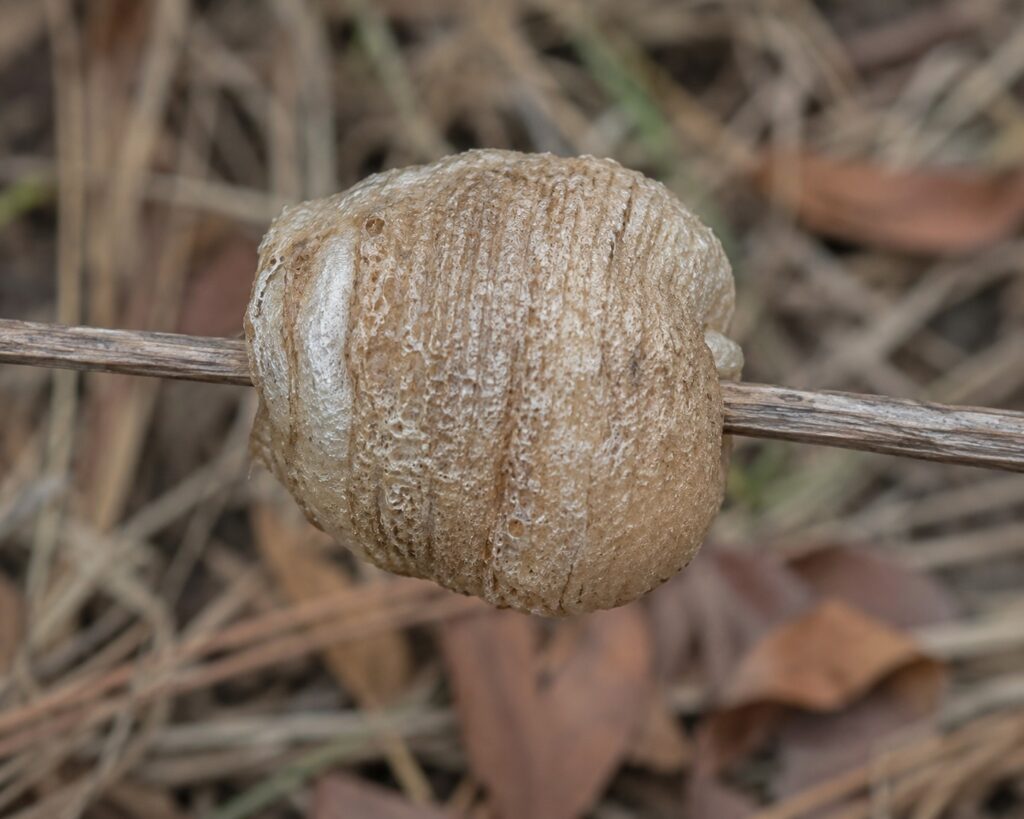
Oothecae: After mating, the female produces large, foam-like oothecae. Chinese mantis oothecae are distinctive: tan or brown, roughly the size of a ping-pong ball, with a ridged surface. They’re attached to branches, walls, or other surfaces. Each ootheca contains 100-300+ eggs.
In the wild, oothecae overwinter and hatch in spring when temperatures warm. In captivity, you can either refrigerate the ootheca for 6-8 weeks (simulating winter) then warm it up to trigger hatching, or keep it at room temperature where it will hatch in 4-8 weeks.
Be prepared: a single ootheca can produce 100-200+ nymphs simultaneously. You’ll need many small containers and a large fruit fly supply to raise even a fraction of them. Most keepers sell, trade, or release the excess.
Common Health Issues
Overfeeding is the most common issue with Chinese mantises because they eat so willingly. An obese mantis is at higher risk for abdominal tears during molting and has a shortened lifespan. Monitor abdomen size and skip feedings if it looks very swollen.
Nymph mortality is high in L1-L2, especially from ootheca hatches. Tiny nymphs can’t find food, drown in water droplets, or simply fail to thrive. This is natural (in the wild, most nymphs are eaten by siblings or predators). Starting with L3+ nymphs from a breeder avoids this frustration.
Failed molts are uncommon but can happen if humidity is too low or the molting surface is inadequate. Ensure the enclosure has a textured ceiling and maintain at least 55% humidity.
Pesticide exposure is a risk for wild-caught Chinese mantises. Garden mantises may have been exposed to insecticides, herbicides, or treated plants. If you bring one in from outside, observe it for a few days before handling.
Cold drafts from windows or air conditioning can stress the mantis. Place the enclosure in a stable temperature zone away from direct airflow.
FAQ
Are Chinese mantises good for beginners?
They’re one of the two most recommended beginner species (alongside ghost mantises). Their large size, docile temperament, broad diet, room-temperature tolerance, and rare molting issues make them ideal for first-time keepers. They’re also widely available and inexpensive.
How big do Chinese mantises get?
Adult females reach 8-11 cm (3-4.3 inches), making them one of the largest pet mantis species commonly available. Males are slightly smaller at 7-9 cm. Their long, stick-like body shape makes them appear even larger than their measurements suggest.
How long do Chinese mantises live?
Total lifespan is 8-14 months from hatching. Adult females live 6-9 months after their final molt at room temperature. Males have shorter adult lifespans (3-5 months). Cooler temperatures extend lifespan; warmer temperatures shorten it.
Where can I find a Chinese mantis?
They’re widespread across the US and commonly found in gardens, meadows, and suburban yards from late summer through fall. You can also buy nymphs or adults from online breeders, or purchase oothecae (egg cases) for $5-10 and hatch them yourself. Garden supply stores sometimes sell oothecae for pest control purposes. Our guide to praying mantises as pets covers buying from breeders versus collecting wild, and what to expect either way.
How many babies come from one Chinese mantis egg case?
A single ootheca can produce 100-300+ nymphs. In captivity, be prepared for a massive hatch. You’ll need many small containers and a large fruit fly supply. Most keepers sell, trade, or release the surplus nymphs rather than attempting to raise all of them.
Track Your Mantis with InvertMate
Keep a detailed care log for your Chinese mantis with InvertMate. Track every molt, log feedings, monitor enclosure conditions, and set reminders for care tasks. Free on the App Store.