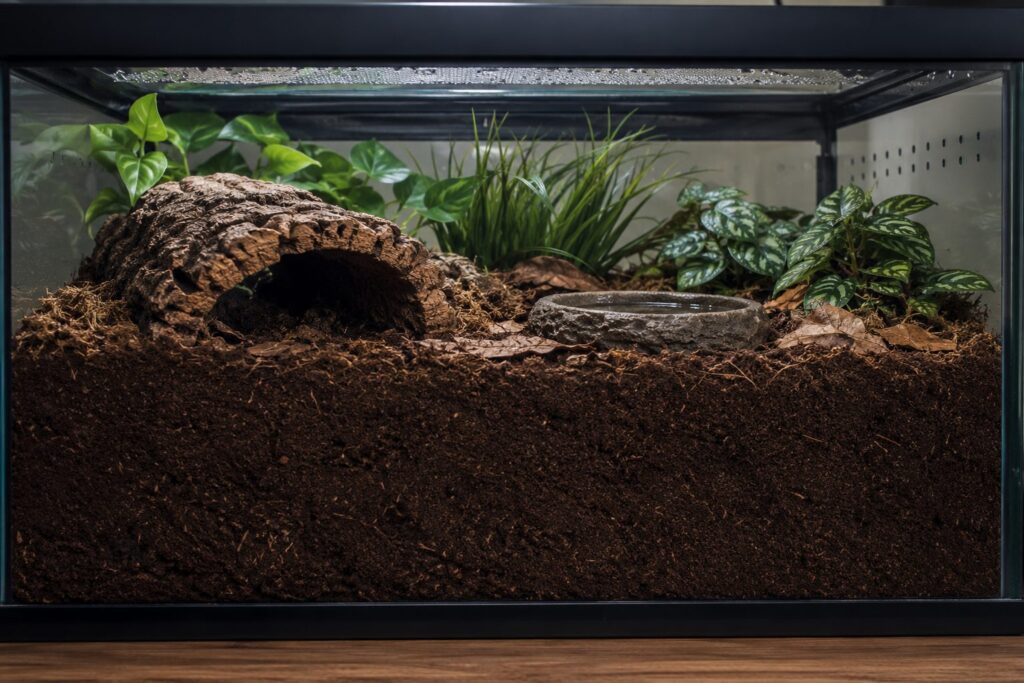
A terrestrial tarantula enclosure needs more floor space than height, with most of that height filled by substrate. The gap between the substrate surface and the lid should be no more than one and a half times the spider’s leg span, because a terrestrial tarantula that climbs and falls can rupture its abdomen fatally.
Almost everything else about a terrestrial setup is straightforward. Get the fall height right, give the animal a hide and a water dish, and you have covered most of what matters. This guide covers sizing by leg span, substrate depth and mix, ventilation, the fossorial species that want something different, and the rehousing routine.
Terrestrial, Fossorial or Arboreal?
Three lifestyle categories drive enclosure design, and most species sit clearly in one.
Terrestrial species live on the ground surface, using a hide or a shallow scrape. This covers most beginner species, including the chaco golden knee and other Grammostola, along with Brachypelma, Tliltocatl, Aphonopelma, and Lasiodora.
Fossorial species dig, sometimes deeply, and may spend months underground. Ceratogyrus, Cyriopagopus, Hysterocrates, and many Aphonopelma fall here. They need the same floor plan with far deeper substrate.
Arboreal species live off the ground on vertical surfaces and need the opposite: height, vertical cork bark, and more ventilation. Poecilotheria, Avicularia pink toes, Caribena, and Psalmopoeus all sit here, and the build is covered separately in our guide to the arboreal enclosure.
Plenty of species blur the lines. Juveniles of many terrestrial species burrow heavily and grow out of it, and some adults dig a scrape under their hide and effectively become semi-fossorial. Which group your species belongs to also correlates loosely with defensive behaviour, and the broader picture is in our comparison of tarantula groups by hemisphere.
Enclosure Size by Leg Span

Size to the animal, not to what looks generous. A large enclosure makes a terrestrial tarantula harder to monitor, makes prey harder to find, and adds fall height.
| Leg span (DLS) | Enclosure footprint | Typical container |
|---|---|---|
| Under 0.75 inches | 2 to 3 times DLS square | 2 to 4 dram vial |
| 0.75 to 1.5 inches | 3 times DLS square | 2 to 4 oz deli cup |
| 1.5 to 3 inches | 3 times DLS square | 32 oz deli cup or small acrylic |
| 3 to 5 inches | Around 3 times DLS | 5 to 8 inch acrylic or 5 gallon tank |
| 5 inches and up | 12 by 12 inches or more | 10 gallon tank or large acrylic |
The floor rule: width and depth should each be roughly two to three times the spider’s leg span. That gives room to move and turn without creating a space it cannot patrol.
The height rule: measure from the substrate surface, not the enclosure floor. No more than 1.5 times leg span of open air above the substrate. A 5 inch tarantula in a 10 gallon tank needs enough substrate that only 7 or 8 inches of air remains, which is a lot of substrate, and that is the point.
A 10 gallon tank is the practical ceiling for almost any terrestrial species. Bigger is not better here.
Housing for the smallest sizes has its own considerations, covered in our guide to raising tarantula spiderlings.
Substrate
Depth: for a terrestrial species, fill to the point where the remaining air gap meets the height rule, usually 3 to 5 inches for an adult. For a fossorial species, go deeper: 6 to 10 inches, or roughly three times the animal’s leg span.
Mix. A workable general blend:
- 3 parts coconut fibre
- 2 parts peat-free topsoil with no fertiliser or perlite
- 1 part play sand
- Optional handful of vermiculite for moisture retention in humid species
Coconut fibre alone works and is what many keepers use. Its weakness is that it does not hold a burrow well, so any digging species benefits from soil and sand in the mix.
Packing matters. Add the substrate slightly damp and press it down firmly, layer by layer. Loose fluffy substrate collapses under a digging spider and gives no structure to a burrow. It should hold a thumbprint.
What to avoid: vermiculite alone, gravel, bark chips as a base layer, cedar or pine shavings, and anything scented or marketed with additives. Reptile calcium sand is unsuitable.
Hide, Water Dish and Decor
A hide is not optional. Cork bark laid on its side, half a cork round, or a piece of curved bark half buried at one end works. Bed one edge into the substrate so it cannot shift, and start a small divot underneath it, which many spiders will accept and extend.
Water dish, always filled. A shallow ceramic or plastic dish for anything over about an inch and a half. Below that, dribble water down one wall instead. Slings can drown in a full dish. Refill rather than top up, and rinse it when it gets fouled.
Decor beyond that is for you, not the spider. A little dry leaf litter gives web anchor points and looks natural. Fake plants are harmless. Skip anything tall or hard the animal could fall onto, and skip live plants, which mostly die in these conditions.
Nothing sharp, nothing unstable. Stacked rocks are a genuine hazard in a tarantula enclosure, unlike in a scorpion setup where the animal is built for it.
Ventilation
A terrestrial tarantula enclosure needs less airflow than an arboreal one, but more than none. Cross ventilation beats lid holes alone.
Put a band of small holes around the sides just above the substrate line, plus a second band higher up or in the lid. Air needs somewhere to enter and somewhere to leave, and holes only in the lid give you a stagnant column.
Use a pin heated over a flame on plastic containers, which gives clean holes a spider cannot widen. For acrylic enclosures, the vents are built in. Check hole size against your smallest animal, since slings escape through gaps that look impossibly small.
Stagnant humid air is what causes mold and, in a damp enclosure, contributes to fungal problems. If you see mold on the substrate surface, add ventilation before doing anything else.
Temperature and Humidity
Room temperature suits nearly every commonly kept terrestrial species. Anywhere from 70 to 80F is fine, and most tolerate the low 60s briefly without harm. Supplemental heat is rarely needed indoors.
If you do heat, use a low wattage mat on a side wall with a thermostat, never underneath the enclosure. A mat below bakes the substrate where the spider sits or burrows and drives out moisture.
Humidity is species specific and not a terrestrial trait. Arid species such as Grammostola want dry substrate and a full water dish. Tropical species such as Lasiodora or Theraphosa want a damp section, achieved by pouring water down one corner rather than misting. Misting an enclosure accomplishes little for the substrate and stresses the animal.
A dried out enclosure is the leading cause of preventable death, and it presents as legs folding beneath the body, which is the tarantula death curl. Keep the dish full and check it as a habit.
Rehousing
Expect to rehouse several times as a spider grows. The routine is the same each time.
- Prepare the new enclosure completely first, substrate packed, hide bedded in, water dish filled.
- Work inside a large empty bin or a bathtub, so a bolting spider has somewhere containable to go.
- Have a catch cup and a card ready in your hand, not across the room.
- Coax, do not grab. A long soft paintbrush or a pair of long tongs used gently behind the spider encourages it forward.
- If it has webbed itself into a burrow, lift the whole clump of substrate and hide into the new enclosure and let it re-dig rather than excavating it.
- Move slowly. Most bites and most falls happen when a keeper rushes.
Do not rehouse an animal in pre-molt, meaning one with a dark taut abdomen that has stopped eating. Wait until a week or two after the molt when the exoskeleton has hardened. Molt timing is the thing worth having written down, and log molts in InvertMate gives you the dates when you need to decide whether it is safe to move an animal.
Common Terrestrial Tarantula Enclosure Mistakes
- Too much open height. The most consequential error, and the reason for the 1.5 times leg span rule.
- Enclosure far too large. The spider cannot find prey and you cannot find the spider.
- Loose, unpacked substrate. Collapses under burrowing and holds no structure.
- Heat mat underneath. Bakes the substrate and dries the enclosure out.
- No hide. A tarantula with nowhere to retreat sits exposed and stressed.
- Empty water dish. The single most common cause of preventable death.
- Misting instead of wetting substrate. Feels like husbandry, achieves very little.
- Lid holes only. Gives a stagnant column of air rather than cross flow.
- Rocks or hard decor. Fall hazards with no upside.
FAQ
How big should a terrestrial tarantula enclosure be?
Roughly two to three times the spider’s leg span in width and depth, with no more than 1.5 times leg span of open air above the substrate. A 10 gallon tank is ample for even a large adult, and anything larger makes monitoring and feeding harder.
How deep should substrate be for a terrestrial tarantula?
Three to five inches for most adult terrestrial species, deep enough to bring the remaining air gap within 1.5 times leg span. Fossorial species that burrow properly want 6 to 10 inches, packed firmly so tunnels hold their shape.
Do terrestrial tarantulas need a water dish?
Yes, filled at all times, for anything over about an inch and a half in leg span. Smaller spiders should get water dribbled down an enclosure wall instead, since they can drown in a standing dish.
Can I keep a terrestrial tarantula in a tall tank?
Only if you fill most of it with substrate. Terrestrial species climb glass and can fall, and a fall from height can rupture the abdomen fatally. Reduce usable height with substrate rather than leaving open air.
Do terrestrial tarantulas need heat?
Rarely. Room temperature between 70 and 80F suits nearly all commonly kept species. If your home runs colder, use a low wattage mat on a side wall with a thermostat, never underneath the enclosure.
How often should I rehouse a terrestrial tarantula?
Whenever it has outgrown the size guide above, typically several times through the first few years. Never rehouse a spider in pre-molt, and wait one to two weeks after a molt so the new exoskeleton has hardened, as covered in our guide to tarantula molting.
Track Your Enclosures with InvertMate
Once you have several enclosures running, the details that matter most are the ones easiest to lose track of: which needs its damp corner refreshed, which spider is in pre-molt, which was last rehoused when. InvertMate lets you log molts and rehousing dates, monitor enclosure temperature and humidity, and set reminders for water dish checks. Free on the App Store and Play Store.