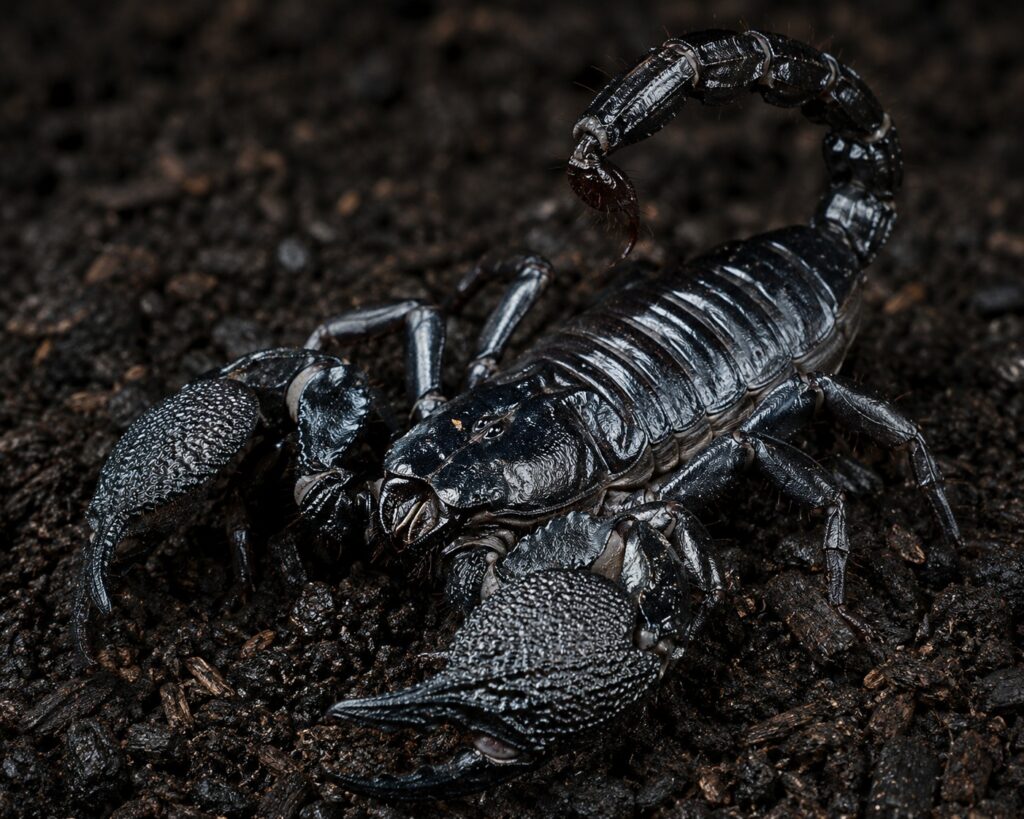
Emperor scorpion care is about as straightforward as arachnid keeping gets. Pandinus imperator is the species most people think of when they picture a pet scorpion: massive, jet-black, impressively armed with oversized pincers, and far gentler than it looks. They’re the “gentle giants” of the scorpion world, preferring to pinch rather than sting and packing venom roughly equivalent to a bee sting.
If you’ve been curious about keeping a scorpion but worried about the danger factor, the emperor is your answer. Their mild venom, docile temperament, and tolerance for handling make them the most commonly recommended beginner scorpion. They’re also one of the few scorpion species that can be kept communally, which adds another layer of interest for keepers who want to observe social behavior. If you’re weighing options, tailless whip scorpions are the other common entry point into arachnid keeping, though they’re not true scorpions.
This guide covers everything: enclosure setup, the critical role of humidity, temperature, feeding, handling (including the pinch you should expect), molting, breeding, and the CITES conservation status you should know about before buying.
Species Overview
The emperor scorpion (Pandinus imperator) is native to the tropical rainforests and humid savannas of West Africa, found in countries including Ghana, Nigeria, Togo, Sierra Leone, and the Congo region. In the wild, they live in communal burrows beneath leaf litter, inside rotting logs, and within termite mounds, spending their days hidden and emerging at night to hunt.
Adults are massive by scorpion standards. They typically reach 6-8 inches (15-20 cm) in length, making them one of the largest scorpion species in the world. Size varies considerably with genetics and feeding. Our emperor scorpion size guide breaks down growth by age and what affects final adult size. Their bodies are glossy black (sometimes appearing dark blue or green under certain lighting), with large, heavily textured pedipalps (pincers) that are their primary weapons. The metasoma (tail) ends in a relatively small stinger, which hints at their defensive strategy: emperor scorpions rely on their powerful claws rather than their venom.
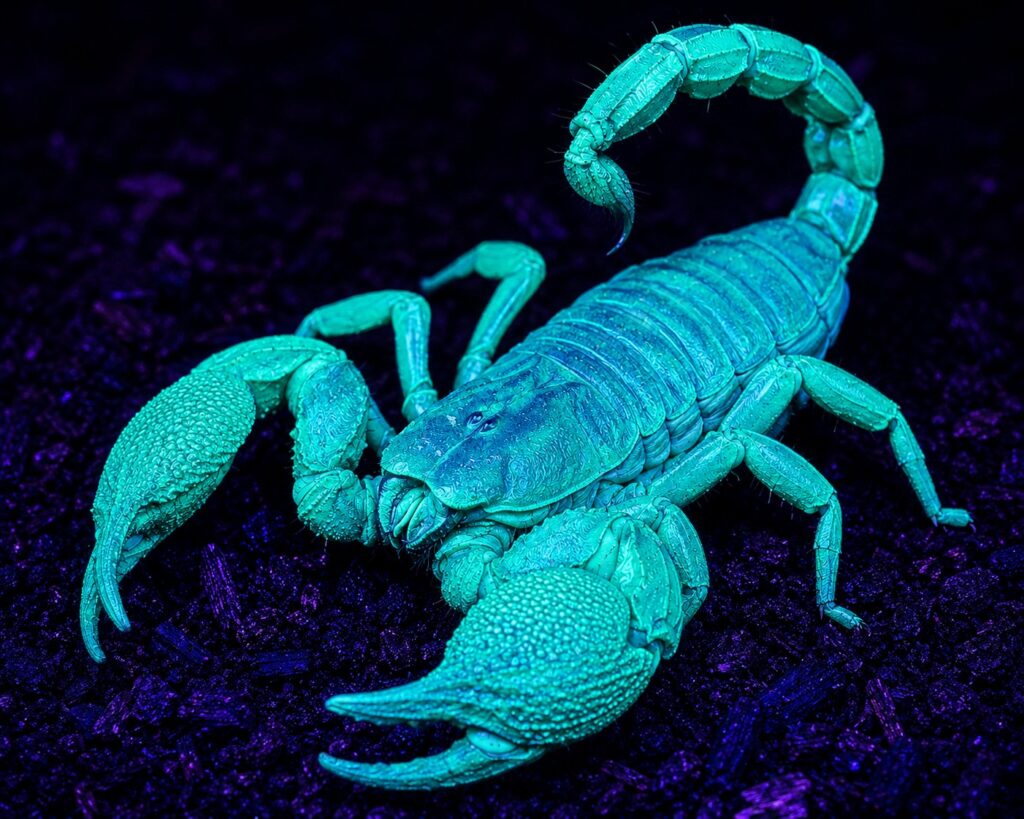
One of the most famous traits of emperor scorpions is their UV fluorescence. Under ultraviolet (blacklight) light, their exoskeleton glows a vivid blue-green. The biological purpose of this fluorescence is still debated, but for keepers, it makes for a spectacular nighttime display.
Emperor scorpions are listed under CITES Appendix II due to overcollection from the wild for the pet trade. This means international trade is regulated. Always buy captive-bred specimens when possible to support conservation and ensure healthier animals.
| Attribute | Details |
|---|---|
| Scientific name | Pandinus imperator |
| Adult size | 6-8 inches (15-20 cm) |
| Lifespan | 6-8 years |
| Difficulty | Beginner |
| Temperature | 75-85°F (24-29°C) |
| Humidity | 70-90% |
Enclosure Setup
Emperor scorpions are terrestrial burrowers that need floor space and deep substrate more than vertical space.
Tank size: A 10-gallon glass aquarium is the minimum for a single adult. For a communal group of 2-4 scorpions, a 20-gallon long tank provides adequate space. Larger is always better, especially for communal setups where each animal needs room to establish territory.
Lid: A tight-fitting mesh screen lid with clips or locks is essential. Emperor scorpions are surprisingly strong and can push off a loose lid. They’re not great climbers, but a secure enclosure prevents any risk of escape.
Substrate is the most important element of the enclosure. Emperor scorpions are enthusiastic burrowers, and deep substrate is critical for both behavioral enrichment and humidity retention.
Provide 5-6 inches of moisture-retaining substrate. Good options include:
- Coconut coir (Eco Earth) as a base
- A mix of coconut coir and organic topsoil (50/50)
- Coconut coir and peat moss (50/50)
The substrate should be moist enough to hold the shape of a burrow when squeezed but not waterlogged. Think of the consistency of a wrung-out sponge. Avoid sand, gravel, or calcium sand, which don’t retain moisture and can cause impaction.
Hides are essential. Provide at least two: one on the warm side and one on the cool side. Cork bark flats, coconut shell halves, reptile caves, or stacked flat rocks (secured so they can’t collapse) all work well. In a communal setup, provide one hide per scorpion minimum.
Water dish: A shallow water dish should be available at all times. Keep it shallow enough that the scorpion can’t submerge and potentially drown. A few small rocks or pebbles in the dish provide a safe exit ramp. Replace water daily.
Decor is optional. Fake plants, driftwood, and leaf litter add visual interest and give the scorpion more cover. Live plants like pothos can help maintain humidity, though the scorpion may uproot them while burrowing.
Lighting is not needed. Emperor scorpions are strictly nocturnal. Room lighting provides a sufficient day/night cycle. A UV blacklight is a fun addition for nighttime viewing, as it makes the scorpion fluoresce blue-green. Don’t leave the blacklight on continuously, as the long-term effects on scorpions are unknown.
Temperature & Humidity
Emperor scorpion care revolves around two things: warmth and humidity. Get these right and the rest is easy.
Temperature should be maintained at 75-85°F (24-29°C) with a gradient across the enclosure. The warm side should reach 80-85°F, and the cool side should sit around 72-75°F. This lets the scorpion thermoregulate by moving between zones.
Use an under-tank heat mat placed on the side wall (not the bottom) of the enclosure. This is critical: emperor scorpions burrow to escape heat. If the heat mat is on the bottom, the scorpion burrows down expecting cooler temperatures and instead hits the hottest spot, which can be fatal. Side-mounting creates a horizontal gradient that the scorpion navigates naturally. Always connect the heat mat to a thermostat.
Avoid heat lamps for this species. They dry out the enclosure too quickly and work against the high humidity these scorpions need.
Humidity is the single most important factor in emperor scorpion care. They are highly susceptible to desiccation and need consistently high humidity of 70-90%.
Maintain humidity by:
- Keeping the substrate consistently moist (not saturated)
- Misting the enclosure 1-2 times daily
- Overflowing the water dish slightly to dampen surrounding substrate
- Adding sphagnum moss on top of the substrate in areas to help retain moisture
A digital hygrometer inside the enclosure is essential. If humidity consistently drops below 65%, your scorpion is at risk. Check that your mesh lid isn’t allowing too much moisture to escape. Covering part of the mesh with plastic wrap or a piece of glass can help retain humidity while still allowing some airflow.
Diet & Feeding
Emperor scorpions are opportunistic predators with slow metabolisms. They don’t need to eat frequently, and overfeeding is actually a bigger concern than underfeeding.
Suitable prey:
- Gut-loaded crickets (the most common feeder)
- Dubia roach nymphs
- Mealworms (occasionally)
- Waxworms (as a treat)
- Superworms (for large adults)
Feeding schedule:
- Adults: 2-3 appropriately sized prey items once per week
- Juveniles: 2-3 smaller prey items twice per week
Sizing: Prey should be no larger than the width of the scorpion’s body (not counting the pincers). Emperor scorpions use their massive pedipalps to crush and tear prey rather than relying on their stinger, so they can handle relatively large insects.
Important rules:
- Remove uneaten live prey within 24 hours. Crickets can stress or injure a molting scorpion.
- Watch the abdomen. If it looks plump and rounded, reduce feeding frequency. If it looks shrunken or wrinkled, feed more and check humidity.
- Emperor scorpions can go weeks without eating with no ill effects. A healthy adult that refuses food is not necessarily sick. Check conditions first.
- Gut-load your feeder insects with fresh vegetables 24 hours before offering them to the scorpion. This passes extra nutrition through to your pet.
Behavior & Handling
Emperor scorpions are the most handleable scorpion species in the hobby, but “handleable” comes with an important caveat: their pincers are powerful and a pinch from an adult can draw blood. They’re far more likely to pinch than sting, and their venom is mild (comparable to a bee sting), but the mechanical force of those pedipalps is no joke.
Day-to-day behavior: Emperor scorpions are nocturnal. During the day, they stay burrowed or hidden under their hides. At night, they emerge to patrol, hunt, and drink. You’ll see the most activity after dark. A dim red light or UV blacklight lets you observe without disturbing them.
Handling tips:
- Approach slowly from the side, not from above (above mimics a predator)
- Use long rubber-tipped tongs to gently nudge the scorpion onto a flat hand or into a container
- Let the scorpion walk across your hands. Don’t grip or restrain it.
- Keep your hands low over a soft surface in case of a fall
- If it raises its pincers and assumes a defensive stance, back off and try another time
- Wash your hands after handling
Handling is best kept to a minimum. While emperor scorpions tolerate it better than most arachnids, frequent handling causes stress. Reserve it for occasional observation or necessary maintenance transfers.
Communal keeping is one of the most appealing aspects of emperor scorpions. Unlike most scorpion species, P. imperator can be housed in groups. In the wild, they live in communal burrows with mixed-age groups. In captivity, communal groups show fascinating social behavior: they’ll huddle together, share hides, and generally coexist peacefully.
Requirements for successful communal keeping:
- Large enclosure (20+ gallons for 2-4 scorpions)
- Multiple hides (at least one per scorpion)
- Adequate food for all individuals (a hungry scorpion is more likely to become aggressive)
- Introduce all group members at the same time if possible
- Monitor for aggression, especially during feeding
Molting
Emperor scorpions molt periodically throughout their lives, shedding their old exoskeleton to grow. Juveniles molt more frequently (every few months), while adults molt roughly once a year.
Pre-molt signs:
- Reduced appetite or complete refusal to eat
- Less activity, spending more time burrowed
- The exoskeleton may appear dull or slightly lighter in color
During the molt, the scorpion typically burrows underground. You may not see the process at all. Do not dig up a molting scorpion under any circumstances. Remove all live prey from the enclosure. Ensure humidity is at the higher end of the range (80-90%).
After the molt, the new exoskeleton is soft and pale, gradually darkening over several days. The scorpion will remain hidden until the exoskeleton hardens. Wait at least one week before offering food. The new exoskeleton needs time to harden before the scorpion can safely crush prey with its pedipalps.
Humidity is critical for molting. If the enclosure is too dry, the old exoskeleton can harden before the scorpion fully emerges, causing a stuck molt. This is one of the most common causes of death in captive emperor scorpions and is entirely preventable by maintaining proper humidity.
Breeding
Breeding emperor scorpions in captivity is achievable and rewarding, though it requires patience and proper conditions.
Sexing: Males have slightly wider pectines (comb-like sensory organs on the underside of the body near the genital opening). Males also tend to be slightly smaller and slimmer than females. Sexing is difficult without experience, and examining the pectines requires handling the scorpion.
Mating: Emperor scorpions perform an elaborate courtship “dance” called the promenade à deux. The male grasps the female’s pincers with his own and leads her in a back-and-forth dance while searching for a suitable surface to deposit his spermatophore (sperm packet). A flat stone or piece of slate in the enclosure helps facilitate this process. The female then positions herself over the spermatophore to collect the sperm.
Mating should be supervised. While cannibalism is rare in this species compared to many other scorpions, it can occur.
Gestation: Emperor scorpions are viviparous, meaning they give live birth rather than laying eggs. Gestation lasts approximately 7-9 months. The female becomes noticeably larger and may eat less as she approaches birth.
Birth and maternal care: Females give birth to 10-30+ scorplings (babies), which are white and soft. The scorplings immediately climb onto the mother’s back, where they ride for the first 2-3 weeks until after their first molt. This maternal carrying behavior is one of the most remarkable aspects of scorpion biology. Do not disturb the mother during this period.
After the scorplings leave the mother’s back, separate them into individual small containers with moist substrate. Feed them pinhead crickets or small mealworms. Mortality is high in the first few months regardless of care quality.
Common Health Issues
Dehydration is the number one killer of captive emperor scorpions. Signs include a shrunken, wrinkled abdomen, lethargy, and loss of appetite. If you see these symptoms, increase misting immediately, ensure the substrate is moist, and check that humidity stays above 70%.
Stuck molts occur when humidity is too low. The old exoskeleton hardens before the scorpion can fully emerge. Prevention: maintain 70-90% humidity at all times, especially if you suspect a molt is approaching. Once a molt is truly stuck, intervention is extremely difficult and rarely successful.
Mites can appear on wild-caught specimens. Small white or brown specks moving independently on the scorpion’s body or substrate surface indicate mites. Increase ventilation slightly, reduce moisture temporarily, and add springtails to the enclosure as natural mite competitors.
Obesity from overfeeding causes lethargy and can complicate molting. Monitor abdomen size and reduce feeding frequency if the scorpion looks very plump.
Misidentification is a real concern when purchasing. Emperor scorpions are frequently confused with Asian forest scorpions (Heterometrus spp.), which are sold under similar common names. The key difference: emperor scorpion pedipalps have a rough, granular, dimpled texture. Asian forest scorpion pedipalps are smooth and shiny. This matters because Asian forest scorpions are generally more aggressive and have slightly different care needs. The red claw scorpion is the other common mix-up: a close relative with rust-coloured pincers, smaller and more defensive than a true emperor.
FAQ
Are emperor scorpions dangerous?
Their venom is mild, roughly comparable to a bee sting, and not medically significant for most people (those with bee sting allergies should exercise extra caution). You’re far more likely to be pinched than stung, and a pinch from an adult’s powerful pedipalps can be painful and occasionally draw blood. They’re one of the safest scorpion species to keep.
How long do emperor scorpions live?
With proper care, 6-8 years in captivity. Some keepers report individuals living longer. Females tend to outlive males slightly. This makes them a much longer commitment than mantises or most invertebrate pets. See how long scorpions live for how that compares across species.
Can emperor scorpions be kept together?
Yes. They’re one of the few scorpion species that can be housed communally. In the wild, they live in social groups. Provide a large enclosure (20+ gallons), multiple hides, and adequate food for all individuals. Monitor for aggression, especially during feeding time.
Do emperor scorpions glow in the dark?
Not exactly. They fluoresce under ultraviolet (UV) light, glowing a vivid blue-green. This is a property of compounds in their exoskeleton, not bioluminescence. A UV blacklight placed near the enclosure creates a stunning nighttime display. They don’t glow under normal lighting conditions.
Why is my emperor scorpion not eating?
The most common reasons are approaching molt (pre-molt fasting is normal), temperatures too low (below 72°F slows metabolism and appetite), or stress from a recent move or enclosure change. Check conditions first. A healthy emperor scorpion can go several weeks without eating with no ill effects.
Track Your Scorpion with InvertMate
Keep a detailed care log for your emperor scorpion with InvertMate. Track molts, log feedings, monitor enclosure conditions, and set reminders for misting and maintenance. Free on the App Store.