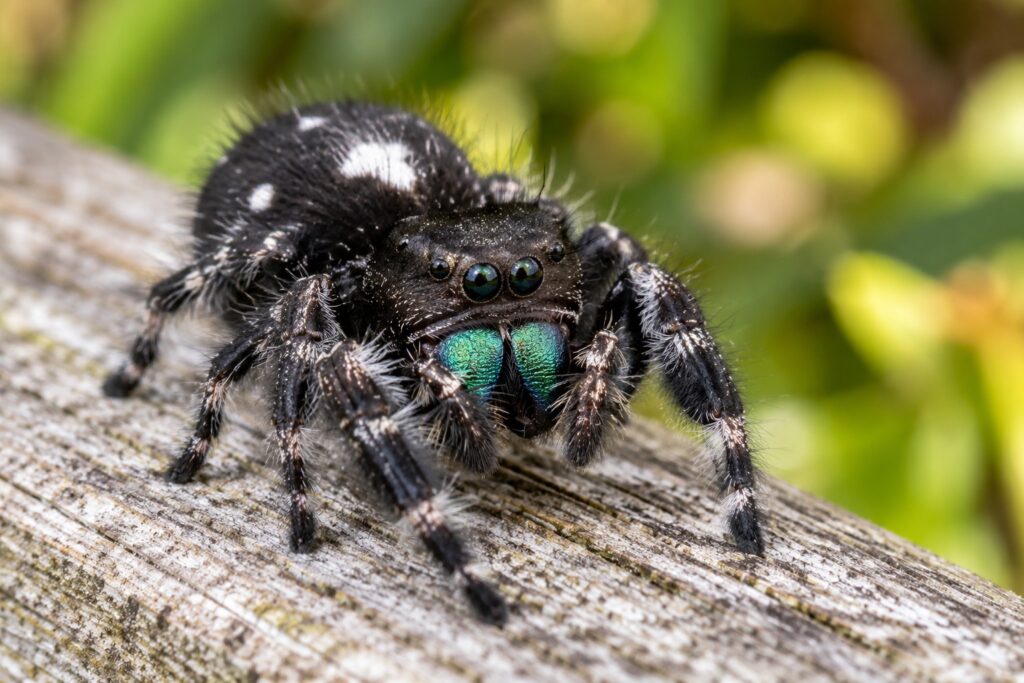
Phidippus audax, the bold jumping spider, is the jumper you find on your own fence, where the regal is the one you order from a breeder. It is smaller and plainer than its famous cousin, black with a white spot instead of orange and velvet, and it is tougher in almost every way that matters to a first-time keeper. It tolerates cooler rooms, drier air and missed mistings, and it shows the same curiosity that makes people fall for jumping spiders in the first place.
This guide covers size and telling males from females, how the bold compares with the regal, whether to catch one or buy one, and the day to day care: housing, feeding, handling, molting and what to expect from a life that lasts about a year or two.
Phidippus Audax at a Glance
| Attribute | Details |
|---|---|
| Common names | Bold jumping spider, daring jumping spider |
| Range | Southern Canada to northern Mexico, most of the United States |
| Adult body length | Females 8 to 15 mm, males 6 to 13 mm |
| Lifespan | 1 to 2 years, females longer than males |
| Temperature | 68 to 80F (20 to 27C) |
| Humidity | 40 to 60%, light misting |
| Adult enclosure | About 4 x 4 x 6 inches, front or bottom opening |
| Diet | Flies, small crickets, small roaches, occasional mealworms |
| Temperament | Curious, tolerant, quick |
| Difficulty | Beginner |
The colouring is easy to recognise. Adults are black with fine white hairs, a white triangular spot in the middle of the abdomen and two smaller spots behind it. The chelicerae, the jaw bases that carry the fangs, shine metallic green or blue. Juveniles often have orange spots that turn white with later molts, which leads some new keepers to think they have a different species.
Bold Jumping Spider Size: Male vs Female
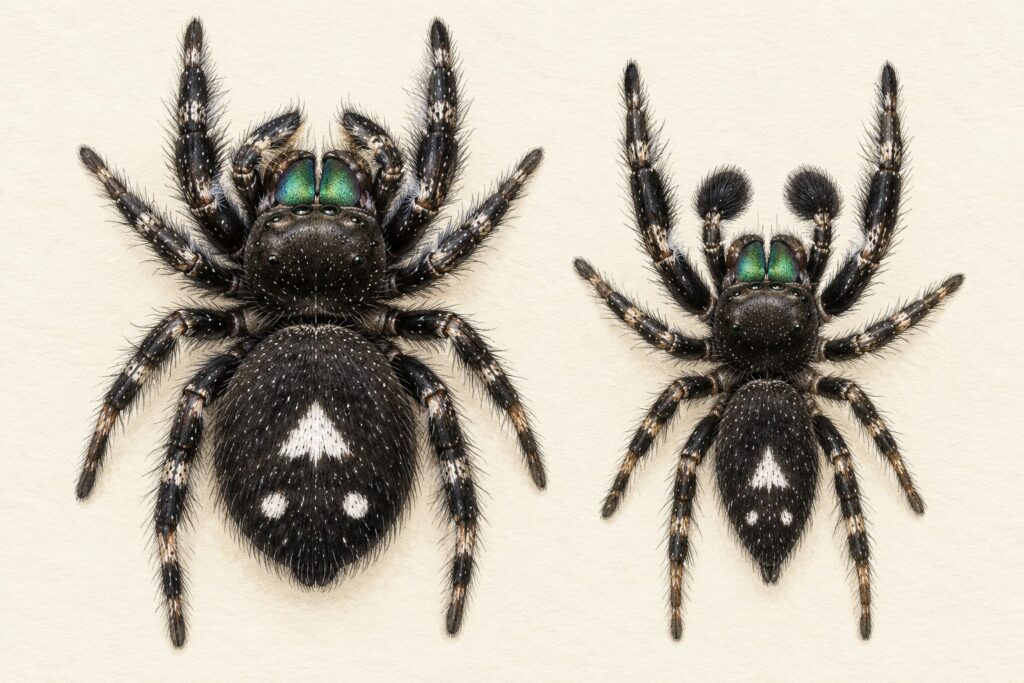
A full-grown bold jumping spider is about the size of a fingernail. Females reach 8 to 15 mm in body length, and a large, well-fed female can pass that. Males run 6 to 13 mm. Body length is measured from the front of the head to the tip of the abdomen, without the legs.
You cannot sex a small sling reliably. Differences show up from the sub-adult stage and are obvious after the final molt.
| Female bold jumping spider | Male bold jumping spider | |
|---|---|---|
| Size | Larger, 8 to 15 mm | Smaller, 6 to 13 mm |
| Abdomen | Wide and rounded | Slim and tapered |
| Front legs | Proportionate | Longer, with heavier fringes |
| Pedipalps | Thin, leg-like | Swollen at the tips, like small boxing gloves |
| Colour | Black with some brown or grey tones | Sharper black and white contrast |
| Behaviour as an adult | Stays near the nest, eats well | Wanders constantly, eats less |
| Lifespan | Up to about 2 years | Usually around 1 year |
The pedipalps are the two short limbs beside the mouth. On a mature male they are the giveaway. A restless adult male that paces the enclosure and ignores food is usually looking for a mate, not unwell.
Bold or Regal? Choosing Between the Two
Most buyers end up choosing between the bold and the regal jumping spider (Phidippus regius). Both are good first jumpers, and they differ in ways that matter.
| Bold (P. audax) | Regal (P. regius) | |
|---|---|---|
| Adult female size | 8 to 15 mm | 15 to 22 mm |
| Colour | Black with white spots | Females grey, orange or tan, males black and white |
| Native range | Most of North America | Southeastern US and Caribbean |
| Warmth needed | Fine at normal room temperature | Prefers the warm end, 75F and up |
| Humidity | 40 to 60% | 50 to 70% |
| Price | Low, or free if collected | Higher, varies by colour form |
| Enclosure | 4 x 4 x 6 inches | 4 x 4 x 8 inches or larger |
Choose the bold if your home runs cool, if you want the hardier animal, or if you like the idea of keeping a native species. Choose the regal if size and colour matter most. The care routine is otherwise the same.
Wild Caught or Captive Bred
Phidippus audax is one of the few pet invertebrates you can legally and easily collect yourself across much of North America. Both routes work, and each has a catch.
Wild caught. Look on sunny fences, window frames, garden walls and tall weeds from late spring to autumn. A wild adult is of unknown age and may have only months left. A wild adult female has very likely mated and may lay an egg sac in your enclosure, which means dozens to over a hundred slings a few weeks later. Decide in advance what you would do with them. Releasing them where the mother was found is reasonable for a local wild spider.
Captive bred. A sling or juvenile from a breeder comes with a known age and a full lifespan ahead. This is the better choice if you want as long as possible with the animal. Never release a captive-bred spider outdoors, since you cannot be sure where its line came from.
Either way, buy or collect one spider per enclosure. Jumping spiders eat each other.
Housing: Small, Bright and Front Opening
An adult bold jumper does well in an enclosure about 4 by 4 by 6 inches. Slings start in a 2 to 4 oz cup and move up as they grow. Three points decide whether the setup works:
- The door is not on top. Jumpers build a silk hammock against the ceiling, and a top lid tears it at every feeding.
- Air crosses the enclosure. Vents on two walls, with holes small enough to hold fruit flies if you are housing a sling.
- It is bright. These are daytime hunters that see their prey. Ten to twelve hours of bright room light or a small LED, with no direct sun on the enclosure.
Add a hide and anchor points near the top, a twig or two for climbing, and a thin layer of substrate or paper towel. Sizes by life stage, kits and a homemade version are all covered in our guide to setting up a jumping spider enclosure.
Feeding by Abdomen, Not by Calendar
Feeding schedules for jumping spiders are rough guides. The abdomen tells you more.
- Plump and round, wider than the head: well fed. Skip a feeding.
- About as wide as the head: offer food.
- Thin, flat or wrinkled: hungry or dehydrated. Offer water droplets first, then food.
What to feed. Flies are the best staple, since jumpers are built to catch them: flightless fruit flies for slings, then house flies and blue or green bottle flies for juveniles and adults. Small crickets and small roach nymphs also work. Mealworms and waxworms are fatty and fine as an occasional extra.
Prey size. About the length of the spider’s body or smaller. A bold jumper will tackle prey larger than itself, but a big cricket can injure a spider, especially one about to molt.
How often. As a starting point, slings every one to two days, juveniles every two to three days, and adults two or three times a week. Adjust by the abdomen.
Clear out leftovers. Remove uneaten crickets within a day and pick out dried prey remains weekly.
A spider this small can go from plump to thin in a week, and the reverse. InvertMate’s feeding history shows at a glance when it last ate and how often it has been refusing, which is the first thing you will want to know when it shuts itself in its hammock.
Temperature, Humidity and Water
Bold jumpers handle ordinary household conditions, which is a large part of their appeal. Anywhere from 68 to 80F suits them, and a cooler night does no harm. They do not need a heat mat in a normally heated home.
Mist one wall of the enclosure lightly every day or two with a fine sprayer and let it dry between mistings. The spider drinks the droplets. Do not use a water dish, and do not spray the spider or its nest. Humidity around 40 to 60% is plenty, a little higher when the spider is sealed in to molt.
Will It Bite? Handling a Bold Jumper
Bold jumping spiders are venomous, as nearly all spiders are, and they are not dangerous to people. Bites are rare and happen when a spider is pinched or trapped against skin. Most people describe a mild sting with some redness and itching that fades within a day or so. As with any bite or sting, an allergic reaction is possible, so wash the area and seek medical advice if swelling spreads or you feel unwell.
They are among the few spiders that tolerate handling well, and many seem to investigate a hand out of curiosity.
- Let the spider come to you. Rest a hand in front of it and let it step or hop on. Do not grab.
- Stay low and sit down. A jump or fall from standing height onto a hard floor can injure it.
- Keep sessions short, a few minutes, and skip them before and after a molt.
- Expect jumps. The spider trails a silk safety line, but a leap off your hand toward a wall is normal behaviour, so handle it away from gaps and furniture it can vanish behind.
Molting, Maturity and a Short Life
A bold jumper molts eight to ten times on the way to adulthood, over roughly eight to twelve months in captivity. Before each molt it thickens its hammock, seals itself in and stops eating. Slings stay in for a few days and sub-adults for up to two weeks or a little more. Do not open the nest, do not leave prey in the enclosure, and keep misting the far wall lightly. The general process is the same as in larger spiders, and our guide to what happens during a tarantula molt explains it in more detail.
After the final molt the spider is mature and will not molt again. From there, males typically live several more months and females up to a year or so.
Old age looks specific. An elderly jumper loses grip on smooth walls, misses jumps, eats less and spends more time low in the enclosure. Help it by adding textured surfaces and lower resting spots, offering smaller or pre-killed prey, and keeping water droplets within easy reach.
That short span is the honest drawback of the species. It is similar to keeping a praying mantis, where you get one full life cycle in about a year. If you want a spider that will still be with you in fifteen or twenty years, a slow-growing tarantula such as the chaco golden knee is the better fit, though it will never watch you back the way a jumper does.
What Goes Wrong
- Not eating. Most often pre-molt, poor light, or a mature male. Check the abdomen before worrying.
- Sealed in for a long time. Normal up to about two weeks before a molt. A female may also be guarding eggs.
- Thin, wrinkled abdomen. Dehydration. Mist more often and check the vents are not drying the enclosure in an hour.
- Stuck molt. Usually air that is too dry. Raise misting slightly whenever the spider seals in.
- Mold. Too wet with too little airflow. Add ventilation and remove prey remains.
- Unexpected egg sac. A wild-caught female. Leave her alone with it and plan for the slings.
FAQ
How big does Phidippus audax get?
Adult females reach 8 to 15 mm in body length and males 6 to 13 mm, not counting the legs. That makes the bold jumping spider about the size of a fingernail, and noticeably smaller than the regal jumping spider.
How long do bold jumping spiders live?
About one to two years. Females usually outlive males and can reach two years in captivity. Males often live around a year in total and only a few months after their final molt. A wild-caught adult may already be most of the way through its life.
Are bold jumping spiders good pets for beginners?
Yes. They tolerate normal room temperature and moderate humidity, eat readily, need very little space and are calm enough to handle. The main requirements are a front-opening enclosure, bright light during the day and a light misting every day or two.
How can I tell a male from a female bold jumping spider?
Mature males are smaller and slimmer, with longer front legs and swollen tips on the pedipalps beside the mouth. Females are larger with a wide, rounded abdomen and thin pedipalps. Sexing is unreliable before the sub-adult stage.
Can I keep a bold jumping spider I found outside?
In most of North America, yes. Wild bold jumpers adapt well to captivity. Bear in mind that the age is unknown and an adult female has probably mated, so an egg sac is likely. House it alone and offer flies or small crickets.
What do audax jumping spiders eat?
Live insects they can stalk: fruit flies as slings, then house flies, bottle flies, small crickets and small roaches. Prey should be about the spider’s own body length or smaller. Judge feeding by the abdomen, and offer food when it is no wider than the head.
How Many Days Since She Last Ate?
With an animal that lives a year or two and hides for a fortnight at a time, that is hard to answer from memory. InvertMate records each feeding and refusal, logs every molt with dated photos so you can see when the final one happened, and sends misting reminders. Free on the App Store and Google Play.