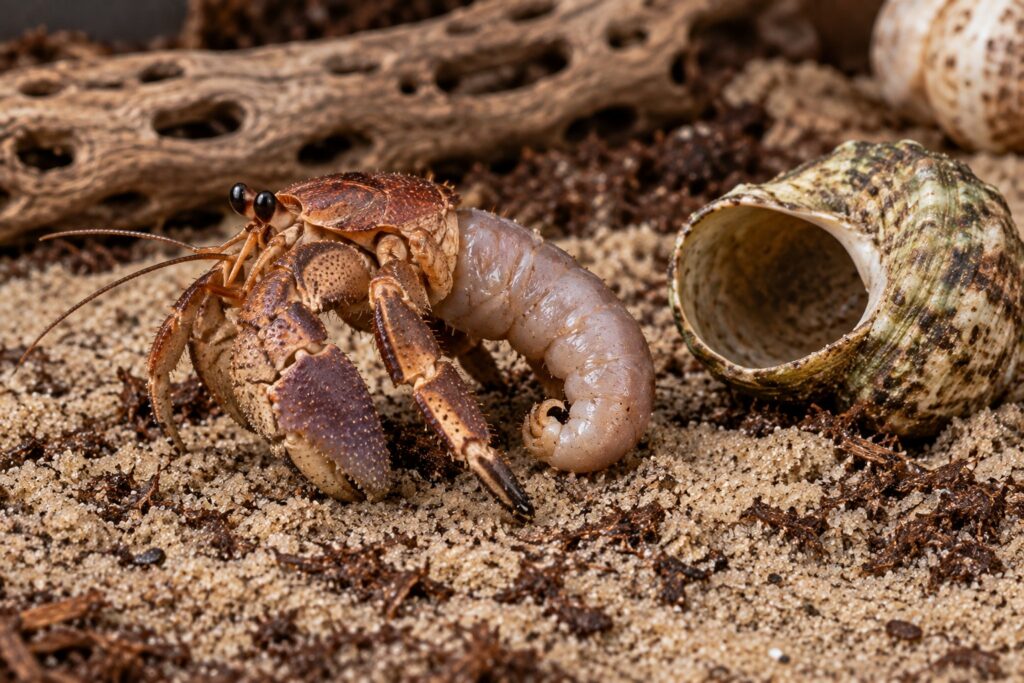
A hermit crab without shell protection rarely survives more than a day or two, so act now. Rinse two or three natural shells of the right size in dechlorinated water, put them in a small cup with the crab, cover it, and set the cup inside the warm, humid tank, somewhere dark and quiet.
That is the emergency version, and most crabs re-shell within an hour or two once they are given the chance. The rest of this guide covers the steps in detail, how to tell a naked hermit crab from one that is molting or dead, why crabs leave their shells in the first place, and what to fix so it does not happen again. It is written around the purple pincher (Coenobita clypeatus), and it applies to every land hermit crab sold as a pet.
Hermit Crab Without Shell: The First Ten Minutes
Work calmly. The crab is stressed, and a soft abdomen tears easily.
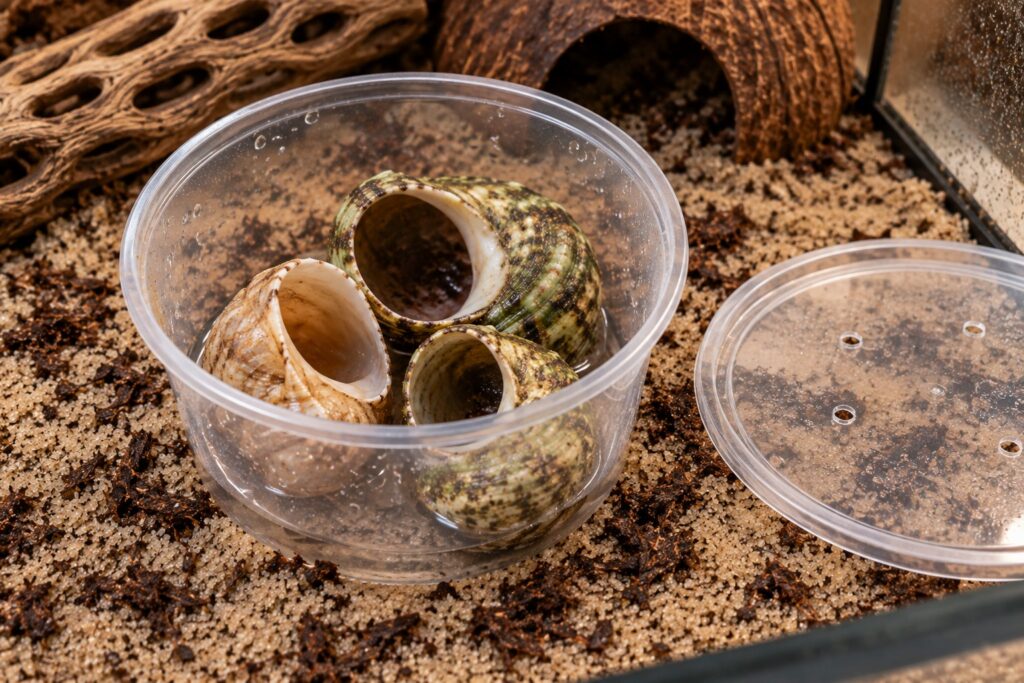
- Look before you touch. Is the crab moving its legs and antennae? Is there a hollow, crab-shaped husk beside it? If the crab is limp with an empty exoskeleton next to it, it is molting, and you should skip to the molting section below.
- Gather shells. Take the shell it just left plus two or three spares with openings close to that size. Natural shells only, no paint.
- Rinse everything. Swish each shell in dechlorinated water at tank temperature and shake the sand out. Leave the insides wet. A grain of sand or a mite inside the old shell may be the whole reason the crab left.
- Move the crab with a spoon or a cupped hand. Scoop from underneath. Do not pinch the abdomen and do not hold it by the legs.
- Rinse the crab if it is sandy. A quick dip in a shallow dish of dechlorinated water clears grit off the abdomen. A crab will not back into a shell with sand stuck to it.
- Use a small cup. Choose a container just big enough for the crab and the shells, so it keeps bumping into them. Add a few millimetres of dechlorinated water to the bottom and set the shells in with the openings facing up or toward the crab.
- Cover it and put it in the tank. A lid with air holes or a cloth over the top keeps it dark. Standing the cup inside the crabitat holds it at the right heat and humidity, and keeps tankmates off.
- Walk away. Check after 20 to 30 minutes, then hourly. Crabs re-shell faster when nobody is watching.
Once the crab is back in a shell, leave it in the cup for another hour to settle, then release it near a hide.
Naked, Molting or Dead? Tell Them Apart First
The right response is different for each, and they can look alike at a glance.
| What you see | Most likely | What to do |
|---|---|---|
| Crab out of shell, walking or waving antennae, normal colour | Naked crab under stress | Cup method above, straight away |
| Crab out of shell, limp or barely moving, pale and soft, hollow husk nearby | Surface molt | Do not move it. Protect it in place |
| Crab half out of the shell opening, still gripping inside | Often normal, sometimes pre-molt or overheating | Check temperature and humidity, watch, do not pull |
| Motionless body, strong rotten fish smell | Dead | Remove the body and nearby substrate, check the tank |
| Empty, light, translucent crab shape with no smell | Shed exoskeleton | Leave it. The crab eats it for calcium |
Smell is the most reliable test. A dead crab stinks within a day or two, and a living one, however still, does not. Our molting guide goes further into telling a molting crab from a dead one, including what a fresh shed looks like.
Why Hermit Crabs Leave Their Shells
A healthy crab in a good tank almost never walks out of a shell without stepping into another. A hermit crab without shell cover in an otherwise calm tank is reacting to something.
| Cause | Clues | Fix |
|---|---|---|
| No suitable shell to move into | Crab has outgrown its shell, few or no spares, wrong opening shapes | Three to five spares per crab, sized and shaped for the species |
| Evicted by a tankmate | Another crab now wearing its shell, rocking or chirping beforehand | More shells, spread around the tank |
| Tank too hot | Temperature above 85F, crabs hanging out of shells or climbing high | Lower heat, check the thermostat |
| Tank too dry | Humidity under 70%, lethargy | Seal the lid, dampen substrate, refill pools |
| Irritant in the shell | Sand, mites, or flaking paint inside | Rinse shells, replace painted ones |
| Stress after purchase | New crab, recent shipping or a boardwalk cage | Correct conditions, no handling |
| Molt on the surface | Limp crab, husk nearby | Protect in place |
| Illness or decline | Weak for days beforehand, limbs dropping | Supportive conditions, low odds |
Shell supply is the most common cause. A crab that has grown needs a bigger shell with the right shaped opening, and purple pinchers and Ecuadorians want different shapes. If the only spares are too small, too big or painted, the crab can end up stuck between shells. The details are in our guide to sizing spare shells by the opening.
Heat is the fastest. A crab cannot cool down inside a shell, so in a tank that climbs past the high 80s it will come out to shed heat. This happens in tanks in direct sun, with heat lamps, or with an unregulated mat.
Low humidity is slower and just as dangerous. Land hermit crabs breathe through modified gills that must stay moist, and they carry a small reserve of water inside the shell, topped up from both the fresh and salt water pools. In dry air that reserve runs out, and the crab weakens until it can no longer hold on.
Sometimes the cause is the shop. Crabs sold in painted shells, wire cages and dry gravel arrive already in trouble, and hermit crabs out of the shell in the first few weeks at home are often still reacting to conditions before you owned them.
If the Crab Is Molting Out of Its Shell
Most molts happen underground and you never see them. A crab that molts on the surface, sometimes partly or fully out of its shell, is soft, pale and unable to move much. Picking it up can tear the new exoskeleton.
Do not use the cup method here. Instead:
- Leave the crab exactly where it is.
- Cover it. Cut the bottom off a clear plastic bottle, make a few air holes, and press the dome an inch into the substrate around the crab, the shed and its shell. This keeps tankmates from eating it.
- Put its shell and one or two spares inside the dome, openings toward the crab.
- Hold the tank steady. No misting over it, no rearranging.
- Wait. It may take days before the crab is firm enough to back into a shell. Leave the shed skin with it.
Older advice was to move molting crabs to an isolation tank. That has been dropped, because the move does more harm than the tankmates do. Protecting the crab in place gives it the same safety without the disturbance. A surface molt also tells you something is wrong below ground, usually substrate that is too shallow or too loose to hold a tunnel.
When the Crab Will Not Go Back In
If an hour or two in the cup has passed and the crab is still naked, change something.
- Offer different shapes. Add a shell with a rounder opening and one with a more oval opening. The size may be right and the shape wrong.
- Check the old shell again. Hold it to a light and look inside for sand, a pebble or mites. Rinse it hard.
- Check the water depth. Enough to keep the shells wet inside, not enough to submerge the crab.
- Make it darker and quieter. Cover the cup fully and stay out of the room.
- Give it time. Some crabs take several hours. Keep the cup in the tank so it stays warm and humid.
Never push a crab into a shell. The abdomen has to coil around the central column of the shell by itself, and forcing it tears soft tissue. The same applies in reverse: never pull a crab out of a shell.
Be prepared for the honest odds. A naked hermit crab that is active and re-shells within a few hours usually recovers fully. A crab that stays out for a day, or one that was weak before it left the shell, often does not survive, and that is rarely something you could have changed in the last hour.
After It Re-Shells: Find and Fix the Cause
A crab back in a shell is a second chance, not the end of the problem. Go through the tank the same day.
- Temperature: 75 to 85F. Read it with a digital gauge at substrate level.
- Humidity: 75 to 85%. A mesh lid will never hold it. Cover the top with glass or plastic.
- Shells: three to five spares per crab, in sizes around what each one wears now, rinsed and spread across the tank.
- No painted shells. Replace them with natural ones and let the crabs switch.
- Substrate: at least 6 inches, damp enough to hold a tunnel.
- Both pools filled and deep enough to climb into, with a way out.
- No handling for two weeks.
If several of those were off, the setup needs rebuilding, and our guide to tank temperature, humidity and substrate depth walks through it. For everything else a crab needs week to week, start with the basics of hermit crab care.
It also helps to know which shell each crab was in before the scare. If you log it in CrabPod with a photo whenever a crab changes shells, an eviction or a missing shell is obvious the next morning.
What Not to Do
- Do not force the crab into a shell, or glue, tape or hold it there.
- Do not leave a hermit crab without shell cover loose in the tank with other crabs. They will attack it.
- Do not put it in deep water. A weak crab drowns.
- Do not use tap water. Chlorine and chloramine irritate the gills and abdomen.
- Do not offer painted or varnished shells.
- Do not move a crab that is molting.
- Do not keep checking every five minutes. Disturbance delays re-shelling.
FAQ
Can a hermit crab survive without a shell?
Not for long. The abdomen is soft and loses moisture quickly, and the crab cannot carry the water its gills need. Without a shell, most hermit crabs die within a day or two from drying out, injury or attack by tankmates. Fast re-shelling is the only fix.
How long can a hermit crab be out of its shell?
Minutes during a normal shell change, when it steps straight from one into another. A crab that stays naked is in danger after a few hours and rarely lasts beyond 24 to 48 hours, less in a dry or hot room.
Why did my hermit crab leave its shell and die?
Usually the crab was already failing. Overheating, low humidity, post-purchase stress and illness all weaken a crab until it cannot hold on to the shell, so leaving the shell is often the last sign and not the cause. Check temperature, humidity and shells for the crabs that remain.
What does a naked hermit crab look like?
The front half looks normal, with claws, legs and eye stalks. Behind it is a soft, curled, pinkish or grey abdomen shaped like a fat comma, with a few small hooked legs at the tip that normally grip the inside of the shell.
Should I put my hermit crab back in its shell?
No. Put the crab next to rinsed shells in a small, dark, covered cup and let it climb in by itself. Pushing a crab into a shell injures the abdomen, and the crab has to choose and coil into the shell without help.
Do hermit crabs leave their shells to molt?
Normally no. They molt underground inside the shell. A crab molting on the surface may slide partly or fully out, which signals a substrate or tank problem. Protect it where it lies with a ventilated dome and do not move it.
Logging Shells Before the Next Scare
CrabPod keeps a photo record of which shell each crab is wearing, logs the dates crabs bury and resurface, and tracks tank temperature and humidity so a slow drift shows up before a crab reacts to it. Free on the App Store.