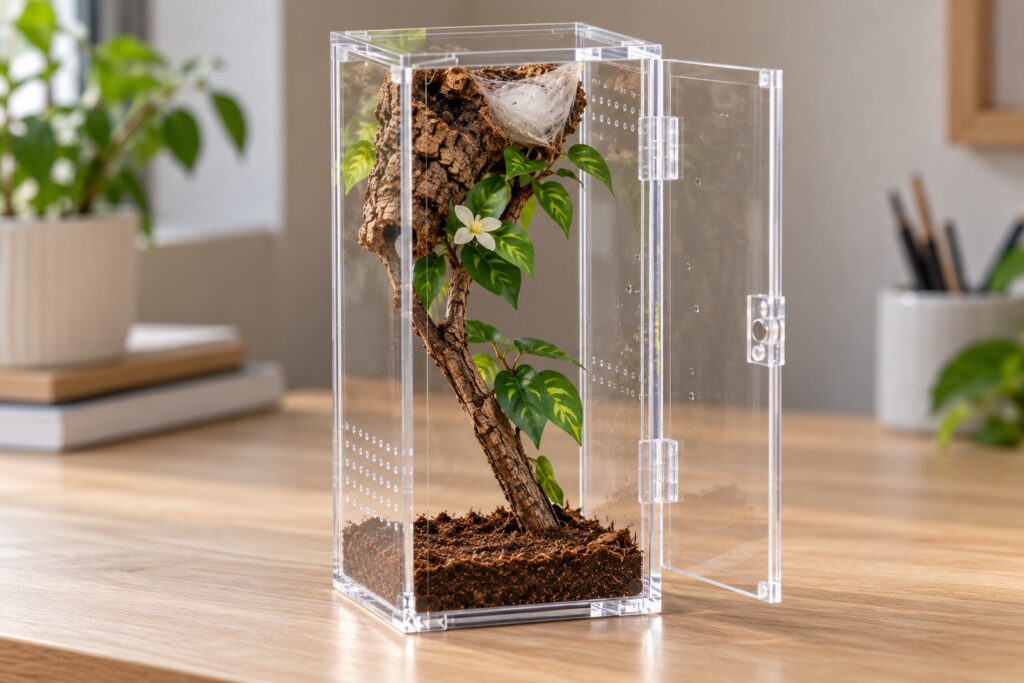
A jumping spider enclosure is a small, bright box that opens at the front or the bottom, and for an adult regal jumping spider (Phidippus regius) the usual size is about 4 by 4 by 8 inches. That is the whole brief. These are spiders the size of a thumbnail that hunt by sight, sleep in a silk hammock at the highest point they can reach, and live one to two years, so the housing looks nothing like a tarantula’s.
It is also the first place new keepers go wrong, usually by buying something too big, too dark, or with a lid that rips the nest apart at every feeding. This guide covers the door question first, then size by life stage, ventilation, lighting, climate, decor, kits, and how to make your own for a few dollars. It is also the starting point for the rest of our jumping spider guides, listed near the end.
The Nest Is at the Top, So the Door Goes Somewhere Else
Almost every jumping spider builds its retreat in the upper corner of whatever it lives in. The retreat is a dense silk sac, usually called a hammock, that the spider sleeps in every night, molts in, and, if female, lays eggs in. It will be anchored to the ceiling and one or two walls.
In a top-opening enclosure, the ceiling is the lid. Every time you open it to feed or mist, you tear the hammock in half, sometimes with the spider inside. The spider rebuilds, you tear it again, and a stressed jumper that keeps losing its nest stops eating and can fail a molt.
Buy or build an enclosure that opens at the front, the side or the bottom. Purpose-made acrylic enclosures for jumping spiders have a front door or a side panel for exactly this reason. Tarantula keepers know the same logic from the other direction, since front access on an arboreal tarantula enclosure keeps your hand out of the escape route. Here it keeps your hand out of the bedroom.
If you already own a top-opening container, turn it upside down. A deli cup or a clear tub stood on its lid has a solid ceiling for the hammock and a door at the floor. This is the cheapest fix in the hobby, and it works.
| Jumping spider enclosure basics | |
|---|---|
| Adult size, large species | 4 x 4 x 8 inches, up to 8 x 8 x 12 inches |
| Adult size, small species | 4 x 4 x 6 inches |
| Opening | Front, side or bottom, never the top |
| Ventilation | Cross flow through two walls |
| Light | Bright room or LED, 10 to 12 hours a day |
| Temperature | 72 to 82F (22 to 28C) |
| Humidity | 50 to 70%, by light misting |
| Water | Droplets on one wall, no dish |
| Occupants | One spider per enclosure, always |
Jumping Spider Enclosure Size by Life Stage
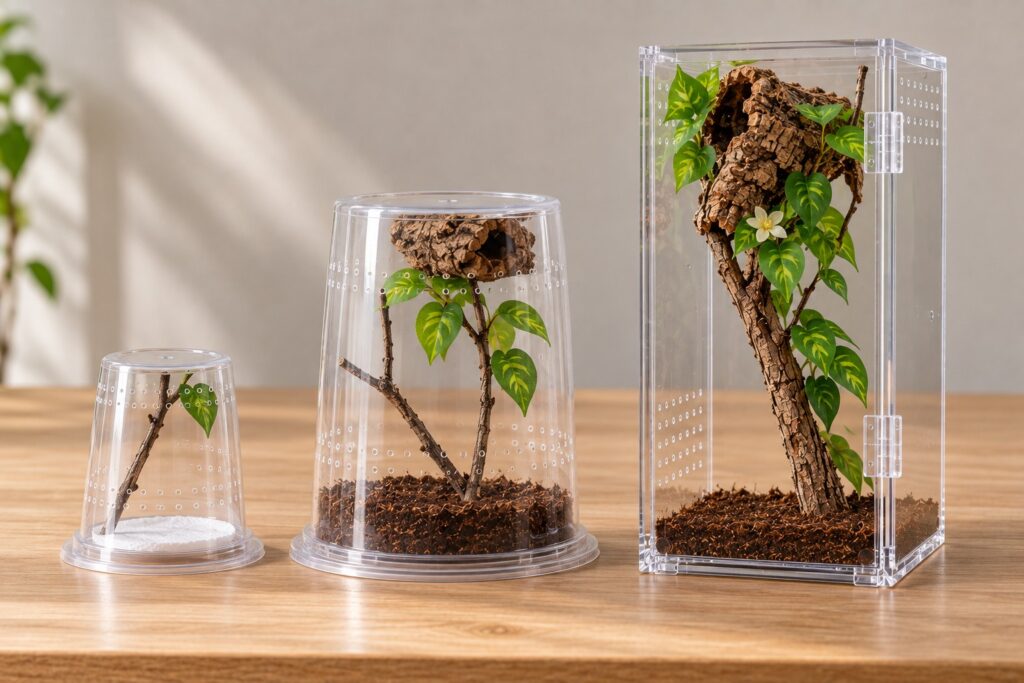
Size to the spider you have now, not the adult it will become. Jumping spider slings are tiny, and a sling in an adult enclosure cannot find its food. Keepers describe age in instars, the stages between molts, written i2, i3 and so on. Most slings are sold between i4 and i6.
| Life stage | Body length | Enclosure size | Typical container |
|---|---|---|---|
| Sling, i2 to i4 | 2 to 5 mm | About 2 x 2 x 3 inches | 2 to 4 oz deli cup, inverted |
| Juvenile, i5 to i7 | 5 to 10 mm | About 3 x 3 x 5 inches | 16 to 32 oz deli cup or small acrylic box |
| Sub-adult and adult, small species | 8 to 15 mm | 4 x 4 x 6 inches | Small acrylic enclosure |
| Adult, large species | 15 to 22 mm | 4 x 4 x 8 inches, up to 8 x 8 x 12 | Front-opening acrylic enclosure |
Height matters more than floor. Jumpers spend their time in the upper half, so a tall footprint gives usable space where a wide one does not. An enclosure taller than it is wide also keeps the hammock well clear of the door.
Can it be too big? Yes, though the limit is more generous than for slings. An adult jumper is an active hunter and will use an 8 by 8 by 12 inch enclosure well. Past about 12 inches in any direction, prey has too many places to hide, you lose track of whether the spider is eating, and misting stops reaching the corner where it drinks. A small jumping spider enclosure that the animal fully uses beats a showpiece it gets lost in.
When to move up. Rehouse after the molt that takes the spider into the next row of the chart, once it has come out and fed. Never rehouse a spider that has sealed itself into its hammock.
Regal jumping spider enclosure size
The regal is the largest jumping spider commonly kept, with adult females reaching 15 to 22 mm in body length and males somewhat smaller. An adult does well in 4 by 4 by 8 inches as a minimum, and a big female will happily use 6 by 6 by 9 or 8 by 8 by 12. The bold jumping spider (Phidippus audax), the most common pet species in North America, tops out around 8 to 15 mm and is comfortable in 4 by 4 by 6.
Ventilation Without Escapes
Jumping spiders live in open, breezy places: fence posts, sunlit walls, shrubs and palm fronds. Still, damp air is as bad for them as it is for canopy tarantulas, and the problem is the one keepers saw for years with pink toe tarantulas in sealed, heavily misted boxes. Mold on the decor and a spider that sits low and refuses food are the usual first signs.
Cross ventilation is the rule. Air should enter through one wall and leave through another, ideally one set of vents low on the front or side and another high on the opposite side. A vented lid alone leaves a column of stale air above wet decor.
The holes have to be smaller than the food. This is the constraint that makes jumping spider ventilation fiddly. Slings eat flightless fruit flies, and a fruit fly walks through any hole much over 1 mm. An i2 sling fits through not much more. Use pinholes, fine stainless or fabric mesh glued over larger cutouts, or the micro-drilled vents that purpose-made enclosures come with.
More vents, more misting. If the enclosure dries out within an hour of misting, do not tape over the vents. Mist a little more often, or add a thin layer of substrate to hold moisture.
Light: The Requirement Tarantula Keepers Miss
Tarantulas want dim and quiet, and nothing in a tarantula enclosure calls for a lamp. Jumping spiders are the opposite. They are diurnal, meaning active by day, and they hunt with the best eyesight of any spider, tracking prey with the two large forward-facing eyes that give them their expression. In poor light they cannot see their food, they stop hunting, and they spend the day in the hammock.
Give them 10 to 12 hours of bright light a day. A spot near a bright window works, as long as direct sun never falls on the enclosure, because a clear box in sun overheats in minutes. A small white LED lamp or strip above or beside the enclosure is the more reliable answer, and a plug-in timer makes it consistent.
Do not use a heat lamp. An incandescent or basking bulb over a 4 inch box cooks it. LEDs give light with almost no heat, which is what you want.
UVB is optional. Keepers are split. Some run low-output UVB and report more activity; plenty of jumpers live full lives without it. Bright visible light is the part that is not negotiable.
A dim shelf is the most common reason a healthy jumping spider “isn’t eating”. Before you change anything else, move the light.
Temperature, Humidity and Water
Temperature. 72 to 82F (22 to 28C) suits the commonly kept species, and regals from Florida and the Caribbean are happiest at the warmer end. Normal room temperature is usually enough. If your room sits below about 68F, fix a small heat mat to the wall behind the enclosure or to one side, on a thermostat, with a gap so it does not touch the acrylic directly. Never put it underneath.
Humidity. Aim for 50 to 70%. Regals like the upper half of that range, and bold jumpers tolerate the lower half. The number matters less than the rhythm: a light misting that dries within a few hours, then another the next day.
Water comes as droplets. Jumping spiders drink from dew. Mist one wall lightly once a day, or every other day in a humid room, with a fine sprayer, and the spider will walk over and drink. Aim for small beads, since a spider this size can get trapped in a large drop.
No water dish. A dish is a drowning hazard for slings and juveniles, and adults ignore it.
Do not spray the spider or the hammock. Wet silk collapses, and a direct hit startles the animal. Mist the opposite wall.
Anchor Points, Decor and Substrate
Decor in a jumping spider house does real work. The spider needs things to walk on, launch from, and tie silk to, and it needs most of them in the top third.
- A ceiling hide. A small cork bark piece, a seed pod, a section of dried cholla wood or a little cup glued or magnet-mounted near the top. Many jumpers build the hammock inside it, which protects the nest when you mist.
- Web anchor points. Thin twigs, cork, and fabric or silk leaves and flowers placed high up. Smooth bare acrylic gives silk little to hold, so textured surfaces near the ceiling matter.
- A route up. One or two branches running from the floor to the top, so prey and spider both travel through the hunting zone.
- Open space in the middle. Jumpers stalk and leap. Leave a gap they can jump across.
Fix decor with aquarium-safe silicone or hot glue and let it cure and air out fully before the spider goes in. Avoid anything sticky, anything with exposed adhesive, and sharp wire stems on cheap artificial plants.
Substrate is optional. A thin layer of coconut fibre, about half an inch, holds a little humidity and looks natural. A sheet of paper towel is easier to clean and makes dropped prey remains obvious. A bare floor works too. Jumping spiders rarely touch the ground, so depth does nothing for them.
Bioactive setups are possible in the larger adult sizes with a thin soil layer and springtails to handle waste. In a 4 by 4 inch footprint the benefit is small, and wiping the floor every week or two does the same job.
Jumping Spider Terrarium Materials: Acrylic, Glass or a Deli Cup
Acrylic is the standard. It is light, clear enough to watch a spider through, and easy for makers to cut with front doors and fine vents. Nearly every enclosure sold specifically for jumpers is acrylic. It scratches, so clean it with water and a soft cloth.
Glass is rare at this size. Small front-opening glass terrariums exist and work once you check two things: the mesh top, which usually lets fruit flies out, and the gaps around the doors, which let slings out.
Plastic deli cups and food tubs are how most breeders house slings and juveniles, and they are perfectly good. Stand them on the lid so the spider nests against the solid base and you open from below.
Mesh cages made for butterflies or mantids are a poor fit. They hold no humidity, and fruit flies leave through the weave.
Jumping Spider Enclosure Kits: What to Check
A jumping spider kit bundles an enclosure with decor and sometimes a mister, and a good one saves time. They vary a lot, so check these before you pay:
- Where it opens. Front, side or bottom. A top-opening kit is a pass.
- Vent size. Holes or mesh fine enough to hold fruit flies if you are buying for a sling.
- Cross flow. Vents on at least two walls.
- Size for your spider’s stage. Many kits are adult sized. A sling needs a small cup first and the kit later.
- Decor position. Anchor points and a hide near the top, not a bare box with a plant on the floor.
- What is missing. Kits rarely include a light or a fine mister, and you need both.
A jumping spider enclosure kit is a convenience, not a requirement. Everything in one can be assembled separately for less.
How to Make a Jumping Spider Enclosure
A homemade enclosure costs a few dollars and suits a sling or juvenile as well as anything you can buy.
- Pick a clear container. A 4 oz deli cup for a sling, a 32 oz cup for a juvenile, or a tall clear food tub around 4 by 4 by 7 inches for an adult.
- Plan to stand it upside down. The lid becomes the floor and the door. The solid base becomes the ceiling.
- Make the vents. Heat a pin over a flame and melt two bands of pinholes, one low on one side and one high on the opposite side. The same method we use for deli cups for tarantula spiderlings applies, only with smaller holes. For an adult tub, cut two coin-sized openings and glue fine mesh over them from the inside.
- Add the ceiling hide. Hot glue a small piece of cork or a seed pod to the inside of the base, which is now the top.
- Add anchors. Glue or wedge a twig running from floor to ceiling and one or two fabric leaves in the upper third.
- Line the lid. A circle of paper towel or a thin layer of coconut fibre.
- Air it out. Leave it open for a day so glue fumes clear.
- Test it. Mist one wall and check that it dries in two to four hours. If it stays wet, add holes.
Slings: A Smaller Box and Smaller Food
A sling’s enclosure is a scaled-down version of everything above, with three differences.
Keep it small. A 2 to 4 oz cup until around i5. The sling needs to bump into its food.
Feed flightless fruit flies. Drosophila melanogaster for the smallest slings and the larger Drosophila hydei from about i4, moving to small flies and tiny crickets as juveniles. If you have raised mantis nymphs, the feeder routine is identical, and our guide to caring for a praying mantis covers culturing and sizing flies.
Mist more carefully. Fine droplets only, on one wall, daily. Slings dehydrate fast and drown easily.
Molting Happens Inside the Hammock
Before a molt, a jumping spider thickens its hammock until you can barely see through it, seals itself in, and stays there. Slings may be shut away for a few days. Sub-adults approaching their final molt can stay sealed for two weeks or more.
During that time, do not open the nest, do not drop prey in, and do not move the enclosure. Keep misting the far wall lightly so the air does not dry out, since low humidity is the usual cause of a stuck molt. The spider comes out when its new exoskeleton has hardened, and it will be hungry a day or two later. The underlying process is the same one described in our guide to how tarantulas molt, on a much shorter clock.
Because a jumper goes through eight to ten molts in about a year, the gaps between them tell you a lot. An InvertMate molt log with the date each time the spider seals in and comes out shows you what is normal for your animal, and when a long hide is worth worrying about.
Jumping Spider Species and Topics
The setup above fits the species usually sold as pets. The details shift a little by species, and each of these gets its own guide as this section grows.
- Regal jumping spider (Phidippus regius). The largest and most popular. Likes warmth and the upper end of the humidity range. Use the large adult sizes.
- Bold jumping spider (Phidippus audax). Black with white spots and metallic green chelicerae, native across North America. Hardy, tolerant of drier air, and fine in a 4 by 4 by 6.
- Other species. Tropical giants such as Hyllus need the largest enclosures and steady warmth. Small natives such as the zebra jumper do best in the sling and juvenile sizes for life.
- Slings and growth. Feeding schedules, instar by instar sizing and when to rehouse.
- Bites and venom. Whether jumping spiders are dangerous, and what a bite is actually like.
Seven Setup Mistakes
- A top-opening lid. The nest gets destroyed at every feeding.
- An adult enclosure for a sling. The spider cannot find its food.
- A dim shelf. A jumper that cannot see does not hunt.
- Direct sun or a heat lamp. A small clear box overheats in minutes.
- Sealed, wet conditions. Mold and a lethargic spider.
- Vents bigger than the prey. Fruit flies in your kitchen, or a sling on your wall.
- Two spiders in one enclosure. One of them gets eaten.
FAQ
What size enclosure does a jumping spider need?
An adult of a large species needs about 4 by 4 by 8 inches, and up to 8 by 8 by 12 is fine. Smaller species do well in 4 by 4 by 6. Slings start in a 2 to 4 oz cup and move up as they molt. Height matters more than floor space.
Do jumping spiders need a light?
Yes. They are daytime hunters that rely on eyesight, so they need bright light for 10 to 12 hours a day. A bright room or a small LED lamp works. Avoid direct sunlight and heat lamps, which overheat a small enclosure quickly. UVB is optional.
Why should a jumping spider enclosure open from the front?
Jumping spiders build their silk hammock against the ceiling. A top-opening lid tears that nest every time you feed or mist. Front, side or bottom access leaves the nest intact, and turning a top-opening container upside down gives the same result.
Do jumping spiders need substrate?
No. They live in the upper part of the enclosure and rarely touch the floor. A thin layer of coconut fibre helps hold humidity, and paper towel makes cleaning easy, but a bare floor is acceptable. Depth is never needed.
Can two jumping spiders live in the same enclosure?
No. Jumping spiders are solitary and cannibalistic outside of brief, supervised mating. Even siblings from the same egg sac need separating once they leave the nest and start hunting. One spider per enclosure is the rule at every life stage.
How often should I mist a jumping spider terrarium?
Lightly once a day, or every other day in a humid room, on one wall away from the hammock. The droplets should dry within a few hours. If the walls stay wet all day, reduce misting or add ventilation.
A Whole Life in Under Two Years
She sealed herself into her hammock nine days ago, and you cannot remember whether the last molt took five days or twelve. With an animal that lives one to two years, there is not much time to learn its pattern by feel. InvertMate logs every molt with dated photos so you can see the gaps between instars, keeps a feeding history for the weeks she refuses food, and sends misting reminders so the enclosure never dries out during a molt. Free on the App Store and Google Play.