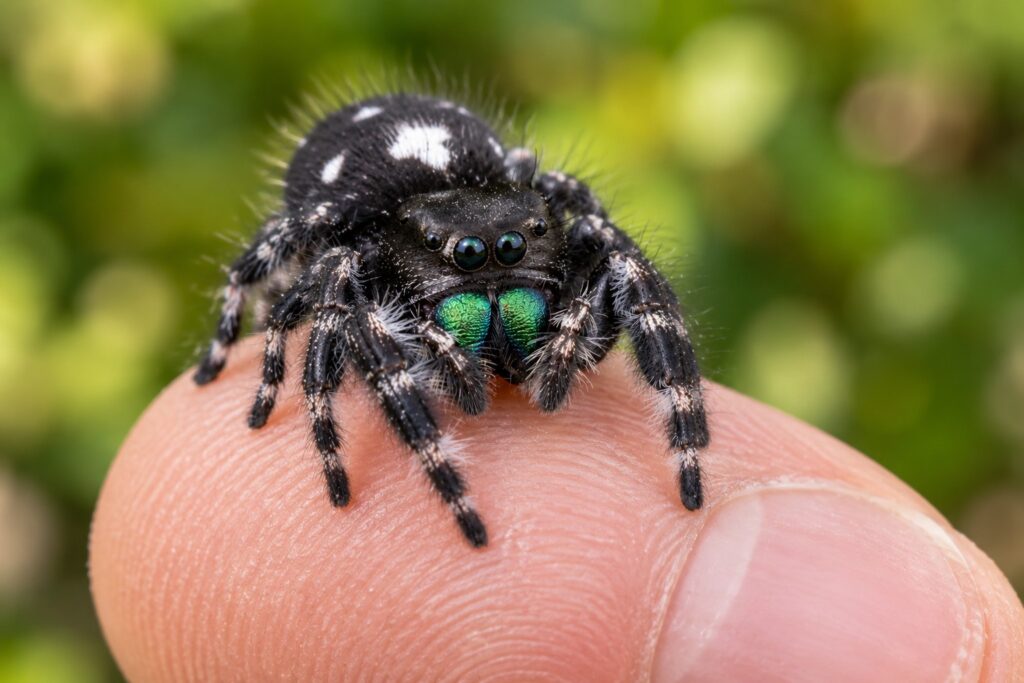
Are bold jumping spiders poisonous? No. A bold jumping spider (Phidippus audax) is venomous, as nearly all spiders are, but its venom is made for flies and is not medically significant to people. Bites are rare and usually feel like a mild bee sting that fades within one to two days.
So the black, fuzzy spider with the white spot that just stared at you from the windowsill is not a threat to you, your children or your pets. The rest of this guide covers what the venom does, what a bite feels like, why these spiders so rarely bite, basic first aid, how to tell a bold jumper from a black widow, and how the risk compares with other invertebrates people keep.
Poisonous or Venomous?
The two words mean different things, and the difference answers most of the question.
Poisonous means harmful if you eat or touch it. A bold jumping spider is not poisonous in any sense. Nothing on its body is toxic to touch, and a dog, cat or toddler that swallows one comes to no harm from it.
Venomous means it injects a toxin through a bite or sting. Bold jumpers are venomous. They have two small fangs and venom glands, and they use them to subdue prey such as flies, moths and small caterpillars within seconds.
That venom is tuned to insect nervous systems and delivered in a tiny dose by a spider 8 to 15 mm long. In a human it produces a brief local reaction and nothing more. When doctors call a spider “not medically significant”, this is what they mean: a bite does not need treatment beyond basic care. So when someone asks “are bold jumping spiders poisonous or venomous”, the accurate answer is venomous, and harmless.
Are Bold Jumping Spiders Poisonous to Dogs, Cats or Children?
The answer is the same across the household.
- Children. A bite is no more serious for a child than for an adult. The usual result is a small red bump. Teach children to let the spider walk onto a hand and never to squeeze it.
- Dogs and cats. A pet that eats a bold jumper is not poisoned. A bite on a nose or paw may cause brief licking or pawing at the spot. If swelling keeps growing or your pet seems unwell, call your vet, as you would for a bee sting.
- Other pets. A jumper is a risk only to animals small enough to be prey, which means feeder insects and other small spiders.
Bold jumpers are sometimes sold or labelled as daring jumping spiders. It is the same species, so everything here applies to both names.
The Bold Jumping Spider Bite: What It Feels Like
Most people who keep these spiders for years are never bitten. When it does happen, this is the typical picture.
| What to expect | |
|---|---|
| At the moment | A quick pinch or sting, often compared to a mosquito bite or a mild bee sting |
| First hours | A small red bump, slight swelling, some itching or tenderness |
| Duration | Usually gone within one to two days |
| Marks | Sometimes two tiny puncture dots, often nothing visible |
| No symptoms at all | Common. Small fangs do not always break the skin |
| Serious effects | Not expected. Allergic reactions are possible but uncommon |
The fangs of a jumping spider are short. On thicker skin such as a palm or fingertip, a bite often fails to get through at all, which is one reason so many handlers report nothing.
Why a Bold Jumper Almost Never Bites
These spiders hunt by sight, and they can see you clearly. To a jumper, a person is a very large moving object to watch, back away from or, if it is curious, climb on. Its defences run in a fixed order, and biting is last.
- Watch. It turns to face you and tracks your movement.
- Retreat. It backs off, sidesteps or drops away on a silk safety line.
- Display. If cornered, it raises its front legs and shows the metallic green chelicerae, the jaw bases that hold the fangs.
- Bite. Only if it is pinned, squeezed or trapped against skin.
Bites almost always come from the fourth situation: a spider caught inside clothing or a glove, pressed under a hand, or grabbed between fingers. A jumper that leaps onto your arm is exploring, not attacking.
If You Are Bitten
Basic first aid is all a bite normally needs.
- Wash the area with soap and water.
- Hold a cool, damp cloth on it for a few minutes if it stings.
- Try not to scratch.
- Keep an eye on it for a day or two.
Seek medical advice if redness or swelling keeps spreading, if the area becomes hot or starts to ooze, if you develop hives, dizziness or trouble breathing, or if you are not sure which spider bit you. People with known allergies to insect stings should be more cautious. This is general information and not a substitute for advice from a doctor.
Is It Really a Bold Jumper? The Lookalike That Matters
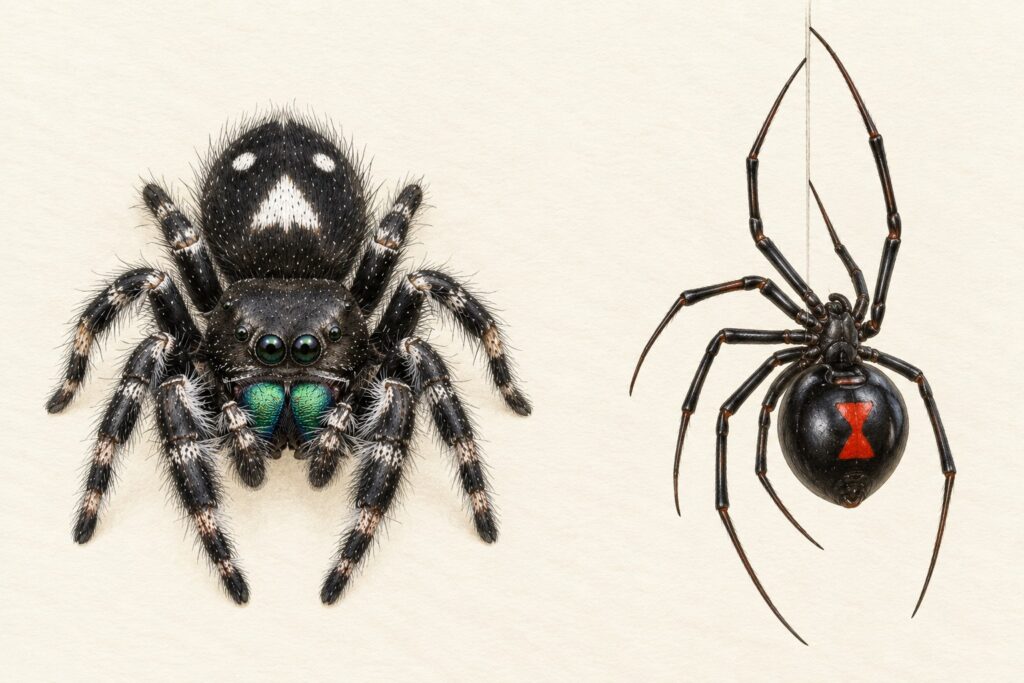
A lot of worry about bold jumpers is really worry about black widows. Both are black North American spiders with contrasting markings, and they are easy to tell apart once you know where to look.
| Bold jumping spider | Black widow | |
|---|---|---|
| Body | Compact, fuzzy, covered in short hairs | Smooth, glossy, hairless |
| Abdomen | Oval, with a white, orange or red spot on top | Round like a bead, with a red hourglass underneath |
| Legs | Short and sturdy | Long and thin |
| Eyes | Two large forward-facing eyes, obvious | Small, not noticeable |
| Jaws | Metallic green or blue | Plain dark |
| Web | None for hunting, only a small silk retreat | Messy, tangled web in a dark corner |
| Behaviour | Out in daylight, walks and jumps, turns to look at you | Hangs upside down in its web, mostly at night |
| Bite | Mild, local, brief | Can be medically significant |
If the spider is fuzzy, out in the sun and looking back at you, it is a jumper. If you cannot tell, do not handle it.
Are Bold Jumping Spiders Friendly?
“Friendly” overstates it, but they are the most approachable spiders you are likely to meet. A bold jumper will often turn to watch a person, follow a moving finger with its eyes, and step onto a hand that is offered slowly. That is curiosity and good eyesight at work, not affection.
It is also why they have become popular pets. A captive jumper kept in a bright enclosure and handled gently for a few minutes at a time rarely shows any defensive behaviour. The times to leave one alone are when it has sealed itself in its silk retreat to molt and for a few days afterwards, when it is soft and easily stressed. Noting those dates in our free invertebrate care app makes it easy to know when handling is off the table.
Day to day care for the species, including size, feeding and lifespan, is in our Phidippus audax care guide, and housing is covered in our guide to jumping spider enclosures.
How the Risk Compares With Other Pet Invertebrates
For anyone choosing a first invertebrate, it helps to see where the bold jumper sits.
| Animal | Defence | Worst realistic outcome | Handling |
|---|---|---|---|
| Bold jumping spider | Mild venom, tiny fangs | Itchy bump for a day or two | Tolerated well |
| New World tarantula | Irritating hairs, mild venom | Itchy rash, bite like a wasp sting | Not recommended |
| Old World tarantula | Fast, potent venom | Severe pain and cramping for days | Never |
| Emperor scorpion | Pinch, mild sting | Similar to a bee sting | Limited |
| Giant centipede | Strong venom, fast | Intense pain and swelling, medical attention advised | Never |
The gap between the two tarantula groups is explained in our comparison of Old World and New World tarantula venom. The far end of the scale is covered in our guide to the risks of keeping centipedes, and the middle ground in our overview of scorpions kept as pets. On that scale, the jumping spider is about as low risk as a predatory invertebrate gets.
Four Myths Worth Dropping
“They jump at people to attack.” They jump to travel and to catch prey. A leap toward you is a leap toward a landing spot.
“A spider that colourful must be dangerous.” The green jaws are thought to play a part in signalling to other jumping spiders. They say nothing about the venom.
“The orange-spotted ones are a more dangerous kind.” Young bold jumpers often have orange or red spots that turn white with age. Same species, same mild bite.
“One in the house means an infestation.” Jumping spiders are solitary and do not nest in groups. One on a windowsill is a lone hunter eating the flies that came in.
If you find one indoors and do not want it there, cover it with a glass, slide a card underneath and put it outside. There is no reason to kill it.
FAQ
Are bold jumping spiders venomous?
Yes. Like almost all spiders they have venom, which they use to subdue insect prey. The venom is not medically significant to humans, and a bite causes at most a mild, local reaction that clears within a day or two.
Do bold jumping spiders bite?
Rarely. They retreat or drop away long before biting, and a bite usually happens only when a spider is squeezed or trapped against skin. Many bites do not break the skin at all because the fangs are so short.
Are daring jumping spiders poisonous?
No. “Daring jumping spider” is another common name for the bold jumping spider, Phidippus audax. It is venomous but harmless to people and pets, and it is not poisonous to touch or to swallow.
What does a bold jumping spider bite look like?
Usually a small red bump, sometimes with two tiny dots at the centre and slight swelling around it. It looks much like a mosquito bite and fades in one to two days. A bite that keeps growing or blisters is worth showing to a doctor.
Is a bold jumping spider dangerous to my dog or cat?
No. A dog or cat that eats one is not poisoned, and a bite causes only brief local irritation. Contact your vet if swelling spreads or your pet seems unwell, the same as you would after an insect sting.
Should I be worried about a bold jumping spider in my house?
No. It is a harmless, solitary hunter that eats flies and other small insects and does not build webs around the home. If you would rather it lived outside, move it with a glass and a card.
Keeping One? Keep Notes
InvertMate holds molt dates, feeding history and enclosure readings for every animal you keep, so you always know when a jumper is due to molt and should be left alone. Free on the App Store and Google Play.