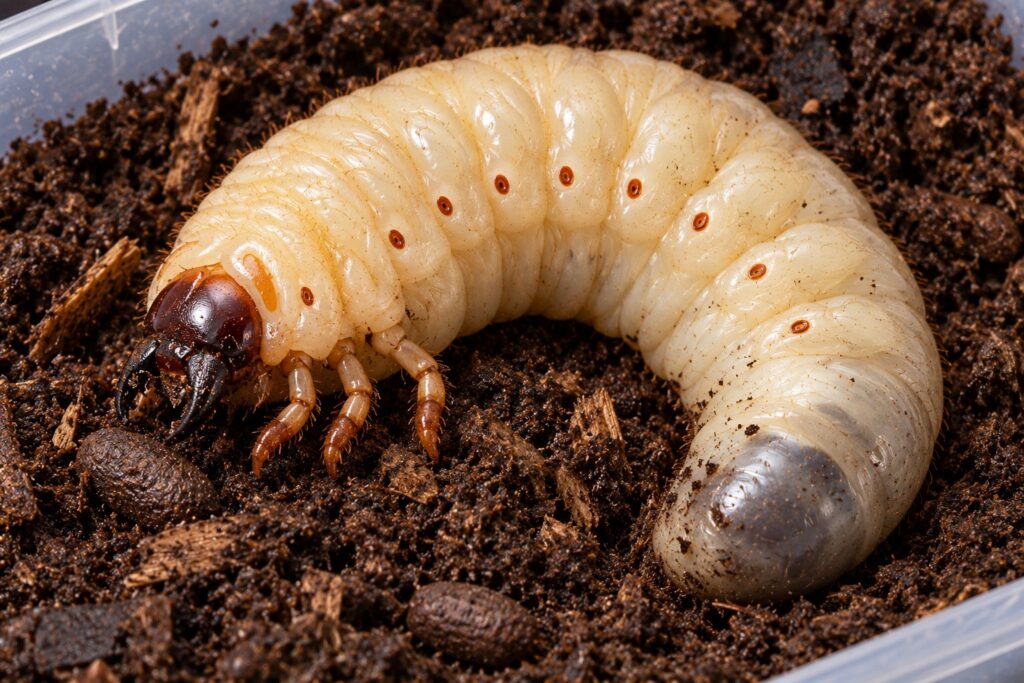
A Hercules beetle larva is the heaviest grub most keepers will ever hold. A well-fed male larva of the tropical Dynastes hercules can grow to about 4.5 inches long and pass 100 grams, more than many small birds, and it spends up to two years underground eating rotting wood before it turns into the horned beetle that gives the species its name.
Raising one is a long, quiet project that pays off at the end with one of the most impressive insects on Earth. This guide covers the legal question, the larval substrate and containers, growth by instar, the long third stage, pupation, adult care and lifespan, and the native North American Hercules beetles that US keepers can raise instead.
Hercules Beetle at a Glance
| Attribute | Details |
|---|---|
| Scientific name | Dynastes hercules |
| Native range | Tropical forests from southern Mexico to Bolivia, including the Lesser Antilles and Trinidad |
| Adult male length | Up to about 7 inches including the horn |
| Larva | Up to about 4.5 inches long and over 100 g |
| Larval period | Up to about 2 years |
| Pupa | About a month |
| Adult life | About 3 to 6 months in captivity |
| Larval food | Rotting hardwood and fermented flake soil |
| Adult food | Beetle jelly and ripe fruit |
| Temperature | 68 to 77F (20 to 25C) |
Can You Keep One Where You Live?
United States. Dynastes hercules is not native to the US. USDA guidance on invertebrate pets says many non-native invertebrates are illegal to own because of the risk to agriculture and the environment, and moving or importing live land invertebrates generally needs a PPQ 526 permit. In practice, live tropical Hercules beetles are not legally available in the American pet trade. The same applies to the rainbow stag beetle, and for the same reasons.
Elsewhere. Captive-bred Hercules beetles are sold in Japan, much of Europe and parts of Asia. Check your national rules and buy from a breeder who names the subspecies.
The native alternatives. North America has its own Hercules beetles: the eastern Hercules beetle, Dynastes tityus, and the western Hercules beetle, Dynastes grantii. Their larvae are raised the same way, on a smaller scale, and our guide to rhino beetle grubs covers both in detail.
Inside the Grub: Three Instars
A Hercules beetle larva looks like any scarab grub, only much bigger: a soft, cream to pale yellow, C-shaped body with a hard brown-black head and six short legs at the front. The back end darkens to grey as the gut fills.
What sets it apart is size. Lab-reared larvae spend roughly 50 days in the first instar, about 56 in the second, and around 450 in the third, which is where nearly all the growth happens. By late third instar, a male can be heavier than any other grub in the hobby.
| Stage | Typical length | Roughly lasts | Container per larva |
|---|---|---|---|
| L1 | Under 1 inch | About 7 weeks | 16 oz cup |
| L2 | 1.5 to 2.5 inches | About 8 weeks | 1 quart container |
| L3, early | 3 inches and up | Several months | 1 to 2 gallon container |
| L3, late | Up to about 4.5 inches | Up to a year or more | 3 to 5 gallon container |
One larva per container from L2 onward. Large Dynastes larvae bite each other, and a wound often kills.
Substrate: Dark, Fermented and Deep
Hercules beetle larvae eat rotting wood, and in captivity they live inside fermented hardwood called flake soil. Dynastes larvae prefer it darker and more broken down than stag beetle larvae do.
A workable mix:
- 7 parts dark, well-fermented flake soil
- 2 parts crumbled rotten hardwood
- 1 part decayed hardwood leaf litter
Moisture: squeeze a handful. It should hold together and release no water.
Depth: at least 8 to 10 inches for an L3, with the bottom third packed down firmly. A large male needs that depth to build its pupal cell.
Changing it: replace about two thirds when the substrate is mostly frass, the hard dark pellets the larva leaves behind. For a large L3 that can be every one to two months. Keep the remaining third and mix it in, because it carries the gut microbes the larva needs.
The substrate is the food, the same principle that runs through millipede care. If you collect your own wood and leaves, the safety rules from our guide to sourcing rotten hardwood apply: hardwood only, no conifers, nothing from treated land.
Growing a Big Hercules Beetle
The size of the adult, horn included, is fixed by how well the larva ate. Adults never grow. Four things decide it:
- Container size. A larva that fills its tub stops growing. Move up a size before it touches the walls on every side.
- Fresh substrate. Change it before it is used up.
- Steady, moderate temperature. 68 to 77F. Warmer speeds up the larval stage and produces smaller adults.
- Leaving it alone. Every dig-out costs time and energy.
Weigh each larva at substrate changes on a kitchen scale. A steady gain in grams is the best health check for an animal you will barely see for two years. Logging those weights in InvertMate turns them into a growth curve, and a larva that stops gaining shows up long before it looks wrong.
Hercules Beetle Larvae: Problems to Watch
- Larva on the surface. Substrate too wet, too dry, used up or too warm.
- Weight loss. Usually spent substrate. Change it.
- Dark patches or a soft, limp larva. A bite or infection. Isolate it.
- Mites. A few are normal. Heavy clusters mean the substrate is too wet or overdue.
- Sour smell. Waterlogged substrate. Replace it.
- A larva that stops eating early. If it shrinks rather than yellows and wrinkles, it is not preparing to pupate. Check temperature and substrate.
Pupation: Up to a Month Behind a Wall
Late in the third instar the larva stops eating, turns a deeper, wrinkled yellow, and builds a pupal cell: an oval chamber with smooth, hard walls, often built vertically for males so there is room for the horn to form.
From the first sign:
- Stop changing substrate.
- Do not move, tip or shake the container. A male’s horn can be deformed if the cell is disturbed.
- Keep moisture steady by adding water only at the edges.
- Wait. The pupa stage lasts about a month. The new adult then stays in the cell for weeks while its shell hardens, and emerges on its own.
If a cell breaks by accident, keepers make an artificial one from damp floral foam or packed substrate, shaped to the pupa and stood upright for males.
Adult Hercules Beetles
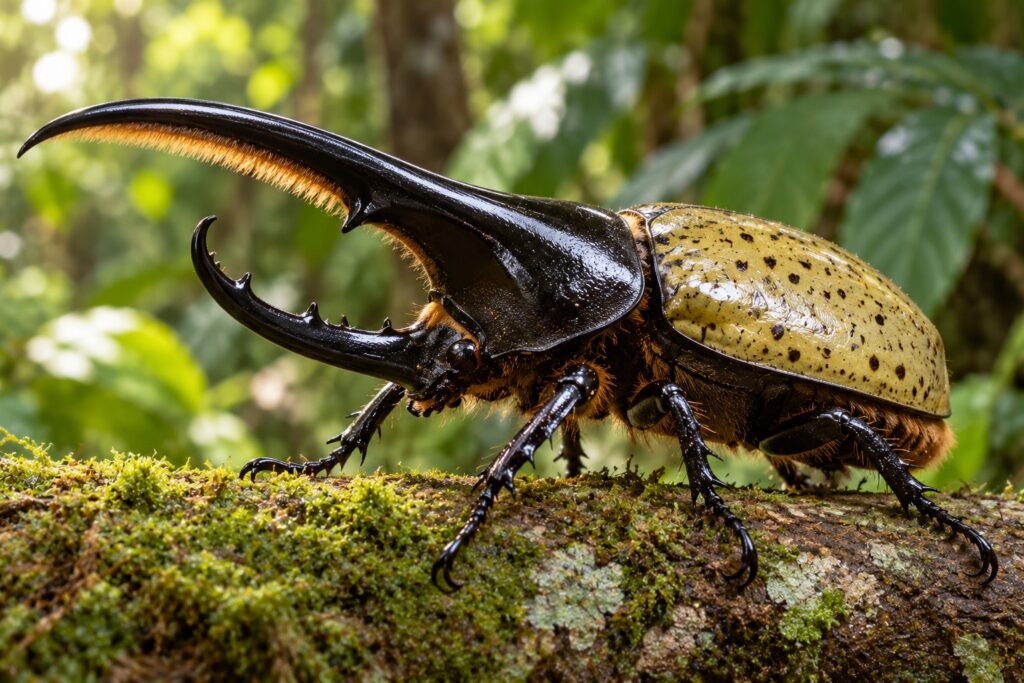
Males and females: males carry a long thoracic horn and a shorter head horn that work like pincers, and can reach about 7 inches including the horn. Females are hornless, smaller, and usually dark with rougher, often hairy wing cases.
Colour that changes: a male’s wing cases are olive, khaki or yellow in dry air and darken to black when humid. It is a normal, reversible response, not a sign of illness.
The first weeks: a newly emerged adult often stays buried and ignores food for several weeks while it finishes hardening. This is normal. Keep the substrate moist, leave jelly on the surface, and wait until it is walking and feeding every night before you handle it or think about pairing.
Food: adults lap sugary liquids. Beetle jelly is the cleanest option. Ripe banana, apple, pear, mango and grapes also work, changed every day or two before they ferment.
Housing: a large tank or tub with a secure lid, several inches of moist substrate to burrow into, and plenty of bark and branches. A beetle on its back on a smooth floor can exhaust itself trying to turn over.
One male per enclosure. Males fight with their horns.
Handling: safe. They do not bite or sting. Their claws grip hard, and a male can pinch with his horns, so let him walk off your hand rather than pulling.
How Long Do Hercules Beetles Live?
| Stage | Duration |
|---|---|
| Egg | About 4 weeks |
| Larva | Up to about 2 years |
| Pupa | About 1 month |
| Adult, active | About 3 to 6 months in captivity |
The whole life cycle runs roughly two and a half years, and the beetle you see is the last few months of it. The Hercules beetle lifespan is mostly a larval lifespan.
Breeding Hercules Beetles
- Let new adults mature and start eating for a few weeks before pairing.
- Pair them for a few days with plenty of food.
- Move the female to a laying container with 8 to 10 inches of flake soil, the bottom half packed very firmly.
- Leave her for one to two months. Females can lay up to about 100 eggs, singly, in the packed layer.
- Tip the substrate out gently and move eggs and L1 larvae into their own cups.
FAQ
How big does a Hercules beetle larva get?
A well-fed Dynastes hercules larva can reach about 4.5 inches long and weigh over 100 grams by the end of the third instar. Males usually grow larger than females. Native North American Dynastes larvae are considerably smaller.
How long is the Hercules beetle larval stage?
Up to about two years, most of it in the third instar. In lab conditions at around 77F, the first two instars took roughly three and a half months together and the third instar about 450 days.
What do Hercules beetle larvae eat?
Rotting hardwood. In captivity that means dark, well-fermented flake soil mixed with crumbled rotten wood and decayed leaf litter. The larva lives inside its food, and it needs no fruit, vegetables or protein.
How long do Hercules beetles live?
Adults live about three to six months in captivity, after a larval stage of up to two years. The full life cycle from egg to adult death takes roughly two and a half years.
Can you keep a Hercules beetle in the US?
The tropical Dynastes hercules is non-native, and USDA says many non-native invertebrates are illegal to keep as pets. US keepers can raise the native eastern Hercules beetle, Dynastes tityus, or western Hercules beetle, Dynastes grantii, instead.
Why did my Hercules beetle change colour?
Male wing cases change with humidity, turning olive or yellow in dry air and black in damp air. It is a normal, reversible response. A beetle that has gone black is not unwell.
Two Years of Weigh-Ins
A Hercules beetle larva gives you almost nothing to look at for two years, so the numbers are what tell you it is on track. InvertMate logs each larva’s weight and substrate changes as a growth curve, keeps a dated photo timeline from L1 to horned adult, and reminds you when a container is due for fresh substrate. Free on the App Store and Google Play.