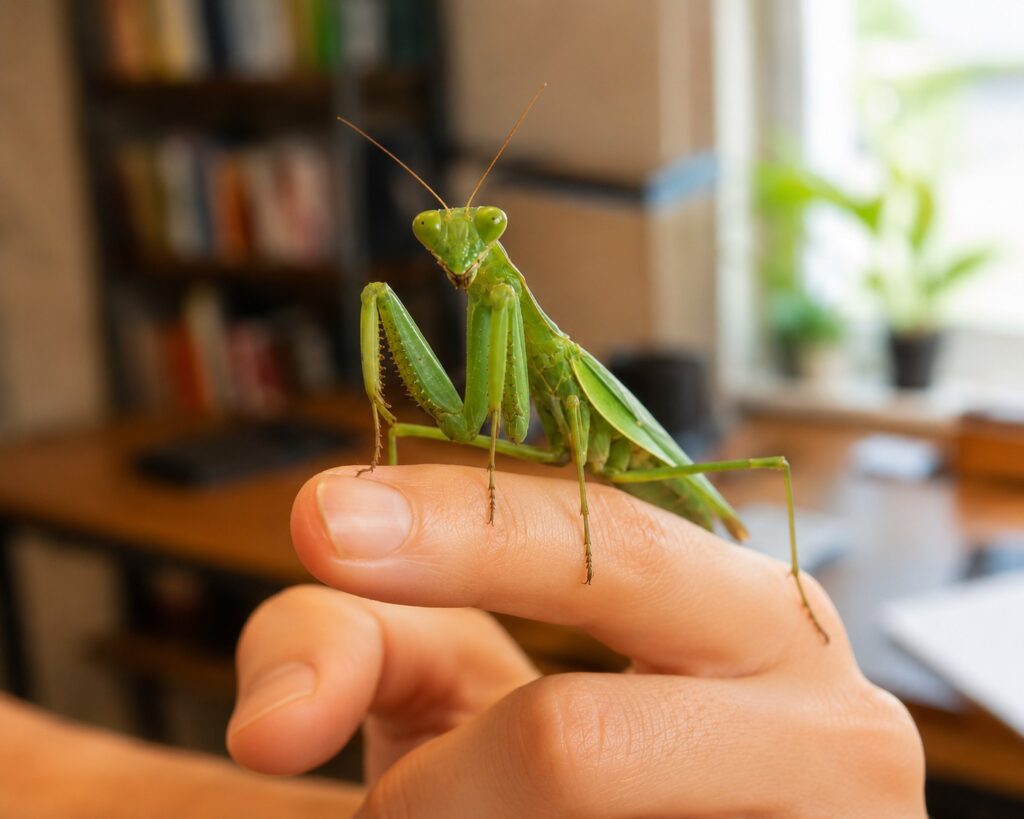
Can you keep a praying mantis as a pet? The short answer is yes, absolutely. Mantises are legal to keep in most places, they’re inexpensive, they take up minimal space, and they’re one of the most fascinating animals you can observe up close. They’re also one of the easiest exotic pets to care for once you understand the basics.
The longer answer involves some honest expectations. A praying mantis as a pet is not like a dog, cat, or even a fish. They don’t bond with you, they don’t come when called, and they live less than a year in most cases. What they offer instead is something different: a front-row seat to one of nature’s most efficient predators, right on your desk. Watching a mantis hunt, molt, and go through its life cycle in your living room is genuinely captivating in a way that surprises most people who try it.
This guide covers everything you need to decide: legality, cost, what daily care looks like, how long they live, the best species to start with, and the honest pros and cons.
Is It Legal to Keep a Praying Mantis?
In most countries, yes. Keeping mantises as pets is legal in the United States, the United Kingdom, Canada, most of Europe, and Australia (with some species restrictions).
United States: Native species (Chinese mantis, Carolina mantis) are legal to keep everywhere. Exotic tropical species may require a USDA permit for interstate transport in some states. In practice, enforcement is minimal, and most hobbyists buy exotic species online without issue. The common myth that it’s illegal to kill or capture a praying mantis in the US is exactly that: a myth. There are no federal laws protecting mantises.
United Kingdom: Keeping mantises is legal. No permits needed for most species.
Canada: Legal, with some import restrictions on exotic species.
Australia: Legal for native species. Exotic species may require permits depending on your state.
If you’re unsure about your specific location, check with your local fish and wildlife department. But for the vast majority of readers, the answer is: you’re fine. Go ahead and get one.
What Does It Cost?
One of the best things about keeping a praying mantis as a pet is how cheap it is compared to virtually any other animal.
The mantis itself: $5-30 for common beginner species. A ghost mantis nymph might cost $8-15. A Chinese mantis ootheca (egg case containing dozens of nymphs) can cost as little as $5-10. Premium species like orchid mantises run $20-50+.
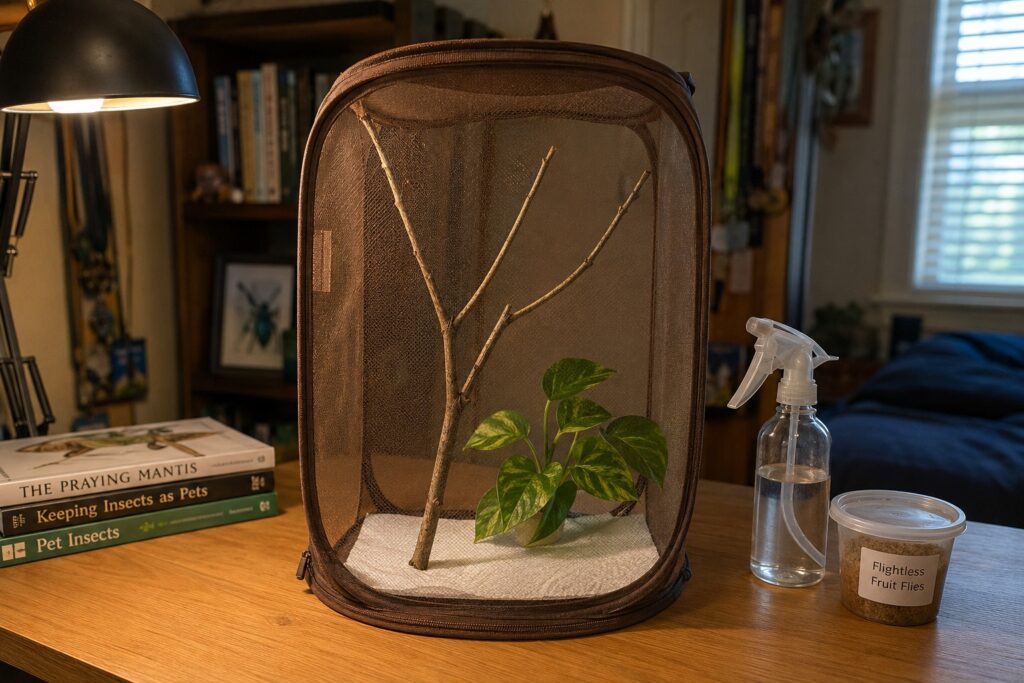
Enclosure: $5-20. A deli cup (free or under $1) works for nymphs. A mesh pop-up cage or small terrarium for adults runs $10-20. You don’t need anything fancy.
Feeder insects: $5-15 per month. A fruit fly culture costs $10-15 and produces thousands of flies over several weeks. Crickets from a pet store run a few dollars per container.
Accessories: A spray bottle ($2), some twigs from outside (free), and optional artificial plants ($3-5). That’s it.
Total startup cost: $15-50. Monthly ongoing cost: $5-15 for feeders. This makes mantises one of the most affordable pets you can keep. No vet bills, no special food, no expensive equipment.
What Is Daily Care Like?
Keeping a praying mantis as a pet requires very little daily effort. Here’s what a typical week looks like:
Daily (1-2 minutes):
- Quick visual check on the mantis (is it perched normally? eating? showing pre-molt signs?)
- Mist the enclosure lightly with a spray bottle (provides water and humidity)
Every 2-5 days (5 minutes):
- Feed the mantis an appropriately sized live insect
- Remove any uneaten prey from the enclosure
Weekly (5-10 minutes):
- Clean the enclosure bottom (remove frass, dead insects, old food)
- Check that temperature and humidity are in range
That’s it. Total weekly time investment is roughly 20-30 minutes. Mantises don’t need walks, grooming, socialization, or companionship. They’re perfectly content being left alone in their enclosure between feedings and mistings.
The one inconvenience some people find is the live feeder insects. You’ll need to keep a supply of fruit flies (for nymphs) and crickets or flies (for adults) on hand. This means either buying feeders regularly from a pet store or maintaining a fruit fly culture at home. It’s not difficult, but it does mean having live bugs in your house.
How Long Do Pet Mantises Live?
This is where honest expectations matter. Most pet mantis species live 6-18 months total, with the adult phase lasting 3-8 months. They’re not long-lived pets. You’re looking at roughly a year of companionship, sometimes less.
For some people, this is a dealbreaker. For others, it’s actually part of the appeal: you get to witness an entire life cycle, from tiny nymph to full-sized adult, in less than a year. Watching a mantis grow through its instars, molt repeatedly, develop wings, and reach adulthood is a complete biological narrative happening on your bookshelf.
If lifespan matters to you, choose a large species. Chinese mantises and giant African mantises can live 10-14 months. Smaller species like spiny flower mantises may only last 6-8 months. Females consistently outlive males in every species.
Best Species for First-Time Owners
Not all mantis species are equally beginner-friendly. Start with one of these:
Ghost Mantis (Phyllocrania paradoxa): The most commonly recommended starter species. Calm, tolerant of varying conditions, unique leaf-like appearance, and one of the few species that can be kept communally. Lives 7-12 months.
Chinese Mantis (Tenodera sinensis): Large, hardy, and easy to feed. Very forgiving of temperature and humidity fluctuations. Widely available and one of the longest-lived common species (10-14 months).
Giant African Mantis (Sphodromantis spp.): Big, bold, and has an incredible feeding response. Tolerates a wide range of conditions. Great choice if you want something visually impressive.
Carolina Mantis (Stagmomantis carolina): Native to the US, smaller than Chinese mantises but equally hardy. A good option if you want a local species.
All four of these species are widely available online, cost under $20, and can be raised successfully by a complete beginner with no prior insect-keeping experience. For a full beginner walkthrough, see our praying mantis care 101.
The Honest Pros and Cons
Pros:
- Fascinating to observe. Hunting, molting, and daily behavior are genuinely captivating.
- Extremely low cost to buy and maintain.
- Minimal space required. A mantis lives happily on your desk.
- Very little daily time commitment.
- No noise, no smell, no mess (beyond occasional frass cleanup).
- Great for apartments, dorms, or small spaces where traditional pets aren’t allowed.
- Educational. Kids and adults learn real biology by watching the life cycle firsthand.
- Each mantis has a distinct personality. Some are bold hunters, others are cautious and shy.
Cons:
- Short lifespan. You’ll have your mantis for less than a year in most cases.
- They eat live insects. You need to be comfortable buying and handling feeder bugs.
- They’re not interactive pets. You can’t train them, and they don’t recognize you.
- Handling is possible but should be limited. They’re observation pets first.
- Molting can go wrong. A failed molt from low humidity or inadequate climbing surfaces can kill your mantis despite good care.
- They’re solitary. Most species will eat each other if housed together.
- Availability varies. Not every pet store sells mantises. You may need to order online.
Where to Buy a Pet Mantis
Online breeders are the best source. They offer healthy, properly identified animals with species-specific care notes. Search for “mantis for sale” on breeder websites, insect forums, or marketplaces like eBay (many reputable breeders sell through eBay). Expect shipping costs of $10-20 on top of the mantis price. Most breeders ship with heat or cold packs depending on the season.
Reptile and exotic pet expos are excellent places to buy mantises in person. You can see the animal before buying, ask the breeder questions directly, and avoid shipping stress. Expos happen regularly in most major metro areas.
Pet stores occasionally carry mantises, but selection is usually limited to Chinese mantis oothecae. Specialty exotic pet shops are more likely to have live nymphs or adults.
Wild-caught mantises are an option if you find one in your garden. It’s legal and perfectly fine. Just note that wild-caught adults may only have weeks or months of lifespan remaining, and you won’t know the exact species or age.
Common First-Timer Mistakes
Buying an adult instead of a nymph. Adults are closer to the end of their lifespan. A nymph gives you the full experience of raising a mantis from small to adult. Start with an L3-L4 nymph (big enough to be hardy but young enough to enjoy the full growth journey).
Keeping the enclosure too dry. New keepers forget to mist, the mantis fails its next molt, and it dies. Set a daily misting reminder on your phone for the first month until it becomes habit. Our guide to what praying mantises need to survive covers the six essentials in one place.
Wrong prey size. Fruit flies for nymphs, crickets for adults. Prey roughly half the mantis’s body length. Too large and the prey can injure the mantis. Too small and the mantis ignores it.
Leaving crickets in the enclosure overnight. Crickets bite. A sleeping or molting mantis is defenseless. Always remove uneaten prey.
Handling too much. Mantises tolerate handling but they’re not hamsters. A few minutes per week is fine. Daily handling sessions stress them out.
FAQ
Can you keep a praying mantis as a pet?
Yes. Praying mantises are legal to keep in most countries, inexpensive (under $50 total startup), easy to care for, and fascinating to watch. They require a small enclosure, live feeder insects, regular misting, and very little daily time. They’re one of the most accessible exotic pets available.
Do praying mantis make good pets for kids?
Yes, with adult supervision for younger children. Mantises are safe (no venom, harmless bite), educational, and teach responsibility through feeding and misting. Children around 10-12 can manage care independently. Younger kids will need help with feeding and humidity maintenance.
Do pet mantises recognize their owners?
No. Mantises don’t have the neurological capacity for individual recognition. They may become habituated to handling (less likely to flee from a familiar hand), but this is conditioning, not recognition. They’re observation pets, not companion pets.
Is it cruel to keep a praying mantis as a pet?
A well-cared-for captive mantis lives longer, faces fewer threats, and has more consistent food than a wild mantis. As long as you provide appropriate temperature, humidity, food, and space, captive keeping is not cruel. It’s arguably a better life than the wild, where most mantises are eaten by predators before reaching adulthood.
Can I release a pet mantis into the wild?
Native species (like Chinese mantis or Carolina mantis in the US) can be released safely. Do not release exotic tropical species into non-native environments, as they could potentially become invasive or simply die in unsuitable conditions.
Track Your Mantis with InvertMate
Start your mantis keeping journey with InvertMate. Track molts, log feedings, monitor enclosure conditions, and set reminders for misting and care tasks. Free on the App Store.