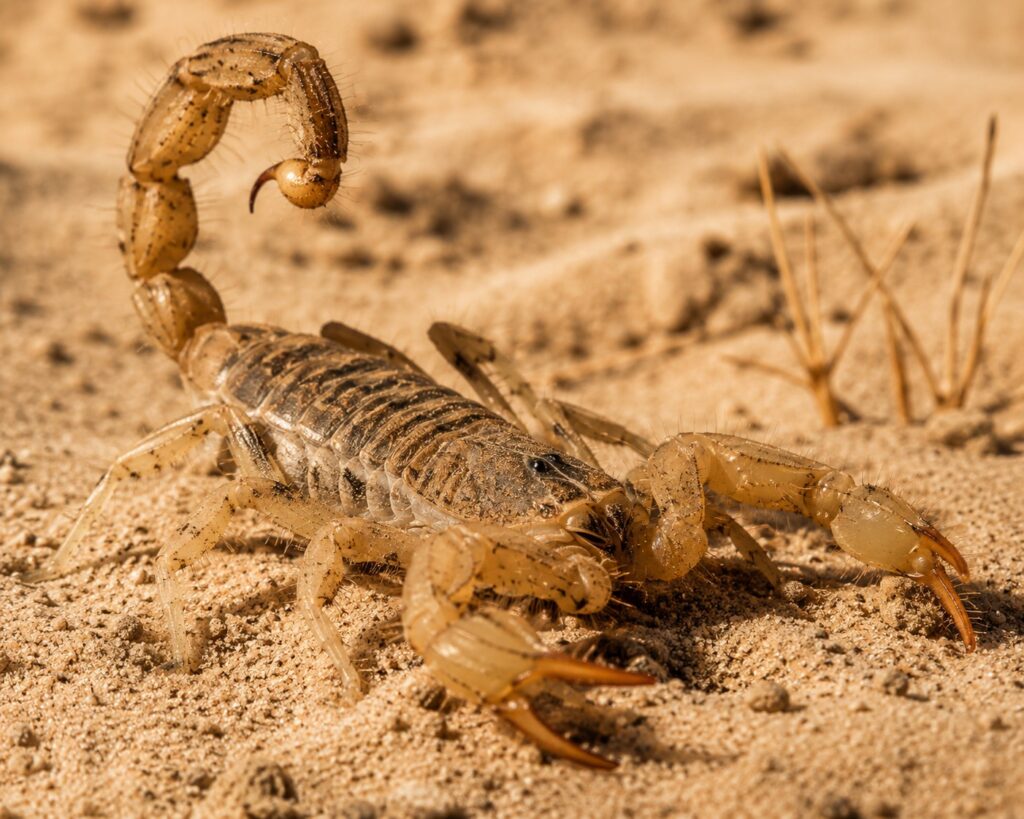
The desert hairy scorpion is the largest scorpion in North America and one of the most rewarding desert species you can keep. If you want a big, bold, long-lived scorpion that thrives in a dry, arid setup, this is the one. Native to the Sonoran and Mojave deserts, the desert hairy scorpion (Hadrurus arizonensis) is hardy, impressive under UV light, and capable of living 15 to 20 years with the right care.
The “hairy” name comes from the dense coating of brown sensory hairs covering its legs, tail, and pedipalps. These setae detect tiny vibrations in the air and soil, letting the scorpion sense prey and predators in total darkness. Despite its intimidating size and appearance, its venom is mild, comparable to a bee sting, which makes it a popular choice among keepers who want something dramatic but not dangerous.
This guide covers everything: the arid enclosure these scorpions demand, the deep substrate they need for burrowing, temperature and humidity, diet, handling realities, and breeding. The key thing to understand from the start is that desert hairy scorpions need the opposite conditions from tropical species like the emperor. Dry, not humid. If you’ve read our emperor scorpion care guide, get ready to flip almost everything about moisture.
Species Overview
Desert hairy scorpions are native to the arid deserts of the southwestern United States (Arizona, California, Nevada, Utah) and northern Mexico. In the wild, they’re obligate burrowers, digging deep vertical tunnels that can reach several feet down to escape the brutal daytime heat and reach cooler, more stable layers of soil. They emerge at night to ambush insects, spiders, and occasionally small vertebrates.
Adults typically reach 4 to 6 inches in total length, with some large females exceeding that. Their coloration is pale yellow to tan with a darker dorsal pattern, an adaptation that blends into desert sand. Like all scorpions, they fluoresce brilliant blue-green under UV light, which makes for spectacular nighttime viewing.
Temperament-wise, desert hairy scorpions are solitary, territorial, and more defensive than emperors. They must be housed alone, as pairing two adults usually ends in a territorial fight or cannibalism. Their venom is mild and not medically significant for healthy adults, but they’re quicker to adopt a defensive posture than the famously docile emperor.
| Attribute | Details |
|---|---|
| Scientific name | Hadrurus arizonensis |
| Adult size | 4-6 inches (10-15 cm) |
| Lifespan | 15-20 years (females); up to 10 years (males) |
| Difficulty | Beginner |
| Temperature | 75-85°F (24-29°C) |
| Humidity | 40-55% (low) |
Enclosure Setup
A 10-gallon glass terrarium is the minimum for a single adult desert hairy scorpion, and floor space matters more than height. These are terrestrial burrowers, so a “long” style tank that maximizes ground area is ideal. Always use a secure, locking lid, because scorpions can climb silicone seams and decorations to escape.
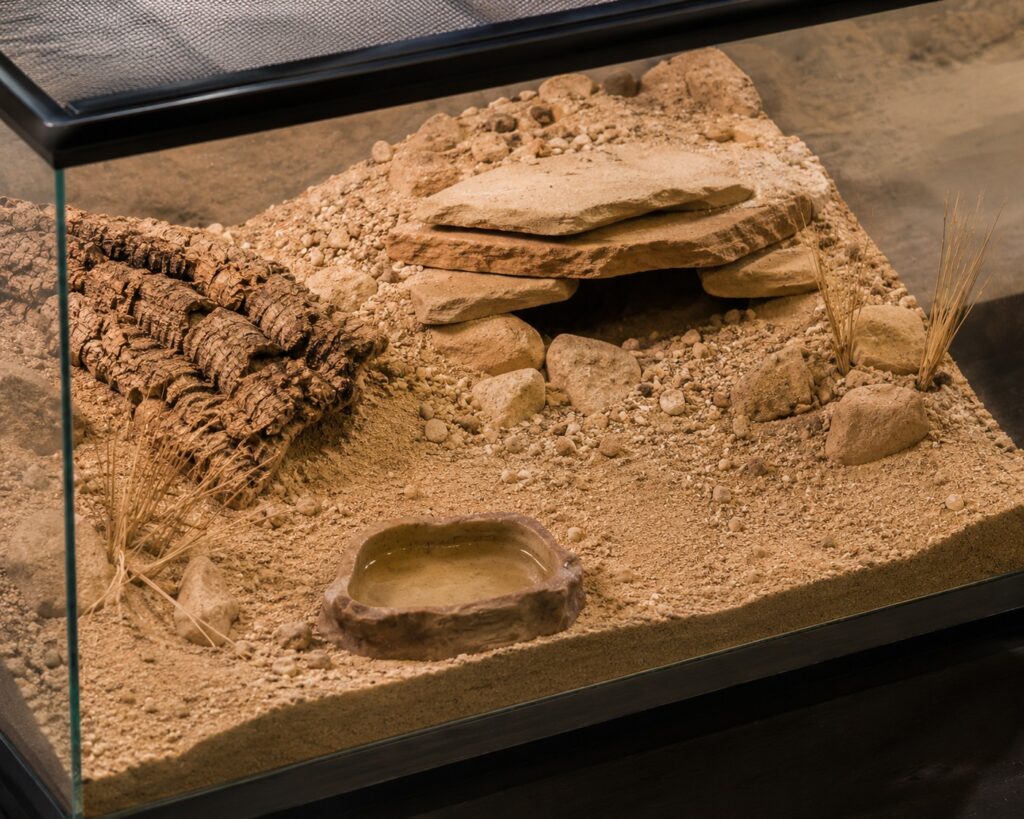
Substrate is the single most important element of a desert hairy setup, and this is where most beginners go wrong. These scorpions need deep, dry, compactable substrate that holds a burrow. Aim for at least 4 to 6 inches of depth, and more is better. A loose substrate that collapses gives you the dreaded “pet hole” problem, where the burrow caves in repeatedly.
The best substrate is a mix that supports stable tunnel walls. A blend of play sand and excavator clay works exceptionally well, as the clay binds the sand into solid, permanent burrow walls. A 60/40 sand to clay ratio is a good starting point. Some keepers use a sand and coconut fiber mix (50/50), which works but holds burrows less reliably than clay. Pure play sand can work for a hardy adult but tends to collapse. Whatever you choose, keep it dry.
Hides and decor: Provide flat rocks, cork bark, or half logs for surface shelter, especially while your scorpion establishes its burrow. Don’t leave the tank bare with a single hide in the corner. Add multiple structures and obstacles to make the environment interesting and give the scorpion places to feel secure. Heavy flat stones placed directly on the substrate also give burrow entrances structural support.
Water: Despite the arid setup, provide a shallow water dish. A jar lid or shallow ceramic dish the scorpion can’t drown in works well. Change the water regularly.
Lighting: No special lighting is required. These scorpions are nocturnal and avoid light. A natural day-night cycle from ambient room light is fine. For nighttime viewing, a red bulb or UV blacklight lets you observe without disturbing them.
Temperature and Humidity
Desert hairy scorpions thrive in a temperature range of 75 to 85°F (24 to 29°C). Many keepers successfully maintain them at normal room temperature without any supplemental heat, since these are remarkably hardy animals adapted to wide temperature swings. If your room drops below 70°F, add a low-wattage heat mat to the side of the glass (never underneath, since a burrowing scorpion will dig down toward the heat and overheat). Always use a thermostat.
Humidity is where desert hairy scorpions differ completely from tropical species. Keep it low, around 40 to 55%. High humidity and poor airflow are the leading causes of health problems in this species, particularly fatal fungal infections. Do not mist the enclosure regularly.
The substrate should stay dry. If you want to provide a little moisture, you can pour a small amount of water down one side of the enclosure every couple of weeks to slightly dampen the bottom layer, taking care that the scorpion isn’t in that area. The surface and most of the substrate should remain bone dry. Strong ventilation is essential to keep air from becoming stagnant and humid.
Monitoring conditions over time helps you catch the humidity creep that causes mycosis before it harms your scorpion. A digital hygrometer is a cheap, essential tool for this dry-loving species.
Diet and Feeding
Desert hairy scorpions are opportunistic ambush predators with hearty appetites. In captivity, feeding them is simple.
Staple feeders: Crickets and dubia roaches make the best primary diet. Both are easy to gut-load with fresh vegetables, passing that nutrition on to your scorpion. Mealworms and superworms work as supplemental feeders. Given their size, adult desert hairy scorpions can take fairly large prey, including larger crickets and roaches.
Feeding frequency: Adults eat 2 to 3 appropriately sized prey items once per week. A good rule is to never offer prey larger than about a quarter of the scorpion’s body length. Juveniles eat smaller prey more frequently, roughly every 4 to 5 days.
Gut-loading is the most important nutritional step. Feed your crickets or roaches fresh vegetables like carrots, sweet potato, and leafy greens for at least 24 hours before offering them. This turns empty chitin into real nutrition.
Remove uneaten prey within 24 hours. Live insects left in the enclosure can stress or bite a molting scorpion. Never feed wild-caught insects, which may carry pesticides or parasites. Don’t be alarmed if your scorpion refuses food for a stretch, as these animals can go weeks or even months without eating, especially around a molt.
Behavior and Handling
Desert hairy scorpions are strictly nocturnal. During the day they stay hidden in their burrows or under hides, emerging after dark to hunt, patrol, and dig. If you want to watch natural behavior, observe at night with a red light or UV blacklight to see the dramatic fluorescent glow.
These scorpions are more defensive than the docile emperor. When startled, they’ll raise their pincers and tail into a threat posture and are quicker to pinch or sting. That said, their venom is mild, roughly comparable to a bee sting, with localized pain and swelling. Anyone with known insect sting allergies should exercise extra caution.
Handling is not recommended. Desert hairy scorpions are observation pets, not interactive ones. They’re heavy-bodied, and a fall from your hand can fatally rupture their exoskeleton. Combined with their defensive temperament, handling simply isn’t worth the risk to you or the animal. For enclosure maintenance, use long soft-tipped tongs to gently guide the scorpion, or place a container over it and slide cardboard underneath to relocate it safely.
Molting occurs as the scorpion grows, reaching adulthood after roughly 5 to 6 molts over several years. Pre-molt signs include refusing food, reduced activity, and a duller appearance. During a molt the scorpion is extremely vulnerable, so never disturb it and remove any live prey from the enclosure. The new exoskeleton takes several days to harden.
Breeding
Breeding desert hairy scorpions in captivity is possible but challenging, partly due to their territorial nature and the difficulty of safely housing two adults together.
Sexing is tricky and usually requires examining the pectines (comb-like structures on the underside). Males typically have longer pectines with more teeth, slightly longer tails, and a more slender build, while females are heavier-bodied.
To breed, a male and female are introduced carefully and monitored closely, as aggression and cannibalism are real risks. The male performs a courtship “dance” (a promenade à deux), grasping the female’s pincers and walking her back and forth until he deposits a spermatophore, then guiding her over it. After mating, separate the pair immediately to prevent the female from cannibalizing the male.
Gestation is long, and the female gives live birth to a brood of roughly 25 to 35 white scorplings. As with all scorpions, the young climb onto her back and remain there through their first molt before dispersing. Once they leave her back, separate the scorplings into individual containers, since cannibalism among siblings is common. Raising desert hairy scorplings is notoriously difficult, as the young are prone to failed molts, which is why most available specimens are wild-caught or sold as adults.
Common Health Issues
Nearly all desert hairy scorpion health problems trace back to too much moisture. Mycosis (fungal infection) is the biggest killer, appearing as dark or discolored patches on the exoskeleton. It develops in damp, poorly ventilated conditions. Keep the enclosure dry and well-ventilated to prevent it.
Failed molts can occur in juveniles, particularly when conditions aren’t right, and are often fatal. Dehydration is less common in this hardy species but can happen, showing as a shriveled, lethargic appearance. A water dish and slightly dampened bottom substrate layer prevent it. Mites occasionally appear on wild-caught specimens. Improve ventilation and consider springtails as a biological control. Falls and trauma are a risk if the heavy-bodied scorpion climbs and drops, which is one more reason to skip handling.
FAQ
Are desert hairy scorpions good for beginners?
Yes. They’re hardy, tolerate a wide temperature range, have mild venom, and are very forgiving as long as you keep them dry. The main beginner mistake is too much humidity, which causes fatal fungal infections. Keep the enclosure arid and well-ventilated and these are one of the easiest scorpions to keep. If you’re still comparing options, our scorpion as a pet guide covers the common beginner species. Tailless whip scorpions are worth a look too if you’d rather skip the stinger entirely.
How long do desert hairy scorpions live?
Females can live 15 to 20 years with proper care, making them one of the longest-lived pet scorpions. The one commonly kept species that outlives them is the flat rock scorpion, which regularly passes 25 years, though it grows so slowly that most keepers buy a wild caught adult of unknown age. Males mature faster and typically live around 10 years or less. For a full breakdown across species, see our guide on how long scorpions live.
How big do desert hairy scorpions get?
Adults reach 4 to 6 inches in total length, making them the largest scorpion native to North America. Large females can exceed 6 inches. Despite the impressive size, their body remains relatively lightweight and their venom is mild. Emperor scorpions are larger still at 6 to 8 inches. Our emperor scorpion size guide has the full comparison.
Can desert hairy scorpions be kept together?
No. Desert hairy scorpions are solitary and territorial. Housing two adults together almost always results in a territorial fight or cannibalism. Always keep them individually, with one scorpion per enclosure.
Do desert hairy scorpions need a heat lamp?
Usually not. These hardy scorpions do well at normal room temperature (70 to 80°F). If your home runs cold, a low-wattage heat mat mounted on the side of the enclosure (with a thermostat) provides gentle warmth. Avoid bright basking lamps, which stress these nocturnal, light-avoiding animals.
Track Your Scorpion with InvertMate
Keep a detailed care log for your desert hairy scorpion with InvertMate. Track feedings, log molts, monitor enclosure conditions, and set smart reminders for maintenance, helping your scorpion thrive for its full 15 to 20 year lifespan. Free on the App Store.