The curly hair tarantula is the one experienced keepers recommend in the same breath as the chaco golden knee, and for many of the same reasons. It is calm, hardy, inexpensive, eats almost anything you offer, and sits out in the open where you can see it. What it lacks in colour it makes up for in texture: a dark, almost black body covered in long, curled hairs tipped with bronze and gold.
Sold for decades as Brachypelma albopilosum, it is now Tliltocatl albopilosus, a New World ground dweller from Central America. This guide covers the name change, the setup and the one detail that separates its care from a chaco’s, feeding, temperament, molting, slings, and how to choose between the two.
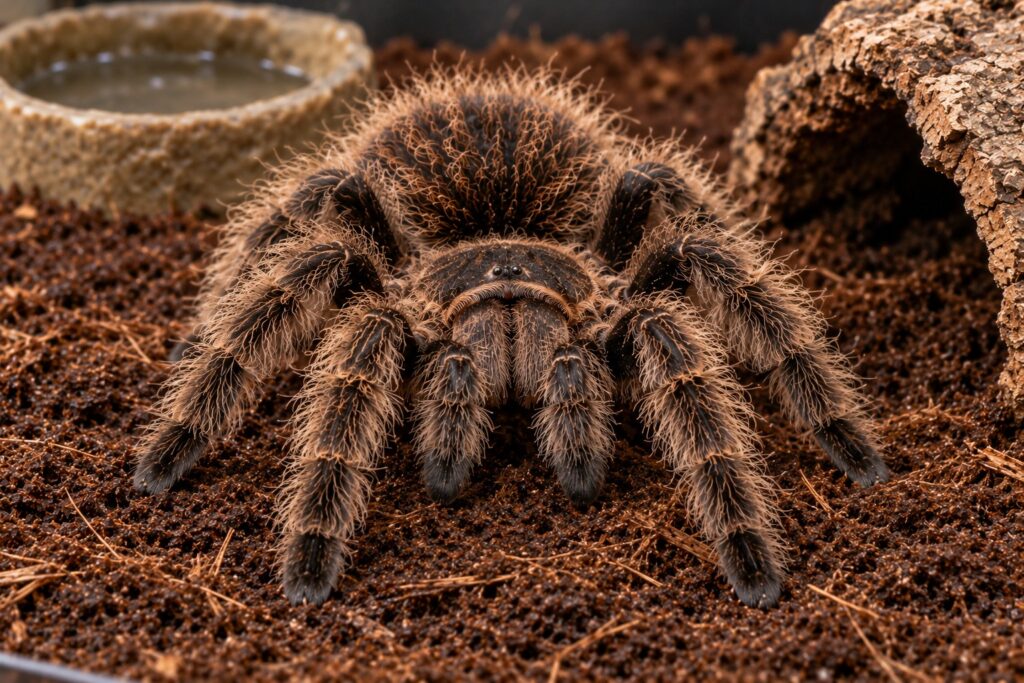
Curly Hair Tarantula at a Glance
| Attribute | Details |
|---|---|
| Scientific name | Tliltocatl albopilosus (formerly Brachypelma albopilosum) |
| Origin | Central America, described from Costa Rica |
| Adult leg span | 5 to 6 inches |
| Lifespan | Females commonly 10 to 15 years, reported past 20. Males 4 to 5 |
| Type | Terrestrial, New World, will dig |
| Temperature | 70 to 80F (21 to 27C) |
| Humidity | Moderate, from a damp corner of substrate |
| Growth | Slow to moderate |
| Temperament | Docile, quick to kick urticating hairs |
| Difficulty | Beginner |
| Trade status | CITES Appendix II, widely captive bred |
From Brachypelma Albopilosum to Tliltocatl
Older books, forums and shop labels call this spider Brachypelma albopilosum, and many breeders still do. In a 2020 revision of the Mexican Brachypelma, arachnologists Jorge Mendoza and Oscar Francke split the old genus and moved the curly hair, along with several dark-bodied relatives, into the new genus Tliltocatl. The name comes from Nahuatl, roughly “black spider”.
You will also see the species written as albopilosum, albopilosus or albopilosa. Those are spelling corrections made to match the gender of each genus name, not different animals. If a seller lists “B. albopilosum” or “T. albopilosum“, it is the same curly hair.
What has not changed is the care. Every Brachypelma curly hair care sheet you find still applies.
The Damp Corner Most Keepers Skip
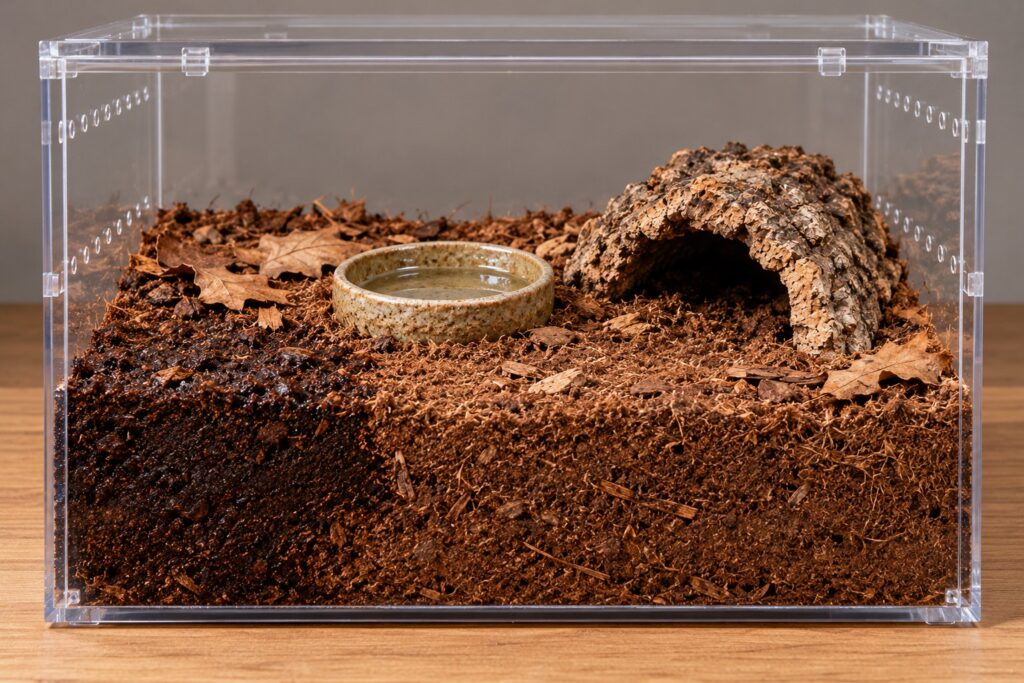
The curly hair looks like a chaco and is often set up like one, bone dry with a water dish. It copes, but it does better with one difference: a section of substrate kept slightly damp.
Its native range is warm, humid lowland forest, and in the wild it digs scrapes and short burrows under roots and logs where the soil holds moisture. In captivity that translates to:
- One corner kept damp. Pour water into one corner every week or two so it soaks down and the surface dries. The rest of the substrate stays dry.
- A full water dish, always.
- No misting. It wets the surface for an hour, does nothing for the spider, and invites mold.
You will know it is right if the spider spends time at the edge of the damp section, and the substrate there never smells sour. A curly hair that is too dry for too long tends to sit with its legs drawn in, refuse food without being in pre-molt, and look shrunken in the abdomen.
A Low Box With Deep Substrate
Curly hairs are heavy-bodied ground dwellers, and like every terrestrial they are bad at falling. Keep the gap between the substrate and the lid small.
| Leg span | Enclosure | Substrate |
|---|---|---|
| Under 1 inch | 2 to 3 inch vial or deli cup | Two thirds of the container |
| 1 to 2 inches | 16 to 32 oz deli cup | 3 to 4 inches |
| 2 to 3.5 inches | 6 to 10 inch box | 3 to 4 inches |
| Adult | About 10 by 10 inches, or a 5 to 10 gallon tank | 4 to 5 inches |
Open air above the substrate no more than about 1.5 times the leg span. A plump adult that climbs and drops can rupture its abdomen.
Substrate: coconut fibre mixed with additive-free topsoil, packed firmly. Curly hairs are keen diggers and movers of substrate. Expect your neat layout to be rearranged, a scrape under the hide, and sometimes a short burrow.
A hide: half a cork round pressed into the substrate, with a starter divot under it.
A water dish: shallow and stable, kept full.
The full build, from hide placement to rehousing, is in our guide to setting up a terrestrial tarantula enclosure.
Climate
Temperature: 70 to 80F suits it, which most heated homes reach without help. If your room drops lower, fix a low wattage heat mat to a side wall on a thermostat. Never underneath, since a spider that feels too warm digs down toward the heat.
Humidity: moderate, and supplied by the damp corner rather than by sealing the enclosure. Keep cross ventilation on two opposing walls.
A Spider That Rarely Says No
Curly hairs are famously keen feeders, which makes them easy to read: when a curly hair turns down food, there is usually a reason.
- What to offer: crickets, dubia roaches, red runners, locusts. Prey no longer than the spider’s body.
- How often: slings every 3 to 5 days, juveniles every 5 to 7, adults every 7 to 14.
- Judge by the abdomen. A curly hair will eat until it is obese if you let it. An abdomen much more than one and a half to two times the size of the carapace means it is time to wait.
- Remove leftovers within 24 hours, including the bolus of chewed remains.
Feeders, schedules and refusals in more detail are in our guide to what tarantulas eat.
Calm Until the Hairs Come Off
The curly hair is one of the most docile tarantulas in the hobby. It is slow, reluctant to bite, and tolerant of routine maintenance. Most will walk away from a paintbrush rather than react to it.
Its defence is not the bite but the hair. Like most New World tarantulas, it carries urticating setae on the abdomen, barbed hairs it kicks off with its back legs when it feels threatened. Curly hairs are quick to do this, even when otherwise calm. The hairs cause itching and a rash on skin and are much worse in eyes, so never put your face near an open enclosure, and wash your hands after maintenance. A bald patch on the back of the abdomen tells you it has been kicking.
A bite, if it ever happens, is usually compared to a wasp sting. As with any bite or sting, an allergic reaction is possible, so seek medical advice if symptoms spread. The broader difference between New World and Old World defences, and why it matters for a first spider, is explained in our comparison of tarantula groups by origin.
Handling. Possible with a calm individual, but it adds risk without benefit. The danger is a fall, not a bite. If you do, sit on the floor and let the spider walk from hand to hand. Never handle in pre-molt or just after a molt.
On Its Back Is Normal: Molting and Growth
Curly hairs grow slowly to moderately, faster than a Chilean rose but slower than most tropical terrestrials. Expect several years from sling to adult female, often four or more.
Pre-molt signs: refusing food, a darkening abdomen, and a bald patch that turns black or shiny as the new exoskeleton forms underneath. Many lie on their back to molt, which alarms new keepers but is completely normal. Do not touch the spider, do not mist, and remove any live prey. The process from start to finish is covered in our guide to how tarantulas molt.
After a molt: wait a week or two before feeding, until the fangs have turned black.
Because the gaps between molts stretch out to a year or more in adults, they are easy to lose track of. Keep a molt log in InvertMate and you can tell a normal long fast from one that is worth worrying about.
Curly Hair Slings
Slings are among the cheapest in the hobby, partly because females produce large egg sacs. They are tiny, tan and plain, and they look nothing like the adults until a few molts in.
- House them small, a vial or 2 to 4 oz cup with two thirds substrate.
- Expect burrowing. Curly hair slings dig hard and may vanish for weeks.
- Keep one corner of substrate damp and add droplets to the wall.
- Feed pre-killed prey or pinhead crickets every 3 to 5 days.
The general routine for slings, including pre-killing and when to rehouse, is in our guide to raising tarantula spiderlings.
Curly Hair or Chaco Golden Knee?
These are the two most common recommendations for a first tarantula. Both are excellent.
| Curly hair | Chaco golden knee | |
|---|---|---|
| Scientific name | Tliltocatl albopilosus | Grammostola pulchripes |
| Adult size | 5 to 6 inches | 7 to 8 inches |
| Look | Dark with curly bronze hair | Dark with gold leg bands |
| Moisture | Damp corner preferred | Dry substrate, full dish |
| Growth | Slow to moderate | Slow to moderate |
| Appetite | Very keen | Reliable, long fasts |
| Hair kicking | Fairly quick to kick | Less inclined |
| Female lifespan | 10 to 15 years, reported past 20 | 20 to 25 years |
| Price | Cheaper as slings | Moderate |
Choose the curly hair if you want a smaller, keener feeder and do not mind the hair kicking. Choose the chaco golden knee if you want the bigger spider, a drier setup and a longer potential lifespan.
Buying: Captive Bred and the Nicaraguan Question
Buy captive bred. The species is listed on CITES Appendix II, which controls international trade, and the hobby supply today is almost entirely captive bred. There is no reason to buy wild-caught.
Nicaraguan and Honduran curly hairs. Many breeders sell “Nicaraguan” curly hairs, often described as larger and curlier than the line that has long been in the hobby, sometimes called Honduran. Keepers disagree about how real or consistent the difference is, and both are sold as the same species. If it matters to you, ask the breeder about the line and buy from someone who keeps them separate.
Sexing: reliable from a shed exoskeleton once the spider passes about 1.5 to 2 inches. A female can live three or four times as long as a male, so it is worth knowing.
What Kills Curly Hairs
- A fall from height. Too much open air above the substrate.
- Dehydration. An empty water dish or months of bone-dry substrate.
- Live prey left during a molt. Remove leftovers within a day.
- Overfeeding. A swollen abdomen is more likely to rupture in a fall.
- A heat mat underneath. It cooks the layer the spider digs into.
- Disturbing a molt. A spider on its back should be left completely alone.
FAQ
Is a curly hair tarantula good for beginners?
Yes. It is docile, hardy, inexpensive and a reliable feeder that spends much of its time in view. The main things to learn are its readiness to kick urticating hairs, the need for a small gap above the substrate, and a damp corner of substrate.
How big do curly hair tarantulas get?
Adults reach 5 to 6 inches in leg span, with females usually heavier bodied than males. Growth is slow to moderate, taking several years from sling to adult.
Is Brachypelma albopilosum the same as Tliltocatl albopilosus?
Yes. The species was moved from Brachypelma to the new genus Tliltocatl in a 2020 revision. Older care sheets and many sellers still use Brachypelma albopilosum, and the spelling of the second name varies, but it is the same spider.
How long do curly hair tarantulas live?
Females commonly live 10 to 15 years, and some are reported past 20. Males live about 4 to 5 years in total and only months after their final molt.
Do curly hair tarantulas bite?
Rarely. They are among the calmest tarantulas and far more likely to kick urticating hairs than to bite. A bite, if it happens, is usually compared to a wasp sting. The hairs cause more trouble, especially in eyes.
Do curly hair tarantulas need humidity?
They do best with moderate humidity supplied by keeping one corner of the substrate damp, plus a full water dish and cross ventilation. They do not need a sealed or misted enclosure.
One Molt a Year, Fifteen Years Running
An adult female might molt once a year, and the date of the last one is the only thing that tells you whether her long fast is normal. InvertMate records every molt with a dated photo, keeps her feeding and refusal history in one place, and reminds you when the damp corner is due for water. Free on the App Store and Google Play.