There are about 800 types of hermit crabs worldwide, but only one small group lives on land, and only a handful of those turn up as pets. Nearly every land hermit crab sold belongs to the genus Coenobita, and in North America almost all of them are one of two species: the purple pincher or the Ecuadorian.
Knowing which one you have matters more than most pet shops let on. The species decides which shells your crab will accept, how much salt water it uses, how warm and humid the tank should be, and how big it will eventually get. This guide covers the seven species keepers are most likely to meet, how to tell them apart, how big hermit crabs get, the giant coconut crab, and whether different types can share a tank.
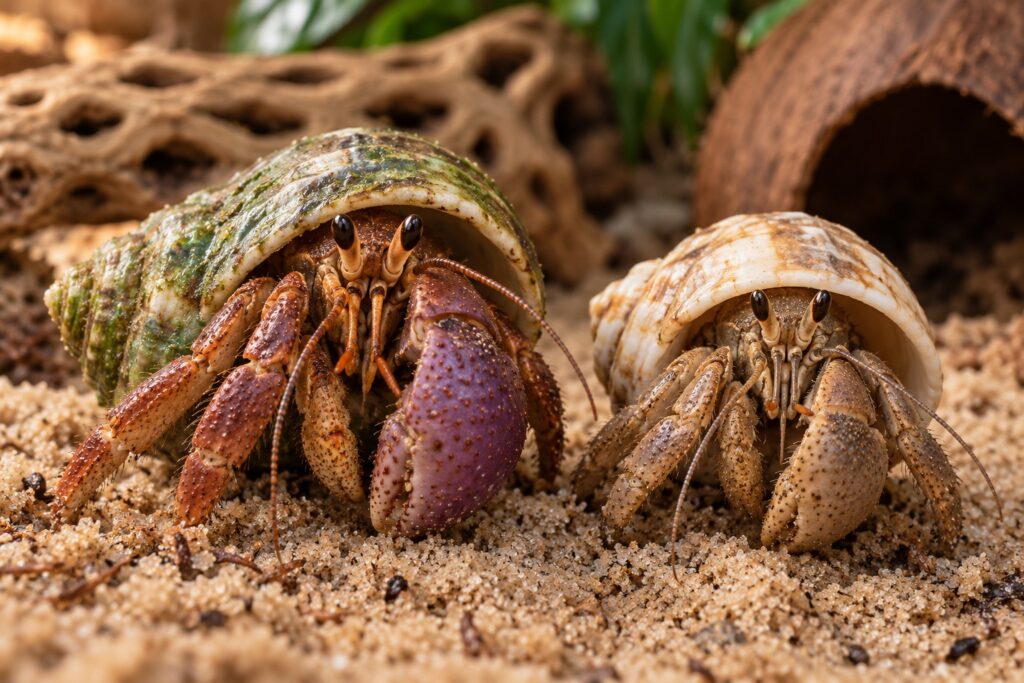
Land vs Marine Hermit Crabs
The word “hermit crab” covers two very different animals.
- Marine hermit crabs live underwater all their lives and breathe with gills like a fish. They belong in a saltwater aquarium and are sold as reef and tank cleaners.
- Land hermit crabs live on land as adults and breathe air through modified gills that must stay moist. They need a humid tank, deep substrate, and both fresh and salt water pools to visit, not to live in.
A land hermit crab put in a fish tank full of water will drown. A marine hermit crab put in a sand tank will dry out. Everything below is about land hermit crabs.
Pet Hermit Crab Species at a Glance
| Common name | Scientific name | Native range | Availability | Adult size |
|---|---|---|---|---|
| Purple pincher | Coenobita clypeatus | Caribbean and western Atlantic | Very common | Small to jumbo |
| Ecuadorian | Coenobita compressus | Pacific coast of the Americas | Common | Small to medium |
| Strawberry | Coenobita perlatus | Indo-Pacific | Specialty | Medium to large |
| Ruggie | Coenobita rugosus | Indo-Pacific | Specialty | Small to medium |
| Indonesian (indo) | Coenobita brevimanus | Indo-Pacific | Specialty | Large to jumbo |
| Cav | Coenobita cavipes | Indo-Pacific | Specialty | Medium to large |
| Australian | Coenobita variabilis | Northern Australia | Rare outside Australia | Small to medium |
“Specialty” means sold by dedicated breeders and importers rather than ordinary pet shops, and availability varies by country.
Purple Pincher Hermit Crab (Coenobita clypeatus)
The purple pincher hermit crab, also called the Caribbean hermit crab, is the species in most North American pet shops and beach souvenir stands. It is also the best documented in captivity, and the long lifespan records belong to it.
- Look: a reddish-brown to tan body and a large left claw that is distinctly purple. The eyes are round on the end of the stalks.
- Shells: prefers round or D-shaped openings, such as turbo shells.
- Size: from small to jumbo. Large adults are bigger than a fist, shell included.
- Care: the standard setup, covered in our hermit crab care guide.
Ecuadorian Hermit Crab (Coenobita compressus)
The Ecuadorian hermit crab, or E crab, is the second common species in the United States, from the Pacific coast of Central and South America.
- Look: smaller and flatter than a purple pincher, with a more compressed body. Colour ranges from tan to grey, cream and even orange or green. The eye stalks end in comma-shaped eyes rather than round ones.
- Shells: prefers oval or slot-shaped openings and often refuses round turbos that fit on paper. Babylonia and some nerite shells suit it better.
- Size: stays small to medium.
- Care: the same tank as a purple pincher, but Ecuadorians are less tolerant of low humidity and shell shortages. They are fast, active and good climbers.
Strawberry Hermit Crab (Coenobita perlatus)
The strawberry hermit crab is the one people picture when they hear “red hermit crab”.
- Look: bright red to orange-red with small white spots, like a strawberry. Juveniles can be paler and gain colour with age.
- Care: needs warmth at the upper end of the range and uses salt water heavily. Strawberries are often seen soaking in the saltwater pool, which needs to be deep enough to submerge in. Our guide to fresh and salt water for hermit crabs explains why.
- Availability: mostly from specialist importers. Long-term captive records are fewer than for purple pinchers.
Ruggie (Coenobita rugosus)
- Look: variable colour, from cream and tan to blue-grey and brown. The large claw has a distinctive row of ridges used to make chirping sounds.
- Size: small to medium.
- Care: similar to Ecuadorians. Ruggies are active and inquisitive and accept a range of shell shapes.
Indonesian Hermit Crab (Coenobita brevimanus)
- Look: a large, heavy crab, often purple-brown to dark, with a big, rounded claw. It is sometimes called the “indo” or the “viola”.
- Size: among the largest pet hermit crabs, reaching jumbo size.
- Care: needs a spacious tank, very heavy shells, deep water pools, and higher humidity. Indos spend a lot of time in and around water.
Cav (Coenobita cavipes)
- Look: dark, often brownish to near black, with a long, slender body.
- Care: cavs are strong salt water users and tend to dig deep. They do best with large pools and plenty of substrate depth, and they are often shy.
Australian Hermit Crab (Coenobita variabilis)
The species kept in Australia, where importing other species is restricted. It is small to medium, varies a lot in colour, and is rarely seen outside the country. Care follows the general Coenobita setup.
How to Tell Purple Pinchers and Ecuadorians Apart
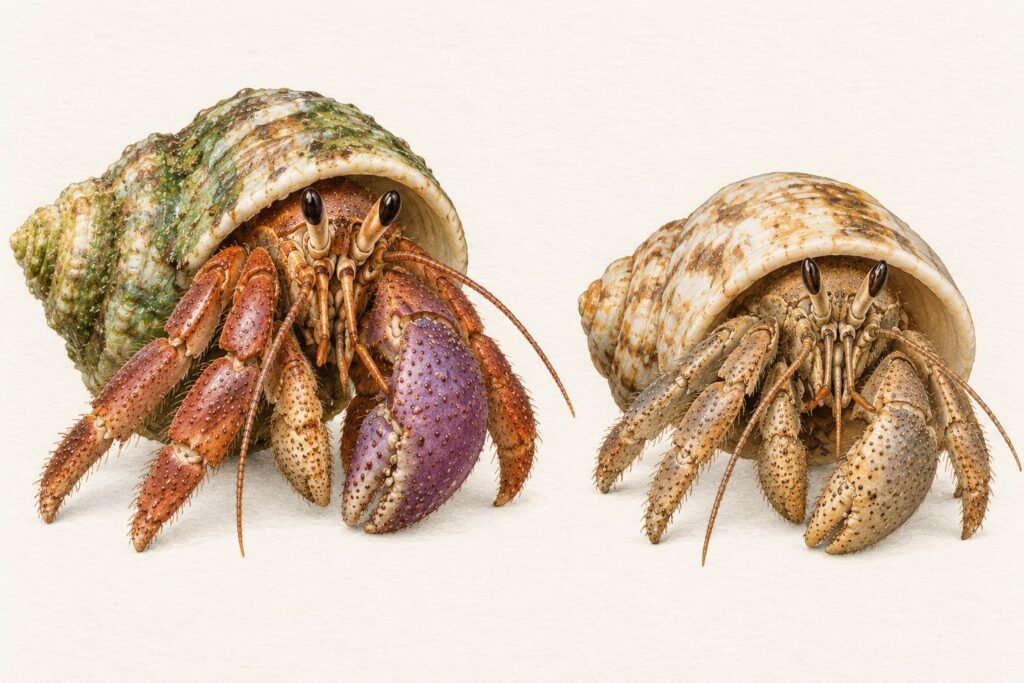
These two make up almost every hermit crab in an American pet shop, so it is worth learning the difference.
| Purple pincher | Ecuadorian | |
|---|---|---|
| Large claw | Distinctly purple | Not purple, matches the body |
| Body | Rounder, chunkier | Flatter, more compressed |
| Eyes | Round tips on the stalks | Comma-shaped tips on the stalks |
| Speed | Moderate | Fast, active |
| Preferred shell opening | Round or D-shaped | Oval or slot-shaped |
| Size | Small to jumbo | Small to medium |
If you have both, offer both shell shapes. A selection that only suits one species is a common cause of shell fights and abandoned shells, and the full shell guidance is in our guide to sizing spare shells by species.
How Big Do Hermit Crabs Get?
Size depends on species, age and how many times the crab has molted. Pet hermit crabs are graded by shell opening rather than body length, since the shell is what you see.
| Size grade | Shell opening | Roughly |
|---|---|---|
| Micro to small | Under 3/4 inch | Fingertip to coin size |
| Medium | 3/4 to 1 1/4 inches | Walnut size |
| Large | 1 1/4 to 2 inches | Golf ball to tennis ball |
| Jumbo | Over 2 inches | Larger than a fist, shell included |
Including the shell, adult land hermit crabs commonly range from about 2 to 6 inches. Purple pinchers and indos reach the jumbo grade. Ecuadorians and ruggies usually stay small to medium.
Hermit crabs grow only when they molt, and large crabs molt rarely, so a jumbo is old. Estimates for how old a crab of each size might be are in our guide to hermit crab lifespan.
The Largest Hermit Crab: The Coconut Crab
The largest land hermit crab in the world is not a pet. The coconut crab, Birgus latro, is a close relative of Coenobita found on islands in the Indian and Pacific Oceans. It is the largest land-living arthropod, weighing up to about 4 kilograms with a leg span of around a metre.
Young coconut crabs carry shells like other hermit crabs. As they grow, they harden their abdomen and abandon shells altogether. They are protected or harvest-limited in many places, are not kept as pets, and need nothing like a household tank.
Can Different Types of Hermit Crabs Live Together?
Usually, yes. Many keepers house purple pinchers and Ecuadorians together without problems, and mixed Coenobita colonies are common among experienced keepers. A few points make it work:
- Offer shells for every species, with both round and oval openings.
- Match the tank to the most demanding species, usually the one that needs more warmth, humidity or salt water.
- Give enough space and hiding places, since a mix of sizes means more competition.
- Watch for bullying of smaller crabs, especially around food and shells.
What else can share a hermit crab tank, and what cannot, is covered in our guide to hermit crab tank mates.
Which Hermit Crab Should You Get?
- First hermit crabs: purple pinchers. They are the most forgiving and the best understood.
- If you want a busier, faster crab: Ecuadorians, with attention to humidity and oval shells.
- For a showpiece: a strawberry or indo from a specialist, once you are confident with the basics.
Whatever the species, the tank matters more than the choice. A crab in a proper setup can live for decades. Our guide to setting up a hermit crab habitat covers the build.
Once you have more than one species, notes help. CrabPod lets you record each crab’s species, shell and photos, so you can tell your purple pinchers from your Ecuadorians at a glance and track each crab’s molts separately.
FAQ
What types of hermit crabs can you keep as pets?
Land hermit crabs in the genus Coenobita. Purple pinchers and Ecuadorians are the most common in North America. Strawberry, ruggie, Indonesian and cav hermit crabs are available from specialists. Marine hermit crabs need a saltwater aquarium and are a different kind of pet.
What is the most common pet hermit crab?
The purple pincher, Coenobita clypeatus, also called the Caribbean hermit crab. It is sold in most pet shops and beach stores in North America, and it is the species with the longest documented lifespans in captivity.
How big do hermit crabs get?
Pet land hermit crabs usually reach about 2 to 6 inches including the shell. Purple pinchers and Indonesian hermit crabs can reach jumbo size, larger than a fist. Ecuadorians and ruggies usually stay small to medium.
What is the largest hermit crab?
The coconut crab, Birgus latro, a close relative of land hermit crabs. It can weigh about 4 kilograms with a leg span of around a metre. Adults no longer use shells, and it is not kept as a pet.
Can purple pinchers and Ecuadorians live together?
Usually, yes. Offer shells with both round and oval openings, keep humidity at the level Ecuadorians need, and provide enough space and hides. Watch for any crab being bullied over food or shells.
Are red hermit crabs a different species?
Usually, yes. Bright red crabs with white spots are typically strawberry hermit crabs, Coenobita perlatus. Be wary of crabs that look unnaturally coloured, since painted shells are common, and the crab inside may be an ordinary purple pincher.
Which Crab Is in Which Shell?
In a mixed tank, the crabs that look alike are usually different species with different needs. CrabPod keeps a profile and photo for every crab, logs shell changes and molts, and tracks your tank’s temperature and humidity. Free on the App Store.