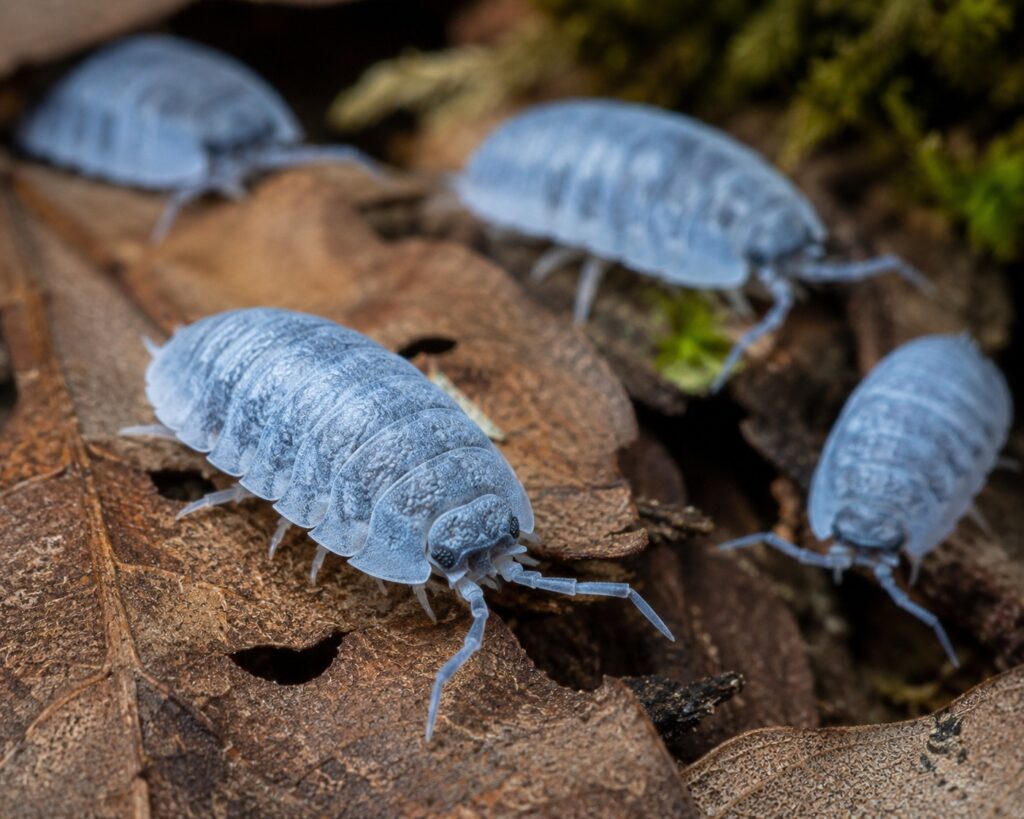
If you’re looking for your first isopod colony, powder blue isopods are hard to beat. They’re cheap, hardy, breed fast, and forgive the kinds of mistakes every new keeper makes. There’s a reason they show up on practically every “best beginner isopod” list.
This guide covers everything you need to keep Porcellionides pruinosus “Powder Blue” thriving: enclosure setup, substrate, temperature and humidity, feeding, breeding, and the handful of problems you might run into along the way.
Species Overview
Powder blue isopods are a color morph of Porcellionides pruinosus, a species originally native to southern Europe and parts of southwestern Asia. Like many isopod species, they’ve hitchhiked their way around the globe through trade and agriculture, and wild populations now exist on every continent except Antarctica.
The name says it all: adults develop a soft, dusty blue-gray coloration across their carapace, sometimes with a slight metallic sheen. Juveniles tend to look more gray or silver, with the blue tone deepening as they mature through successive molts. They’re a smaller species compared to something like a dairy cow isopod, but what they lack in size they make up for in speed, activity level, and sheer reproductive output.
Powder blues are surface-active, diurnal (active during the day), and constantly on the move. They’re also soft-bodied, which makes them more delicate to handle than harder-shelled species like Armadillidium. That’s not a problem for most keepers, though, since the real appeal of this species is watching a colony grow and work rather than picking individuals up.
| Attribute | Details |
|---|---|
| Scientific name | Porcellionides pruinosus “Powder Blue” |
| Adult size | 1.0-1.5 cm (0.4-0.6 in) |
| Lifespan | 1-2 years |
| Difficulty | Beginner |
| Temperature | 65-85°F (18-29°C) |
| Humidity | 50-80% (with moisture gradient) |
For a broader look at isopod lifespans across species, check out our isopod lifespan guide.
Still choosing your first species? Our beginner isopod species roundup compares 15 of the most commonly kept options.
Enclosure Setup
Powder blue isopods are small and prolific, so you don’t need a large container to get started. A 6-quart plastic storage bin is perfect for a starter colony of 10-15 individuals. As your population grows (and it will), you can upgrade to a 15-quart or 32-quart bin.
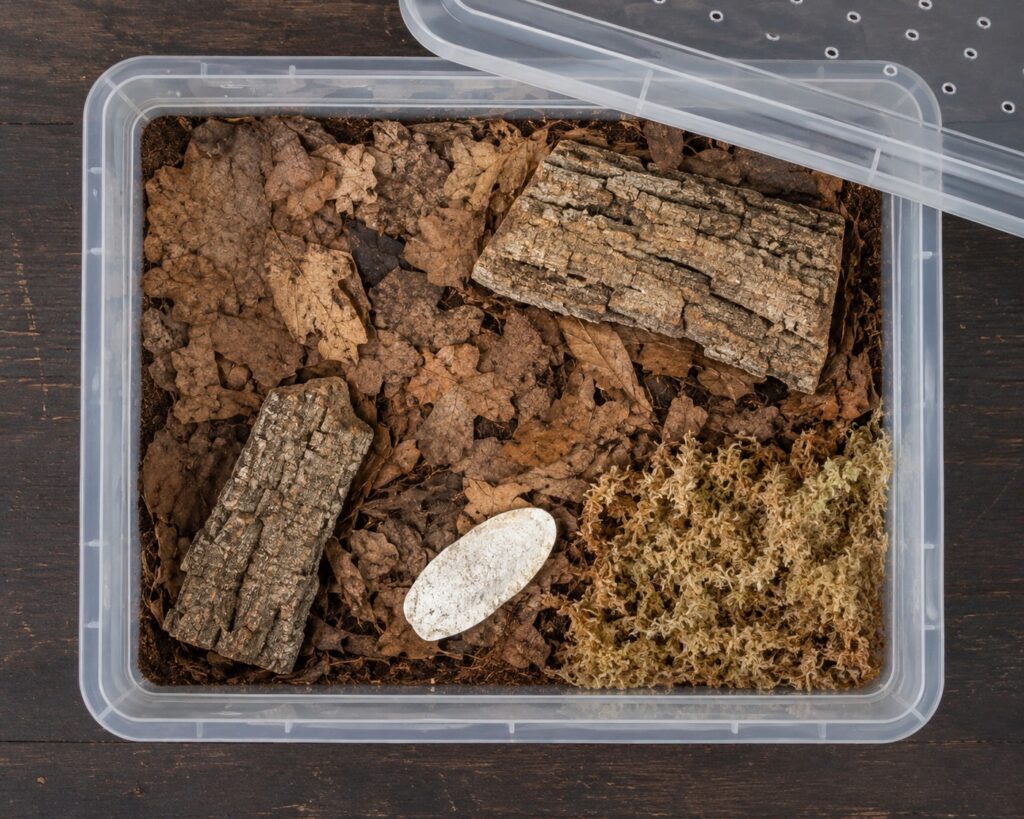
Plastic bins are generally better than glass terrariums for culturing powder blues. They hold humidity more consistently, they’re lightweight, and they’re cheap enough to run multiple colonies without breaking the bank. If you’re using them in a bioactive vivarium, the vivarium itself becomes the enclosure.
Ventilation matters. Drill or melt a cluster of small holes in the lid, or cut a rectangle out of the lid and cover it with fine mesh. Powder blues tolerate a range of humidity levels, but stagnant, swampy air leads to mold problems fast. Good airflow keeps things healthy.
One important note: powder blues are escape artists. They’re small, fast, and surprisingly good climbers. Make sure your ventilation holes are genuinely small (pin-sized works), and check lid seals regularly. A thin line of petroleum jelly around the inside rim of the bin, just below the lid, acts as an effective barrier.
Substrate should be 2-3 inches deep. A simple mix of 60% organic topsoil and 40% coconut coir works well. Some keepers add a small amount of earthworm castings or flake soil for extra microbial activity and nutrition.
On top of the substrate, layer in:
- Leaf litter – oak, magnolia, or Indian almond leaves. This serves as both food and shelter. Keep the layer thick enough that the substrate is mostly hidden underneath.
- Cork bark – a few flat pieces create hides and surface area. Powder blues love to cluster under cork bark, especially during the day.
- Sphagnum moss – a clump on one end of the enclosure creates your moisture gradient.
- Cuttlebone or crushed eggshell – a constant calcium source for healthy molts.
No special lighting is needed. Room lighting is fine, and direct sunlight should be avoided since it can overheat a small plastic bin within minutes.
For a full walkthrough of setting up your first bin, see our isopod enclosure setup guide.
Temperature & Humidity
One of the best things about powder blue isopods is how tolerant they are of varying conditions. They’ll do well in a temperature range of 65-85°F (18-29°C), which means room temperature in most homes is perfectly fine. You won’t need heat mats or supplemental heating unless your house regularly dips below 60°F.
Breeding and activity do slow down at the cooler end of that range. If you want maximum colony growth, aim for the 72-80°F sweet spot.
For humidity, target 50-80% with a moisture gradient across the enclosure. Mist the sphagnum moss end once or twice a week so it stays damp to the touch without being soaked. The opposite end should remain dry. This lets individual isopods choose the moisture level they prefer at any given moment.
Powder blues can handle higher humidity than many Porcellio species, which makes them especially well-suited for tropical bioactive setups with dart frogs, crested geckos, or other humidity-loving reptiles and amphibians.
A small digital hygrometer inside the bin helps you dial things in, especially during the first few weeks. Once you’ve got a routine down and the colony is established, you’ll develop a feel for when things need misting just by lifting the lid.
Diet & Feeding
Powder blue isopods are detritivores with a broad appetite, which is part of what makes them such low-maintenance pets. Their primary food source should always be available in the enclosure, with supplemental foods added a few times per week.
Primary diet (always available):
- Leaf litter (oak, magnolia, Indian almond): the backbone of any isopod diet
- Decaying hardwood or cork bark: they’ll slowly graze on this over time
Supplemental foods (2-3 times per week):
- Vegetables: zucchini, carrot, squash, sweet potato, cucumber
- Protein: dried shrimp, fish flakes, freeze-dried bloodworms, or a pinch of high-quality fish food
- Fruits (sparingly): apple, banana, melon. Remove uneaten portions within 24 hours to prevent mold
Calcium (always available):
- Cuttlebone pieces
- Crushed oyster shell
- Crushed eggshell (boiled first to sanitize)
Like all isopods, powder blues need calcium to build and maintain their exoskeleton. Demand increases during molting and when females are carrying eggs in their marsupium. A piece of cuttlebone left in the enclosure at all times is the easiest solution.
Protein is especially important for colony growth. Without enough protein, reproduction slows down and you may see more competition and stress within the colony. A small offering of dried shrimp or fish flakes once or twice a week keeps things running smoothly.
Foods to avoid: anything salted, seasoned, or treated with pesticides. Skip citrus fruits, onions, and softwoods like pine or cedar. The resins in conifer wood are toxic to isopods.
For a complete breakdown of isopod nutrition, see our feeding guide.
Behavior & Handling
Powder blues are one of the most active isopod species you can keep. They’re constantly foraging, exploring, and interacting with each other, which makes them genuinely fun to observe. Unlike burrowing species that disappear into the substrate, powder blues spend a lot of time on the surface, even during the day.
That said, they’re also fast. The moment they feel threatened, they scatter in every direction at surprising speed. This, combined with their small size and soft bodies, makes them poor candidates for handling. They won’t bite or harm you, but they’re easy to accidentally injure when trying to pick them up, and catching an escaped powder blue on a carpet is no fun.
If you need to move individuals between bins, use a soft paintbrush, a spoon, or gently coax them onto a piece of cork bark and transfer the whole piece.
Molting follows the standard two-stage isopod pattern: the back half sheds first, then the front half follows a day or two later. Freshly molted isopods are pale and extra soft, so leave them alone during this time. Shed exoskeletons will be eaten by the colony for their calcium content.
Signs of stress to watch for include clustering near ventilation holes (often a sign the enclosure is too humid or lacking airflow), mass die-offs, or isopods trying to escape. These usually point to a moisture, temperature, or air quality problem.
Breeding
Breeding powder blue isopods requires almost zero intervention on your part. Provide decent conditions, adequate food, and protein, and the colony will handle the rest. P. pruinosus is one of the fastest-breeding isopod species in the hobby, and a starter colony of 10-15 can explode into hundreds within a few months.
Females carry fertilized eggs in a marsupium (brood pouch) on their underside. After a relatively short gestation of about 2-4 weeks, they release fully formed miniature isopods called mancae. Brood sizes are generous, typically 30-50 mancae per clutch, and females can produce multiple broods throughout their lives.
Mancae are incredibly tiny when first released, just 1-2 mm long and nearly translucent. They develop their blue-gray coloration gradually over their first several molts (each growth stage is called an instar). They reach reproductive maturity in roughly 2-3 months under good conditions.
To maximize breeding output:
- Keep temperatures in the 72-80°F range
- Maintain consistent moisture on the damp side
- Offer protein-rich supplements weekly
- Ensure calcium is always available
- Don’t disturb the colony too frequently
Overcrowding is the most common issue with fast-breeding species. If the population outgrows the enclosure, you’ll notice more stress behaviors and potentially slower reproduction. At that point, split the colony into a second bin, use surplus isopods as a bioactive cleanup crew, or share them with fellow hobbyists.
Catching that before it becomes a problem means having some sense of how fast the population is actually moving, which is the sort of thing CrabPod is built to track.
Common Health Issues
Powder blue isopods are hardy, but a few issues can crop up, especially for new keepers still dialing in their enclosure conditions.
Mites – Grain mites are the most frequent pest. They appear as tiny white specks crawling on the substrate surface. Low populations are harmless, but heavy infestations compete with your isopods for food and cause stress. Reduce supplemental feeding temporarily, remove any uneaten food promptly, and add springtails to the enclosure if you haven’t already. Springtails are natural mite competitors.
Dehydration – If you’re finding curled, dried-out isopod bodies, the enclosure is too dry. Increase misting frequency and double-check that your ventilation isn’t pulling moisture out too quickly. Powder blues are more humidity-tolerant than many species, but they still need that moist retreat.
Mold – Thin white mold on leaf litter is normal and harmless. Thick green or black mold means too much moisture, too little ventilation, or rotting food left in the enclosure too long. Remove the moldy material, improve airflow, and reduce misting temporarily.
Failed molts – Occasionally caused by low humidity or calcium deficiency. Keeping cuttlebone available and maintaining your moisture gradient prevents most cases.
Escape attempts – If isopods are clustering near the lid or ventilation holes and trying to climb out, something is wrong inside the enclosure. Check humidity (too high or too low), temperature, and ventilation. A thin barrier of petroleum jelly near the rim of the bin prevents escapes while you troubleshoot.
FAQ
Are powder blue isopods good for beginners?
They’re one of the top two or three beginner species recommended across the hobby. Powder blues tolerate a wide range of conditions, breed quickly, and cost very little to set up and maintain. If you’ve never kept isopods before, P. pruinosus “Powder Blue” is an excellent first colony.
How big do powder blue isopods get?
Adults reach about 1.0-1.5 cm (0.4-0.6 inches), making them a small to medium-sized species. They’re noticeably smaller than dairy cow isopods or giant canyon isopods, but their high activity level and constant surface movement make them easy to observe despite their size.
How fast do powder blue isopods breed?
Very fast. Under good conditions (warm temperatures, adequate protein, proper humidity), a starter colony of 10-15 individuals can grow to several hundred within 3-4 months. Females produce broods of 30-50 mancae and can reproduce multiple times throughout their lifespan.
Can powder blue isopods live in a bioactive terrarium?
Absolutely. They’re one of the most popular cleanup crew species for bioactive setups, especially tropical enclosures housing dart frogs, crested geckos, small skinks, or similar species. Their small size, fast breeding, and love of humid conditions make them ideal for breaking down waste, decaying plant matter, and leftover food. For a drier enclosure, Porcellio scaber “Lava” handles the same job while tolerating substrate that would be too dry for powder blues.
Do powder blue isopods need protein?
Yes. While leaf litter and decaying wood form the bulk of their diet, regular protein supplementation (once or twice a week) is important for healthy reproduction and colony growth. Dried shrimp, fish flakes, or freeze-dried bloodworms all work well. Without enough protein, breeding slows and you may see increased competition within the colony.
Start Tracking Your Colony
Want to stay on top of your powder blue isopod colony as it grows? CrabPod lets you log population counts, track humidity and temperature trends, set feeding and misting reminders, and monitor multiple colonies in one place. Free on the App Store.