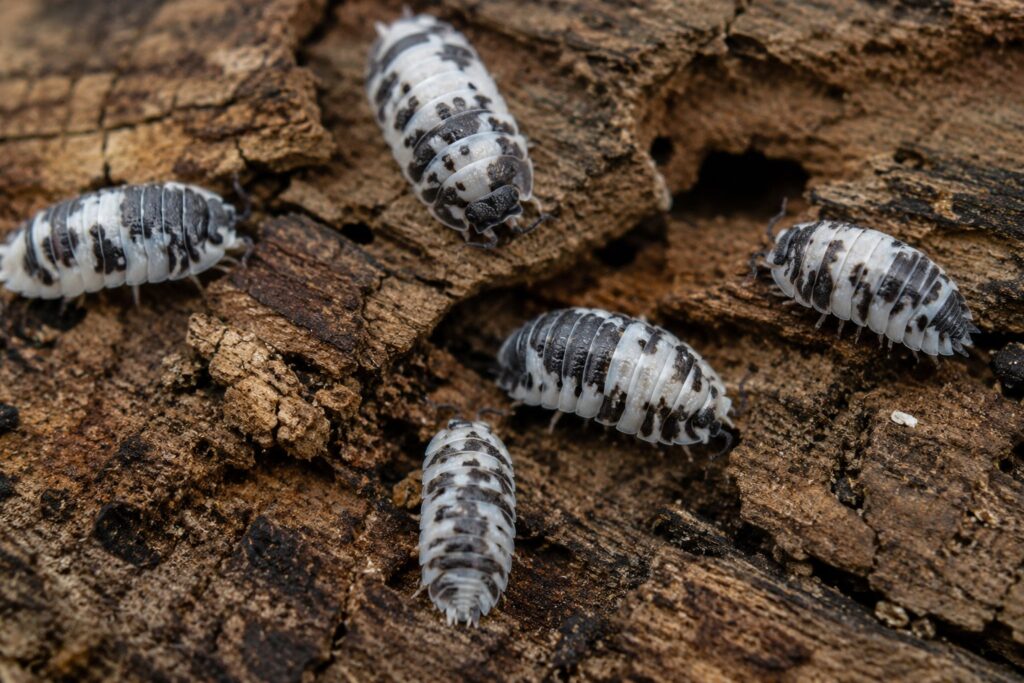
Dairy cow isopods are one of the most rewarding species you can keep as a beginner. They’re bold, fast-growing, and breed like crazy once they settle in. If you’ve been eyeing that striking black-and-white pattern and wondering whether they’re the right colony to start with, the short answer is yes.
This guide covers everything you need to know about keeping Porcellio laevis “Dairy Cow” happy and thriving: enclosure setup, substrate, temperature and humidity ranges, what to feed them, breeding, and the most common mistakes new keepers make.
Species Overview
The dairy cow isopod is a color morph of Porcellio laevis, a species originally native to southern Europe and northern Africa. Thanks to centuries of global trade, P. laevis is now considered cosmopolitan, with wild populations found on almost every continent. The “dairy cow” name comes from their bold white body segments splashed with irregular black spots, giving them a holstein-like appearance that makes them one of the most visually striking isopod morphs available.
These are large, fast, and confident isopods. Adults reach up to 2 cm (about 0.8 inches), and unlike many isopod species, dairy cows don’t bolt for cover every time you open the lid. They’re surface-active, surprisingly personable, and have a voracious appetite (especially for protein), which makes them outstanding cleanup crew members in bioactive enclosures. Worth distinguishing them from the other big Porcellio morph people ask about. Lava isopods are P. scaber rather than P. laevis, and they stay noticeably smaller and grow slower, though the bin setup is close to identical.
| Attribute | Details |
|---|---|
| Scientific name | Porcellio laevis “Dairy Cow” |
| Adult size | 1.5-2.5 cm (0.6-1.0 in) |
| Lifespan | 2-3 years |
| Difficulty | Beginner |
| Temperature | 70-85°F (21-29°C) |
| Humidity | 50-75% (with moisture gradient) |
For a deeper look at isopod longevity across different species, check out our guide on how long isopods live.
Dairy cows are one of many beginner-friendly options. See our roundup of 15 isopod species worth starting with if you’re still deciding.
Enclosure Setup
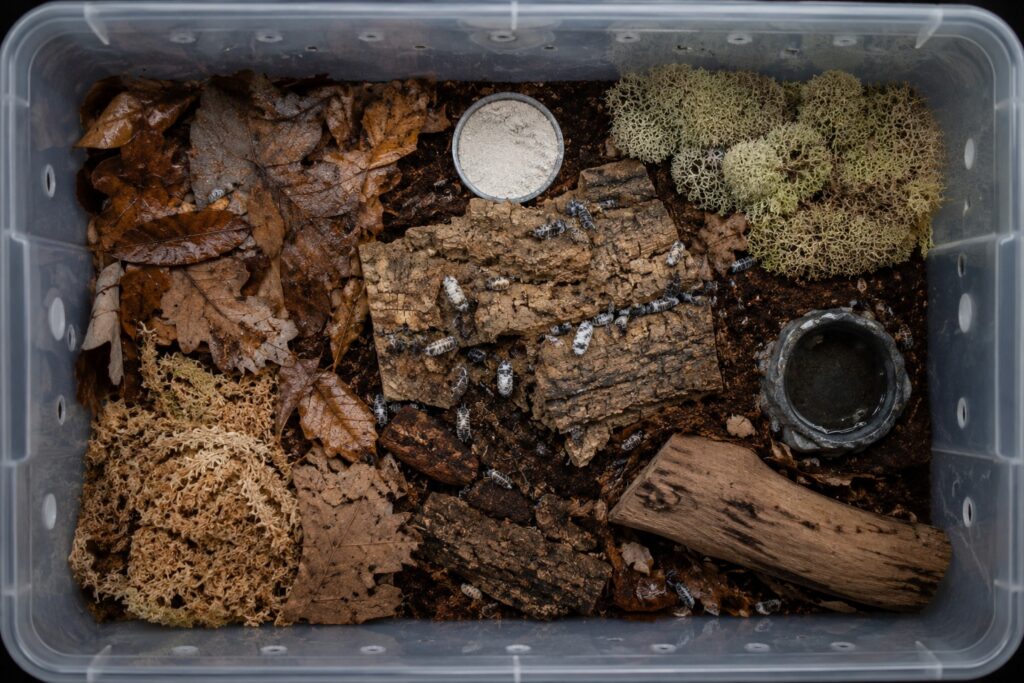
Dairy cow isopods don’t need anything fancy. A 6-quart plastic storage bin works perfectly for a starter colony of 10-15 isopods, and you can scale up to a 15-20 quart bin as the population grows. Glass terrariums work too, but plastic bins hold humidity more consistently and cost a fraction of the price.
Ventilation is essential. Drill or melt a grid of small holes in the lid, or cut out a rectangle and hot-glue fine mesh over it. You want enough airflow to prevent stagnant, swampy conditions without letting all the moisture escape.
Substrate should be 3-4 inches deep. A reliable mix is roughly 60% organic topsoil (no fertilizers or pesticides) and 40% coconut coir. Some keepers add a handful of flake soil or decomposed hardwood leaf mulch to boost microbial activity. Dairy cows like to dig, so give them enough depth to burrow into.
On top of the substrate, add:
- Leaf litter – oak, magnolia, or Indian almond leaves work great. This is both food and cover. Keep a generous layer; you should barely see the substrate underneath.
- Cork bark or hardwood pieces – flat pieces laid on the surface create hides and give the colony structure. Dairy cows will also nibble on decaying wood over time.
- Sphagnum moss – place a clump on one end of the enclosure to help create a moisture gradient (more on that below).
- Cuttlebone or crushed eggshell – always keep a calcium source available. Isopods need calcium for their exoskeleton, especially during molting.
You don’t need any special lighting. Dairy cow isopods are most active in low light and at night, and direct sunlight can overheat a small enclosure fast. Room lighting or a nearby window (out of direct sun) is plenty.
For a more detailed walkthrough, see our step-by-step isopod enclosure guide.
Temperature & Humidity
Dairy cow isopods are tolerant of a wide temperature range, which is part of what makes them so beginner-friendly. Aim for 70-85°F (21-29°C). Room temperature in most homes falls right in that sweet spot, so you probably won’t need supplemental heating. If your house drops below 65°F regularly, a small heat mat on a thermostat placed on one side of the bin can help. Just make sure it doesn’t dry out the substrate.
Humidity is where most beginners need to pay a bit more attention. Dairy cows don’t need swamp-level moisture, but they do need a moisture gradient: one side of the enclosure stays damp, the other stays dry. This lets individual isopods choose the moisture level they need at any given time.
To create this gradient, mist the sphagnum moss end of the enclosure once or twice a week until the moss feels damp (not soaking wet). The opposite end should stay relatively dry. If you squeeze the substrate on the moist side and water drips out, you’ve overdone it. Let it dry back a bit.
A good target range is 50-75% humidity on the damp side, which is easy to maintain in a ventilated plastic bin. A small digital hygrometer placed inside the enclosure takes the guesswork out of it.
Tracking temperature and humidity over time helps you spot trends before they become problems. A small digital thermometer/hygrometer combo stuck to the inside wall of your bin is all you need.
Diet & Feeding
Dairy cow isopods are detritivores, meaning they eat decaying organic matter. But they have a notably higher protein demand than many other isopod species. This is actually important to understand: if you don’t provide enough protein, large colonies of P. laevis have been known to nibble on soft-skinned tank mates in bioactive enclosures. Keep them well-fed and this won’t be an issue.
Primary diet (always available):
- Leaf litter (oak, magnolia, Indian almond) – this should be the backbone of their diet
- Decaying hardwood or cork bark
Supplemental foods (2-3 times per week):
- Dried shrimp, fish flakes, or freeze-dried bloodworms (protein source)
- Vegetables: carrot, zucchini, sweet potato, squash, cucumber
- Fruits (sparingly): apple, banana, melon. Remove uneaten portions within 24 hours to prevent mold
Calcium (always available):
- Cuttlebone (broken into pieces)
- Crushed oyster shell
- Crushed eggshell (boiled first)
Calcium is non-negotiable. Isopods need it to build and maintain their exoskeleton, and demand spikes during molting and reproduction. A piece of cuttlebone wedged into the substrate is the easiest approach. The colony will graze on it constantly.
Foods to avoid: anything with salt, seasoning, citrus fruits, or onions. Avoid pesticide-treated produce and softwoods like pine or cedar, which contain resins that are toxic to isopods.
For a full breakdown of what isopods can and can’t eat, see our complete isopod feeding guide. Protein timing is one of the things worth logging, which is what I built CrabPod for.
Behavior & Handling
One of the things keepers love about dairy cows is their boldness. While many isopod species scatter the moment you lift the lid, P. laevis tend to stay put. Some will even walk right over your hand if you place it in the enclosure. They’re surface-active during the day (unusual for isopods) and genuinely entertaining to watch, especially during feeding time when a large colony swarms a piece of shrimp.
That said, these isopods are fast. The species nickname “swift woodlouse” exists for a reason. If they do decide to run, they can cover ground quickly, so handle them over the enclosure or a smooth-sided container.
Molting happens roughly every 2-3 weeks in growing juveniles and less frequently in adults. Isopods molt in two stages: the back half sheds first, followed by the front half a day or two later. You might spot a half-white, half-dark isopod in your colony. That’s a mid-molt animal. Leave it alone. Don’t remove shed exoskeletons either. The colony will eat them for the calcium.
Signs of stress include clustering in corners, burrowing deep and refusing to surface, or a sudden die-off. These usually point to a humidity or temperature problem, protein deficiency, or mite infestation.
Breeding
Breeding dairy cow isopods barely requires any effort on your part. You mostly just need to provide good conditions and get out of the way. P. laevis is one of the most prolific isopod species in the hobby, and a healthy colony can grow rapidly once established.
Females carry fertilized eggs in a fluid-filled pouch called a marsupium on their underside. After a gestation period of roughly 3-5 weeks (depending on temperature), she releases fully formed miniature isopods called mancae, typically 20-40 per brood, sometimes more. The warmer and more humid the conditions, the faster they reproduce.
To encourage breeding, make sure your colony has:
- Consistent temperatures in the 75-82°F range
- Adequate moisture on the damp side
- Plenty of protein and calcium
- Enough leaf litter and hides to reduce stress
You’ll typically see your first mancae within a few weeks of establishing a new colony, assuming you started with at least a few adult females. Mancae are tiny, about 1-2 mm, and white or translucent. They develop their dairy cow patterning as they grow through successive molts (called instars).
One thing to watch for in fast-growing colonies: overcrowding. If population density gets too high, you may notice increased stress behaviors or protein-related aggression. At that point, it’s time to split the colony into a second bin or sell/trade some animals.
Common Health Issues
Dairy cow isopods are hardy, but they’re not invincible. Here’s what to watch for:
Mites – Grain mites are the most common pest. They look like tiny white or tan specks moving independently on the substrate surface. Small populations are usually harmless, but heavy infestations stress the colony. Reduce moisture slightly, remove any decaying food promptly, and add springtails to the enclosure. Springtails compete with mites for food and help keep populations in check.
Dehydration – If isopods are dying with their bodies curled and desiccated, your enclosure is too dry. Increase misting frequency and check that your ventilation isn’t excessive.
Mold – A light fuzz of white mold on leaf litter or food is normal and even beneficial. Thick green or black mold usually means too much moisture, too little ventilation, or uneaten food left too long. Remove the affected material, improve airflow, and cut back on misting.
Failed molts – Occasionally an isopod will get stuck mid-molt. This is usually caused by low humidity or calcium deficiency. Maintaining your moisture gradient and keeping cuttlebone available prevents most cases.
Protein deficiency – In a large colony without enough protein supplementation, you may see isopods attacking each other or, in bioactive setups, nipping at sleeping reptiles. Regular protein offerings (2-3 times per week) solve this.
FAQ
Are dairy cow isopods good for beginners?
Absolutely. Dairy cow isopods are one of the most commonly recommended beginner species, and for good reason. They tolerate a wide range of conditions, breed easily, and are far less skittish than many other isopod species. If you’re setting up your first colony, P. laevis “Dairy Cow” is an excellent choice.
How big do dairy cow isopods get?
Adults typically reach 1.5-2.5 cm (roughly 0.6-1.0 inches) in length, making them one of the larger commonly kept isopod species. Males tend to be slightly narrower, and you can identify them by their longer, pointed uropods (the small tail-like appendages at the rear).
Can dairy cow isopods live with other isopod species?
You can house them with other species, but there are risks. Dairy cows are fast breeders and voracious eaters, so they tend to outcompete smaller or slower-breeding species over time. If you want a mixed colony, pairing them with a similarly hardy species like Armadillidium vulgare gives you the best chance, but dedicated single-species bins are more reliable.
How often should I feed my dairy cow isopods?
Leaf litter and a calcium source should always be available. Add supplemental protein (dried shrimp, fish flakes) and fresh vegetables 2-3 times per week. Remove uneaten fresh food within 24 hours to prevent mold. A well-stocked leaf litter layer means your colony always has something to graze on even between feedings.
Do dairy cow isopods need heat?
Not usually. They thrive at normal room temperature (70-80°F). If your home regularly drops below 65°F, a small heat mat on a thermostat placed on one side of the enclosure will keep them comfortable. Avoid placing enclosures near drafty windows or heating vents where temperatures fluctuate.
Start Tracking Your Colony
Want to keep tabs on your growing dairy cow isopod colony? CrabPod lets you log population counts, monitor humidity and temperature trends, set feeding and misting reminders, and watch your colonies grow over time. Free on the App Store.