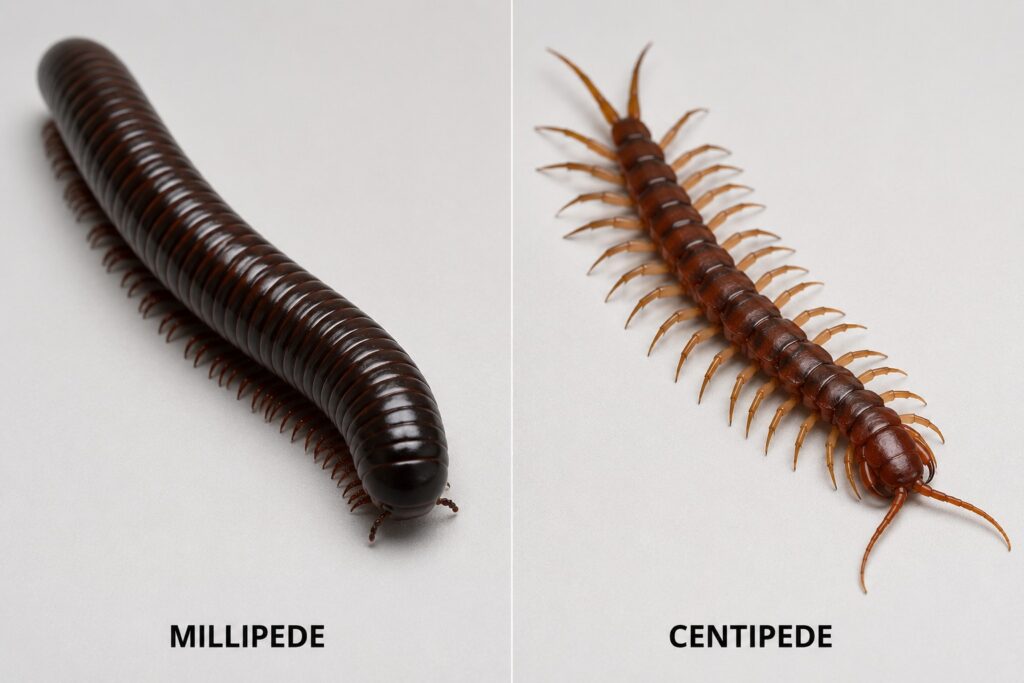
Millipede vs centipede is one of the most common mix-ups in the invertebrate world, and it’s easy to see why. Both are long, segmented, many-legged arthropods that crawl through leaf litter and turn up in damp basements. But despite the surface similarity, these two creatures are profoundly different in how they’re built, how they move, what they eat, and whether they can hurt you.
Here’s the quickest way to tell them apart: count the legs per segment. Centipedes have one pair of legs per body segment, splayed out to the sides of a flat body, and they’re fast predators that hunt with venom. Millipedes have two pairs of legs per segment, tucked underneath a rounded, cylindrical body, and they’re slow-moving recyclers that eat decaying plant matter. One sprints when threatened. The other curls into a coil.
This guide breaks down every key difference between millipedes and centipedes, covering body shape, legs, movement, diet, defense mechanisms, and which one makes the better pet. By the end, you’ll never confuse the two again.
The Quick Answer
If you only remember a handful of differences, make them these:
| Feature | Millipede | Centipede |
|---|---|---|
| Legs per segment | Two pairs | One pair |
| Leg position | Tucked under the body | Splayed out to the sides |
| Body shape | Rounded, cylindrical | Flat, elongated |
| Speed | Slow, plodding | Fast, agile |
| Diet | Decaying plant matter | Live prey (carnivore) |
| Defense | Curls up, secretes chemicals | Bites with venom, flees |
| Class | Diplopoda | Chilopoda |
Everything else flows from these core differences. A millipede’s body is built for slow burrowing and recycling; a centipede’s body is built for speed and hunting.
Legs: The Defining Difference
The single most reliable way to distinguish a millipede from a centipede is the legs, both how many there are per segment and where they sit.
Centipedes have exactly one pair of legs per body segment. Their legs are long, slender, and splay outward from the sides of the body, which makes them look wider than they are and gives them their sprinting speed. Despite the name meaning “hundred legs,” centipedes always have an odd number of leg pairs, so no centipede actually has exactly 100 legs. Counts typically range from 30 to over 350 depending on the species.
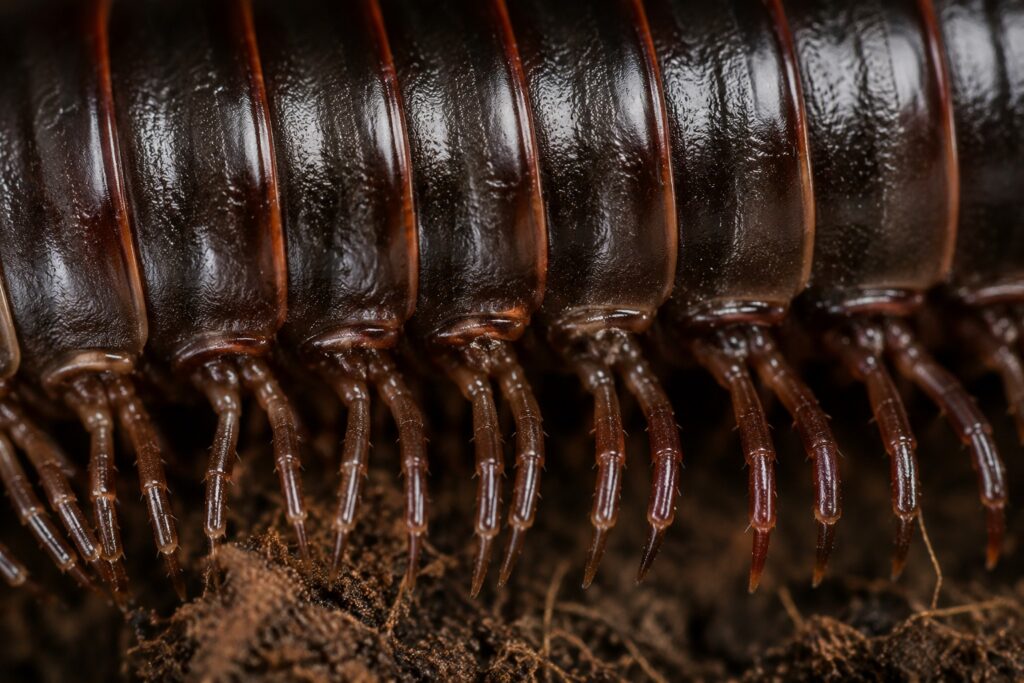
Millipedes have two pairs of legs per body segment, positioned directly underneath the body and running parallel to the ground. These shorter, sturdier legs move in a mesmerizing wave-like pattern as the millipede walks. The name means “thousand legs,” and while most species have between 80 and 400, one recently discovered species (Eumillipes persephone) holds the record at over 1,300 legs, the most of any animal on earth.
If you can get a clear look at a single segment, the leg count settles the question instantly: two pairs means millipede, one pair means centipede.
Body Shape and Movement
Look at either creature from the side and the difference is obvious. Millipedes are rounded and cylindrical, shaped like a tiny tube or train. This rounded body is built for burrowing, letting them push through soil and leaf litter with ease. Their rigid, subcylindrical build and short legs make them slow but steady.
Centipedes are flattened from top to bottom (dorsoventrally flattened) with a more elongated, flexible body. This flat profile lets them squeeze into tight crevices and move with surprising speed. Their flattened, triangular head is built for hunting.
Speed is where these two diverge dramatically. Centipedes are fast and agile, capable of darting across a surface and vanishing into cover the instant you flip on a light. Millipedes plod along at a meandering pace, seemingly in no hurry, and they burrow while centipedes generally do not. The behavioral test is simple: if it outruns your reaction, it was a centipede. If it curls into a tight spiral, it was a millipede.
Not all millipedes want the same conditions, though. Desert millipedes are built for arid ground rather than damp leaf litter, and their care reflects that.
Diet: Hunter vs Recycler
This is where the two differ most fundamentally. Centipedes are carnivores. They’re active predators that hunt insects, spiders, silverfish, cockroaches, and other small invertebrates. The largest tropical species can even take down small frogs, lizards, and rodents. They subdue prey using modified front legs called forcipules, which inject venom. In an ecosystem (and in your home), centipedes act as pest controllers.
Millipedes are detritivores. They feed primarily on decaying plant material, rotting wood, and decomposing leaf litter. By breaking down this organic matter, they play an essential ecological role in soil nutrient cycling and microbial decomposition. They’re nature’s recyclers, not hunters. Occasionally they’ll nibble on living seedling roots or leaves, but their diet is overwhelmingly dead plant matter.
This dietary difference explains a lot about their respective bodies. The centipede’s speed and venom serve its predatory lifestyle, while the millipede’s slow, armored, burrowing build suits a life spent grazing through soil and leaf litter.
Defense Mechanisms
The two groups defend themselves in completely different ways, and this matters a great deal if you’re considering handling one.
Centipedes are venomous. Their forcipules deliver venom that can paralyze prey and, on rare occasions, deliver a painful bite to a human who grabs, steps on, or traps one. For most people, a bite from a common centipede feels like a bee sting: sharp pain, redness, and some swelling that fades within a day or two. Larger tropical species can deliver considerably more painful bites. Anyone with insect venom allergies should be cautious.
Millipedes cannot bite or sting. They have no venom and nothing built for attacking. Instead, when threatened, a millipede curls its body into a tight spiral to protect its delicate legs and underside. As a secondary defense, many species secrete a foul-smelling chemical fluid from glands along their sides. This secretion can irritate skin, stain it a brownish-purple color, and is especially irritating around the eyes and mouth. If you handle a millipede, simply wash your hands afterward.
The common phrasing is that centipedes are venomous while millipedes are poisonous, since centipedes inject venom and millipedes secrete an irritating chemical defense.
Which Makes a Better Pet?
For invertebrate keepers, millipedes are by far the more popular and beginner-friendly choice. Because they’re slow, non-venomous, and unable to bite, millipedes like the giant African millipede can actually be gently handled, making them one of the few invertebrates suitable for that. They’re calm, low-maintenance detritivores that thrive in a humid enclosure with deep substrate and a steady supply of decaying leaves and wood. If you’re interested in keeping one, our giant African millipede care guide walks through everything, and our general millipede care guide covers setup for any species. For something smaller and available captive bred, the Texas gold millipede is the easier starting point. They’re also long-lived for an invertebrate, which is part of the appeal. See how long millipedes live for what to expect by species.
Centipedes are kept too, but they’re an advanced species. They’re fast, escape-prone, and capable of a painful venomous bite, so they’re strictly observation pets for experienced keepers who understand the risks. They require secure enclosures and careful handling protocols (using tongs, never bare hands). If that’s the challenge you want, our giant centipede care guide covers the enclosure security and feeding protocols in detail.
For most people entering the hobby, a millipede offers a gentle, fascinating, hands-on experience, while a centipede is better admired from behind glass.
If you do go that way, the containment side matters more than the husbandry, and securing a centipede enclosure is where to start before buying the animal.
FAQ
What is the easiest way to tell a millipede from a centipede?
Count the legs per body segment. Millipedes have two pairs per segment tucked under a rounded body, while centipedes have one pair per segment splayed out to the sides of a flat body. If you can’t get close enough to count, watch the behavior: a centipede sprints away, a millipede curls into a coil.
Are centipedes or millipedes dangerous?
Centipedes are venomous and can deliver a painful bite (usually comparable to a bee sting for common species), though they’re rarely dangerous to healthy adults. Millipedes cannot bite or sting at all, but they secrete an irritating chemical that can bother skin and eyes. Wash your hands after handling a millipede.
Do millipedes really have a thousand legs?
Most don’t. Despite the name, most millipede species have between 80 and 400 legs. However, one species discovered recently, Eumillipes persephone, was documented with over 1,300 legs, making it the first true “thousand-legger” and the leggiest animal known.
Why are centipedes so much faster than millipedes?
Centipedes have long legs splayed out to the sides and a flat, flexible body built for speed and hunting. Millipedes have short legs tucked under a heavy, rounded body built for slow, steady burrowing. The centipede’s anatomy is optimized for chasing prey, while the millipede’s is optimized for pushing through soil.
Can you keep millipedes and centipedes together?
No. Centipedes are predators and would hunt and kill a millipede. The two have completely different care requirements and temperaments, and a centipede should never be housed with any other animal it could eat. Always keep them in separate enclosures.
Track Your Inverts with InvertMate
Whether you keep millipedes, centipedes, or a whole collection of invertebrates, InvertMate helps you track molts, log feedings, monitor enclosure humidity and temperature, and manage every species in one place. Built for invertebrate keepers who care about the details. Free on the App Store.