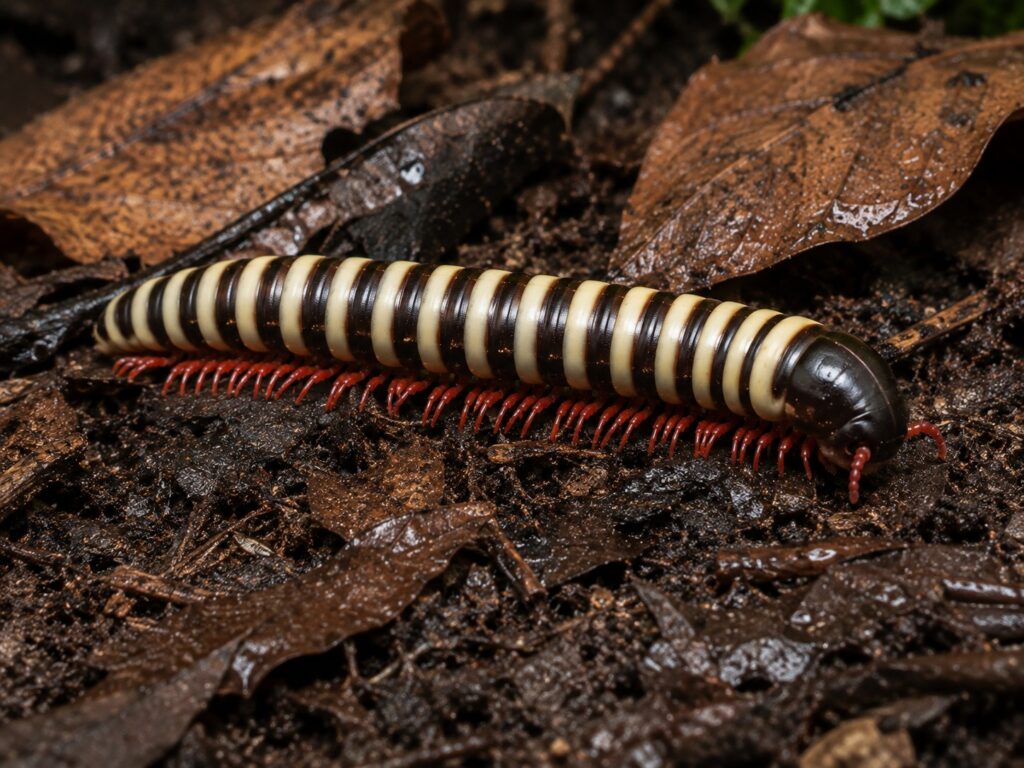
Bumblebee millipedes are the best starter species in the hobby and the one most likely to breed for you without any effort at all. Anadenobolus monilicornis is a slim Caribbean species reaching 3 to 4 inches, banded in cream and dark brown with bright red legs, and it reproduces so readily that a starter group of five becomes a colony you are giving away within two years. They are cheap, hardy, and available captive bred, which makes them the sensible first millipede.
Species Overview
Bumblebees are native to the Caribbean, particularly Jamaica and surrounding islands, and are now established in southern Florida where they arrived through the plant trade. They live in leaf litter and rotting wood on the forest floor and are shallow burrowers rather than deep diggers.
Adults reach 3 to 4 inches, slim and cylindrical, with alternating cream and dark brown or black bands along the body and distinctly reddish legs and antennae. The banding is what gives them the common name, and it is more consistent between individuals than in many species.
They are detritivores, eating decaying plant matter and taking no live prey. Like all millipedes they secrete a defensive fluid containing benzoquinones when handled roughly. It is harmless on skin but stains and should be kept away from the eyes, so wash your hands afterward.
The wider comparison between millipedes and the predatory centipedes they get confused with is in our guide to telling the two apart.
| Attribute | Details |
|---|---|
| Scientific name | Anadenobolus monilicornis |
| Adult size | 3 to 4 inches |
| Lifespan | 2 to 4 years |
| Difficulty | Beginner |
| Temperature | 70 to 80F (21 to 27C) |
| Humidity | 70 to 80% |
| Breeding | Prolific, minimal intervention |
Enclosure Setup
A 6 to 12 quart plastic bin or a 5 to 10 gallon tank suits a group of five to eight. Bumblebees are social in the sense that they tolerate each other completely, and a group is both easier and more interesting than a single animal.
Substrate depth: 4 to 5 inches. Less than the giant species need, since bumblebees are shallow burrowers, but enough for molting chambers and egg laying.
The mix, built around decaying wood because that is the food:
- 3 parts crumbling rotten hardwood
- 2 parts coconut fibre or peat
- 1 part organic topsoil with no fertiliser
- A thick top layer of dry hardwood leaf litter
The rotten wood is not decoration. A millipede kept on plain coconut fibre slowly starves while looking healthy, and this is the commonest reason beginner millipedes fail to thrive. Use wood soft enough to crumble in your hand.
Leaf litter, generously. Oak, magnolia, maple, or beech, several inches deep. Its steady disappearance is the clearest sign the colony is eating well.
Cover: a piece of cork bark laid flat and a few chunks of decaying wood on the surface.
Lid: solid with modest pinhole ventilation. Millipedes climb, and the humidity needs holding in. A mesh top will dry the bin out within a day.
The full build, including how to source wood safely, is covered in our millipede enclosure guide.
Temperature and Humidity
Room temperature suits them across 70 to 80F, and no supplemental heat is needed in most homes. They tolerate the low 60s briefly without harm.
Humidity should sit at 70 to 80%, achieved through substrate moisture rather than misting. Pour water into one section until it is damp throughout and let the rest stay moderately moist. Squeezed, the substrate should hold together without water running out.
Both extremes cause problems. A bin that dries out makes millipedes bury and stop eating, and prolonged drying kills. A waterlogged bin goes anaerobic, smells sour, and produces mites and mold. The moisture gradient is your margin, since the animals will position themselves wherever suits.
Check by pushing a finger into a corner where nothing is buried, once a week.
Diet and Feeding
Substrate and leaf litter do most of the work. Supplementary feeding is easy and easy to overdo.
Calcium, always available. Cuttlebone or crushed oyster shell on the surface, replaced as it disappears. Bumblebees use it heavily and molt badly without it.
Vegetables, twice weekly at most. Cucumber, courgette, squash, sweet potato, carrot, and small amounts of soft fruit. Remove anything uneaten within 48 hours.
Protein, occasionally. A pinch of fish flake every few weeks. Optional and easily overdone.
Skip: citrus, salted foods, produce from a treated garden, and any conifer wood or leaves.
Add springtails at setup to suppress mold. A small population of moisture-tolerant isopods works alongside them, processing leftover vegetables before mites establish, and powder blue isopods are a reasonable choice since they breed fast enough to keep pace in a humid bin.
Behaviour and Handling
Bumblebees are among the easiest invertebrates to handle. They do not bite, have no sting, and a millipede on your palm simply walks. Keep sessions short, stay low over a table, and wash your hands afterward because of the defensive secretion.
Expect most activity at night and in the hours after you dampen the substrate. During the day they are usually buried or under bark.
Normal behaviours:
- Coiling into a flat spiral. Defensive. Leave it alone.
- Burying for days or weeks. Usually a molt.
- Surface wandering in daylight. Often a substrate problem, either too dry or too wet.
Breeding
This is the species’ real advantage, and it requires almost nothing from you.
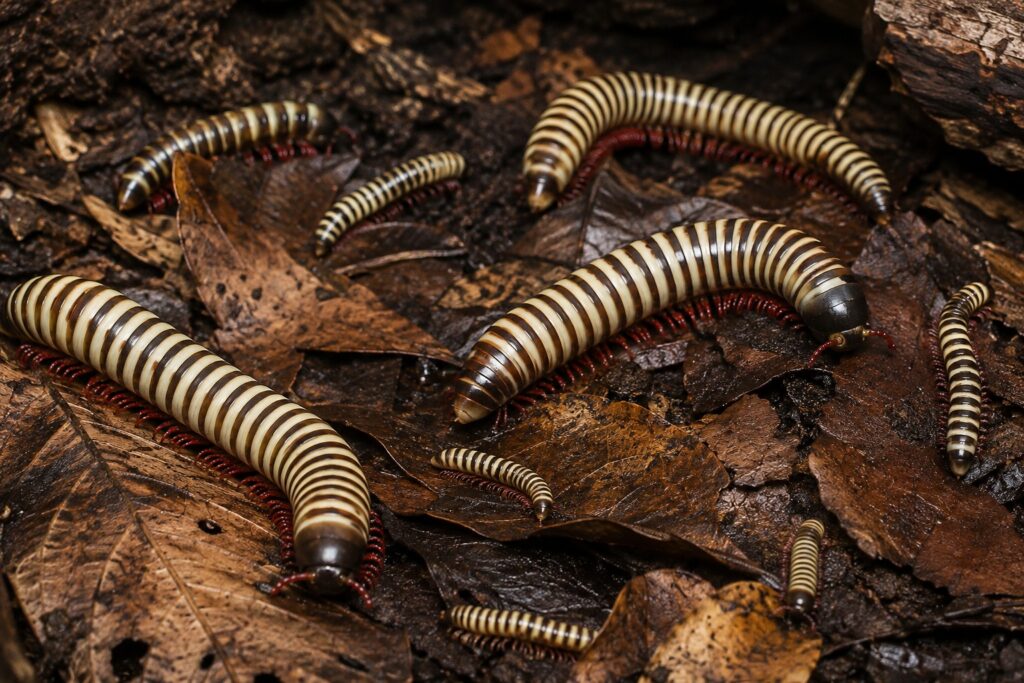
Bumblebees breed prolifically in a well-established bin. Given deep substrate with plenty of rotting wood, consistent humidity, constant calcium, and a group of five or more so both sexes are present, they will reproduce on their own schedule without any intervention.
Sexing is possible by examining the seventh body segment, where males have modified legs called gonopods in place of a normal leg pair. It takes a careful look and is unnecessary if you buy a group.
Females lay eggs in the substrate, and hatching takes several weeks. Juveniles emerge tiny with few segments and legs, adding both with each molt until they reach the adult count. They are easy to miss entirely for the first few months.
Do not sift the substrate looking for eggs or young. The most common cause of breeding failure is a keeper disturbing the bin.
Realistic timeline: from a group of five, expect visible juveniles within six months and a genuinely populous bin by around two years. Because the growth is gradual and most of the colony is below the surface, the change is invisible week to week and obvious over a year, provided you noted where it started. Logging rough counts and litter top ups in InvertMate turns that into something you can actually check.
Buying and Comparing to Other Beginner Species
Captive bred is standard for this species, since they breed so readily that no supplier needs to import them. That removes the mite load and unknown age that come with wild caught stock in other species.
Buy a group of five or more. Sexing is fiddly and unnecessary if you buy enough animals that both sexes are almost certainly present. A group also settles faster than a pair.
They are inexpensive, typically among the cheapest millipedes available, and a starter group costs less than the substrate you put them in.
Expect a quiet first month. New arrivals often bury and stay down while they settle, which is normal and not a sign of a problem.
Against the other beginner options:
| Bumblebee | Texas gold | Giant African | |
|---|---|---|---|
| Adult size | 3 to 4 in | 3 to 4 in | 6 to 8 in |
| Substrate depth | 4 to 5 in | 4 to 6 in | 8 to 10 in |
| Breeding | Very easy | Moderate | Slow |
| Lifespan | 2 to 4 yrs | 5 to 7 yrs | 5 to 7 yrs |
The Texas gold lives noticeably longer for a similar size and setup, which matters if you want individual animals rather than a colony, and it is covered in our Texas gold millipede guide. Giant Africans are the display option and need considerably more depth, covered in our giant African millipede care sheet.
The honest summary: buy bumblebees if you want a self-sustaining colony that costs almost nothing to run. Buy a larger species if you want an impressive individual animal.
Molting
Millipedes molt in an underground chamber they build themselves, adding body segments and legs with each molt rather than simply getting longer.
A molting bumblebee stays buried for one to several weeks and is soft and vulnerable throughout. Do not dig, do not disturb the bin, and leave any shed exoskeleton where you find it, since they eat it for the calcium.
Because molts happen out of sight, an animal you have not seen for a fortnight is almost certainly fine. Look for it only if the substrate conditions have changed.
Common Problems
Mites. Pale specks around the legs and segments. A light load is normal and harmless. A heavy load usually follows overfeeding vegetables, so cut back and rehouse into fresh substrate if it persists.
Not growing or breeding. Almost always insufficient rotting hardwood. This is the commonest underlying problem in millipede keeping.
Sour smelling bin. Waterlogged. Increase ventilation and let it dry back.
Constant surface wandering. Substrate too dry, too wet, or exhausted.
Deaths shortly after purchase. Usually shipping stress. Keep the bin stable and leave the animals alone for the first few weeks.
FAQ
Are bumblebee millipedes good for beginners?
Yes, and they are arguably the best starting species. They tolerate a wide temperature range, need no heating, do not bite or sting, handle calmly, and breed readily. The only strict requirement is plenty of decaying hardwood in the substrate.
How big do bumblebee millipedes get?
Three to four inches as adults, slim and cylindrical. That is considerably smaller than giant African species, which reach eight inches or more and need substantially deeper substrate.
How long do bumblebee millipedes live?
Two to four years as individuals, which is shorter than larger species. A breeding colony sustains itself indefinitely through overlapping generations, so an established bin never needs restocking. Lifespans across the group are compared in our guide to millipede longevity.
Do bumblebee millipedes breed easily?
Yes, more readily than almost any other species in the hobby. A group of five in a well-established bin with deep substrate, rotting wood, and constant calcium will breed without intervention. Expect visible juveniles within six months.
What do bumblebee millipedes eat?
Decaying hardwood and leaf litter as the staple, plus a permanently available calcium source and small amounts of vegetables twice weekly. They are detritivores and take no live prey. Overfeeding vegetables is the main cause of mite outbreaks.
Can bumblebee millipedes live together?
Yes. They are not territorial and are commonly kept in groups, which is also necessary for breeding. Five to eight animals in a 10 gallon bin works well, provided the substrate is deep and there is plenty of rotting wood. General principles are in our millipede care guide.
Track Your Colony with InvertMate
A millipede colony that goes from five animals to fifty does it slowly enough that you notice only in hindsight, and only if you wrote the numbers down. InvertMate lets you log rough counts and molts, monitor substrate moisture and temperature trends, and set reminders for leaf litter top ups and calcium checks. Free on the App Store & Play Store.