If you have a rhino beetle grub sitting in a tub of dark soil and no clear idea what happens next, the short version is this: it eats the soil, it stays a grub for most of its life, and almost everything you do right or wrong is decided by what that soil is made of. The beetle with the horn is the last few months of a story that runs one to two years underground.
Rhinoceros beetles are the subfamily Dynastinae, and the one most North American keepers raise is the eastern Hercules beetle (Dynastes tityus). The care below applies across the group, with timings that shift by species. This is also the starting point for our beetle guides, listed near the end.
Which Rhinoceros Beetle Do You Have?
“Rhino beetle” is a loose trade name covering dozens of species. Size, timing and legality all depend on which one is in the tub, so pin it down before anything else.
| Species | Kept mainly in | Adult size | Time as a grub | Active adult life |
|---|---|---|---|---|
| Eastern Hercules beetle (Dynastes tityus) | United States, native | 1.5 to 2.5 inches | 12 to 18 months | 3 to 6 months |
| Western Hercules beetle (Dynastes grantii) | United States, native | 2 to 3 inches | 18 to 24 months | 2 to 4 months |
| Ox beetle (Strategus species) | United States, native | 1.2 to 2.4 inches | About 12 months | A few months |
| Japanese rhinoceros beetle (Trypoxylus dichotomus) | Asia and Europe | 1.5 to 3 inches | 8 to 10 months | 2 to 3 months |
| Hercules beetle (Dynastes hercules) | Europe and Asia | Up to 6 or 7 inches with horn | 18 to 24 months or more | 6 to 12 months |
A note on legality. In the United States, live non-native beetles generally need a federal permit to import or ship between states, which is why American keepers work almost entirely with native species. Rules differ elsewhere, so check before you buy, and buy captive bred from a breeder who names the species.
The Substrate Is the Food
A rhino beetle grub does not get fed. It lives inside its food and eats its way through it. Keepers who already raise millipedes will recognise the idea, since a millipede’s bedding doubles as its diet in the same way. For a beetle larva the stakes are higher, because the size of the adult, horn included, is fixed by how well the grub ate. An adult beetle never grows.
Flake soil is the standard. It is hardwood sawdust that has been fermented for weeks or months until it turns dark brown, crumbly and earthy smelling. Fermentation breaks the wood down to the point a grub’s gut can use it. Fresh sawdust, coconut fibre and bagged potting soil have almost no food value to a beetle larva, and potting soil often carries fertiliser or wetting agents that kill grubs.
A workable mix for rhino beetle larvae:
- 6 parts dark, well-fermented flake soil
- 2 parts crumbled rotten hardwood, soft enough to break in your fingers
- 2 parts decayed hardwood leaf litter, crushed
Dynastes and Trypoxylus grubs prefer their substrate darker and more broken down than stag beetle larvae do, which is worth knowing if you buy flake soil sold for “beetles” in general. If you collect the wood and leaves yourself, the rules are the same ones we set out for sourcing rotten hardwood for a millipede bin: hardwood only, no conifers, nothing from roadsides or sprayed land.
Moisture. Squeeze a handful. It should hold its shape as a clump and release no water. Too dry and the grub loses weight and struggles to molt. Too wet and the substrate turns sour and airless, and the grub comes to the surface to get away from it.
Depth and packing. Fill the container at least three quarters full, and press the bottom third down firmly. Grubs feed through the looser upper layers and need the firm base later for pupation.
Rhino Beetle Larvae: Three Instars
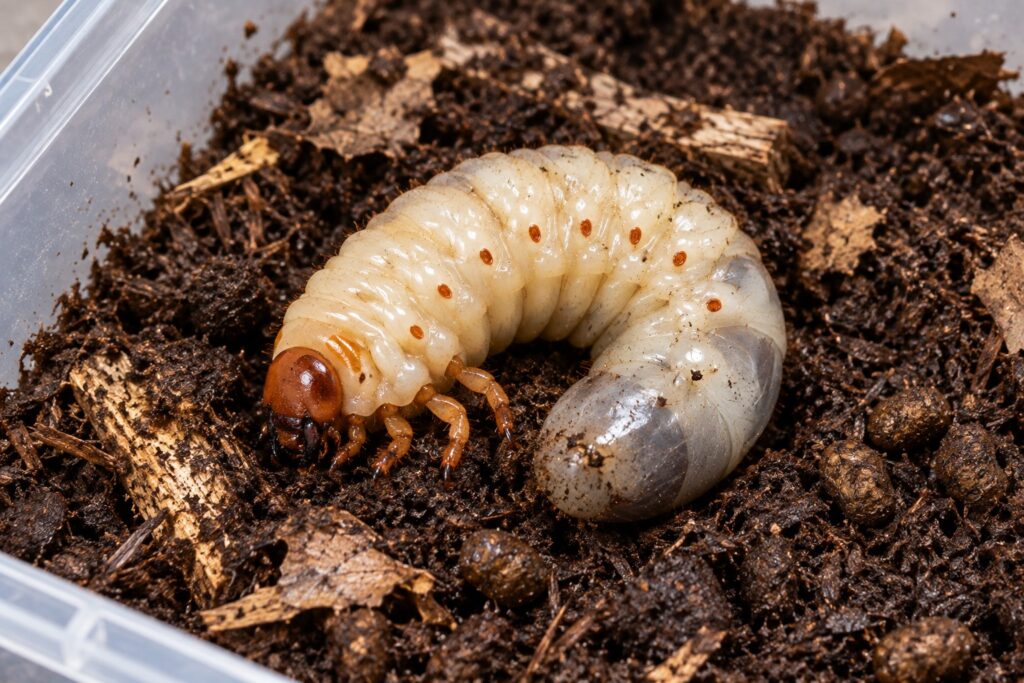
Beetle grubs pass through three larval stages called instars, written L1, L2 and L3. Each ends with a molt in which the head capsule, the hard orange-brown head, jumps in size. The body between molts simply swells.
| Stage | What you see | Container per grub | Lasts roughly |
|---|---|---|---|
| L1 | Under an inch, head capsule 2 to 3 mm | 8 to 16 oz cup | 3 to 6 weeks |
| L2 | 1 to 1.5 inches, head capsule about 5 mm | 16 to 32 oz cup | 1 to 2 months |
| L3 | 2 to 3 inches for most species, 4 inches or more for D. hercules | 2 quarts to 1 gallon, larger for giants | Most of the grub’s life |
House L3 grubs one per container. Young larvae tolerate company, but large rhinoceros beetle grubs bite each other when they meet in a tunnel, and a wound usually kills.
Ventilation is modest. A few pinholes in the lid, or a lid with a small filter patch, is enough. Too many holes dry the substrate out and invite fungus gnats.
Changing the substrate. The grub turns food into frass, hard oval pellets a few millimetres long. When the upper layer is mostly pellets, usually every two to three months for an L3, replace about two thirds with fresh mix. Keep the remaining third of the old substrate and stir it in, because it carries the gut microbes the grub relies on.
Handle as little as possible. A healthy rhinoceros beetle grub is firm, off-white to cream, and curls into a tight C when disturbed. Lift it with a spoon, not fingers. Many keepers weigh each grub on a kitchen scale at every substrate change, and a steady gain in grams is the best health check there is. Jot the weight and date in InvertMate and a stalled grub shows up in the numbers long before it looks wrong.
Temperature and Where to Keep the Tub
Rhino beetle larvae do best at 68 to 77F (20 to 25C). A dark cupboard in a normal room is fine.
Warmer is not better. Heat speeds the grub through its instars and produces a smaller adult with a shorter horn, and anything sustained above about 82F risks losing the animal. If the room is cold, raise the temperature of the space or fix a low wattage heat mat to a side wall on a thermostat. Never put heat underneath a container, since a grub that feels too warm digs down.
Pupation: The Stage You Must Not Disturb
Late in L3 the grub stops eating, turns from cream to a deeper wrinkled yellow, and wanders. This is the prepupa. It then builds a pupal cell, an oval chamber with smooth hard walls made of compacted substrate and its own frass, usually against the bottom or side of the tub where you can see it.
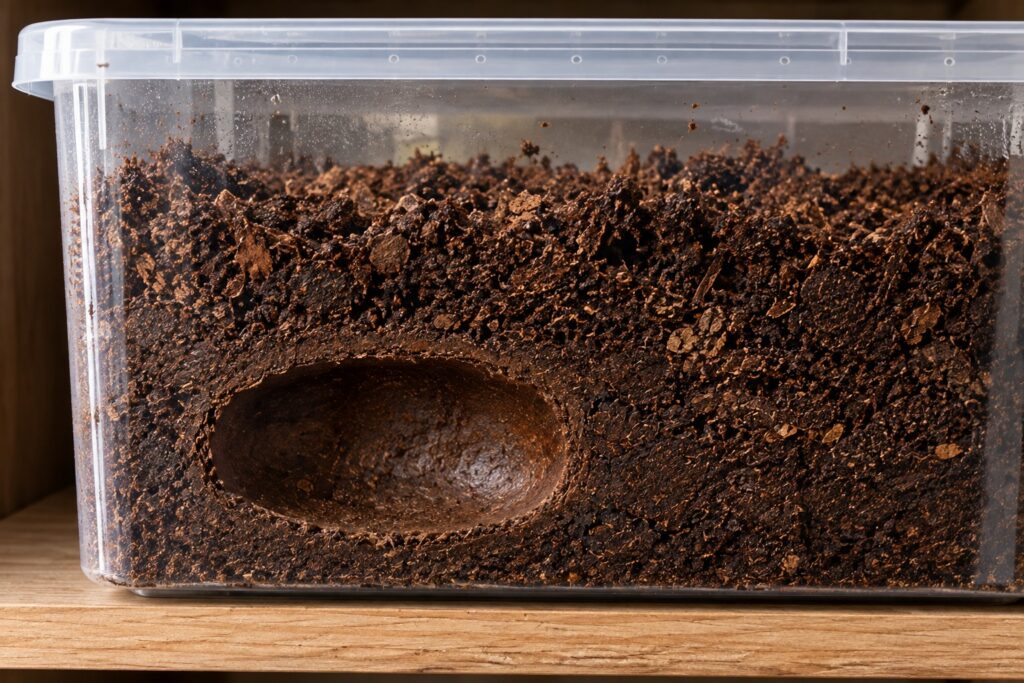
Once you see yellowing or a cell, the rules change:
- Stop changing substrate. No more digging in that container at all.
- Do not move, tilt or shake the tub. Some species build the cell upright and need it to stay that way for the horn to form properly.
- Keep the moisture steady. Add a little water around the edges if the surface dries, never over the cell.
- Wait. The pupa stage lasts one to two months. The new adult then stays inside the cell for weeks while it hardens and darkens.
If a cell is broken by accident, keepers rebuild one by pressing a matching hollow into damp floral foam or firmly packed substrate and laying the pupa in it. It is a rescue, not a method.
Expect a long quiet period. Eastern Hercules beetles typically become adults in late summer and then sit dormant in the cell through winter, emerging the following spring or summer. A beetle that has not surfaced for months is normal. Digging one up to check is the most common way keepers lose a healthy animal at the last step.
Adult Rhinoceros Beetles: Jelly, Bark and a Short Life
When the adult digs itself out and starts walking the surface at night, move it to an adult setup.
Enclosure. A 5 to 10 gallon tank or tub with a tightly fitting lid. Adults are strong and they fly. Add 3 to 4 inches of moist coconut fibre or old flake soil for them to bury into by day.
Bark and branches, everywhere. A beetle that flips onto its back on a smooth surface cannot right itself and will exhaust itself and die within a day or two. Cover the floor with bark pieces, twigs and leaf litter so there is always something to grab.
Food. Adults do not eat substrate. They drink sugars. Beetle jelly, sold in small cups, is the cleanest option. Ripe banana and apple also work, changed every day or two before they ferment and draw flies. Avoid citrus.
One male per enclosure. Males use the horn to pry rivals off branches, and in a tank the loser has nowhere to go.
Handling. Rhinoceros beetles do not bite or sting, and they are safe to hold. The hooked claws grip skin hard, so let the beetle walk off your hand instead of pulling it. With large males, keep fingers out of the gap between the two horns, which can pinch.
Lifespan. This is the honest drawback. Most species are active as adults for only two to six months, much like a mantis that lives under a year. If you want a large, slow detritivore you can handle for a decade, a giant African millipede is the better fit. The appeal of a beetle is the whole cycle, not the length of the last chapter.
Breeding the Next Generation
A pair kept together for a few days will usually mate. Move the female to a container with at least 6 to 8 inches of flake soil, the lower half packed firmly, and she will bury and lay eggs singly in the compacted layer over several weeks. Leave it alone for a month or two, then tip the substrate out gently and collect the eggs and L1 grubs into their own cups.
What Goes Wrong With a Rhino Beetle Grub
- Grub on the surface. Substrate is too wet, too dry, spent or too warm. Check each in that order.
- Dark patches or a grub that goes limp. Usually a bite wound or infection. Isolate it, though recovery is rare.
- Mites on the grub. A few are normal. Heavy clusters around the head and breathing pores mean the substrate is too wet or overdue for a change.
- Small adult or short horn. Poor substrate or high temperatures during L3. It cannot be fixed afterwards.
- Deformed wings or horn. A disturbed or collapsed pupal cell.
Skip the cleanup crew here. Isopods that are useful in other bins will chew on a soft pupa or eggs, so grub containers are one place we do not recommend them.
Beetle Species and Topics
The grub-first approach above carries across most pet beetles. Each of these gets its own guide as this section grows.
- Hercules beetles. The giants of the group, with the longest larval stage.
- Stag beetles. Wood-feeding larvae that want coarser, less fermented substrate.
- Bess beetles. Social adults that live in rotting logs and suit classrooms.
- Flower beetles. Fast life cycles and day-active adults.
- Darkling beetles and mealworms. Colony keeping, and a feeder insect for other pets.
FAQ
What does a rhino beetle grub eat?
Fermented hardwood, sold as flake soil, mixed with crumbled rotten hardwood and decayed leaf litter. The grub lives in this mix and eats it continuously. It does not need fruit, vegetables or protein, and ordinary potting soil or coconut fibre will starve it.
How long does a rhino beetle stay a grub?
Between 8 months and 2 years, depending on species and temperature. Japanese rhinoceros beetles take 8 to 10 months, eastern Hercules beetles 12 to 18, and the large tropical Hercules beetle up to two years or more. Most of that time is spent in the third instar.
Can rhino beetle larvae live together?
Small L1 and L2 larvae can share a container. Large L3 grubs should be housed one per tub, since they bite when they meet and a wounded grub rarely survives. Separate containers also protect each pupal cell from being broken by a neighbour.
How do I know my rhinoceros beetle grub is about to pupate?
It stops feeding, its colour shifts from cream to a wrinkled yellow, and it builds a smooth-walled oval chamber against the side or bottom of the container. From that point, stop changing substrate and do not move the tub until the adult emerges.
Do rhinoceros beetles bite?
No. Adults have no biting mouthparts suited to it and no sting. Their claws grip tightly and large males can pinch a finger between the horns, but they are harmless. Grubs have strong jaws and can nip if handled, which is another reason to use a spoon.
How long do rhinoceros beetles live as adults?
Usually two to six months of active life, with large Hercules beetles reaching up to a year. Some species also spend months dormant in the pupal cell before emerging. The whole life cycle from egg to death runs one to three years.
Eighteen Months Underground Is a Long Time to Remember
A grub gives you almost nothing to look at, so the only way to know it is on track is to compare today with three months ago. InvertMate logs each instar molt with a date, keeps a photo timeline from L1 to horned adult, and sends reminders when a substrate check is due. Free on the App Store and Google Play.