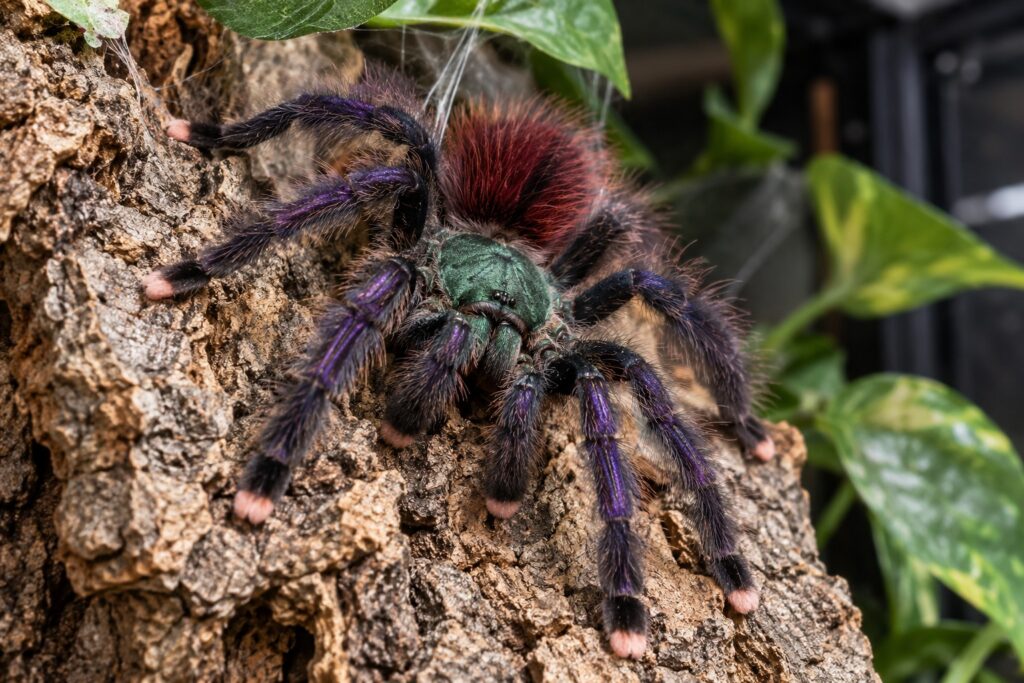
Caribena versicolor still has a reputation, repeated on older care sheets, as a fragile tarantula that needs a humid, sealed box and dies anyway. The first half of that is the reason for the second. Kept with strong airflow and a damp corner of substrate instead, the Antilles pink toe is a steady, calm, long-lived arboreal, and one of the most colourful spiders in the hobby at every stage of its life.
It comes from Martinique in the Lesser Antilles, and until 2017 it was sold as Avicularia versicolor, a sister to Avicularia avicularia, the common pink toe. The care for the two is close, but not identical, and the differences matter most in the first year. This guide covers the colour changes, the name, the setup, slings, temperament, and how to choose between the two pink toes.
Antilles Pink Toe at a Glance
| Attribute | Details |
|---|---|
| Scientific name | Caribena versicolor (formerly Avicularia versicolor) |
| Common names | Antilles pink toe, Martinique pink toe, Martinique red tree spider |
| Origin | Martinique, Lesser Antilles |
| Adult leg span | 4.5 to 6 inches |
| Lifespan | Females 10 to 12 years, males about 2 to 3 |
| Type | Arboreal, New World |
| Temperature | 75 to 82F (24 to 28C) |
| Humidity | 70 to 80%, with strong cross ventilation |
| Growth | Moderate, about 2 to 3 years to adult |
| Difficulty | Beginner to intermediate, slings need more care |
Three Spiders in One: The Colour Change
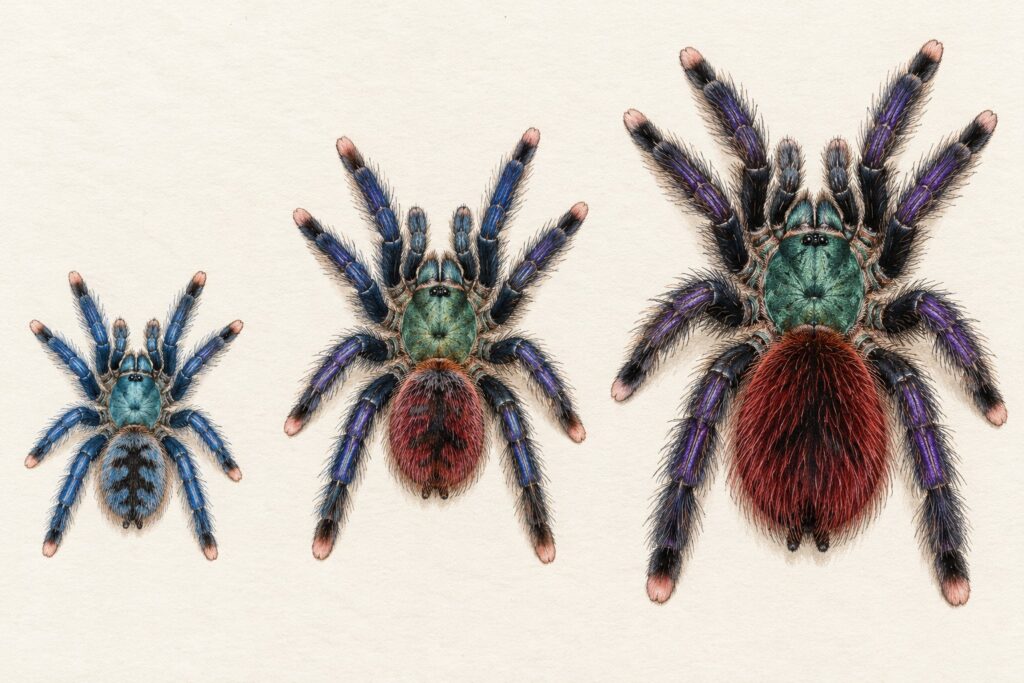
Part of the appeal of the versicolor tarantula is that you get three different-looking animals over its life.
| Stage | Leg span | Colours |
|---|---|---|
| Sling | Under 1 inch | Bright metallic blue legs and body, with a dark tree-like pattern on the abdomen |
| Juvenile | 1 to 3 inches | Blue fades. The carapace turns green, the abdomen picks up red hairs, and the pattern breaks up |
| Adult | 4.5 inches and up | Metallic green carapace, red to burgundy abdomen hair, purple sheen on the legs, pink-tipped feet |
The shift is gradual and happens over several molts, so a half-blue, half-green juvenile is normal, not a sign of a mixed or mislabelled animal. Colours are always at their brightest just after a molt, and they dull slightly as the next one approaches.
Why It Moved From Avicularia to Caribena
For over a century this spider sat in the genus Avicularia alongside the common pink toe. In 2017, arachnologists Caroline Fukushima and Rogério Bertani revised the whole group, split it into four genera, and moved the Antilles pink toe and its Puerto Rican relative, Caribena laeta, into the new genus Caribena.
For keepers, that has two practical effects.
- Old names are everywhere. Breeders, forums and care sheets written before 2017 call it Avicularia versicolor or A. versicolor. It is the same spider.
- “Pink toe” alone is not a species. Shops use it for Avicularia avicularia, Caribena versicolor and several others. If the label does not carry a scientific name, ask for one before you buy, since the price and the sling care differ.
Older guidance written for “pink toes” in general was usually written for A. avicularia. Most of it transfers. The humidity figures do not quite, as below.
Airflow Is the Whole Setup
Ventilation is the one requirement that decides whether this species thrives, so it comes before everything else.
Martinique’s canopy is warm, wet and breezy. The spider lives in tree hollows and leaf bases where rain is frequent and the air never stops moving. A closed enclosure kept humid by heavy misting gives it the wet without the breeze, and that combination, stagnant saturated air, is what lies behind most of the sudden losses that gave both pink toes their reputation. The case made for the common pink toe applies here unchanged.
What to do instead:
- Vents on two opposing walls, one set low on one side and another high on the opposite side, so air crosses the enclosure.
- Moisture from below. Pour water into one corner of the substrate every few days and let it evaporate upward.
- Mist the webbing lightly or not at all. A fine mist gives the spider droplets to drink. Misting to push a hygrometer reading higher defeats the airflow.
- If you see mold or condensation that never clears, add holes before changing anything else.
The step-by-step build, from cork placement to front access, is in our walkthrough on building an arboreal enclosure with cross ventilation.
Caribena Versicolor Enclosure by Size
Size by leg span, not by the adult the spider will become. An oversized box means a sling that cannot find its food and a retreat you cannot see.
| Leg span | Enclosure | Notes |
|---|---|---|
| Under 1 inch | 4 to 6 inches tall, vial or small deli cup stood upright | Pinhole ventilation on two sides |
| 1 to 2 inches | 6 to 8 inches tall, 32 oz deli cup upright | First small cork piece |
| 2 to 3.5 inches | 8 to 12 inches tall, small front-opening acrylic | Vertical cork tube |
| Adult | About 8 by 8 inches, 12 inches tall or more | Front opening, cork tube most of the height |
Inside an adult setup:
- A vertical cork tube running most of the height, bedded firmly into the substrate. A flat slab works if it leans with a gap behind it for the retreat.
- 1 to 2 inches of substrate, coconut fibre or a coconut and topsoil mix, kept damp in one section.
- Artificial foliage or thin branches near the top as web anchors.
- A small water dish on the substrate once the spider passes about 1.5 inches.
The same sizing logic for every lifestyle is laid out in our size chart for every tarantula enclosure, which is useful if you keep terrestrials alongside.
Climate: Warm, Damp Below, Moving Above
Temperature. 75 to 82F suits this species, which matches the near-constant warmth of its home island. Most heated homes reach the lower end without help. If yours runs cooler, fix a low wattage heat mat to a side wall on a thermostat, never underneath, and keep it away from the cork so the retreat does not overheat.
Humidity. 70 to 80%, slightly higher than many keepers run for the common pink toe. The number matters less than how you get there. A damp substrate corner and steady airflow is right. A wet, sealed box is not.
Watch for dehydration. A thin, shrivelled abdomen or legs folding under the body means the spider is short of water, which can happen in a well-ventilated box if the dish runs dry. Refill it, dampen more of the substrate, and check it daily for a week.
Prey From the Webbing
Antilles pink toes are keen feeders that take prey from the webbing or ambush it near the retreat.
- Slings: pre-killed cricket pieces or small flightless fruit flies every 3 to 5 days.
- Juveniles: small crickets, roach nymphs or blue bottle flies every 5 to 7 days.
- Adults: crickets, dubia roach nymphs or flies every 7 to 10 days.
Keep prey no longer than the spider’s body. Remove anything uneaten within 24 hours, since a cricket left in the enclosure can chew on a molting tarantula. A fast of several weeks before a molt is normal, provided the abdomen is not shrinking and water is available.
The Sling Stage Is the Risky One
This is where Caribena versicolor earns its reputation, and where it differs most from the common pink toe. Versicolor slings are less tolerant of both extremes than adults are. A sling container that dries out completely can lose its spider in a few days, and one that is damp and sealed loses it in a few weeks.
What works:
- A small container, about three times the sling’s leg span across, stood upright.
- Pinholes on two opposite sides, not only in the lid.
- A third to half of the container filled with substrate, kept damp in one corner. Many arboreal slings dig before they climb, which is normal.
- A small piece of cork or a twig for the first web.
- Water droplets on the wall or webbing every few days. No dish yet, since a sling can drown in one.
Once the spider reaches about 2 inches, it becomes about as hardy as any pink toe. The general routine for small spiders is covered in our guide to keeping tarantula slings alive.
Every Molt Changes the Colour
Expect two to three years from sling to adult female, with molts every few weeks at first and several months apart later.
Pre-molt looks like food refusal, a darker abdomen and heavier webbing around the retreat. Arboreals usually molt inside the silk tube, often lying on their back, and you may not see it at all. Do not open the retreat, do not mist the web, and do not feed until a week or two after the molt, when the fangs and exoskeleton have hardened. The full sequence is explained in our guide to the tarantula molting process.
Molts matter here for another reason. Each one is a step in the colour change, and the interval between them is the best health check you have for a spider that hides most of the time. InvertMate’s molt history with a photo at each molt gives you both.
Fast, Not Feisty: Temperament and Handling
The Antilles pink toe is calm and rarely bites. Its defence is speed. Startled, it bolts upward and outward, and from a top-opening enclosure that route leads onto your arm and off the edge of the shelf.
It may also squirt a jet of faeces at a perceived threat, which is harmless and a clear sign the spider is stressed. As a New World species it carries urticating setae, but pink toes press them against an attacker rather than flicking them into the air, and the hairs are mild. Venom is in line with other New World species, usually compared to a wasp sting. The broader difference between the groups is explained in our comparison of how New World tarantulas defend themselves.
Handling is not recommended, mainly because of falls and escapes. If you need to move the spider, move the cork tube it has webbed itself into.
Antilles Pink Toe vs Common Pink Toe
| Caribena versicolor | Avicularia avicularia | |
|---|---|---|
| Origin | Martinique | Northern South America and Trinidad |
| Adult look | Green carapace, red abdomen hair, purple legs | Dark body, pink foot pads |
| Sling look | Bright blue with a dark tree pattern | Pinkish with a dark tree pattern |
| Humidity | 70 to 80% | 65 to 75% |
| Sling sensitivity | Higher | Moderate |
| Female lifespan | 10 to 12 years | 8 to 12 years |
| Price | Higher | Lower |
| Best for | A keeper ready for a careful first year | A first arboreal |
If this is your first tarantula of any kind, the common pink toe is the easier start. If you already keep a few spiders and want the most colourful beginner arboreal, buy a versicolor juvenile at 2 inches or more and skip the riskiest stage.
Buying and Sexing
- Buy captive bred on scientific name. Captive breeding is routine for this species, and there is no reason to buy wild caught.
- Juveniles cost more than slings, and they are worth it for a first versicolor.
- Sexing is reliable from a shed exoskeleton once the spider passes about 2 inches. It matters, since a female can live 10 years or more and a male usually 2 to 3, and only months after his final molt.
Five Ways Versicolors Are Lost
- Closed, misted enclosure. The classic loss. Add cross ventilation.
- Sling container dried out. Pinholes and a damp corner, checked every few days.
- Top-opening lid. Escapes during feeding.
- Cricket left in during a molt. Remove leftovers within a day.
- Wrong species on the label. Ask for the scientific name.
FAQ
Is Caribena versicolor good for beginners?
Yes, as a juvenile or adult, provided the enclosure has cross ventilation. Slings are more sensitive to drying out and to stagnant air than common pink toe slings, so a first-time keeper is better off starting with a spider of 2 inches or more.
How big does an Antilles pink toe get?
Adults reach 4.5 to 6 inches in leg span. Females are usually larger and heavier bodied than males. Growth to full size takes about two to three years in captivity.
Is Avicularia versicolor the same as Caribena versicolor?
Yes. The species was moved from Avicularia to the new genus Caribena in 2017. Older care sheets, breeders and forums still use Avicularia versicolor, but it refers to the same spider, the Antilles pink toe from Martinique.
How long do Antilles pink toe tarantulas live?
Females typically live 10 to 12 years. Males live about 2 to 3 years in total and only a few months after their final molt, so whether you buy a male or a female makes a large difference.
Why is my versicolor sling blue?
All Caribena versicolor slings are blue. The colour fades over several molts as the carapace turns green and the abdomen develops red hair. A juvenile showing a mix of blue and green is normal.
What humidity does a Caribena versicolor need?
Around 70 to 80%, created by a damp section of substrate rather than heavy misting, and always with cross ventilation. Stagnant humid air in a sealed enclosure is the main cause of losses in this species.
The Blue Sling Only Lasts a Year
Two years from now she will be green and red, and the photos from her blue sling stage will be the only proof of what she looked like. InvertMate keeps a dated photo timeline across every molt, logs molt intervals so you can see whether growth is on track, and records the humidity your enclosure actually runs at. Free on the App Store and Google Play.