Theraphosa blondi, the goliath birdeater, is the heaviest spider in the world, with a body up to 5 inches long, a leg span approaching 12 inches and a weight of up to about 175 grams. It is also one of the least forgiving tarantulas to keep well. It needs warmth, a damp burrow, a large enclosure and a keeper who can live with the worst urticating hairs in the hobby.
None of that makes it dangerous to people. Its bite is usually compared to a wasp sting, and it would much rather hiss and retreat than fight. But it is not a first tarantula, and it is often not even the species written on the label. This guide covers size, the stirmi question, setup, humidity, feeding, the hair problem, growth, and how to decide whether it belongs in your collection.
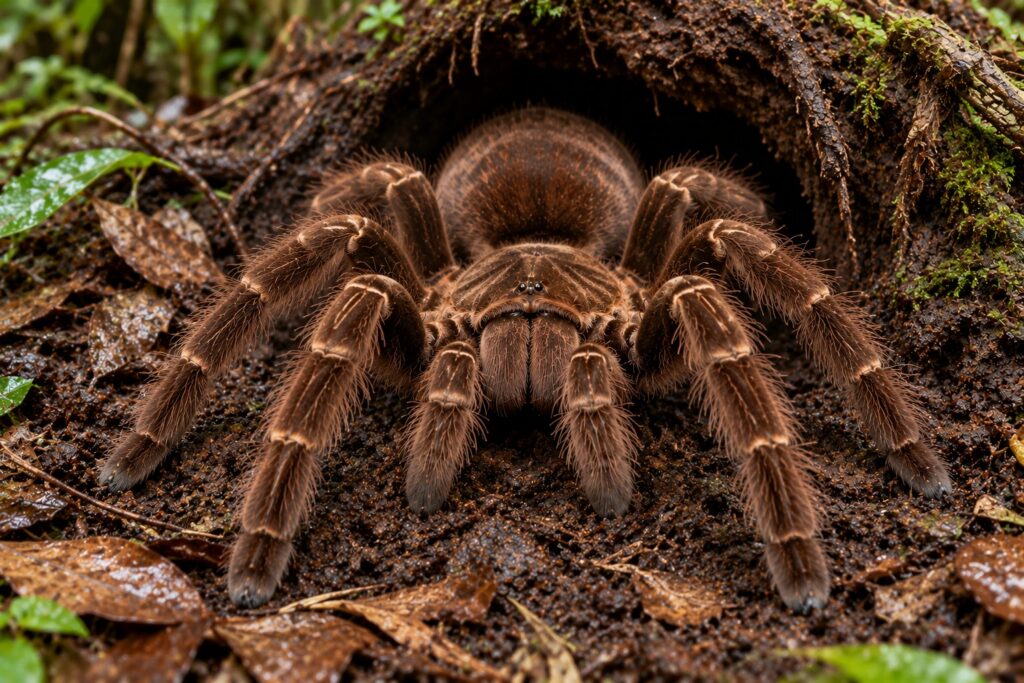
Goliath Birdeater at a Glance
| Attribute | Details |
|---|---|
| Scientific name | Theraphosa blondi |
| Common names | Goliath birdeater, goliath tarantula |
| Native range | Northern South America: Suriname, Guyana, French Guiana, northern Brazil, eastern Colombia, southern Venezuela |
| Habitat | Deep burrows in damp, often marshy rainforest floor |
| Adult leg span | Up to about 12 inches (30 cm) |
| Body length | Up to about 5 inches (13 cm) |
| Weight | Up to about 175 g (6.2 oz) |
| Lifespan | Females 15 to 25 years, males 3 to 6 |
| Type | Terrestrial and fossorial, New World |
| Temperature | 75 to 85F (24 to 29C) |
| Humidity | 75 to 85%, from damp substrate with cross ventilation |
| Difficulty | Advanced |
How Big Is a Goliath Birdeater?
It depends which record you measure. By mass and body length, Theraphosa blondi is the largest spider known. By leg span, the giant huntsman spider of Laos edges it out with longer, thinner legs.
A large adult female goliath birdeater spans 10 to 12 inches, about the size of a dinner plate, with a body as long as a computer mouse. Males are lighter, longer-legged and slimmer. Most captive animals sit at the lower end of the range, and anything near 12 inches is exceptional.
Do Goliath Birdeaters Really Eat Birds?
Rarely. The name comes from an 18th-century engraving of a tarantula eating a hummingbird, and it stuck to the whole group.
In the wild, goliaths eat mostly large insects, earthworms and frogs, along with the occasional lizard, snake or rodent that wanders near the burrow. They are opportunists, not bird hunters. In captivity, insects are all they need.
Blondi or Stirmi? Check Before You Pay
The genus Theraphosa has three species that look alike as slings and juveniles:
| Theraphosa blondi | Theraphosa stirmi | Theraphosa apophysis | |
|---|---|---|---|
| Common name | Goliath birdeater | Burgundy goliath | Pinkfoot goliath |
| Adult look | Brown with faint pale bands at the joints | Darker, reddish-brown to burgundy, plain legs | Pink-tipped feet as a sling, pale leg markings |
| In the trade | Less common, harder to breed | The most commonly available goliath | Available, less common than stirmi |
| Care | Same | Same | Same |
For years, many spiders sold as T. blondi were really T. stirmi, which was only described as a separate species in 2010. Keepers have long reported that true blondi is harder to breed in captivity and less often available. Care is effectively identical across the three, so this matters most if you plan to breed: the species should not be mixed.
What to do: ask the breeder for photos of the parents, or of the animal itself as a juvenile, and buy from someone who keeps the lines separate. If the price is low and the label says blondi, be sceptical.
The Hair Problem
The goliath birdeater’s main defence is not its fangs. It is its urticating setae, the barbed hairs on the abdomen that it kicks off with its back legs when disturbed. Theraphosa hairs are widely considered the most irritating in the hobby.
- On skin, they cause intense itching, a red rash and sometimes raised welts that can last for days.
- In eyes, they can cause serious, lasting irritation. Never lean over an open enclosure.
- In the air, they settle on surfaces and linger. Some keepers develop a sensitivity over time.
Most experienced keepers service a goliath enclosure wearing gloves and eye protection, and some wear a mask. Wash your hands and forearms afterwards with cool water before warm, since heat opens the skin.
Goliaths also hiss. When threatened, a goliath rubs bristles on its legs and pedipalps together to make a loud rasping sound. Hissing, rearing up and kicking hairs all come before a bite.
Long Fangs, Mild Venom
The fangs are long, up to about an inch and a half, so a bite punctures deeply even without venom. The venom itself is considered mild for people, usually compared to a wasp sting, and some bites are dry, with no venom injected at all. Bites happen almost only when the spider is handled or cornered.
Wash any bite with soap and water and watch it for signs of infection, which is the more likely problem with fangs that large. Seek medical advice if symptoms spread or you have known allergies. The general difference between New World and Old World tarantula defences is covered in our comparison of the two tarantula groups.
Handling: don’t. A goliath is nervous, heavy and fragile. A fall from even a modest height can split the abdomen, which is often fatal for a spider this heavy.
Theraphosa Blondi Enclosure
Goliaths are ground dwellers that dig, and they need more floor space and more substrate than almost any other commonly kept tarantula.
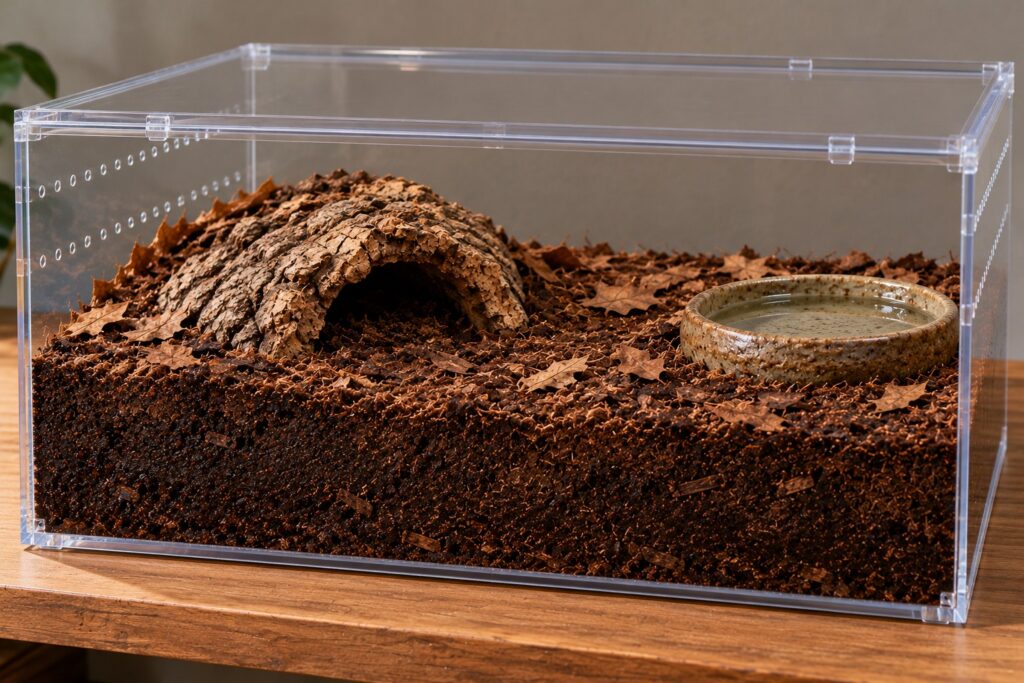
| Leg span | Enclosure footprint | Substrate depth |
|---|---|---|
| Under 2 inches | 32 oz deli cup | 3 to 4 inches, two thirds of the container |
| 2 to 4 inches | About 10 by 8 inches | 4 to 5 inches |
| 4 to 7 inches | About 16 by 12 inches | 5 to 6 inches |
| Adult, 7 inches and up | About 18 by 18 to 24 by 18 inches | 6 to 8 inches |
The general rule for ground dwellers is a footprint two to three times the leg span, and goliaths are the exception that need the top end of it. They are the giants our size chart for every tarantula enclosure singles out for an 18 to 20 inch footprint.
Keep the gap above the substrate small. No more than about 1.5 times the leg span, so a climbing spider cannot fall far.
Substrate: coconut fibre and additive-free topsoil, packed firmly and kept damp in the lower layers. Goliaths dig burrows, move substrate around constantly, and often cover the water dish.
A large hide: a half cork round or a starter burrow at one end.
A wide, heavy water dish, kept full and checked often, since a goliath can tip or bury it overnight.
Lid: solid, with drilled cross ventilation on two sides. Never an uncovered mesh lid.
The step-by-step build for ground dwellers is in our guide to setting up a terrestrial tarantula enclosure.
Humidity Without a Swamp
This is the hardest balance with goliaths. They come from damp, often marshy forest, and they do badly in dry substrate. But a sealed, waterlogged enclosure grows mold and can be just as harmful.
- Keep the substrate damp, not wet. Squeeze a handful from the lower layer: it should hold together without water running out.
- Water from below. Pour water down one corner or the side of the enclosure every few days so it soaks through.
- Keep the airflow. Cross ventilation on two opposing walls, even though you want high humidity.
- Do not mist the spider. It stresses the animal and wets the surface without helping the substrate.
- Temperature 75 to 85F. Most homes need some extra warmth at the cooler end. Fix a heat mat to a side wall on a thermostat, never underneath.
Goliaths that are kept too dry tend to sit at the water dish, refuse food and molt badly. In any tarantula, legs drawn tightly under the body are the warning sign of serious dehydration.
Feeding a Goliath
Goliaths are strong, reliable feeders and can take large prey.
- Slings: pre-killed cricket pieces or small roaches every 3 to 5 days.
- Juveniles: crickets or roach nymphs every 5 to 7 days.
- Adults: large roaches, locusts or several crickets every 7 to 14 days.
Prey no longer than the spider’s body is still the rule, and with an adult goliath that covers almost any feeder insect. Skip mice and lizards. They are messy, carry bacteria and add nothing insects do not.
Remove leftovers within 24 hours, along with the bolus. A goliath eats a lot and leaves a lot of waste, so check the enclosure for mold more often than you would for a smaller species. More on feeders and schedules is in our guide to what tarantulas eat.
Fast Growth, Long Life
Theraphosa grow quickly for tarantulas. Under warm, well-fed conditions a sling can reach several inches within its first year, and females mature in roughly three to six years.
Molting: before a molt, a goliath stops eating, darkens, and often seals itself into its burrow. Many molt on their backs. Leave the enclosure alone, remove live prey, and keep the substrate damp, since a dry molt is more likely to fail. After the molt, wait a week or two before feeding. The full sequence is in our guide to how tarantulas molt.
Lifespan: females commonly live 15 to 25 years. Males mature sooner, wander, and usually die within months of their final molt, at around three to six years old.
Goliath slings are a common way into the species, since they cost far less than juveniles and grow quickly. The basics of sling housing and pre-killed feeding are in our guide to raising tarantula spiderlings, but keep goliath slings on the damp side from the start.
Is a Goliath Birdeater Right for You?
A goliath suits you if you already keep a few New World terrestrials, you can hold warmth and humidity steady, you have room for a large enclosure, and you are fine wearing gloves and eye protection to change water.
Look elsewhere if this would be your first tarantula, you want a spider you can watch in the open, or you share the space with children or pets that could get into the hairs. A curly hair or a chaco golden knee is a much better start.
Five Ways Goliaths Are Lost
- Dry substrate. The most common long-term problem.
- A fall. Too much open height, or handling.
- Waterlogged, stagnant enclosures. Mold and poor molts.
- Live prey left during a molt.
- A disturbed molt. A goliath on its back should be left completely alone.
FAQ
How big do goliath birdeaters get?
Adult females reach up to about 12 inches in leg span, with a body up to 5 inches long and a weight of up to around 175 grams. That makes Theraphosa blondi the heaviest spider in the world, though most captive adults stay somewhat below the maximum.
Is a goliath birdeater dangerous?
Not seriously. The venom is mild for people and usually compared to a wasp sting, but the fangs are long enough to puncture deeply. The urticating hairs are the bigger problem, causing intense itching on skin and serious irritation in eyes.
Do goliath birdeaters eat birds?
Rarely. The name comes from an old engraving of a tarantula eating a hummingbird. In the wild they eat mostly insects, earthworms and frogs, and in captivity insects such as roaches and crickets are all they need.
Is the goliath birdeater a good beginner tarantula?
No. It needs high, carefully balanced humidity, a large enclosure and protective gear because of its hairs, and it reacts quickly to disturbance. Start with a docile, hardy New World species and come back to goliaths later.
How long does a goliath birdeater live?
Females commonly live 15 to 25 years. Males live about three to six years and usually die within months of their final molt.
What is the difference between Theraphosa blondi and Theraphosa stirmi?
They are separate species with near-identical care. T. stirmi, the burgundy goliath, is darker and more commonly available, and was sold as blondi for years before it was described in 2010. True blondi is reported to be harder to breed. Ask the breeder for photos and lineage.
Twenty Years of Molts and Water Changes
A goliath that does well can outlast most of the other animals in your collection, and its moisture needs leave little room for drift. InvertMate logs every molt with dated photos so you can follow its growth, records feedings and refusals, and reminds you when the substrate is due for water. Free on the App Store and Google Play.