The Peruvian centipede, sold as the Peruvian giant centipede and known to science as Scolopendra gigantea, is the largest centipede in the world. Big adults pass 12 inches, and in the wild it hunts mice, lizards, frogs, small snakes and even bats, which it catches by hanging from cave ceilings with its back legs. It is a spectacular animal and one of the most demanding invertebrates anyone keeps.
It is also not a pet in any ordinary sense. It is fast, climbs anything, escapes through gaps you would not believe, and has a bite that is extremely painful and, in at least one recorded case, fatal to a young child. This guide covers what the species is, whether the animal you are offered is really one, the bite risk, enclosure and escape-proofing, climate, feeding, and who should and should not keep it.
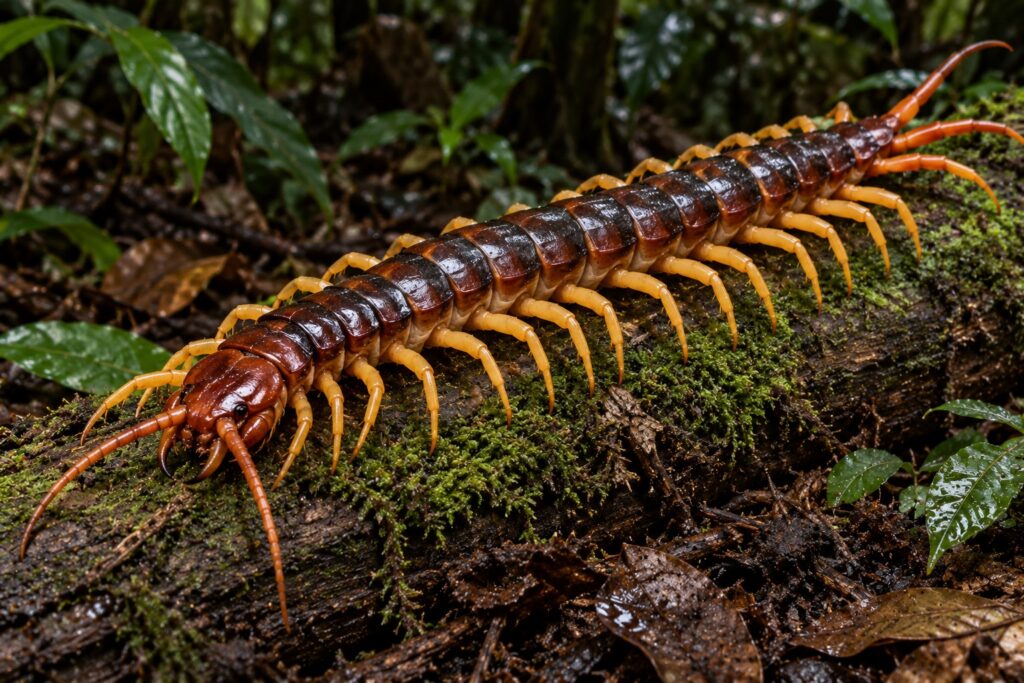
Peruvian Giant Centipede at a Glance
| Attribute | Details |
|---|---|
| Scientific name | Scolopendra gigantea |
| Common names | Peruvian giant yellow-leg centipede, Amazonian giant centipede |
| Native range | Northern South America and nearby islands, including Venezuela, Colombia, Trinidad, Aruba and Curaçao |
| Habitat | Tropical rainforest and dry forest, under logs, rocks and bark, and in caves |
| Adult length | Commonly 8 to 12 inches, largest individuals over 12 |
| Diet | Insects and other invertebrates in captivity; small vertebrates in the wild |
| Temperature | 75 to 82F (24 to 28C) |
| Humidity | 70 to 80%, from damp substrate |
| Handling | Never |
| Difficulty | Expert only |
The World’s Largest Centipede
Scolopendra gigantea holds the record as the largest centipede species, with the biggest individuals exceeding 30 cm, about 12 inches. Captive adults more commonly sit in the 8 to 12 inch range.
Most animals in the trade have a dark red-brown to near-black body and yellow to orange legs, which is where the “yellow-leg” name comes from. Colour varies with origin and age. The head and the large venom claws, called forcipules, sit at the front, and the last pair of legs is long and thick.
Size is not just a number here. A centipede this long is strong enough to push up a poorly fitted lid, fast enough to cross a desk in a second, and heavy enough that its bite delivers a large dose of venom.
Is It Really a Peruvian Centipede?
“Peruvian giant” is a trade name, and it causes confusion.
- The verified range of S. gigantea is northern South America: Venezuela, Colombia and Trinidad, plus Aruba and Curaçao, and Brazil. Despite the name, Peru is not part of the confirmed range.
- Many large centipedes sold as “Peruvian giants” come from elsewhere in South America and may be other big Scolopendra, such as S. viridicornis, or regional forms whose identity is debated.
- Sizes and prices are often inflated by the name.
None of this changes the care. Any centipede sold under this name is a very large, very fast tropical Scolopendra with a serious bite. But if the exact species matters to you, buy from a dealer who gives a scientific name and an origin, and treat claims about size with caution.
What the Bite Does
All Scolopendra are venomous, and the largest species deliver the worst bites.
What a bite causes: severe, burning pain, often described as among the worst of any invertebrate bite, with significant swelling and redness that can last days. Nausea, vomiting, fever and headache are reported. Severe reactions from Scolopendra bites can include tissue damage at the bite and, rarely, effects on the kidneys or heart.
Deaths: at least one death has been attributed to this species. In 2014 a four-year-old child in Venezuela died after being bitten by a centipede hidden in a drinks can. Deaths from centipede bites are extremely rare, but this species is one of the reasons the risk is taken seriously.
If you are bitten: wash the bite with soap and water, use a cold pack, and seek medical attention promptly. Do not cut the wound, suck it or apply a tourniquet. Seek emergency care straight away if a child is bitten, or if you have chest pain, breathing problems, dizziness, dark urine or rapidly spreading swelling. This is general information, not medical advice.
How this compares with house centipedes and other species is laid out in our guide to whether centipedes are dangerous.
Who Should Not Keep One
Be honest with yourself before buying.
- Not a first centipede. Start with a tiger leg, then a mid-sized species, and only then consider a giant.
- Not in a home with young children or anyone who might open the enclosure.
- Not in a home with cats, dogs or small pets that could find an escaped centipede.
- Not without a secure, lockable enclosure and a plan for an escape.
The general case for and against keeping centipedes at all is in our guide to centipedes as pets.
Escape-Proofing Comes First
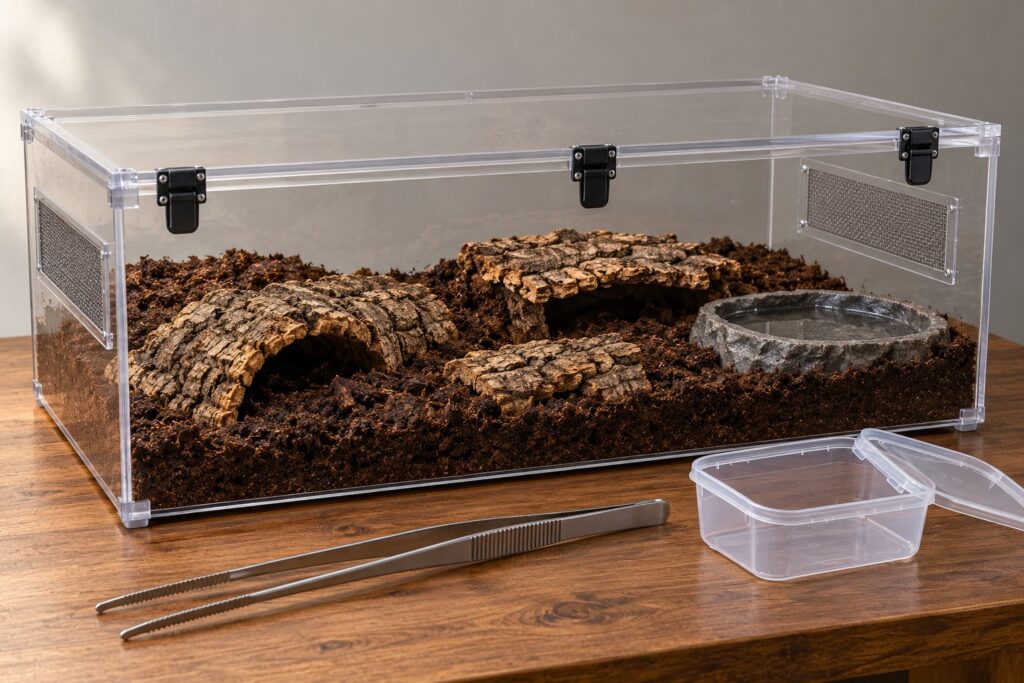
S. gigantea climbs readily, uses bark and walls, and in the wild hangs from cave ceilings. Assume it can reach every part of its enclosure, including the lid.
- A locking lid, with latches or clamps. Nothing held on by friction or weight alone.
- Every gap smaller than the head. If the head fits, the body follows.
- Fine mesh or tiny holes for ventilation, checked regularly for damage.
- Know where it is before opening the enclosure. Many keepers wait until the centipede is buried, or move it to a secure holding container first.
- Work in a closed room, with gaps under doors blocked, so an escape stays contained.
- Long tongs for everything. Never put a hand inside.
The full method is in our centipede enclosure and escape-proofing guide.
Peruvian Giant Centipede Enclosure
| Length | Enclosure footprint | Substrate depth |
|---|---|---|
| Under 3 inches | Small tub, about 8 by 5 inches | 3 to 4 inches |
| 3 to 6 inches | About 16 by 8 inches | 4 to 5 inches |
| 6 to 9 inches | About 24 by 12 inches | 5 to 6 inches |
| Adult, 9 inches and up | About 30 by 15 inches or larger | 6 inches or more |
Footprint: at least twice the centipede’s length on the long side. Height matters only for escape. Keep decor well below the lid so it cannot reach the seams.
Substrate: coconut fibre and additive-free topsoil, packed firmly and kept damp in the lower layers.
Hides: several pieces of cork bark, bedded into the substrate so they cannot shift.
Water: a wide, shallow dish, kept full.
Climate: Warm and Humid
This is a tropical species, unlike the desert centipedes.
- Temperature: 75 to 82F. Use a heat mat on a side wall with a thermostat if the room is cool, never underneath.
- Humidity: 70 to 80%, from damp substrate. Pour water into one end so the lower layers stay moist.
- Ventilation: small holes on two opposite sides. Stagnant, wet air leads to mold.
- No misting. Water the substrate instead.
A centipede that is too dry curls tightly, moves slowly and refuses food. Dehydration is a common cause of losses in captive centipedes.
Feeding: Insects Only
Wild S. gigantea eat vertebrates, but captives do not need them.
- What to feed: large roaches such as dubia, large crickets, and superworms with the head crushed.
- How often: juveniles every 4 to 5 days, adults every 7 to 10 days.
- How to offer: drop prey in with long tongs and close the lid immediately.
- Remove leftovers within 24 hours.
- Skip mice and lizards. They are messy, a bacterial risk, and unnecessary.
Logging feeding dates in InvertMate means you never have to open the lid “just to check” whether it ate, which is one less chance for an accident.
Buried for Weeks: Molting
Before a molt, a giant centipede stops eating and buries itself, sometimes for weeks. Do not dig it up, remove live prey, and keep the substrate damp. A freshly molted centipede is soft and vulnerable. Wait until it is moving normally before feeding.
Rehousing Without an Accident
Moving a centipede this size is the riskiest job you will do, so plan it.
- Prepare the new enclosure completely before you touch the old one, and check the lid locks.
- Work inside a large, empty, smooth-sided bin in a closed room, so an escape stays contained.
- Use a deep catch container with a lid, large enough for the whole centipede, and long tongs.
- Guide, do not grab. Coax the centipede into the container from behind and close it at once.
- Never rehouse a centipede in pre-molt or shortly after a molt.
- Have a second person in the room who knows what to do if something goes wrong.
Peruvian Giant vs Other Large Centipedes
| Peruvian giant | Vietnamese centipede | Texas redheaded | |
|---|---|---|---|
| Scientific name | Scolopendra gigantea | Scolopendra subspinipes | Scolopendra heros |
| Adult length | 8 to 12 inches and up | 8 to 10 inches | About 6.5 to 8 inches |
| Climate | Tropical, humid | Tropical, humid | Dry with a damp corner |
| Bite | Severe | Severe | Very painful |
| Suitable for | Experts | Experienced keepers | Experienced keepers |
The Vietnamese and other tropical giants are covered in our giant centipede care guide, and the largest North American species in our Texas redheaded centipede guide.
FAQ
How big do Peruvian giant centipedes get?
Most captive adults reach 8 to 12 inches, and the largest individuals exceed 12 inches. That makes Scolopendra gigantea the largest centipede species in the world.
Is a Peruvian giant centipede dangerous?
Yes. Its bite causes severe pain and swelling and can bring on nausea and fever. Serious reactions are rare, but at least one death, of a young child, has been attributed to the species. Seek medical attention after any bite.
Do Peruvian giant centipedes eat bats?
In the wild, yes. Large individuals have been recorded hanging from cave ceilings and catching bats, and the species also eats mice, lizards, frogs and small snakes. In captivity, large insects such as roaches are all it needs.
Where do Peruvian giant centipedes come from?
The verified range of Scolopendra gigantea is northern South America and nearby islands, including Venezuela, Colombia, Trinidad, Aruba and Curaçao. “Peruvian” is a trade name, and some animals sold under it may be other large species.
Can you handle a Peruvian giant centipede?
No. It is fast, climbs readily and has a severe bite. All work in the enclosure should be done with long tongs, and many keepers move the centipede to a secure container before cleaning or feeding.
How long do Peruvian giant centipedes live?
Keepers commonly report lifespans of several years to a decade in captivity, though reliable records are limited. Growth to full size takes several years.
Fewer Reasons to Open the Lid
With a centipede this size, every unnecessary opening is a risk. InvertMate records feedings, refusals and molts so you can see what your centipede needs without disturbing it, and reminds you when the substrate needs water. Free on the App Store and Google Play.