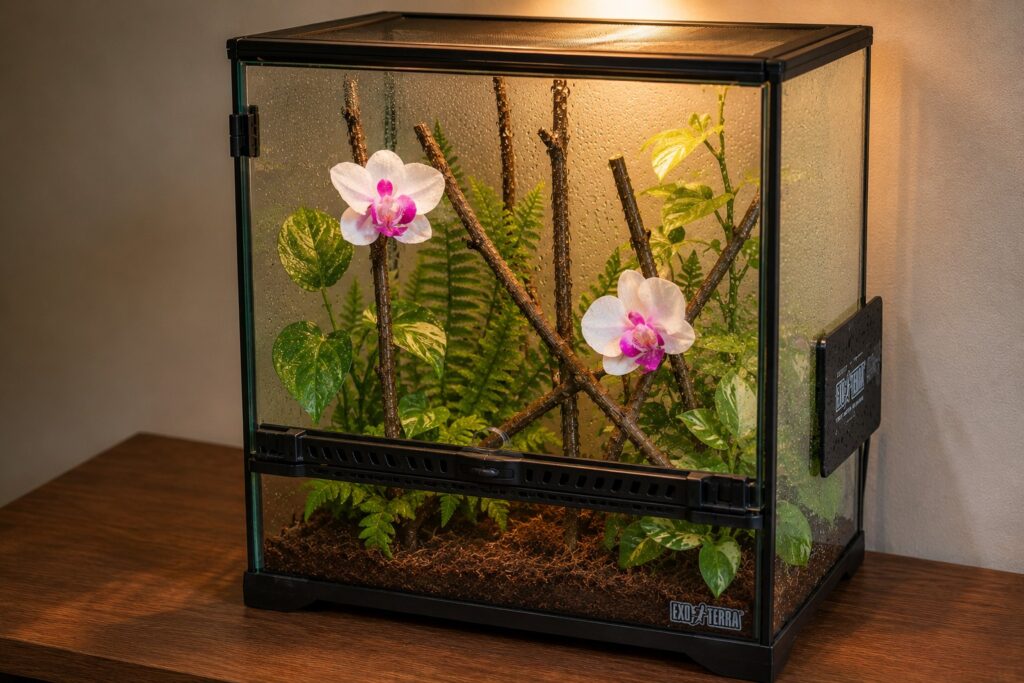
Getting the orchid mantis enclosure right is the difference between a mantis that thrives and one that struggles. Hymenopus coronatus is more sensitive to enclosure conditions than beginner species like ghost mantises or Chinese mantises. They need warmer temperatures, higher humidity, and excellent ventilation all at the same time, which is a trickier balance than it sounds. Add in the extreme size difference between males and females, and you’re dealing with a species that may need different enclosure setups at different life stages.
This guide walks you through every aspect of orchid mantis enclosure design: sizing for nymphs vs. adults, enclosure types, ventilation, heating, humidity management, decor, substrate, and the common setup mistakes that lead to dead mantises. For full species care beyond just the enclosure, see our orchid mantis care guide.
Enclosure Sizing
The standard Rule of Three applies: height should be at least 3 times the mantis’s body length, width at least 2 times. But with orchid mantises, the extreme sexual dimorphism means you need to think about sizing differently for males and females.
Adult females reach 6-7 cm (2.4-2.8 inches). Minimum enclosure: 8 inches tall, 6 inches wide. An Exo Terra Nano Tall (8″ x 8″ x 12″) or similar small terrarium is ideal. Bigger is always welcome.
Adult males reach only 2.5-3 cm (about 1 inch). They’re so small that they can live comfortably in a 32 oz deli cup or a very small mesh enclosure for their entire adult lives.
Nymphs can start in 16-32 oz deli cups, upgrading as they grow. Females will outgrow deli cups around L5-L6 and should move to their adult enclosure. Males may never need anything larger than a 32 oz cup.
One important note: Don’t put a small nymph in a large adult enclosure right away. Small nymphs in oversized enclosures have trouble finding their food (fruit flies get lost in the space), and maintaining consistent humidity in a large container with a tiny mantis is harder than it needs to be. Size up gradually as the mantis grows.
The Rule of Three applies across species. Our praying mantis care guide covers the general enclosure principles if you’re keeping more than one species.
Enclosure Types
There are three main options for housing orchid mantises, each with trade-offs.
Glass Terrariums
Best for: Adult females, display setups
Glass terrariums (like the Exo Terra Nano or REPTIZOO Mini) are the most popular choice for adult orchid mantises. They retain heat and humidity well, provide clear viewing from multiple angles, and look great on a shelf. The front-opening door makes feeding and misting easy without disturbing the mantis from above.
Requirements: The lid must be mesh or screen for ventilation and molting grip. Drill or add ventilation holes on the lower sides for cross-airflow if the terrarium doesn’t already have them. Glass-only ventilation (just the mesh lid) may not provide enough airflow for this species, which is prone to bacterial infections in stagnant air.
Mesh Enclosures
Best for: Keepers who prioritize ventilation
Full mesh enclosures provide the best airflow of any option. The mantis can grip every surface, and cross-ventilation happens naturally. The downside is that mesh enclosures lose humidity fast. You’ll need to mist more frequently (once or twice daily) and may struggle to maintain the 60-80% humidity orchid mantises need.
Mesh enclosures work best in rooms that are already warm and somewhat humid. In dry, air-conditioned environments, the constant humidity loss becomes frustrating.
Deli Cups
Best for: Nymphs, adult males, temporary housing
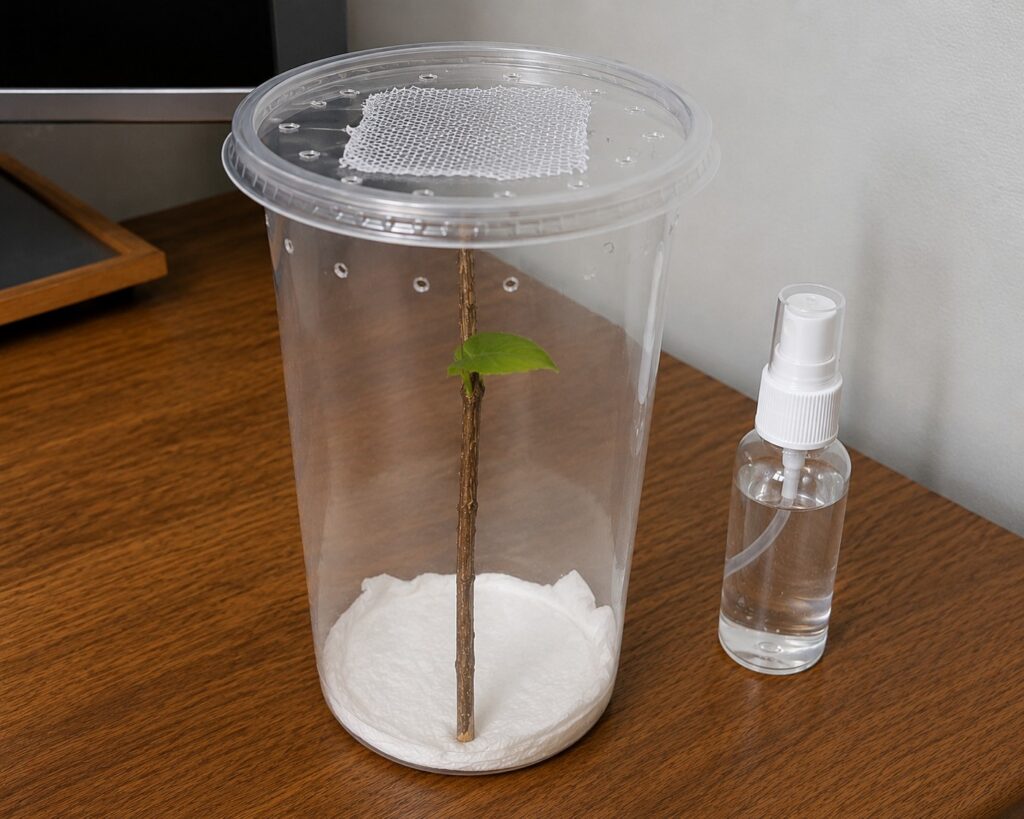
Clear plastic deli cups (16-32 oz) are the practical workhorse of mantis keeping. They’re cheap, stackable, and easy to maintain. Poke small ventilation holes in the lid or sides, and hot-glue a piece of mesh to the inside of the lid for a molting grip surface.
For orchid mantis nymphs, deli cups are honestly the best option. The small enclosed space holds humidity well, makes it easy for the nymph to find fruit flies, and takes seconds to mist.
Ventilation: The Most Critical Factor
Ventilation is where orchid mantis enclosure setup gets tricky. This species needs high humidity AND good airflow simultaneously. Most mantis species can tolerate moderate ventilation, but orchid mantises are unusually susceptible to bacterial infections that thrive in stagnant, humid air.
The goal: Air moves through the enclosure without stripping all the moisture out.
Best approach: Cross-ventilation. This means air enters from one side (usually lower) and exits from the opposite side (usually higher, or through the mesh lid). The airflow moves through the habitat without creating a wind tunnel.
For a glass terrarium:
- Mesh lid on top (provides ventilation and molting surface)
- Small ventilation holes or mesh strip on the lower front or side wall
- Air naturally rises from the lower vents through the habitat and out the mesh lid
For a deli cup:
- Small holes poked in the lid AND near the bottom of the sides
- Don’t overdo it. 8-12 small holes in the lid and 4-6 holes in the upper side walls is plenty for a 32 oz cup
Signs of inadequate ventilation:
- Mold growing on substrate, decor, or uneaten prey
- Condensation that never clears from the walls
- Musty smell when you open the enclosure
- The mantis develops dark spots on its body (possible bacterial infection)
Signs of too much ventilation:
- Humidity drops below 50% within hours of misting
- The substrate dries out completely between mistings
- The mantis appears dehydrated (shrunken abdomen)
Adjust by covering or opening ventilation holes until you find the right balance for your specific room conditions.
Temperature and Heating
Orchid mantises need 77-90°F (25-32°C), which is warmer than most common mantis species require. Unless your home stays above 77°F consistently, you’ll need supplemental heating.
Heating options:
Heat mat on the side wall (most popular method): Stick a small reptile heat mat to one side of the terrarium. Always connect it to a thermostat with the probe placed inside the enclosure at mantis-perching height. This creates a warm zone on one side and a slightly cooler zone on the other, letting the mantis choose.
Low-wattage heat lamp (good for glass terrariums): A small desk lamp with a 25W bulb placed above or beside the enclosure provides gentle warmth. Position it so the mantis can move closer or farther from the heat source. Be careful not to overheat the enclosure or dry out humidity.
Room heater (simplest if you keep multiple mantises): Warming the entire room to 77-80°F eliminates the need for individual enclosure heating. This is the approach many breeders use.
Temperature rules:
- Never place the enclosure in direct sunlight. Even brief sun exposure can overheat a small container to lethal temperatures.
- Nighttime drops to 72°F are fine.
- Temperature affects lifespan. Warmer temperatures speed up growth and aging. Cooler temperatures (within range) extend how long your mantis lives.
- If you’re trying to synchronize male and female development for breeding, temperature control is your primary tool. Keep males cooler (65-68°F) to slow them down.
Humidity Management
Target 60-80% humidity for orchid mantises. Nymphs in earlier instars (L1-L3) can tolerate slightly lower humidity (around 60%), but older nymphs and adults need the higher range (70-80%) for safe molting.
How to maintain humidity:
- Mist the enclosure once daily for nymphs in deli cups
- Mist once or twice daily for adults in glass terrariums
- Mist twice daily for adults in mesh enclosures
- Use a fine mist spray bottle. You want small droplets, not a heavy drench.
- Aim the spray at decor, branches, and walls, not directly at the mantis
Substrate helps. A thin layer (0.5-1 inch) of coconut coir at the bottom of the enclosure absorbs water during misting and slowly releases it between mistings, creating a humidity buffer. Paper towel works too but dries faster.
Live plants in a bioactive setup contribute to humidity through transpiration. Pothos, ferns, and small orchids work well and make the enclosure look stunning alongside the mantis’s flower-like appearance. If you go this route, add springtails and dwarf white isopods as a cleanup crew.
Monitor with a hygrometer. A small digital hygrometer placed inside the enclosure takes the guesswork out of humidity management. Check daily until you have a routine dialed in.
Decor and Climbing Surfaces
Orchid mantises are arboreal. They spend nearly all their time perched on branches, twigs, and leaves, waiting to ambush prey. The enclosure needs plenty of vertical surfaces.
Essential:
- Vertical twigs and thin branches (the mantis perches on these all day)
- A textured surface at the top for molting (mesh lid handles this, or add a piece of cork bark near the ceiling)
Recommended for display:
- Artificial white or pink orchid flowers (the mantis will often perch on these, and the visual effect is stunning)
- Artificial or live green plants for cover and humidity
- A few dried leaves for visual complexity
What to avoid:
- Overcrowding the enclosure with too much decor. The mantis needs open space to move, strike at prey, and especially to molt. A molting mantis hangs straight down and needs body-length clearance below it with no obstructions.
- Sharp or rough decorations that could injure the mantis’s delicate petal lobes
- Heavy items that could fall and crush the mantis
For nymphs (L1-L4): Keep it simple. One or two thin twigs and a mesh ceiling surface is all they need. Too much decor in a small deli cup makes it harder to find and remove uneaten fruit flies.
For adults: You can create a more elaborate display setup with flowers, plants, and multiple perching spots. This is when orchid mantis keeping becomes truly visually rewarding.
Common Setup Mistakes
Not enough ventilation. This is the number one killer of orchid mantises in captivity. Keepers focus on maintaining high humidity and seal the enclosure too tightly, creating a stagnant environment where bacteria thrive. Always prioritize airflow, even if it means misting more often.
Enclosure too large for nymphs. A tiny L1 nymph in a large terrarium can’t find its fruit flies, can’t maintain humidity efficiently, and is more likely to fall during molting. Start small and size up.
No molting surface at the top. Smooth glass or plastic ceilings don’t give enough grip. The mantis needs a mesh lid or a piece of rough material at the top to hang from during molts. Without it, the mantis falls mid-molt, which is often fatal.
Heat source too close or uncontrolled. A heat mat without a thermostat can overheat the enclosure, cook the mantis, and crash humidity all at once. Always use a thermostat.
Direct sunlight. Even 10 minutes of direct sun on a small glass terrarium can raise the temperature to lethal levels. Place the enclosure in a bright room with indirect light only.
FAQ
What size enclosure does an orchid mantis need?
For adult females: at least 8 inches tall and 6 inches wide (an Exo Terra Nano Tall is ideal). For adult males: a 32 oz deli cup is sufficient. For nymphs: 16-32 oz deli cups, sizing up as they grow. Always follow the Rule of Three: height at least 3 times body length, width at least 2 times.
Do orchid mantises need a heat lamp?
Usually yes, unless your room stays above 77°F consistently. A small heat mat on the side of the terrarium (with thermostat) or a low-wattage desk lamp nearby are the most common heating methods. Target 77-90°F during the day with a slight nighttime drop.
How often should I mist an orchid mantis enclosure?
Once daily for nymphs in deli cups, once or twice daily for adults in glass terrariums, and twice daily for adults in mesh enclosures. Use a fine mist and let the enclosure dry between mistings. The walls should have visible droplets after misting but be dry within a few hours.
Can I use live plants in an orchid mantis enclosure?
Once daily for nymphs in deli cups, once or twice daily for adults in glass terrariums, and twice daily for adults in mesh enclosures. Use a fine mist and let the enclosure dry between mistings. The walls should have visible droplets after misting but be dry within a few hours.
What substrate should I use for an orchid mantis?
A thin layer (0.5-1 inch) of coconut coir works well for humidity retention. Paper towel is a simpler alternative that makes cleanup easier. For bioactive setups with live plants, use a tropical soil mix. Substrate is optional for mantises, but it does help buffer humidity between mistings.
Track Your Mantis with InvertMate
Monitor your orchid mantis enclosure conditions with InvertMate. Log molts, track feeding schedules, and set misting reminders so your enclosure stays dialed in. Free on the App Store.