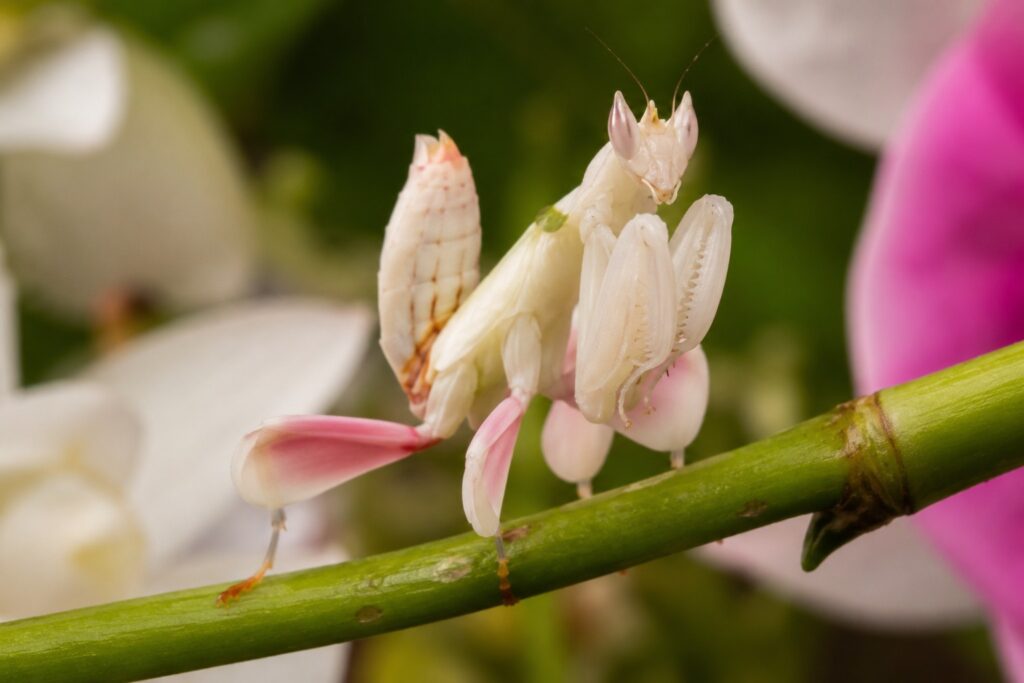
Orchid mantis care requires more attention than beginner species, but the reward is keeping arguably the most beautiful insect on the planet. With petal-shaped leg lobes, a body that shifts between pure white and soft pink, and a hunting strategy based on looking like a flower, Hymenopus coronatus is the species that makes people realize mantis keeping is a real hobby. Photos of orchid mantises go viral regularly, and for good reason: they genuinely look like they were designed by an artist.
That beauty comes with a catch. Orchid mantises are more demanding than beginner species like ghost mantises. They need higher humidity, warmer temperatures, and careful attention to ventilation. The extreme sexual dimorphism (females grow three times larger than males) makes breeding particularly challenging. This is an intermediate-level mantis, not a first pet.
This guide covers everything you need to keep an orchid mantis healthy: enclosure setup, temperature and humidity, feeding at every instar, molting, the notorious male-female size gap, and breeding for those ready to attempt it.
Species Overview
The orchid mantis (Hymenopus coronatus) is native to the tropical rainforests of Southeast Asia, primarily Malaysia, Indonesia, and Thailand. In the wild, they perch on flowering plants, where their remarkable camouflage serves a dual purpose: hiding from predators and luring pollinating insects close enough to grab.
Their appearance is genuinely extraordinary. Females develop broad, flat lobes on their middle and hind legs that resemble flower petals. Their body coloration ranges from pure white to vivid pink, and can shift between molts depending on environmental conditions (particularly humidity and light). Nymphs in the first instar (L1) look nothing like adults: they hatch out black and orange, mimicking certain toxic assassin bugs for protection.
The sexual dimorphism in this species is among the most extreme in the entire mantis world. Females grow to 6-7 cm (2.4-2.8 inches) with large, showy petal lobes and green wing spots. Males reach only 2.5-3 cm (1-1.2 inches), are slimmer, often more brownish, and have greatly reduced leg lobes. Males also mature faster (7 molts to adulthood vs. 8-9 for females), which creates a significant breeding challenge.
| Attribute | Details |
|---|---|
| Scientific name | Hymenopus coronatus |
| Adult size | Females: 6-7 cm; Males: 2.5-3 cm |
| Lifespan | 6-12 months (total); females live longer |
| Difficulty | Intermediate |
| Temperature | 77-90°F (25-32°C) |
| Humidity | 60-80% (with good ventilation) |
For more on mantis lifespans, see our praying mantis lifespan guide.
Enclosure Setup
Orchid mantises need vertical space for molting and well-ventilated enclosures to prevent bacterial infections, which this species is particularly prone to in stagnant, overly humid conditions.
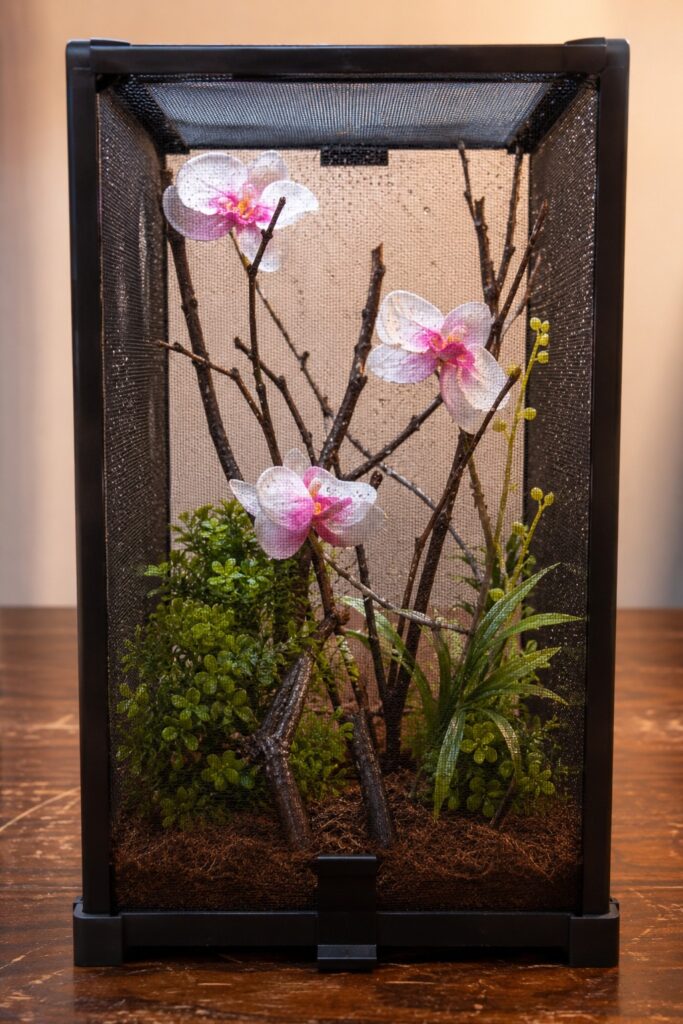
Follow the Rule of Three: enclosure height should be at least 3 times the mantis’s body length, and width at least 2 times. For an adult female at 7 cm, that means a minimum of about 8 inches tall and 6 inches wide. For smaller males, a 32 oz deli cup works throughout much of their life. Females need a proper terrarium or large mesh enclosure once they reach sub-adult size.
Mesh enclosures are the preferred choice for orchid mantises. They provide excellent ventilation (critical for this species) and give the mantis a textured surface to grip for molting. Glass or plastic enclosures work if the lid is fully mesh and you add additional ventilation holes on the sides for cross-airflow.
Decor and climbing structures:
- Vertical branches and thin twigs for perching (essential)
- Artificial flowers in white or pink (orchid mantises often perch on these, and it looks spectacular)
- Artificial or live plants for cover
- A mesh or rough-textured ceiling for molting grip
Substrate is optional. A thin layer of paper towel, coconut coir, or sphagnum moss at the bottom helps retain humidity during misting. Some keepers skip substrate entirely and just mist the enclosure walls and decor directly.
Ventilation cannot be overstated. Orchid mantises are more susceptible to bacterial infections than many other mantis species, and stagnant, humid air is the primary cause. Good cross-ventilation (airflow entering from one side and exiting from the other) is the most effective setup. If you’re using a glass enclosure, mesh on the top and holes on the lower sides creates a chimney effect that moves air through the habitat.
For a full build walkthrough including specific enclosure recommendations and ventilation modifications, see our orchid mantis enclosure guide.
Temperature & Humidity
Getting temperature and humidity right is the most important aspect of orchid mantis care, and where this species differs most from hardier mantids like ghost mantises.
Orchid mantises need warmer temperatures than most commonly kept mantis species. This is not a room-temperature mantis for most homes.
Temperature should stay between 77-90°F (25-32°C) during the day. Nighttime drops to 72°F are acceptable. If your home sits at 70-72°F, you’ll need supplemental heating. A small heat lamp placed near (not directly on) the enclosure, or a heat mat on the side wall connected to a thermostat, can provide the extra warmth needed.
Temperature directly affects development speed. Warmer temperatures accelerate growth and shorten lifespan. Cooler temperatures (within the safe range) slow development and extend life. This becomes important when you’re trying to synchronize male and female maturation for breeding.
Humidity should be maintained at 60-80%. Nymphs need the higher end of this range (70-80%) to molt safely, as their delicate, lobed exoskeletons are more prone to getting stuck during shedding. Adults can tolerate slightly lower humidity but still need regular misting.
Mist the enclosure lightly once daily for nymphs, and once every 1-2 days for adults. The goal is to provide water droplets on branches and walls for drinking without saturating the enclosure. After misting, the enclosure should dry within a few hours. If it’s still wet hours later, your ventilation is insufficient.
The critical balance: High humidity AND good ventilation simultaneously. This sounds contradictory, but it’s essential. The enclosure needs to be humid enough for healthy molting but well-ventilated enough to prevent bacterial growth. Mist, let it dry, mist again. Don’t maintain a constantly damp environment.
Diet & Feeding
Orchid mantises are ambush predators that prefer flying insects. In the wild, their flower mimicry lures pollinators directly to them. In captivity, flies are the gold standard feeder, though they’ll accept other prey.
Feeding requirements change as the mantis grows through its instars:
L1 nymphs: Drosophila melanogaster (flightless fruit flies). Feed daily or every other day. L1 nymphs are tiny and black/orange, looking nothing like the flower-like adults. They’re delicate and need small prey.
L2-L3 nymphs: Drosophila hydei (larger fruit flies). Feed every 1-2 days. The white/pink coloration begins to develop.
L4-L5 nymphs: Blue bottle flies, green bottle flies, small houseflies. Feed every 2-3 days.
L6 to sub-adult: Blue bottle flies, moths, small roaches, appropriately sized crickets. Feed every 3-4 days. Females start eating significantly more than males at this stage.
Adult females: Blue bottle flies, moths, waxmoths, roaches, large crickets. Feed every 3-5 days. Adult females can eat surprising amounts, especially when building up fat reserves for egg production.
Adult males: Blue bottle flies, small prey items. Feed every 4-5 days. Males are tiny and need appropriately sized food.
Key feeding notes:
- Orchid mantises strongly prefer flying prey. Flies trigger a feeding response more reliably than crawling insects.
- Pre-molt fasting is normal (3-5 days before a molt). Don’t panic.
- Overfeeding females before breeding increases the chance that the male survives mating.
- Remove uneaten prey within 24 hours.
Behavior & Handling
Orchid mantises are calmer than many species but can be skittish, especially as nymphs. They spend most of their time motionless on a perch, swaying gently to mimic a flower in the breeze, then striking with explosive speed when prey comes within range.
One distinctive behavior: orchid mantises are aggressive feeders compared to ghost mantises. They have a strong feeding response and will strike at prey quickly. Some individuals will even lunge toward fingers if they detect movement nearby. This isn’t aggression toward you; they’re just enthusiastic hunters.
Handling is possible but should be kept brief. Gently coax the mantis onto your hand rather than grabbing. Their petal-shaped leg lobes are delicate and can tear if handled roughly. Move slowly and avoid sudden movements. Adult males are especially fragile due to their tiny size.
Threat displays are less common in orchid mantises than in some other species. When startled, they’re more likely to flee or freeze than display.
Communal keeping is not recommended. Orchid mantises will readily cannibalize each other, especially when there’s a size difference between individuals. House them individually from L3 onward.
Molting occurs every 2-3 weeks for nymphs, with longer intervals for older instars. The sub-adult to adult molt can take 4-6 weeks. Orchid mantises have a more complex exoskeleton than many species due to the petal lobes, which makes their molts slightly higher-risk. Adequate humidity and an undisturbed environment during molting are critical. The mantis will hang upside down from a mesh surface or branch and wriggle free of the old skin. This process can take 30 minutes to several hours.
Breeding
Breeding orchid mantises is considered advanced-level due to the extreme sexual dimorphism and the difficulty of synchronizing male and female maturation.
The core problem: Males go through 7 molts to adulthood, while females need 8-9. Males also develop faster at the same temperature. This means a male and female raised together from nymphs will result in the male reaching adulthood (and starting his limited adult lifespan) weeks or even months before the female is ready to mate.
Solutions for synchronizing:
- Slow the male down by keeping him at cooler temperatures (65-68°F / 18-20°C) and feeding him less. This extends his development time.
- Speed the female up by keeping her at warmer temperatures (85-90°F / 29-32°C) and feeding her as much as she’ll eat.
- Buy males and females at different ages. Starting with an older female and younger male can bridge the gap.
- Use multiple males. Having 2-3 males gives you backup if one dies before the female is ready.
Mating: Wait at least 2-3 weeks after the female’s final molt. Feed her heavily in the days before introducing the male. Place the male in the female’s enclosure and give them space. Some breeders offer the female a large fly to keep her occupied during the male’s approach. Mating can last several hours. The male may or may not survive the encounter, Whether she eats him depends more on how well fed she is than on anything else, which is why the heavy feeding beforehand matters.
After mating, the female produces oothecae (egg cases) attached to branches or enclosure walls. Each ootheca contains 50-100+ eggs. At 77-82°F, nymphs hatch in 5-7 weeks. L1 nymphs are black and orange and should be separated into individual containers soon after hatching to prevent cannibalism. Feed them Drosophila melanogaster immediately.
Common Health Issues
Bacterial infections are the most common cause of death in captive orchid mantises. Symptoms include black spots on the body, lethargy, and sudden death. The primary cause is stagnant, overly humid conditions with poor ventilation. Prevention: ensure good cross-ventilation and let the enclosure dry between mistings.
Failed molts happen more frequently with this species than with hardier mantises like ghost mantises. The elaborate petal-shaped lobes create more surface area that can stick during shedding. Prevention: maintain 70-80% humidity during the molt period, provide a textured ceiling surface for secure hanging, and never disturb a molting mantis.
Dehydration shows up as a shrunken abdomen. Increase misting frequency and ensure water droplets are available on perches and walls.
Overheating can occur if a heat source is too close or the thermostat fails. Orchid mantises tolerate warm temperatures but sustained exposure above 95°F can be lethal. Always use a thermostat with any heating element.
Nymph mortality is highest in L1-L2. The tiny nymphs are fragile, can drown in water droplets, and need very small prey. Light misting (fine mist, not heavy spray) and appropriately tiny fruit flies are essential.
FAQ
Are orchid mantises good for beginners?
Not ideal. They’re an intermediate-level species that needs higher temperatures, precise humidity management, and good ventilation balance. If you’ve successfully kept a ghost mantis or similar beginner species through its full lifecycle, you’re ready to try an orchid mantis. If it would be your very first mantis, start with something hardier, Our praying mantis care guide covers the fundamentals that apply across species.
How long do orchid mantises live?
Total lifespan from hatching is typically 6-12 months. Females live longer than males, both because they develop more slowly and because males have a very short adult lifespan (often just 2-3 months after their final molt). Cooler temperatures within the safe range extend lifespan.
Why is my orchid mantis brown instead of pink?
Color in orchid mantises is influenced by environmental conditions, especially humidity and light exposure. Lower humidity and certain light conditions can produce more brownish or yellowish coloring, particularly in males. Females kept in higher humidity tend to develop more white and pink coloration. Color can shift between molts.
Can orchid mantises be kept together?
No. They will cannibalize each other. House them individually from L3 onward. Even same-sized siblings housed together will eventually result in one eating the other.
How often should I mist my orchid mantis?
Once daily for nymphs, once every 1-2 days for adults. Use a fine mist and let the enclosure dry between mistings. The goal is water droplets for drinking and temporary humidity boost, not a constantly wet environment. Good ventilation should dry the enclosure within a few hours after misting.
Track Your Mantis with InvertMate
Log every molt, track feeding schedules, and monitor enclosure conditions for your orchid mantis with InvertMate. Set smart reminders so you never miss a care task. Free on the App Store.