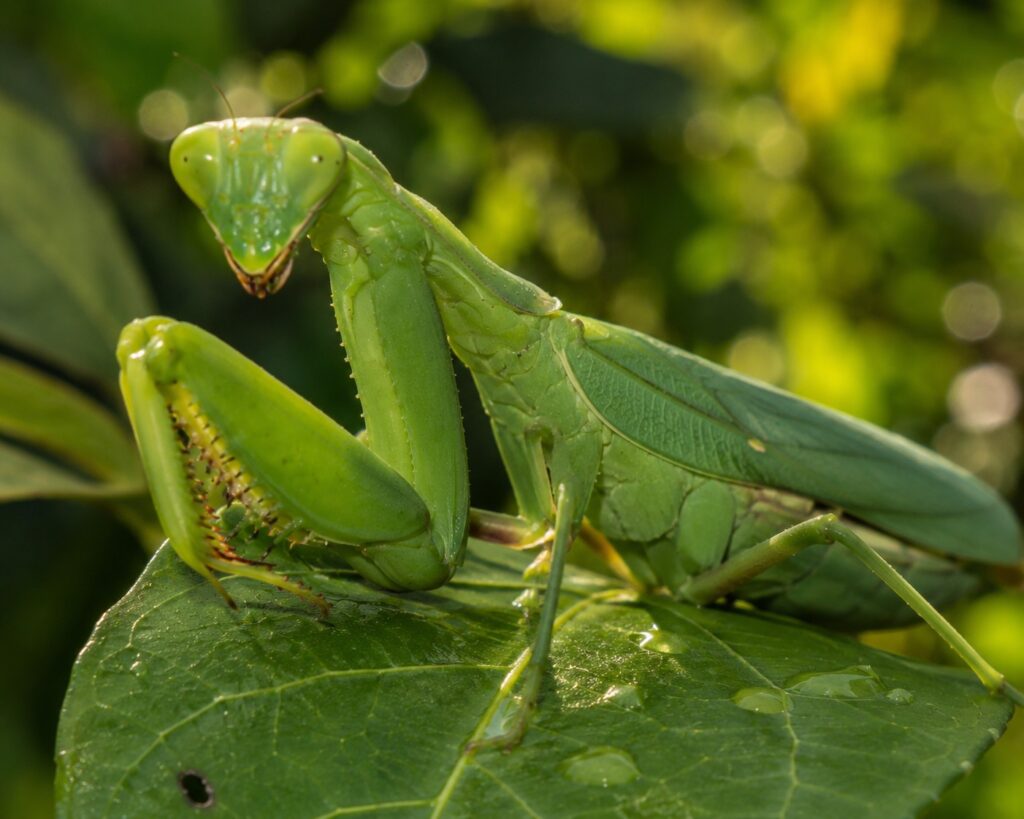
The giant African mantis is one of the best mantis species you can keep, period. They’re big, bold, and have a feeding response so aggressive they’ll tackle prey nearly their own size without hesitation. If you want a mantis that’s always visible, always hungry, and genuinely impressive to watch hunt, Sphodromantis species deliver on every count.
What makes the giant African mantis especially appealing for newer keepers is how forgiving they are. They tolerate a wide temperature range, don’t need fussy humidity levels, and are robust enough to bounce back from the kind of minor care mistakes that would stress more delicate species like orchid mantises. If the ghost mantis is the “calm and easy” beginner recommendation, the giant African mantis is the “bold and exciting” one.
This care sheet covers everything you need: enclosure setup, temperature, humidity, feeding (including their famously voracious appetite), molting, handling, and breeding. For general mantis care principles that apply to all species, see our praying mantis care 101.
Species Overview
The “giant African mantis” label covers several closely related species in the genus Sphodromantis, primarily Sphodromantis viridis and Sphodromantis lineola. Both are native to sub-Saharan Africa, where they inhabit woodland, savanna, and bush environments. Care requirements are nearly identical across the genus, so this guide applies to any Sphodromantis species you’re likely to find in the pet trade.
Adults are large and heavily built. Females reach 8-10 cm (3-4 inches), making them one of the biggest commonly kept mantis species. Males are slightly smaller at 7-8 cm (2.8-3.2 inches). Coloration is typically bright green, though brown and tan individuals occur depending on environmental conditions. Their bodies are thick, muscular, and designed for power. Unlike the delicate, camouflage-dependent orchid mantis, giant Africans are built like linebackers.
Their temperament matches their build. Giant African mantises are confident, active hunters with one of the strongest feeding responses in the mantis world. They’ll strike at anything that moves within range, including prey items nearly as large as themselves. Some keepers have observed them catching and eating small reptiles and even pinkie mice, though insects should make up the vast majority of their diet.
| Attribute | Details |
|---|---|
| Scientific name | Sphodromantis viridis / S. lineola |
| Adult size | Females: 8-10 cm; Males: 7-8 cm |
| Lifespan | 9-14 months (total) |
| Difficulty | Beginner |
| Temperature | 72-86°F (22-30°C) |
| Humidity | 50-70% |
For more on mantis lifespans across species, see our praying mantis lifespan guide.
Enclosure Setup
Giant African mantises are large animals that need appropriately sized housing, especially adult females. Follow the Rule of Three: height at least 3 times body length, width at least 2 times.
For an adult female at 10 cm, that means a minimum of about 12 inches tall and 8 inches wide. An Exo Terra 30x30x30 cm or the 30x30x45 cm terrarium works well. For nymphs and sub-adults, 32 oz deli cups are perfect.
Enclosure type: Glass terrariums with mesh lids are the most popular choice. They retain some humidity while the mesh provides ventilation and a molting surface. Full mesh enclosures also work but require more frequent misting. Deli cups are ideal for nymphs through about L5-L6.
Furnishings:
- Vertical branches and twigs for perching (essential)
- Artificial or live plants for cover and visual enrichment
- A mesh or textured ceiling for safe molting
- Optional: thin layer of coconut coir or paper towel as substrate
Keep the decor moderate. Too much clutter hides prey, and the mantis may not find its food. Giant Africans are active hunters that benefit from some open space to spot and chase prey.
Ventilation should be good but doesn’t need to be excessive. This species is hardier than orchid mantises when it comes to air quality. A standard mesh lid with sealed glass or plastic sides provides plenty of airflow for most setups.
Temperature & Humidity
One of the biggest advantages of keeping giant African mantises is their tolerance for a wide range of conditions.
Temperature: They thrive between 72-86°F (22-30°C). That’s a broad comfortable range that covers typical room temperature in most homes. They don’t need supplemental heating unless your house drops below 70°F regularly. If you do need heat, a small heat mat on the side of the enclosure connected to a thermostat is the simplest solution.
Warmer temperatures (78-86°F) produce faster growth and more active behavior. Cooler temperatures (72-76°F) slow development and extend lifespan. Both are perfectly healthy. A nighttime drop of 5-10°F is natural and fine.
Humidity: Target 50-70%, which is moderate by mantis standards. Mist the enclosure once daily or every other day with a fine spray. The goal is to provide water droplets for drinking and a brief humidity boost, not to create a tropical rainforest. Let the enclosure dry between mistings.
Giant Africans are less sensitive to humidity fluctuations than many species. A brief dry spell won’t kill them. That said, consistent humidity is still important for healthy molting, especially during the nymph stages when molts happen frequently.
Diet & Feeding
This is where giant African mantises really shine. Their feeding response is legendary in the mantis hobby. They’re bold, aggressive hunters that strike at prey with impressive speed and power. Watching a giant African mantis hunt is one of the most entertaining experiences in invertebrate keeping.
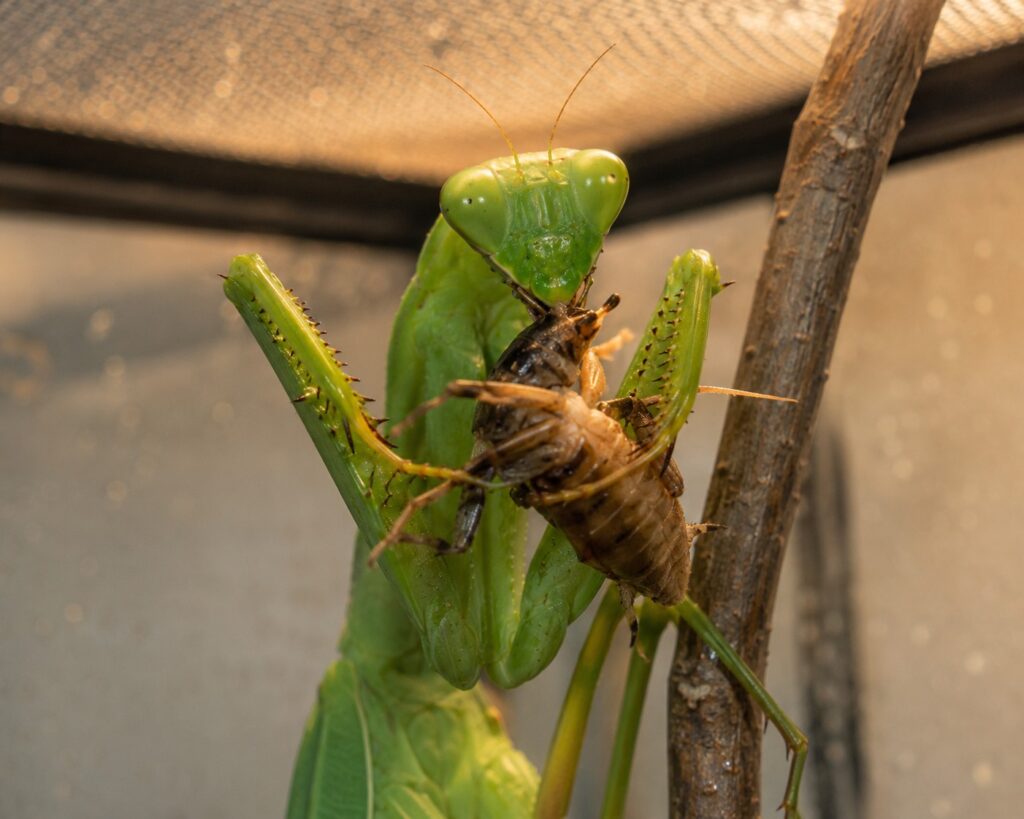
Feeding by life stage:
L1-L2 nymphs: Drosophila melanogaster (flightless fruit flies). Feed daily.
L3-L4 nymphs: Drosophila hydei or small houseflies. Feed every 1-2 days.
L5-L6 nymphs: Houseflies, blue bottle flies, small crickets, small dubia roaches. Feed every 2-3 days.
Sub-adult and adult: Blue bottle flies, crickets, dubia roaches, superworms, waxmoths, moths. Feed every 3-5 days. Prey can be up to one-third the mantis’s body length.
Feeding tips specific to this species:
- Giant Africans will eat almost anything that moves. They’re far less picky than many other species and readily accept crickets, roaches, and flying insects with equal enthusiasm.
- Don’t overfeed. Their willingness to eat doesn’t mean they should eat constantly. An obese mantis (abdomen extremely swollen and tight between feedings) faces higher risk during molts and a shortened lifespan. If the abdomen looks very round, skip feeding for a few days.
- Remove uneaten prey within 24 hours. Even though these mantises are large and robust, a cricket can still injure them during a molt.
- Pre-molt fasting is normal (3-7 days). Don’t panic.
- Avoid feeding them wild-caught insects, which may carry parasites or pesticide residue.
Some keepers offer pinkie mice or small reptiles as occasional novelty feedings. While giant Africans can handle this, it’s not necessary and shouldn’t be a regular part of the diet. Insects provide everything they need nutritionally.
Behavior & Handling
Giant African mantises are bold, confident, and surprisingly interactive for an insect. They don’t shy away from movement and often turn their heads to track your finger or any motion near the enclosure. This head-tracking behavior, combined with their large compound eyes, gives them an almost charismatic personality.
They spend most of the day perched on a branch or the enclosure wall, swaying gently and scanning for prey. When food is introduced, the transition from patient stillness to explosive strike is dramatic and fast. First-time keepers are often startled by the speed.
Handling is straightforward with this species. They’re large enough to handle comfortably, generally calm on the hand, and not as flighty as smaller species. Gently coax the mantis onto your hand and let it walk. Move slowly and avoid sudden movements. They rarely bite keepers, but their strong grip with the raptorial forelegs can be surprising.
When not to handle: Within 3 days of a molt, during feeding, or when the mantis is showing a threat display (forelegs raised and spread, wings fanned open). The threat display looks intimidating but is purely defensive. Give it space.
Communal keeping is not recommended. Giant Africans are highly predatory and will readily cannibalize each other. House them individually at all times.
Molting follows standard mantis patterns. Nymphs molt every 2-3 weeks, sub-adults every 4-6 weeks. Females go through 8-9 molts, males 7-8. Given their large size, molts take longer and are more physically demanding than for smaller species. Ensure adequate vertical space, a textured ceiling surface, and proper humidity during the molt period.
Breeding
Breeding giant African mantises is relatively straightforward compared to many other species, making them a popular choice for keepers attempting mantis breeding for the first time.
Sexing: From about L5 onward, you can sex by counting abdominal segments on the underside. Males have 8 segments, females have 6-7. Adult males are slimmer with longer wings that extend past the abdomen. Females are broader and heavier with shorter wings.
Timing: Females should be at least 2-3 weeks past their final molt before breeding. Males mature slightly faster but the difference is less extreme than in orchid mantises, so synchronization is easier.
Mating: Feed the female very heavily in the days before introducing the male. A well-fed female is far less likely to eat the male during or after mating. Place the male behind the female in her enclosure and let him approach on his own. Mating can last several hours. Supervise the encounter and be ready to remove the male afterward.
Despite precautions, the female may eat the male. This is a natural risk with mantis breeding. Having multiple males available increases your chances of a successful pairing.
Oothecae: After mating, the female produces foam-like egg cases (oothecae) attached to branches or enclosure walls. Each ootheca can contain 100-300+ eggs. Keep oothecae at the same temperature and humidity as the adults. Nymphs hatch in 4-6 weeks at warmer temperatures. L1 nymphs should be separated quickly and fed Drosophila melanogaster to prevent cannibalism.
Common Health Issues
Overfeeding is actually a bigger concern with this species than underfeeding. Giant Africans are so eager to eat that keepers often feed them too frequently. An overfed mantis becomes obese, which complicates molting (the bloated abdomen can tear during the shed) and shortens lifespan. If the abdomen looks extremely round between feedings, reduce frequency.
Failed molts remain a risk, particularly during the sub-adult to adult molt when the mantis is largest. Ensure humidity is adequate (mist the enclosure a few hours before an expected molt), provide at least 3 times body length in vertical space, and guarantee a textured ceiling for grip.
Bacterial infections are less common in this species than in orchid mantises but can occur in poorly ventilated, overly damp enclosures. Keep ventilation adequate and let the enclosure dry between mistings.
Prey injuries can happen if crickets or roaches are left in the enclosure during a molt. Always remove uneaten feeders before a suspected molt.
Falls during handling or from inadequate molting surfaces can cause injury. Their large body size makes falls more dangerous than for smaller, lighter species.
Most of these trace back to one of the six basics. See what praying mantises need to survive if you want the checklist version.
FAQ
Are giant African mantises good for beginners?
Yes, they’re one of the top beginner recommendations alongside ghost mantises. They tolerate a wide temperature range, don’t need precise humidity, eat readily, and are robust enough to handle minor care mistakes. Their large size and active behavior also make them more engaging than many smaller species. If you’re at the earlier stage of deciding whether to keep one at all, our guide to keeping mantises as pets covers what the commitment actually involves.
How big do giant African mantises get?
Adult females reach 8-10 cm (3-4 inches) in body length, with males slightly smaller at 7-8 cm. They’re one of the largest commonly available pet mantis species. Their heavy, muscular build makes them appear even larger than their measurements suggest.
How long do giant African mantises live?
Total lifespan is typically 9-14 months from hatching. The adult phase lasts 4-8 months for females and 2-4 months for males. Cooler temperatures within the safe range extend lifespan, while warmer temperatures shorten it.
Can giant African mantises eat mice?
Technically yes. Large adult females have been observed catching and eating pinkie mice in captivity. However, this should be treated as an occasional novelty, not a regular diet component. Insects (crickets, roaches, flies) provide complete nutrition and are much safer as primary feeders.
Why is my giant African mantis brown instead of green?
Coloration in Sphodromantis species can vary based on environmental conditions, particularly humidity and light. Lower humidity and certain lighting conditions tend to produce brown or tan coloration, while higher humidity promotes greener coloring. Color may shift between molts. Both green and brown individuals are perfectly healthy.
Track Your Mantis with InvertMate
Keep a detailed care log for your giant African mantis with InvertMate. Track molts, log feedings, monitor enclosure conditions, and set reminders for care tasks. Free on the App Store.