The pink toe tarantula is the beginner arboreal tarantula, and it kills more beginners’ spiders than any other docile species for one reason: ventilation. Avicularia avicularia comes from exposed positions in South American canopy where air moves constantly, and the closed, heavily misted enclosure that older caresheets recommend is close to the worst thing you can give it. Get the airflow right and it is a hardy, calm, genuinely beautiful spider that lives 8 to 12 years as a female.

Species Overview
Pink toes come from northern South America and the Caribbean, across Trinidad, Guyana, Suriname, French Guiana, and Brazil. They live on tree trunks, in bromeliads, and among leaf bases, building silk retreats in exposed positions rather than deep sheltered ones.
Adults reach 4.5 to 6 inches in leg span, with a dark body covered in dense setae, a metallic sheen in good light, and the pink or salmon foot pads that give the name. Spiderlings look completely different, showing bright blue or purple bodies with orange abdomens that fade to adult colouration over successive molts.
They are New World, meaning they have urticating setae, though pink toes are reluctant to kick them and their hairs are milder than most. The group differences are covered in our comparison of tarantulas by region.
On naming: the trade uses “pink toe” loosely across several Avicularia and Caribena species. The common pink toe is A. avicularia. The Antilles pink toe or Martinique, Caribena versicolor, is a separate and more expensive species with similar care. Buy on scientific name.
| Attribute | Details |
|---|---|
| Scientific name | Avicularia avicularia |
| Adult size | 4.5 to 6 inches |
| Lifespan | 8 to 12 years female, 3 to 4 male |
| Difficulty | Beginner, with one strict requirement |
| Temperature | 75 to 82F (24 to 28C) |
| Humidity | 65 to 75% with strong airflow |
| Type | Arboreal |
The Ventilation Problem
This section matters more than the rest of the article combined.
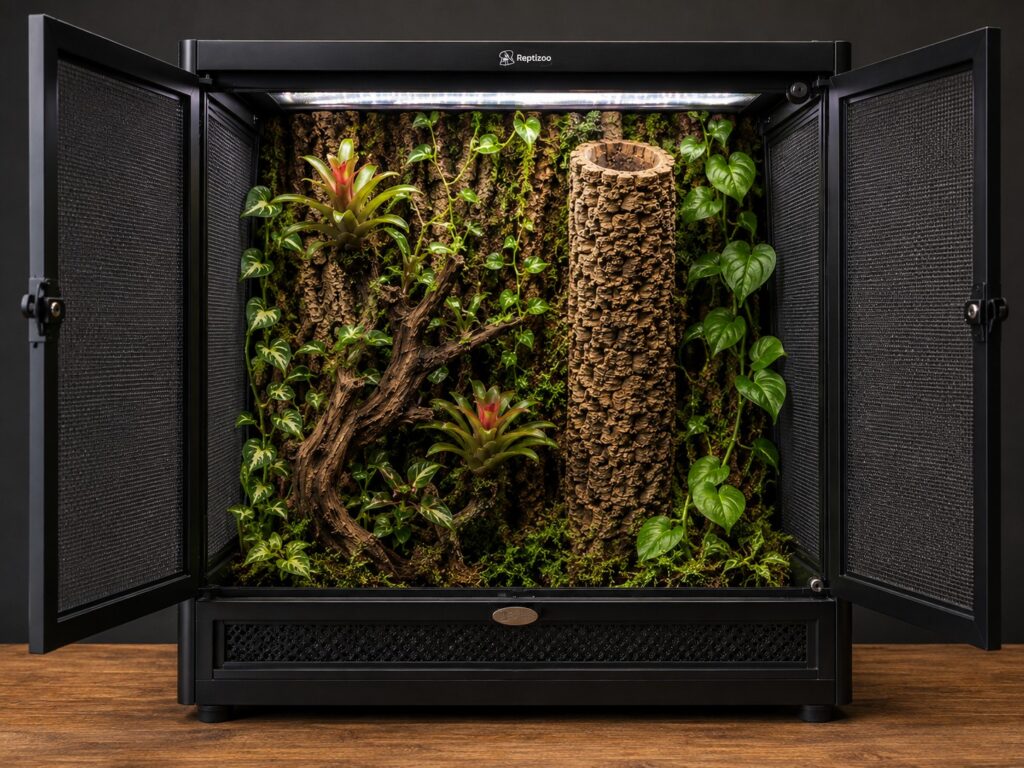
For years, pink toes had a reputation for sudden unexplained death. Keepers reported healthy spiders that declined over days with no obvious cause, and the phenomenon acquired informal names suggesting a disease. The current consensus is that most of those losses were husbandry: enclosures kept humid, closed, and heavily misted, producing stagnant saturated air that a canopy species is not adapted to.
Nobody has demonstrated a single mechanism, and it is likely that several unrelated problems were grouped under one label. What is not in dispute among current keepers is that pink toes kept with strong cross ventilation and moderate humidity do markedly better than those kept in closed humid boxes.
What this means practically:
- Cross ventilation on two opposing walls, not a mesh lid alone. Air must enter one side and leave the other.
- Err toward too much airflow. A slightly dry enclosure is a small problem. Stagnant humid air is a serious one.
- Do not mist heavily. Dampen a section of substrate and let it evaporate upward.
- Ignore older caresheets recommending 80% humidity in a sealed enclosure. That advice is what caused the problem.
The full build is covered in our arboreal tarantula enclosure guide.
Enclosure Setup
Adult enclosure: 12 inches tall minimum, ideally taller, with a footprint around 8 by 8 inches. Height roughly two to three times the width.
Front opening is strongly preferred. Pink toes bolt upward and outward when startled, so a top-opening lid puts your hand directly in the escape route. They are among the more flighty species in this respect, more likely to run than to bite.
Cork bark, vertical. A hollow tube stood upright is ideal, giving an immediate retreat. A flat slab leaned against a back corner works if you leave a gap behind it for webbing.
Substrate: 1 to 2 inches only. Enough to hold moisture and anchor the cork. Depth is wasted volume for a spider that lives off the ground.
Foliage near the top. Artificial plants or thin branches give anchor points. Pink toes web extensively and will construct a tube retreat, often incorporating whatever you provide.
Water dish: small, on the substrate, kept filled. They also drink from droplets on webbing.
Temperature and Humidity
Target 75 to 82F, which most homes reach without intervention. If your room runs cold, use a low wattage mat on a side wall with a thermostat, never underneath.
Humidity at 65 to 75%, achieved through substrate moisture with ventilation intact. Pour water into one corner of the substrate every week or so and let evaporation carry it upward.
A light mist on the webbing is fine and gives the spider something to drink from. Misting to raise a humidity reading is not, since it works directly against the airflow the animal needs.
Dehydration still kills, and it presents as legs folding beneath the body, which is the posture that signals a dehydrated or dying spider. Keep the dish full. The balance to strike is moist substrate and moving air, not still humid air.
Diet and Feeding
Pink toes are enthusiastic feeders and will take prey readily from the webbing.
What to offer: crickets, dubia roach nymphs, red runners, and flying prey such as blue bottle flies, which arboreals take particularly well.
How often: adults every 7 to 10 days, juveniles every 5 to 7, slings every 3 to 5.
Prey size: no longer than the spider’s body length, and smaller is fine.
Remove uneaten prey within 24 hours. A cricket left with a molting arboreal will chew on it, and molting happens inside the retreat where you cannot intervene.
Fasting before a molt is normal and may last weeks. Provided the abdomen is not shrinking and water is available, leave it.
Feeding intervals, refusals, and molts across a decade-long animal are the sort of detail that exists only if recorded. Logging them in InvertMate takes a moment at the time and saves guessing later.
Temperament and Handling
Pink toes are docile and reluctant to bite, which is most of why they are recommended. The realistic risk is not venom but speed: a startled pink toe bolts, and it is fast, and it goes upward.
They are also known for a specific defensive behaviour worth mentioning: when badly startled they may fire a jet of faeces at the perceived threat. It is harmless and startling and tells you the spider is stressed.
Handling is not recommended. A bolting arboreal from height is a fall risk and an escape risk simultaneously. If you must move one, move the cork tube it has webbed itself into rather than the spider.
Normal behaviour is a spider that sits in or beside its silk retreat, comes out at night, and webs steadily. A pink toe wandering the enclosure repeatedly in daylight usually means something is wrong with ventilation or moisture.
Molting and Growth
Growth is moderate, faster than a terrestrial such as the chaco and slower than most Old World arboreals. Expect two to three years from sling to adult female.
Pre-molt signs: food refusal, a darkening abdomen, reduced activity, and heavier webbing around the retreat.
Arboreals molt in the retreat, typically on their back or side inside the silk tube, and you often will not see it happen. Do not disturb the enclosure, do not mist, and do not try to look. The process is covered in our guide to the tarantula molt cycle.
After a molt, wait a week or two before feeding. Colours are at their brightest at this point, and the metallic sheen is most obvious.
Sexing becomes reliable from a shed exoskeleton at a few inches. It matters here, since females live 8 to 12 years and males typically 3 to 4, living only months after their final molt.
Slings and Buying
Pink toe slings are widely available and inexpensive, and they look nothing like the adults, which is part of the appeal. They are also less forgiving than adults on ventilation, so the same airflow rules apply from the start, in a proportionally smaller enclosure.
Arboreal slings frequently burrow before they take to climbing, which surprises new keepers and is entirely normal. Sling housing generally is covered in our guide to raising tarantula spiderlings.
Juveniles at 2 inches are the practical compromise, already climbing and showing adult behaviour.
Captive bred is standard, so there is no reason to buy wild caught.
Common Health Issues
Decline from poor ventilation. The defining risk with this species, and entirely preventable.
Dehydration. Empty water dish or bone dry substrate.
Fall injury. Less consequential than for heavy terrestrials, but not zero, particularly in a tall enclosure with hard decor.
Prey injury during a molt. Remove uneaten crickets within 24 hours.
Escape. Fast, upward, and through the lid you just opened. Front-opening enclosures reduce this substantially.
FAQ
Are pink toe tarantulas good for beginners?
Yes, provided the enclosure has strong cross ventilation. They are docile, reluctant to bite, and hardy in other respects. Poor airflow in a humid closed enclosure is the one mistake that reliably kills them.
How long do pink toe tarantulas live?
Females typically reach 8 to 12 years. Males live 3 to 4 years in total and only months after their final molt, so an unsexed juvenile represents a significant difference in how long you will have the animal.
Do pink toe tarantulas need high humidity?
Moderate humidity around 65 to 75%, combined with strong airflow. The combination matters more than the number. High humidity in a closed enclosure is what causes the sudden declines this species is known for.
Do pink toe tarantulas bite?
Rarely. They are among the most docile tarantulas and far more likely to bolt than to defend. Their urticating setae are mild and seldom used. As a New World species the venom is comparable to a wasp sting.
How big do pink toe tarantulas get?
Four and a half to six inches in leg span as adults. Spiderlings look entirely different, with blue or purple bodies and orange abdomens that fade to the adult dark colouration with pink foot pads over successive molts.
What size enclosure does a pink toe need?
At least 12 inches tall with a footprint around 8 by 8 inches for an adult, with height two to three times the width. Front opening is strongly preferred, since a startled pink toe bolts upward through a top-opening lid.
Track Your Tarantula with InvertMate
A female pink toe can live over a decade, and the molt and feeding history that tells you whether she is doing well only exists if you wrote it down. InvertMate lets you log every molt with dates and photos, record feeding refusals, and monitor the temperature and humidity your enclosure actually runs at. Free on the App Store & Play Store.