How long do hermit crabs live? A realistic hermit crab lifespan is 10 to 30 years in a proper tank, and the record for a pet crab is over 45. Most die within months of purchase, and the cause is nearly always humidity, substrate or water, not age.
That gap between what a land hermit crab can do and what usually happens is the whole story. The crab in a painted shell at a beach shop is not a short-lived animal. It is a long-lived animal in a setup that cannot keep it alive. This guide covers lifespan by setting, why the first year kills so many, what decides how long yours will live, how to guess a crab’s age, and what a multi-decade pet means in practice. It is written around the purple pincher (Coenobita clypeatus), the species in most pet shops.
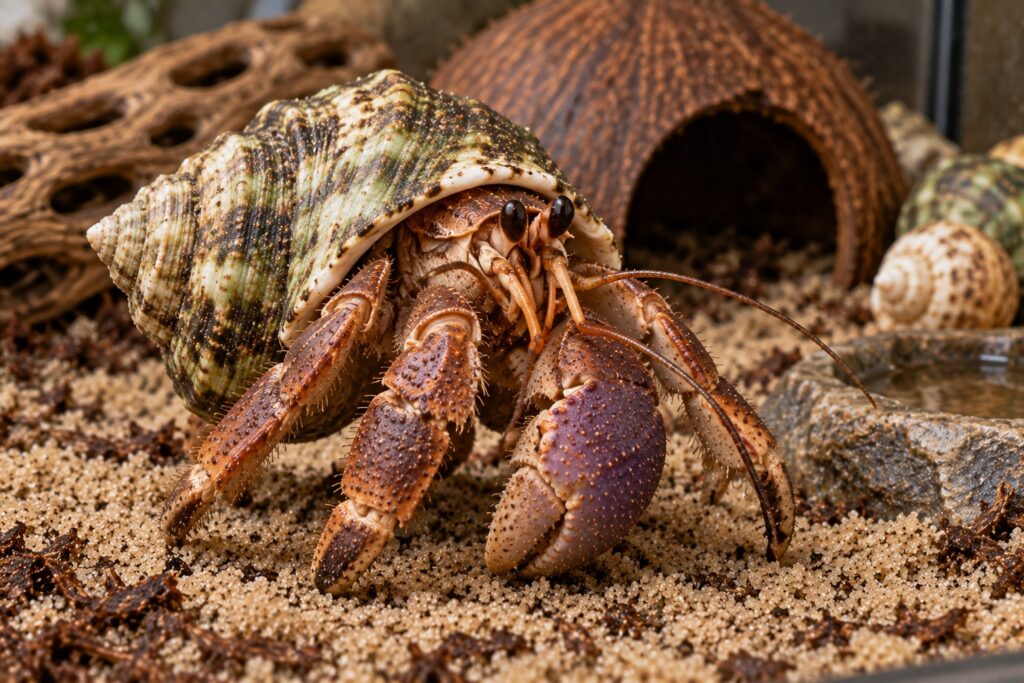
Hermit Crab Lifespan by Setting
| Setting | Typical lifespan | Why |
|---|---|---|
| Wild | Decades, exact figures unknown | No way to age a wild crab reliably |
| Well-kept tank | 10 to 30 years, sometimes more | Stable heat, humidity, deep substrate, both water pools |
| Average home setup | 1 to 5 years | One or two essentials missing, usually humidity or substrate depth |
| Wire cage or small plastic carrier | Weeks to a year | Gills dry out, no room to molt |
The hermit crab average lifespan you see quoted, often “a few months to a year”, describes that last row. It is an average of failures, not a biological limit.
By species. The purple pincher is the best documented, and the long records all belong to it. Ecuadorian crabs (Coenobita compressus) are thought to have similar potential but are less forgiving of low humidity and shell shortages. Strawberry crabs (Coenobita perlatus) need more heat, more humidity and heavy salt water use, and long-term captive records for them are thin. If lifespan is your priority, the purple pincher is the safe choice.
Why Most Pet Hermit Crabs Die in the First Year
Almost every early death traces back to one of six things, and most tanks sold as “hermit crab kits” get several wrong at once.
Dry air. Land hermit crabs breathe through modified gills that only work when moist. Below about 70% humidity they are slowly suffocating. A mesh lid or a wire cage cannot hold humidity at all.
Shallow substrate. A crab has to bury itself to molt. With an inch of gravel it cannot, so it either molts on the surface, where tankmates attack it, or delays until it dies. The process and its timeline are covered in our guide to how hermit crabs molt underground.
Wrong water. Crabs need both dechlorinated fresh water and marine salt water, deep enough to climb into. Tap water and table salt both cause harm over time, for reasons set out in our explainer on fresh and salt water for hermit crabs.
Cold. Below 70F a crab slows, stops eating and cannot complete a molt.
Shell trouble. Painted shells, too few spares, or the wrong opening shape lead to fights and to crabs abandoning shells. A crab that ends up naked is in immediate danger, and what to do in that case is covered in our guide to a hermit crab that has left its shell.
The journey before you bought it. Nearly all pet hermit crabs are collected from the wild, shipped and held in poor conditions for weeks. Many arrive depleted, and some die in the first month whatever you do. Keepers call this post-purchase stress.
One more piece of old advice shortens lives: the sponge in the water dish. Sponges breed bacteria and do nothing a proper pool does not do better. Leave them out.
How Long Will a Hermit Crab Live in Your Tank?
Seven things decide a pet hermit crab lifespan. Get all seven right and a decade is the expectation, not the hope.
- Humidity of 75 to 85%, held by a solid glass or plastic lid and measured with a digital hygrometer.
- Temperature of 75 to 85F, with a heat mat on the back or side wall above the substrate line, on a thermostat. Never underneath.
- Substrate at least 6 inches deep, or three times the height of your largest crab, in a mix of five parts play sand to one part coconut fibre, damp enough to hold a tunnel.
- Two pools, one dechlorinated fresh water and one marine salt water, each deep enough to submerge in with a safe way out.
- A varied diet with constant calcium. Commercial pellets alone are not enough, and our list of safe foods for hermit crabs covers what to rotate.
- Three to five spare natural shells per crab, in the right opening shape. Sizing is explained in our guide to choosing spare shells.
- Company and space. Hermit crabs are social. Keep at least two or three, in a tank of 20 gallons or more.
The full build, from tank size to substrate mixing, is in our guide to setting up a hermit crab tank.
There is an eighth factor that is easy to overlook: leaving them alone. A buried crab that gets dug up “to check” often dies, and a large crab can stay down for months. Recording the day each crab buries in CrabPod gives you a date to check against when the wait starts to feel too long.
How Old Is My Hermit Crab?
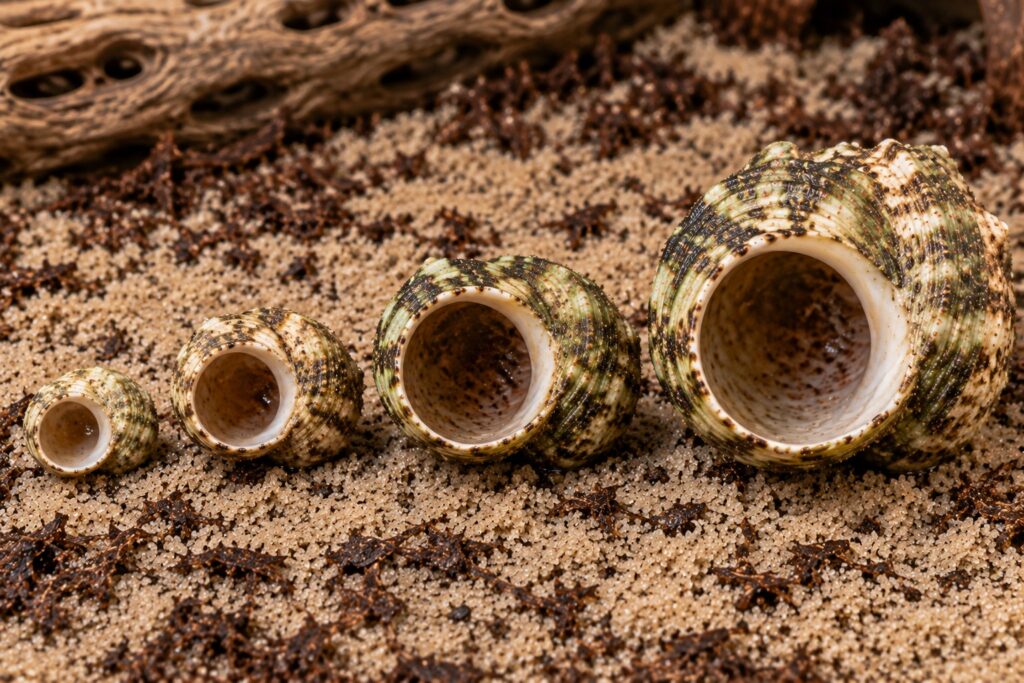
Nobody can tell you precisely. Crabs shed their entire exoskeleton at every molt, so they carry no growth rings or other record of age, and there is no accepted method for aging one.
Size is the only clue, and it is a loose one, because growth depends on food, temperature and how often the crab molts.
| Size | Shell opening | Rough age estimate |
|---|---|---|
| Tiny to small | Under 3/4 inch | 1 to 5 years |
| Medium | 3/4 to 1 1/4 inches | 5 to 10 years |
| Large | 1 1/4 to 2 inches | 10 to 20 years |
| Jumbo | Over 2 inches | 15 to 20 years or more |
Those ranges are keeper estimates, not measurements. The useful point is that pet shop crabs are wild caught, so even a small one is probably several years old on the day you buy it, and a jumbo may already be older than its new owner’s children.
The Record: 45 Years From a Boardwalk Shop
The best documented long-lived hermit crab was a purple pincher named Jonathan Livingston Crab. His keeper, Carol Ann Ormes, bought him at a boardwalk shop in the summer of 1976, and he lived in her care for 45 and a half years, until February 2021. A second crab bought the same summer, Crab Kate, lived until 2011, about 35 years.
Neither crab was a hatchling when purchased, so both were older than those figures. Their keeper credited regular exercise outside the tank, among other things. The record matters less as a target than as proof: a crab sold as a disposable souvenir can outlast a dog three times over.
How Old Hermit Crabs Die
Old age in a hermit crab does not look like a slow fade. It usually ends at a molt.
Each molt is harder than the last. A bigger crab has more exoskeleton to shed, needs more stored water and calcium to do it, and stays buried longer, up to several months for a jumbo. Eventually a molt fails, and the crab dies underground or soon after surfacing.
You can lower that risk even for an old crab: deeper substrate than the minimum, steady warmth and humidity, both pools kept full, and calcium always available. Signs that an older crab is declining, as opposed to preparing to molt, include dropping several limbs, staying on the surface without eating for weeks, and a weak grip on its shell.
A 20 to 30 Year Commitment
A hermit crab kept properly belongs in the same planning category as a parrot or a tortoise, not a goldfish.
- It will move house with you, probably more than once. A 20 gallon tank with 6 inches of damp sand is heavy and has to be rebuilt at the other end.
- It may outlast a child’s interest. A crab bought for a seven-year-old could still be alive when that child is 30. An adult needs to own the commitment.
- It needs a named backup, someone who can top up pools and check gauges when you travel.
- The running cost is low but permanent: salt mix, dechlorinator, food, shells and electricity for heat.
If that sounds like more than you want, it is better to know before buying. Start with what a hermit crab needs week to week and decide from there.
FAQ
How long do hermit crabs live as pets?
With correct humidity, heat, deep substrate and both water pools, 10 to 30 years is realistic, and the record is over 45. In the wire cages and small plastic tanks they are usually sold with, most die within weeks to a year.
What is the average hermit crab lifespan?
By most keeper accounts the average pet hermit crab lives under two years, because most are kept in setups that cannot hold humidity or allow molting. That average reflects care, not biology. The same species routinely passes 10 years in a proper tank.
How long do hermit crabs live in the wild?
Probably decades. Nobody knows exactly, because a crab sheds its whole exoskeleton at each molt and carries no record of its age. Large wild crabs are assumed to be at least 15 to 20 years old based on growth rates seen in captivity.
What is the oldest hermit crab on record?
Jonathan Livingston Crab, a purple pincher bought in 1976, lived 45 and a half years with his keeper and died in 2021. He was not a hatchling when bought, so his true age was higher.
Do hermit crabs die after molting?
A healthy crab does not. Molting is how it grows, and most molts go fine when the crab can bury itself in deep, damp substrate and is left undisturbed. Deaths around molting usually follow shallow substrate, low humidity, missing salt water or being dug up.
How can I make my hermit crab live longer?
Hold humidity at 75 to 85% and temperature at 75 to 85F, give at least 6 inches of sand and coconut fibre substrate, keep both fresh and salt water pools full, feed a varied diet with calcium, offer spare natural shells, and never dig up a buried crab.
Thirty Years Is Too Long to Keep in Your Head
Over a life that long, the details that explain a problem are usually years old: when a crab last molted, which shell it wore before, what the humidity did last winter. CrabPod keeps a molt history for each crab with burial and surfacing dates, logs shell changes with photos, and tracks temperature and humidity over time. Free on the App Store.