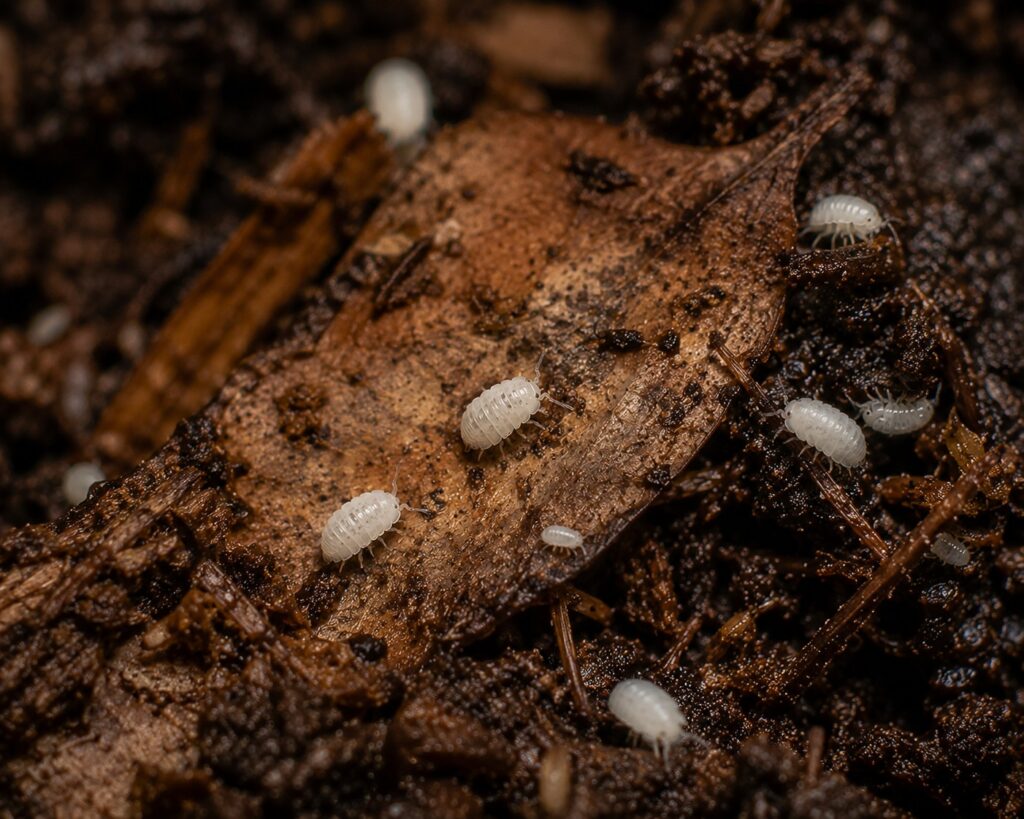
Dwarf white isopods are the unsung heroes of the bioactive terrarium world. They’re tiny, they’re plain-looking, and they spend most of their time buried in the substrate where you can’t see them. None of that sounds exciting. But here’s why they’re one of the most widely kept isopod species in the hobby: they breed without needing a mate, they multiply faster than almost any other isopod, and they’re one of the most effective cleanup crews you can put in a vivarium.
If you’re building a bioactive setup for dart frogs, geckos, small skinks, or tropical plants, Trichorhina tomentosa is probably the species you want. And if you’re just keeping them as a standalone colony, they’re practically effortless once established.
This guide covers everything: enclosure setup, substrate, humidity, feeding, their unique reproductive biology, bioactive applications, and common issues.
Species Overview
The dwarf white isopod (Trichorhina tomentosa) is native to the tropical regions of Central and South America, where it lives in damp leaf litter, rotting wood, and moist soil on the forest floor. It’s one of the smallest commonly kept isopod species, with adults reaching only 2-5 mm in length. That’s roughly the size of a grain of rice.
They’re uniformly white to pale cream in color with smooth, oval bodies. There are no fancy patterns, no color morphs, and no visual variation between individuals. What they lack in looks, they make up for in sheer biological efficiency.
The most remarkable trait of dwarf white isopods is parthenogenesis: females can reproduce without mating with a male. Every individual in your colony can produce offspring on its own. This means even a tiny starter culture of 10-15 isopods will establish and grow faster than almost any sexually reproducing species. It also means you can start a thriving colony from a single individual (though starting with more is always better for genetic health and faster establishment).
Dwarf whites are burrowers. Unlike surface-active species like dairy cow isopods or powder blues, they spend most of their time in the substrate, leaf litter, and under hides. You won’t see them out in the open often, especially during the day. Their primary role in captivity is functional (cleanup crew, substrate aeration) rather than display.
| Attribute | Details |
|---|---|
| Scientific name | Trichorhina tomentosa |
| Adult size | 2-5 mm (0.08-0.2 in) |
| Lifespan | 1-2 years |
| Difficulty | Beginner |
| Temperature | 72-85°F (22-29°C) |
| Humidity | 70-90% |
For more on isopod lifespans, see our isopod lifespan guide.
Enclosure Setup
For a standalone culture (not inside a bioactive terrarium), a 6-quart plastic bin is more than enough space. Dwarf whites are so small that even a modest container gives them plenty of room. As the colony grows, you can upgrade or split into multiple bins.
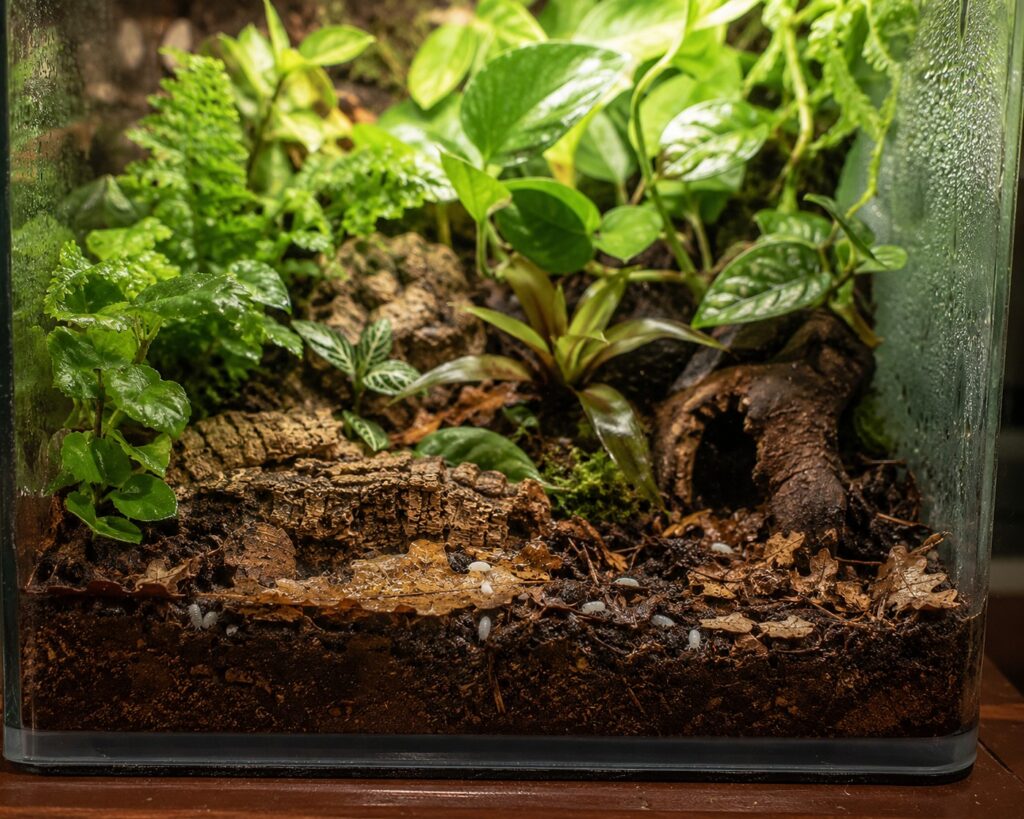
Ventilation should be minimal. Dwarf whites are tropical species that need high, consistent humidity. A few small pin-sized holes in the lid provide enough airflow without letting moisture escape too fast. If you use too much ventilation, the enclosure dries out quickly and the colony suffers.
Substrate should be 2-3 inches deep. These are burrowing isopods that live in the substrate, so the substrate quality matters a lot. A good mix includes:
- Coconut coir or ABG (Atlanta Botanical Garden) mix as the base
- A handful of earthworm castings mixed in for nutrition
- A light dusting of calcium carbonate powder
The substrate should stay consistently moist, closer to the wet end of what you’d use for other species. Dwarf whites prefer damper conditions than most Porcellio or Armadillidium species.
On top of the substrate:
- Leaf litter (oak, magnolia, Indian almond). Keep a generous layer. This is their primary food and habitat.
- Cork bark or small wood pieces for hides. They’ll cluster under these and gradually consume the decaying wood.
- Sphagnum moss scattered across the surface for moisture retention.
- Cuttlebone or crushed eggshell for calcium.
No lighting needed. Dwarf whites are photophobic and stay buried most of the time anyway.
For a full enclosure walkthrough, see our isopod enclosure setup guide.
Temperature & Humidity
Dwarf white isopods are tropical species that like it warm and wet. This makes them ideal for tropical bioactive enclosures but means they need more moisture than temperate species.
Temperature should be between 72-85°F (22-29°C). They’re most active and breed fastest at the warmer end of this range (78-85°F). Room temperature works in most homes, and if they’re living inside a heated reptile or amphibian enclosure, the habitat’s own heating takes care of this.
Humidity should stay between 70-90%. This is higher than what most Porcellio or Armadillidium species need. The substrate should feel consistently damp (not waterlogged, but noticeably moist). Mist 2-3 times per week for standalone cultures, or more if the enclosure dries quickly.
A moisture gradient is less critical for dwarf whites than for other species because they already live deep in the substrate where moisture is naturally higher. But it doesn’t hurt to keep one side slightly damper with sphagnum moss.
If the colony is inside a bioactive terrarium, the enclosure’s own humidity and misting system usually provides everything the isopods need without extra effort.
Diet & Feeding
Dwarf white isopods are detritivores that eat decaying organic matter. Their small size means they consume tiny amounts individually, but a large colony processes a surprising volume of material collectively.
Primary diet (always available):
- Leaf litter (their main food source and habitat)
- Decaying hardwood and cork bark
- Calcium source (cuttlebone, crushed eggshell)
Supplemental foods (1-2 times per week):
- Vegetables: cucumber, zucchini, carrot (cut into very thin slices, as the tiny isopods can struggle with large, hard pieces)
- Protein: fish flakes, dried shrimp, freeze-dried bloodworms (a small pinch is plenty)
- Mushrooms (they seem to particularly enjoy these)
In a bioactive terrarium, supplemental feeding is usually unnecessary. The isopods will feed on animal droppings, dead plant material, uneaten feeder insects, and the substrate itself. The vivarium provides a self-sustaining food web.
In a standalone culture, regular feeding keeps the colony growing at maximum speed. Offer small amounts of food 1-2 times per week. Remove uneaten fresh food within 24 hours to prevent mold.
Portion size matters more with dwarf whites than with larger species. A piece of cucumber the size of your thumbnail is plenty for a colony of 50-100. Overfeeding is the fastest way to create mold and mite problems in a small, humid enclosure.
For a full feeding breakdown, see our isopod feeding guide.
Breeding
Breeding dwarf white isopods is essentially automatic. Their parthenogenetic reproduction means every individual is female and every individual can produce offspring without mating. You don’t need to worry about sex ratios, pairing, or mating conditions. Just provide food, warmth, and moisture, and the colony will grow.
Females carry developing embryos in a marsupium (brood pouch) and release fully formed mancae. Brood sizes are small compared to larger species (5-15 mancae per clutch is typical), but the constant, overlapping reproduction across the entire colony means population growth is rapid.
Under ideal conditions (warm, humid, well-fed), a starter culture of 15-20 dwarf whites can grow to several hundred within 2-3 months. Some keepers report colony sizes in the thousands within 6 months.
Conditions for maximum breeding speed:
- Temperatures at 78-85°F
- Humidity at 80-90%
- Abundant leaf litter and calcium
- Regular protein supplementation
- Minimal disturbance
Cross-contamination warning: Because dwarf whites breed so prolifically and are so small, they can accidentally transfer between enclosures on your hands, tools, or shared materials. If you keep multiple isopod species, wash your hands and tools after working with your dwarf white culture. A few hitchhikers introduced to another species’ bin can establish and outcompete the resident colony over time.
With a species that can go from twenty to several hundred in a couple of months, population counts stop being something you can eyeball. CrabPod is built for logging that kind of change over time.
Bioactive Use
This is where dwarf white isopods truly shine. They’re the most popular cleanup crew isopod for tropical bioactive terrariums, and for good reason. If you’re building the enclosure itself rather than just the cleanup crew, our bioactive enclosure guide covers the substrate layers and drainage.
What they do in a bioactive setup:
- Break down animal waste (droppings from frogs, geckos, skinks)
- Consume dead plant material and fallen leaves
- Eat uneaten feeder insects and leftover food
- Aerate the substrate through constant burrowing
- Process organic matter into nutrients that benefit live plants
Best pairings:
Dwarf whites work well in enclosures housing dart frogs, crested geckos, day geckos, small skinks, anoles, and similar tropical species. Their tiny size means they’re less likely to be noticed or eaten by smaller inhabitants, though some animals (especially dart frogs and small geckos) will eat them as a supplemental food source. This is fine and actually beneficial: the colony reproduces fast enough to sustain itself even with some predation.
When to add them: Seed your bioactive enclosure with dwarf whites at least 2-4 weeks before adding the primary inhabitants. This gives the colony time to establish, burrow into the substrate, and begin reproducing before predation pressure begins.
Pairing with other isopod species: Many keepers use dwarf whites alongside a larger display species (like Porcellio or Armadillidium) in the same vivarium, zebra isopods being a common choice for the surface layer. Worth knowing that the two want opposite moisture: dwarf whites need the substrate damp throughout, zebras want two thirds of it on the dry side, so a mixed enclosure only works if it’s large enough to hold a real gradient. The dwarf whites handle the deep substrate cleanup while the larger species handles the surface. This works well as long as the enclosure is large enough for both populations.
They also earn their keep in a warm, humid hermit crab habitat, where leftover protein and shed exoskeletons would otherwise attract mites.
Common Health Issues
Drying out is the biggest threat. Dwarf whites dehydrate faster than larger species because of their tiny body size and high surface-area-to-volume ratio. If humidity drops below 65% for extended periods, you’ll lose animals. Keep the substrate consistently moist.
Mold can become a problem in very wet, poorly ventilated enclosures. White mold on leaf litter is harmless. Green or black mold on food or substrate needs to be removed. Adding springtails alongside your dwarf white colony is the best prevention. Springtails and dwarf whites coexist perfectly and complement each other’s cleanup roles.
Mites (grain mites) can explode in warm, humid environments if food is left too long. Remove uneaten fresh food within 24 hours and avoid overfeeding. Springtails help here too.
Population crashes can happen if conditions suddenly change: a temperature spike, a dry spell, substrate replacement, or chemical contamination (cleaning products, pesticide residue on food). The good news is that dwarf white colonies recover quickly from crashes. Even a small surviving population can rebuild to full strength within a few months thanks to parthenogenesis. Recovery is much easier to judge against a record than against memory, especially when the colony lives underground and you only see a fraction of it.
Escapees are a minor nuisance. Dwarf whites are small enough to fit through very tiny ventilation holes. Use pin-sized holes or fine mesh over larger openings. If a few escape into your home, they won’t survive long in dry household conditions, but preventing escapes keeps your colony intact.
FAQ
Are dwarf white isopods good for beginners?
Yes. They’re one of the easiest isopod species to keep and breed. Their care requirements are simple (warm, humid, leaf litter, calcium), and their parthenogenetic reproduction means the colony grows with minimal effort. The only thing beginners may find disappointing is their lack of visual appeal compared to colorful species.
How fast do dwarf white isopods breed?
Very fast. Thanks to parthenogenesis, every individual can produce offspring. A starter culture of 15-20 can grow to several hundred within 2-3 months under ideal conditions. They’re among the fastest-breeding isopod species in the hobby.
Can dwarf white isopods live with other isopod species?
Yes, particularly in large bioactive terrariums where dwarf whites handle the substrate layer and a larger display species handles the surface. In small culture bins, however, dwarf whites can outcompete other species over time. Keep them in separate bins if you’re culturing multiple species.
Do dwarf white isopods need males to breed?
No. Dwarf white isopods reproduce through parthenogenesis, meaning females produce offspring without mating. Every individual in your colony can breed, which is why their populations grow so quickly.
Are dwarf white isopods good feeders for reptiles?
They can serve as occasional supplemental feeders for very small species like dart frogs, thumbnail geckos, and small skinks. Their tiny size (2-5 mm) limits their use as a primary food source, but they add nutritional variety. In bioactive setups, the natural predation is part of the ecosystem balance.
Track Your Colony with CrabPod
Stay on top of your dwarf white isopod colony with CrabPod. Monitor enclosure conditions, set feeding reminders, log population observations, and manage multiple colonies in one place. Free on the App Store.