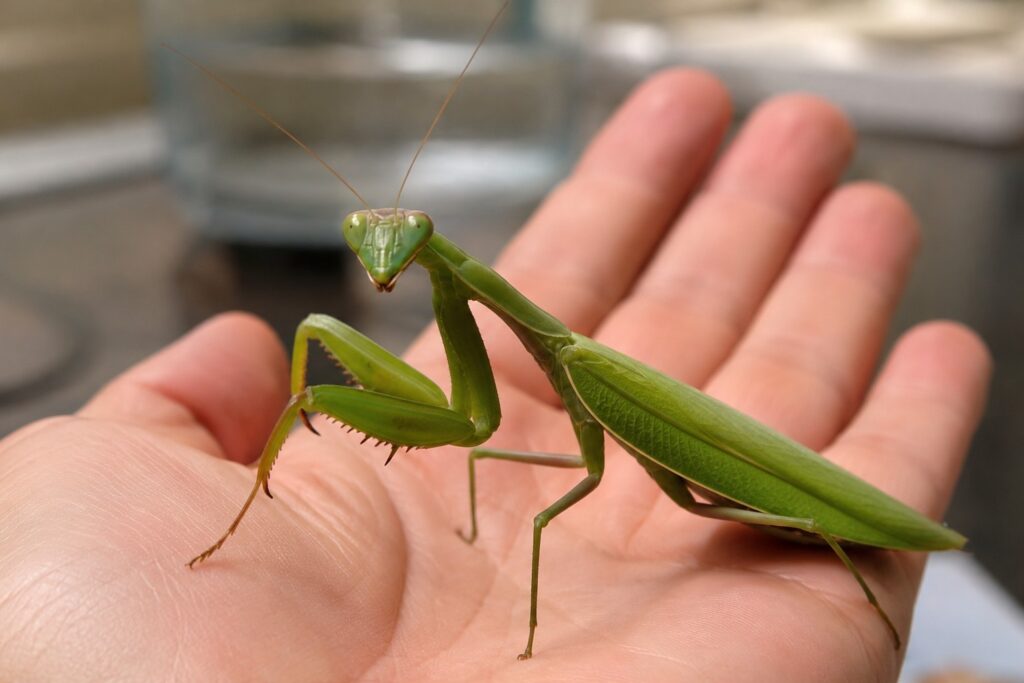
Praying mantis care is simpler than most people expect. They don’t need expensive equipment, UV lighting, or complicated feeding schedules. A small enclosure with some branches, the right temperature and humidity, live feeder insects, and some basic observation skills are all it takes to keep a mantis healthy from nymph to adult.
Mantises are fascinating pets. They’re ambush predators with alien-like heads that can swivel 180 degrees, and they strike prey with a speed that’s nearly impossible to see with the naked eye. They’re also surprisingly individual. Keepers quickly notice personality differences between specimens, from bold and aggressive hunters to shy, cautious ones that need their food placed right in front of them.
This guide covers everything a first-time keeper needs: choosing a species, setting up an enclosure, getting temperature and humidity right, feeding at every life stage, understanding molting, handling, and the common mistakes that kill pet mantises.
Choosing Your First Species
Not all mantis species are equally suitable for beginners. Some need precise humidity, warm temperatures, or specific prey types. Others are forgiving and thrive in typical household conditions.
Best beginner species:
- Ghost Mantis (Phyllocrania paradoxa): Calm, tolerant of a wide temperature range, and one of the few mantises you can keep in groups. The top recommendation for first-time keepers.
- Chinese Mantis (Tenodera sinensis): Large, hardy, and easy to feed. Widely available and very forgiving of beginner mistakes.
- Giant Asian Mantis (Hierodula membranacea): Big, bold, and voracious. Excellent feeding response makes them satisfying to keep.
- Carolina Mantis (Stagmomantis carolina): A smaller North American native. Hardy and adaptable.
- Giant African Mantis (Sphodromantis viridis): Large, bold, and among the easiest species to keep. Strong feeding response and forgiving of beginner mistakes.
Species to avoid as your first:
- Orchid Mantis (needs high humidity, warm temperatures, and has tricky breeding)
- Spiny Flower Mantis (smaller, shorter-lived, slightly more delicate)
- Any Old World species with complex care requirements
Start with one mantis. Learn the basics with a single animal before building a collection.
Enclosure Setup
The golden rule for mantis enclosures is the Rule of Three: height should be at least 3 times the mantis’s body length, and width should be at least 2 times. Height matters more than floor space because mantises are vertical animals that hang upside down to molt and spend most of their time perched on elevated surfaces.
Enclosure options (from simplest to fanciest):
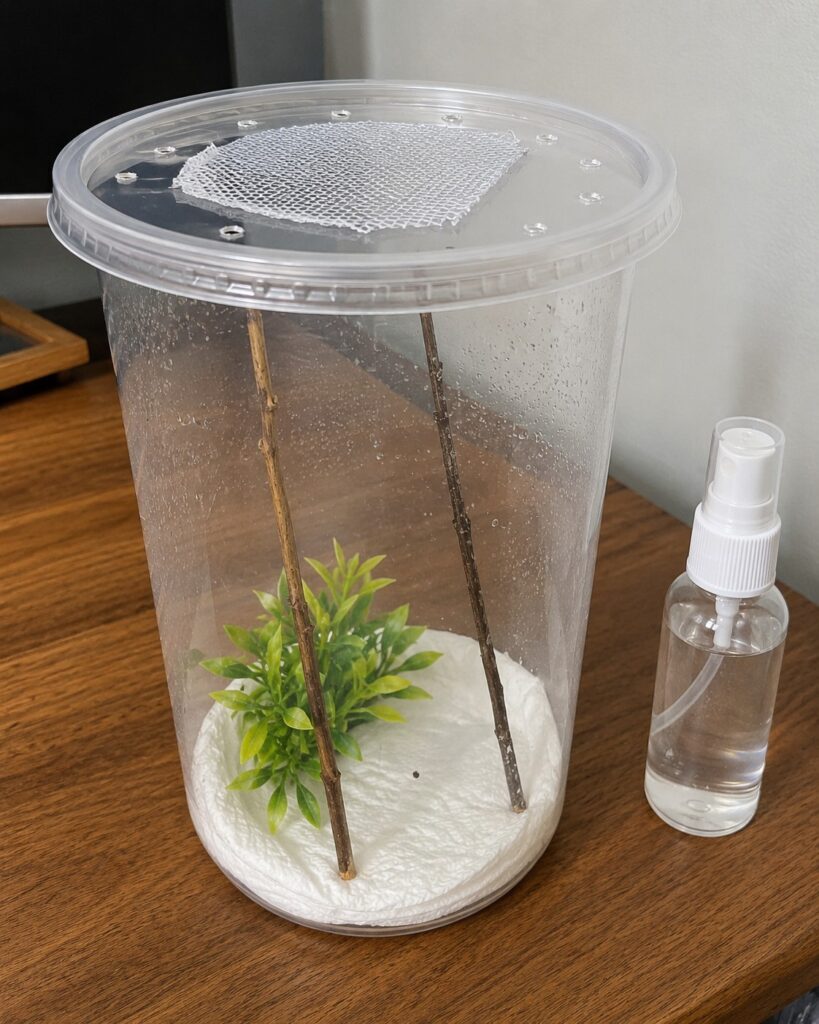
- Deli cups (16-32 oz): Perfect for nymphs. Cheap, easy to clean, and you can see the mantis clearly. Poke small holes in the lid for ventilation, and hot-glue a piece of mesh inside the lid for a molting grip surface.
- Mesh pop-up enclosures: Excellent ventilation, lightweight, and the mantis can grip every surface. Popular for sub-adults and adults.
- Small glass or acrylic terrariums (Exo Terra Nano, etc.): Best for display. Make sure the lid is mesh for proper ventilation and molting grip.
Essential furnishings:
- Vertical branches or twigs for perching and molting
- A few artificial or live plants for cover
- A mesh or rough-textured ceiling surface (critical for safe molting)
Substrate is optional for mantises. Many keepers use paper towel at the bottom for easy cleanup. Others use a thin layer of coconut coir to help hold humidity. Both approaches work fine. The substrate is not as important for mantises as it is for isopods or tarantulas.
Ventilation is non-negotiable. Stagnant air leads to mold and bacterial growth, which can kill a mantis quickly. Mesh enclosures handle this automatically. For glass or plastic enclosures, ensure the lid is mesh and consider adding small ventilation holes on the sides for cross-airflow.
For a worked example of a species-specific build, see our orchid mantis enclosure guide. The principles transfer to most species.
Temperature & Humidity
Most commonly kept mantis species do well at or slightly above room temperature. You don’t need elaborate heating setups for beginner species.
Temperature: Aim for 72-82°F (22-28°C) for most beginner species. This is typical room temperature in most homes. If your house runs cool, a small desk lamp with a low-wattage bulb placed near (not on top of) the enclosure provides gentle warmth. Avoid placing enclosures near windows where temperatures fluctuate, or directly above radiators.
Humidity: Most species need 50-70% humidity, which is achieved through regular misting. Lightly mist the enclosure walls and decor once a day for nymphs, every 1-2 days for adults. The misting serves two purposes: it creates water droplets for the mantis to drink, and it temporarily raises humidity to support healthy molting.
The key word is “lightly.” You want a fine mist that creates small droplets on surfaces, not a heavy spray that soaks everything. The enclosure should dry within a few hours after misting. If it’s still wet hours later, you’re either misting too much or ventilation is insufficient.
Species-specific needs: Some species need warmer or more humid conditions than the ranges above. Always check the specific care guide for your species. The ranges here are safe starting points for the beginner species listed above.
Feeding
Mantises eat live insects. There’s no dry food, no pellets, no shortcuts. This is the one aspect of mantis keeping that some people find inconvenient, because it means you need to keep a supply of feeder insects on hand.
Feeding by life stage:
L1-L2 nymphs (tiny): Drosophila melanogaster (wingless or flightless fruit flies). Feed daily or every other day. These are the only prey small enough for freshly hatched nymphs.
L3-L4 nymphs: Drosophila hydei (larger fruit flies) or small houseflies. Feed every 1-2 days.
L5-L6 nymphs: Houseflies, blue bottle flies, small crickets. Feed every 2-3 days.
Sub-adult and adult: Blue bottle flies, crickets, dubia roaches, moths, waxworms. Feed every 3-5 days. Prey should be roughly half the length of the mantis’s body.
Key feeding rules:
- Mantises prefer flying prey. Flies almost always trigger a stronger feeding response than crawling insects. If your mantis ignores crickets, try flies.
- Remove uneaten prey within 24 hours. Live crickets left in the enclosure can bite and injure a resting or molting mantis.
- Pre-molt fasting is normal. If your mantis stops eating for a few days, it’s probably preparing to molt. Don’t panic, and don’t try to force-feed.
- Mantises drink water droplets from enclosure walls and decor after misting. They don’t need a water dish (and nymphs can actually drown in standing water).
Where to get feeders: Fruit fly cultures and blue bottle fly pupae are available online from feeder insect suppliers. Crickets are available at most pet stores. Starting a fruit fly culture at home is cheap and ensures you always have food for nymphs on hand.
Molting
Molting is the most critical event in praying mantis care, and understanding it is the single most important thing you can learn as a new keeper. Every premature mantis death that isn’t caused by starvation or dehydration is probably related to a molting problem.
What happens: The mantis hangs upside down from a mesh surface or branch, splits its old exoskeleton along the back, and slowly wriggles out. The new exoskeleton underneath is soft and pale, hardening and darkening over the next 24-48 hours.
How often: Nymphs molt every 2-3 weeks. Sub-adults take 4-8 weeks between molts. The final molt to adulthood can take even longer. After reaching adulthood, mantises do not molt again.
The rules around molting:
- Never disturb a molting mantis. Don’t touch it, spray it, or move the enclosure.
- Remove all live prey before a suspected molt. A cricket can kill a defenseless, mid-molt mantis.
- Ensure humidity is adequate. Dry air causes the old exoskeleton to harden before the mantis can escape, leading to a stuck (failed) molt.
- Provide a textured ceiling surface. Smooth glass or plastic doesn’t give enough grip. Mesh lids, rough branches, or a piece of mesh hot-glued inside the lid all work.
Pre-molt signs: Refusing food for several days, hanging from the ceiling more than usual, reduced activity, and sometimes a visible darkening or swelling of the wing buds in older nymphs.
For more detail on what happens during and after a molt, see our praying mantis lifespan guide which covers each life stage.
Handling
Mantises can be handled, but they’re observation pets first and handling pets second. Too much interaction causes stress, and stressed mantises eat less, may refuse to molt, and are more likely to have health problems.
How to handle a mantis:
- Place your hand flat in front of the mantis and gently nudge its rear end. Most will walk forward onto your hand.
- Move slowly. Sudden movements trigger a flight response, and a falling mantis can be injured.
- Don’t grab the mantis from above. This mimics a predator attack and will panic the animal.
- Handle over a soft surface (bed, couch, carpet) in case of a fall.
When NOT to handle:
- Within 3 days of a molt (the exoskeleton is still soft and fragile)
- When the mantis is eating
- When the mantis shows a threat display (forelegs raised, wings spread)
- If the mantis is very small (L1-L3 nymphs are too fragile and fast for safe handling)
Most bites from pet mantises happen when the mantis mistakes a finger for prey. The bite is harmless (they don’t have venom) but can startle you into dropping the animal. If a mantis grabs your finger, stay calm and gently lower it back into the enclosure. It will release on its own.
Common Mistakes Beginners Make
Enclosure too small or too smooth. A mantis that can’t hang properly from the ceiling will fail its next molt. Make sure there’s adequate vertical space and a textured grip surface at the top.
Too much humidity, not enough ventilation. New keepers often think “more humidity is better” and keep the enclosure constantly wet. This causes mold and bacterial infections. Mist lightly, let it dry, mist again.
Leaving live prey in the enclosure. Crickets and roaches left overnight can chew on a sleeping or molting mantis. Always remove uneaten feeders.
Wrong prey size. Prey should be roughly half the mantis’s body length. Too-large prey can injure the mantis. Too-small prey may not trigger a feeding response in larger specimens.
Handling too soon after a molt. The new exoskeleton needs 24-48 hours minimum to harden. Handling during this window risks serious injury.
Keeping multiple mantises together. Most species are cannibalistic. Unless you’re keeping a species specifically noted as communal-tolerant (like ghost mantises), house them individually.
FAQ
Can you keep a praying mantis as a pet?
Absolutely. Mantises are legal to keep as pets in most places, require minimal space and equipment, and are genuinely fascinating to observe. They’re suitable for adults and older children who can handle the responsibility of feeding live insects and maintaining proper humidity, Our guide to keeping a praying mantis as a pet covers the legal side, what to expect day to day, and whether one is a good fit for you.
How much does it cost to keep a praying mantis?
Very little. A mantis itself costs $5-30 depending on species. A basic enclosure (deli cup or small mesh cage) runs $5-15. Feeder insects cost a few dollars per month. Total startup is typically under $50, and ongoing costs are minimal.
How long do pet praying mantis live?
Most pet species live 6-18 months total, with the adult phase lasting 3-8 months. Larger species live longer. Females outlive males in every species. Cooler temperatures (within the safe range) extend lifespan.
Do praying mantis bite?
They can bite, but it’s rare and harmless. Mantises don’t have venom and their mandibles are designed for eating insects, not defending against large animals. A bite from a large mantis might pinch slightly but won’t break skin in most cases. The bigger risk is dropping the mantis when startled.
What is the easiest praying mantis to keep?
Ghost mantises (Phyllocrania paradoxa) and Chinese mantises (Tenodera sinensis) are the two most commonly recommended beginner species. Ghost mantises are calm and tolerant; Chinese mantises are large and hardy. Both are forgiving of minor care mistakes.
Track Your Mantis with InvertMate
Keep a detailed care log for your praying mantis with InvertMate. Track each molt, log feedings, monitor enclosure conditions, and set smart reminders so you never miss a care task. Free on the App Store.